Feeling disconnected from yourself often means that your thoughts, emotions, values, and actions no longer feel like parts of one coherent person. You may still function normally on the outside while feeling distant, unreal, emotionally flat, or uncertain about who you are on the inside.
This experience can sound like: “I do not feel like myself,” “I do not know what I want anymore,” “my decisions do not feel like mine,” or “I feel like a stranger to myself.” It can emerge during prolonged stress, burnout, emotional suppression, constant adaptation, major life changes, relationship strain, perfectionism, masking, or cognitive overload.
It is not a diagnosis by itself. In the Knowledge OS framework, it can be understood as identity drift: a growing mismatch between your internal model of who you are and the signals you are currently receiving from your body, emotions, environment, relationships, and repeated behaviour.
Direct answer: You may feel disconnected from yourself when the signals that normally support identity become noisy, contradictory, suppressed, or difficult to access. Reconnection begins by improving signal quality, updating outdated self-models, and taking small actions that restore alignment between what you value, what you feel, and what you do.
Key takeaways
- Feeling disconnected does not automatically mean that you have lost your identity.
- Identity depends on coherence between values, emotions, actions, and self-understanding.
- Stress, overload, masking, perfectionism, and constant adaptation can weaken that coherence.
- Reconnection usually happens through small aligned actions, not dramatic reinvention.
- Persistent or distressing disconnection deserves professional support.

In this article
- What self-disconnection feels like
- Why you may feel disconnected from yourself
- How the mind constructs identity
- The identity drift process
- Common life contexts that create disconnection
- What self-disconnection is not always the same as
- Common misconceptions
- Common mistakes when trying to reconnect
- How to reconnect with yourself
- The Identity Clarity Framework
- A practical identity audit
- A seven-day reconnection plan
- When professional support may help
- Frequently asked questions
What Feeling Disconnected From Yourself Can Feel Like
Self-disconnection is the experience of no longer feeling fully connected to your own emotions, choices, values, or sense of identity. It may be subtle or intense, temporary or persistent.
Your external life may look unchanged. You may attend school or work, reply to messages, complete tasks, and appear calm. The change happens in the relationship between your experience and your identity.
You may notice that:
- your decisions do not feel fully yours;
- you struggle to identify what you want or need;
- your emotions feel distant, flat, delayed, or confusing;
- familiar activities feel mechanical rather than meaningful;
- you adapt so quickly to other people that your own position disappears;
- you recognize your life intellectually but do not feel connected to it;
- you feel as though you are performing a version of yourself;
- you keep asking, “Why do I not feel like myself anymore?”
These experiences often arrive gradually. There may be no single moment when you “lost yourself.” Instead, small mismatches accumulate: repeatedly acting against your values, suppressing emotions, living under constant urgency, absorbing other people’s expectations, or remaining in roles that no longer fit.
Key distinction: A disconnected feeling does not always mean that you have no identity. It can mean that your existing identity model no longer explains your current life accurately.
Identity is not something you find once. It is something your mind continually reconstructs from the signals it trusts.
Why Do I Feel Disconnected From Myself?
People often feel disconnected from themselves when internal signals become harder to hear, interpret, or trust. Stress, overload, masking, value conflict, and major change can all create this effect.
1. Cognitive overload leaves little capacity for self-awareness
When attention is consumed by tasks, messages, deadlines, choices, conflict, and unfinished demands, the mind prioritizes immediate functioning. Subtle signals—fatigue, preference, discomfort, curiosity, emotional meaning—receive less processing.
You do not necessarily stop having an inner life. You may simply lose access to it.
2. Constant adaptation weakens your internal reference point
Adaptation is useful, but constant adaptation can make identity externally anchored. You begin scanning for what a situation requires instead of noticing what you genuinely think or feel.
Over time, “What do I want?” becomes “What response is safest, most acceptable, or most useful here?”
3. Emotional suppression reduces signal quality
Emotions are not infallible instructions, but they carry information. Repeatedly dismissing, hiding, or overriding them makes your internal landscape harder to read. Eventually, you may know what you are supposed to feel without knowing what you actually feel.
4. Your actions no longer match your values
A stable sense of self is reinforced when values, choices, and behaviour support one another. When daily actions repeatedly contradict what matters to you, the mismatch creates inner friction.
This does not always feel like guilt. Sometimes it feels like distance.
5. Prolonged stress narrows the self
Under sustained stress, attention becomes organized around threat, urgency, and control. Curiosity, play, creativity, reflection, and long-term meaning may become less available.
You may still be yourself, but your system is operating through a much smaller window.
6. Major change makes an old identity obsolete
Roles, relationships, goals, responsibilities, and environments change. Sometimes the identity that once organized your life no longer fits, while a new one has not yet formed.
The uncertainty between identities can feel like emptiness, but it may also be transition.
7. Perfectionism replaces experience with performance
Perfectionism can turn life into continuous self-monitoring. Instead of experiencing a conversation, task, or relationship, you evaluate how well you are performing it.
When self-observation becomes constant, spontaneity weakens. You may become highly controlled and increasingly unfamiliar to yourself.
8. Masking creates a gap between public and private self
Masking means adjusting expression, behaviour, or emotional display to fit expectations or avoid negative consequences. It can be adaptive and sometimes necessary. But when the performed self becomes dominant, the unperformed self may become difficult to access.
9. Digital saturation fragments attention
Continuous exposure to other people’s opinions, achievements, aesthetics, crises, and identities gives the mind more social signals than it can integrate. Comparison becomes automatic. Preferences become less stable. Silence feels unfamiliar.
Confusion often grows when external signals become louder than internal ones.
Explore the mechanism: Read Signal vs Noise to understand how the mind separates meaningful information from distraction.
How the Mind Constructs a Sense of Self
Your sense of self is continuously reconstructed from memory, emotion, values, social roles, behaviour, and prediction. Identity feels stable when these inputs support one another.
The mind combines:
- memories of who you have been;
- beliefs about who you are;
- emotional and bodily signals;
- values and priorities;
- social roles and relationships;
- feedback from other people;
- the actions you repeatedly take;
- predictions about what you are likely to do next.
Together, these form an Internal Model of Reality—including a model of yourself.
When incoming experience matches that model, identity feels stable. When experience repeatedly contradicts it, the model becomes less reliable. You may then feel uncertainty not only about a decision, but about the person making it.
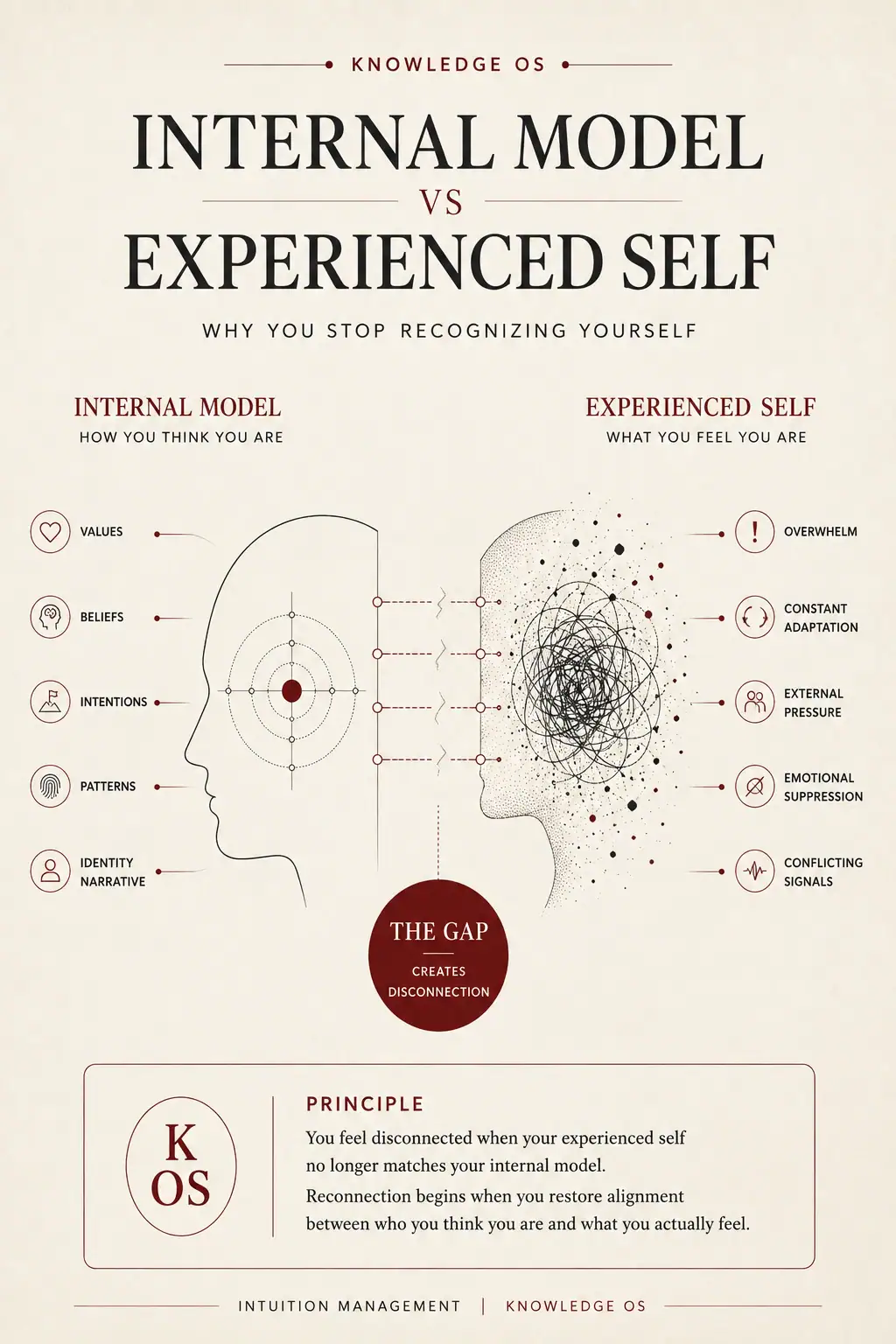
The gap between who you think you are and what you experience
You may think of yourself as decisive while repeatedly feeling unable to choose. You may believe that a goal still matters while noticing that your motivation has disappeared. You may continue performing a familiar role even though it no longer reflects your values.
“I know who I am supposed to be, but I cannot feel that person from the inside.”
The gap is not proof that one side is false. It is information that your internal model may need updating, your environment may need changing, or your signals may need enough quiet to become readable again.
Deepen this idea: Read What Are Mental Models? to see how hidden assumptions shape perception, identity, and decisions.
The Identity Signal Integration Loop
Identity drift begins when the signals supporting your self-model become fragmented, contradictory, or unreliable. Recalibration restores coherence by improving signal quality and updating the model.
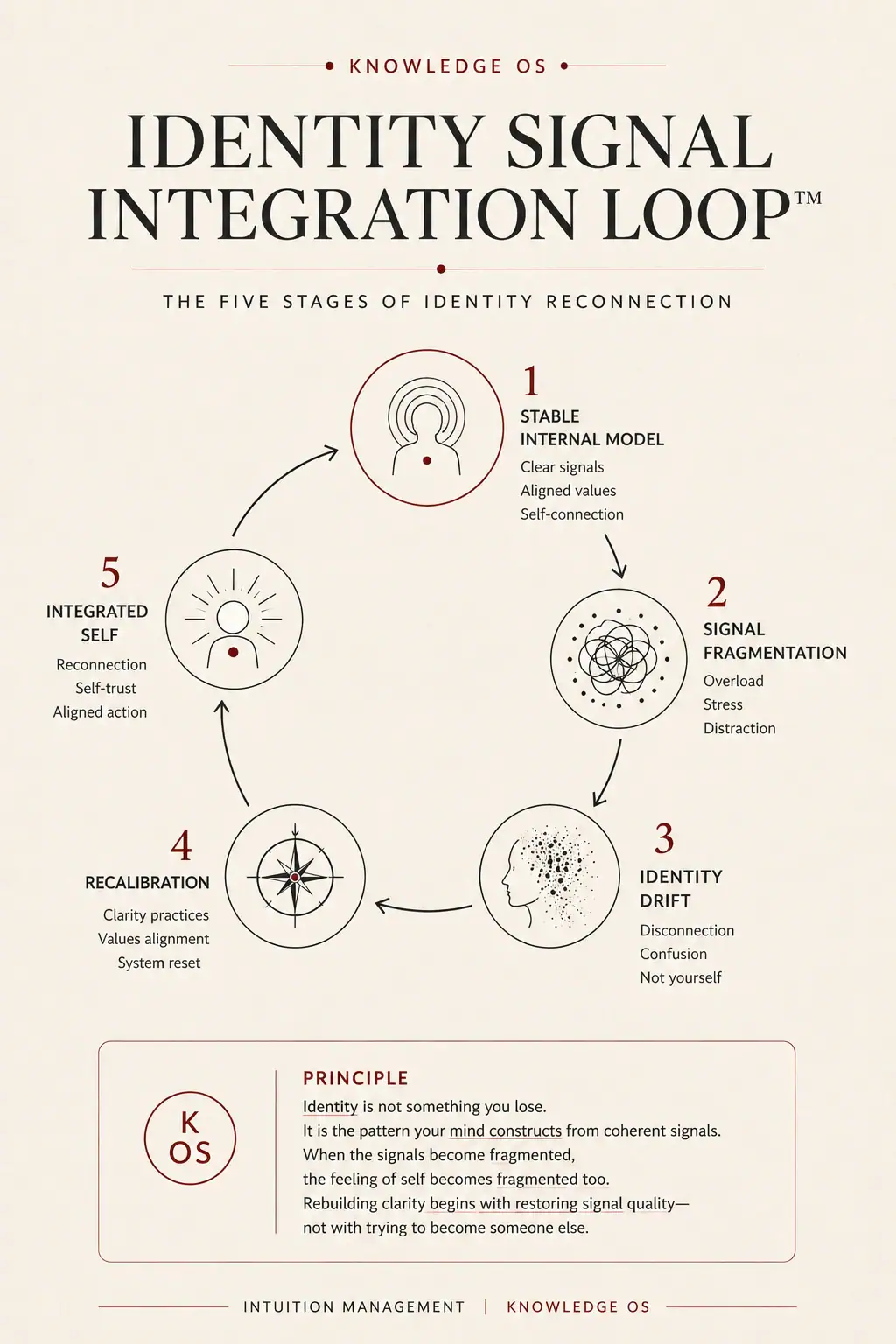
Stage 1: Stable internal model
Your values, emotions, actions, and self-understanding broadly reinforce one another. You do not need complete certainty. You have enough coherence to recognize your direction.
Stage 2: Signal fragmentation
Stress, overload, distraction, conflicting expectations, and emotional suppression make internal signals harder to distinguish from noise.
Stage 3: Identity drift
Your choices, motivation, and emotions stop feeling familiar. You rely more heavily on external rules because your internal reference point feels unreliable.
Stage 4: Recalibration
You begin reducing noise, noticing patterns, questioning outdated assumptions, and restoring alignment between values and behaviour.
Stage 5: Integrated self
Identity becomes coherent again—not because you return perfectly to an earlier version of yourself, but because your internal model now reflects current reality more accurately.
Identity drift exists on a spectrum
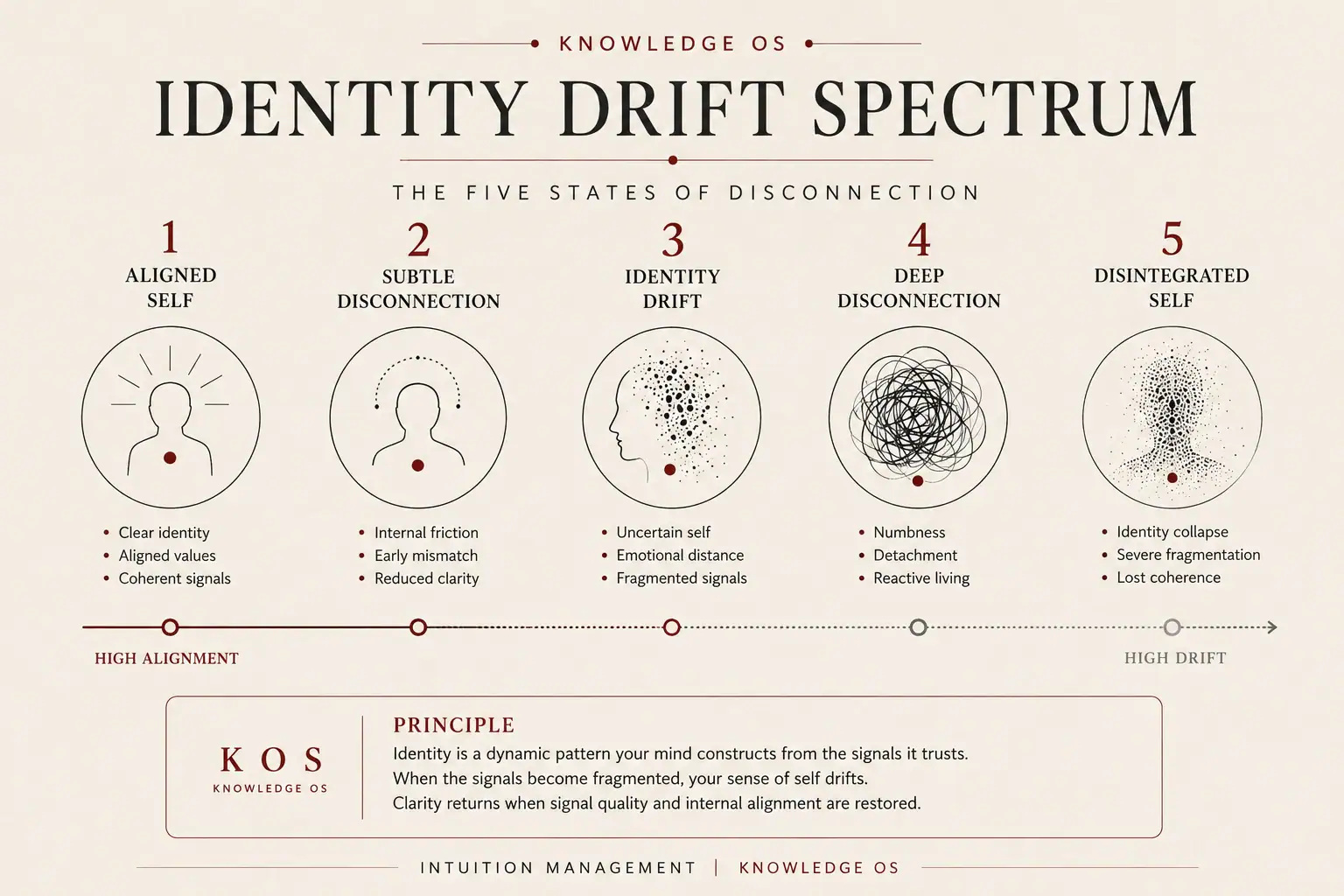
The important principle is that drift is not disappearance. A weak signal can be strengthened. An outdated model can be revised. A fragmented pattern can become coherent again.
Decode your own pattern: Continue with The Personal Signal Decoder.
Common Life Contexts That Can Create Self-Disconnection
Self-disconnection often appears during periods when identity must adapt faster than the mind can integrate change.
After burnout
Burnout can make your interests, ambitions, and emotional range feel inaccessible. You may confuse reduced capacity with a permanent personality change.
After a major relationship change
Relationships organize identity through routines, roles, shared language, and future expectations. When a relationship changes or ends, part of the identity built around it may collapse.
During career or academic transition
When competence, status, or routine changes, the old identity may stop receiving confirmation. A new environment can make you feel less capable or less real even when your underlying abilities remain.
After prolonged caregiving or responsibility
When your attention is organized around another person’s needs, your own preferences can become secondary for a long time.
After chronic stress or trauma
When the nervous system is repeatedly organized around safety, the self may become defined by vigilance, compliance, avoidance, or control. Professional support is especially important when disconnection is linked to traumatic experiences.
During adolescence or early adulthood
Identity naturally changes as roles, values, relationships, and independence develop. Not knowing exactly who you are is not automatically failure.
During social media overexposure
Repeatedly seeing polished versions of other people can weaken confidence in ordinary experience. Your own life may feel insufficiently vivid because it is being compared with edited signals rather than lived reality.
Feeling Disconnected Is Not Always the Same as Emotional Numbness, Burnout, or Anxiety
These experiences can overlap, but they are not identical. Distinguishing them helps you choose a more useful response.
Self-disconnection vs emotional numbness
Emotional numbness primarily describes reduced emotional access or intensity. Self-disconnection is broader.
Self-disconnection vs burnout
Burnout commonly involves exhaustion, reduced capacity, and detachment related to prolonged demands. Self-disconnection can accompany burnout, but it may also emerge through role change, value conflict, chronic adaptation, or identity transition.
Self-disconnection vs anxiety
Anxiety often involves heightened threat prediction and uncertainty. Self-disconnection may include anxiety, but it can also feel quiet, flat, unreal, or emotionally distant. See Intuition or Anxiety? for a practical distinction.
Self-disconnection vs “everything feels fake”
When everything feels fake, the world or your experience may feel unreal or strangely artificial. Feeling disconnected from yourself is more specifically about weakened identification with your own thoughts, emotions, choices, or identity.
Self-disconnection vs low motivation
Low motivation can be situational. Self-disconnection involves a wider loss of authorship, familiarity, or coherence.
Common Misconceptions About Losing Your Sense of Self
“I must discover one permanent true self”
Identity is not a hidden object waiting to be found once. It is a living pattern that changes as your values, roles, relationships, and experience change.
“If I feel different, I have become fake”
Change does not automatically make you inauthentic. Sometimes the old identity was accurate for an earlier period and now needs revision.
“I need a dramatic life change”
Major changes can occasionally help, but dramatic action taken from confusion may create more noise. Small, repeated alignment is usually a more reliable foundation.
“I should trust every feeling”
Feelings are signals, not commands. Reconnection requires interpretation, pattern recognition, and context—not automatic obedience.
“Thinking harder will solve it”
Reflection helps only when it improves signal quality. Endless analysis can become another layer of noise. This is why the more you think, the less certain you may feel.
Common Mistakes When Trying to Reconnect With Yourself
Waiting for perfect clarity
Clarity often follows action. Waiting to feel completely certain can keep the system frozen.
Trying to become your past self
Your earlier identity may contain strengths worth keeping, but restoring it exactly can prevent necessary updating.
Using constant self-analysis as a substitute for experience
You cannot think your way into every answer. Some parts of identity become visible only through action, relationships, rest, and feedback.
Mistaking numbness for peace
Reduced emotion can feel calm, but true regulation usually includes access to a wider emotional range rather than total absence of feeling.
Comparing yourself with edited versions of other people
Comparison introduces borrowed standards into your signal system. It can make your own preferences feel weak or inadequate.
Looking for one life-changing insight
Reconnection is usually cumulative. Small, repeated evidence rebuilds self-trust more reliably than one dramatic realization.
Reconnection is less about changing who you are than improving how clearly you can hear yourself.
How to Reconnect With Yourself
Reconnection happens when you reduce noise, notice real signals, clarify values, and act in ways that rebuild coherence.
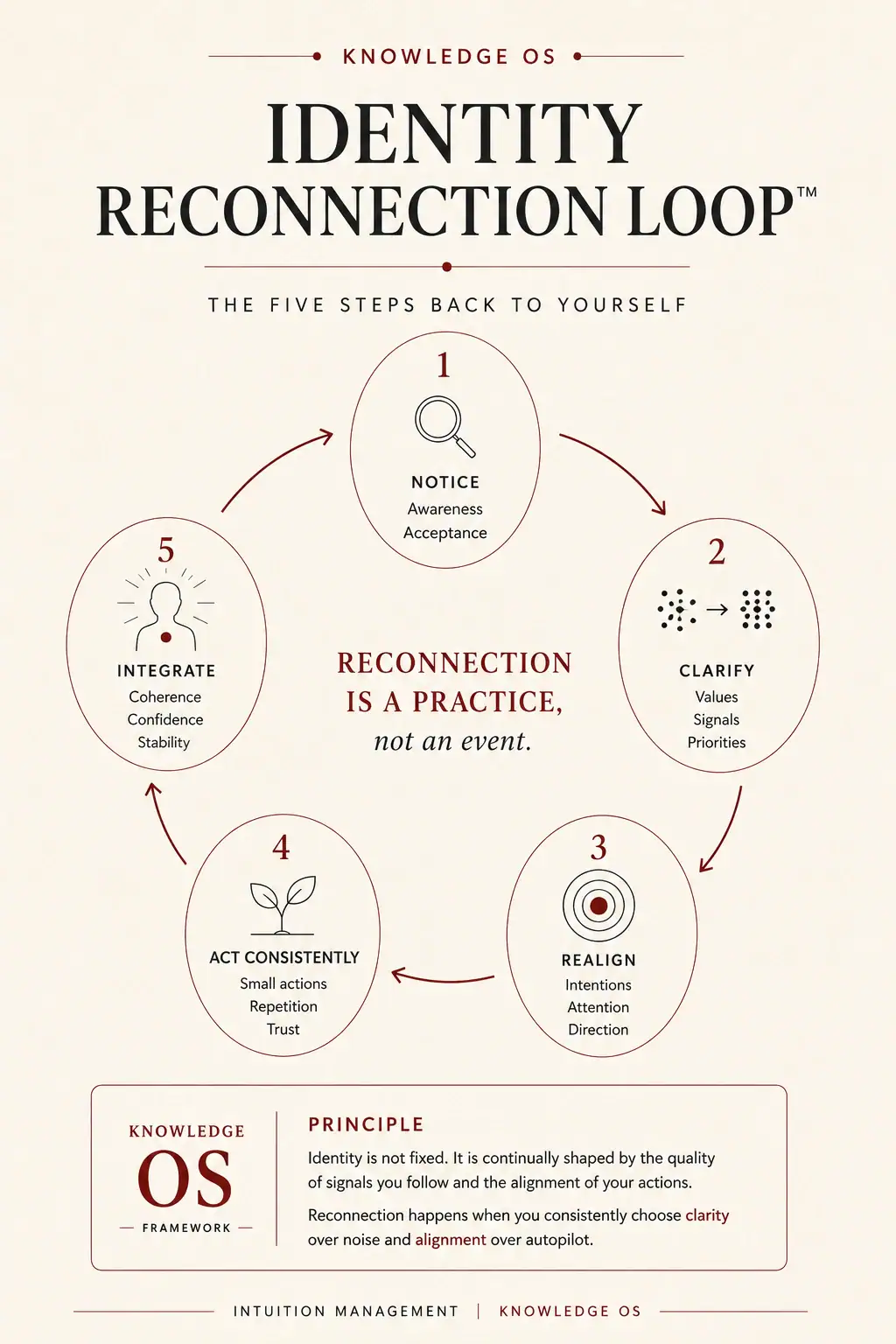
1. Notice without immediately judging
Begin with observation rather than correction. Ask when disconnection becomes stronger, when you feel most like yourself, and what changes immediately before the shift.
2. Clarify signal from noise
Not every thought deserves equal weight. Not every expectation is yours. Not every emotion is a command.
3. Realign values, attention, and direction
Choose one area where your behaviour no longer reflects what matters to you. Restore one small line of alignment rather than redesigning your entire life.
4. Use repeated action to rebuild self-trust
Self-trust develops when internal signals, stated intentions, and repeated actions begin matching again.
5. Let the new identity integrate
Reconnection may not feel like recovering an old self. It may feel like meeting a more accurate one.
Practical next step: Use the Signal vs Noise Simulator to observe how you separate meaningful information from distraction under uncertainty.
The Identity Clarity Framework
A clear identity emerges through alignment across values, direction, actions, emotions, and identity narrative.
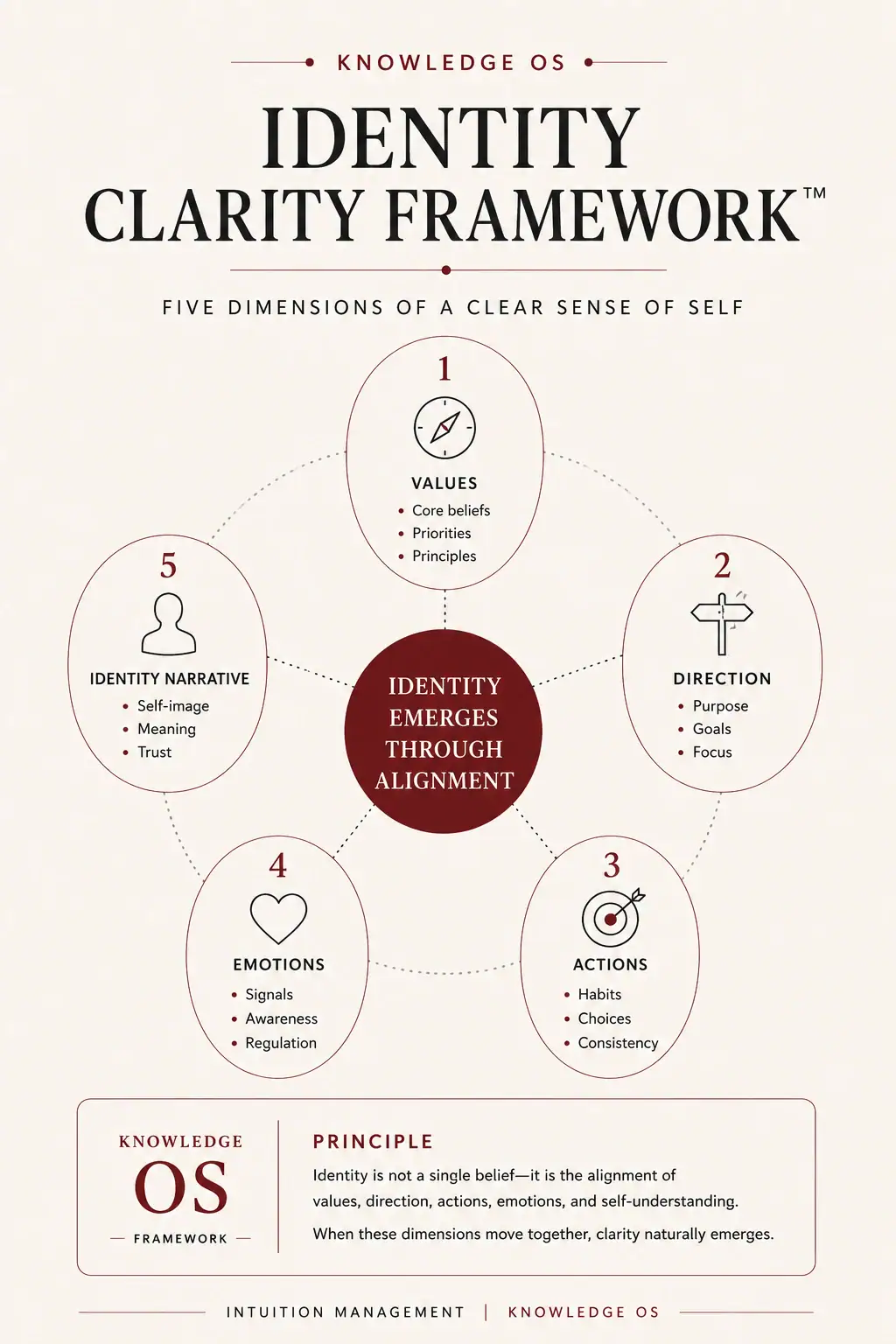
Values
What matters enough to guide trade-offs?
Direction
What are you moving toward?
Actions
What are you repeatedly doing?
Emotions
What information is your emotional system providing?
Identity narrative
What story are you using to explain yourself?
A Practical Identity Audit
An identity audit helps you find the area where your values, attention, emotions, actions, or relationships are most out of alignment.
Values audit
- What do I claim matters to me?
- What does my calendar suggest actually matters?
- Where do these two lists conflict?
Attention audit
- What receives most of my attention?
- What receives almost none?
- Which inputs make me feel clearer, and which make me feel fragmented?
Emotion audit
- Which emotions do I permit?
- Which emotions do I immediately suppress or explain away?
- What information might those emotions contain?
Action audit
- Which repeated actions strengthen self-trust?
- Which repeated actions weaken it?
- What is one behaviour I can change this week?
Relationship audit
- Where can I express myself without performing?
- Where do I become smaller, quieter, or more agreeable than I want to be?
- Which relationships help me remember what matters?
Identity narrative audit
- What sentence do I repeatedly use to describe myself?
- Is it still accurate?
- What evidence no longer fits that story?
A Seven-Day Reconnection Plan
Day 1: Reduce input
Create one short period without messages, scrolling, music, or multitasking.
Day 2: Track moments of self-recognition
Write down three moments when you felt even slightly more like yourself.
Day 3: Identify one value conflict
Choose one place where your behaviour and values diverge.
Day 4: Make one aligned decision
Take one small action that reflects your current value rather than habit, pressure, or image.
Day 5: Say one honest sentence
In a safe context, state one genuine preference, limit, uncertainty, or need.
Day 6: Revisit an old identity
Ask which parts of your earlier self remain useful and which no longer fit.
Day 7: Write a current identity statement
Complete: “Right now, I am someone who values…, is learning…, needs…, and is moving toward…”
How the Knowledge OS Identity Architecture Connects Everything
Your identity is shaped by a sequence: signals are filtered, models are built, reality is interpreted, self-trust develops, and repeated decisions reinforce a sense of self.
- You encounter more signals than you can consciously process.
- Your mental models filter and interpret those signals.
- Together, those models form an internal model of yourself, others, and reality.
- When that model predicts experience accurately enough, consistency builds self-trust.
- Repeated patterns become identity.
- Identity shapes attention, choices, and decision-making.
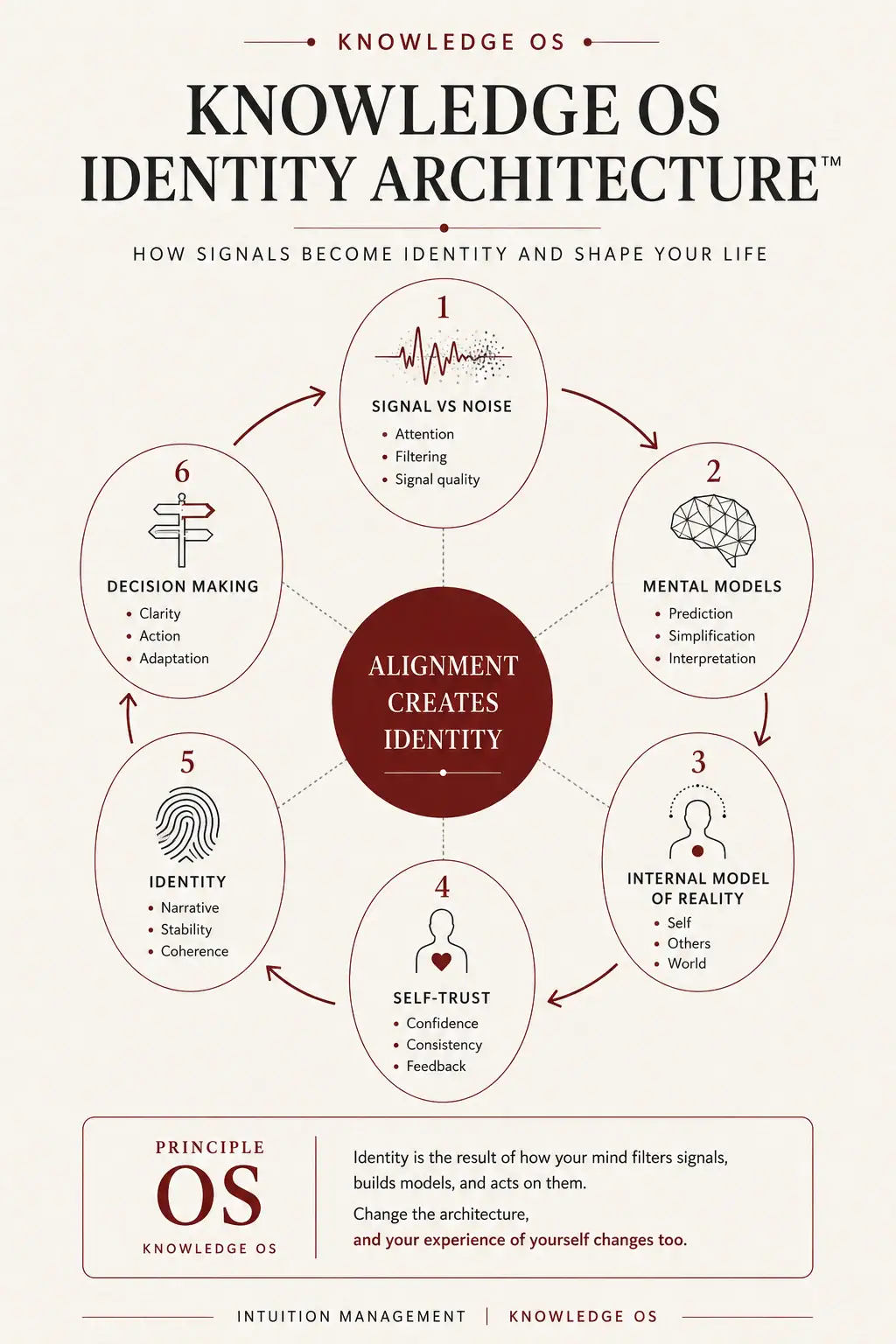
This is why reconnection is not merely emotional. It is architectural. Improving signal quality, updating mental models, and aligning behaviour changes the conditions through which identity is constructed.
When Professional Support May Help
Professional support is appropriate when disconnection persists, becomes frightening, or interferes with daily functioning.
- the feeling persists or becomes stronger;
- it interferes with school, work, relationships, sleep, or daily functioning;
- it includes severe anxiety, panic, memory difficulties, or a strong sense of unreality;
- it appears after trauma, illness, medication changes, substance use, or major sleep disruption;
- it feels difficult to manage alone.
A qualified mental health or medical professional can help evaluate possible causes and recommend appropriate support. The frameworks in this article are educational tools, not a substitute for individualized assessment or care.
Final Principle
Identity is the pattern your mind constructs from the signals it trusts, the models it uses, and the actions you repeat.
When those signals become fragmented, your sense of self may become fragmented too. Reconnection begins by restoring signal quality, updating the internal model, and taking small actions that make your values, emotions, and behaviour more coherent.
You do not have to force yourself to become the person you used to be. You can learn to recognize the person your current experience is asking you to become.
Frequently Asked Questions
Why do I feel disconnected from myself?
You may feel disconnected when stress, overload, emotional suppression, constant adaptation, conflicting values, or major change weaken the coherence between your internal model and your current experience.
Why do I not feel like myself anymore?
Your circumstances, capacity, values, emotional state, or roles may have changed faster than your identity model has updated.
Is feeling disconnected from yourself normal?
Brief periods can occur during stress, exhaustion, grief, transition, conflict, or major change. Duration, intensity, and effect on daily life matter.
Can stress make you lose your sense of self?
Stress can narrow attention, reduce emotional access, and increase reactive behaviour. This can weaken coherence without meaning your identity has literally disappeared.
Can burnout make me feel disconnected from myself?
Yes. Prolonged exhaustion can make values, interests, and emotions feel inaccessible, although other causes are also possible.
Can anxiety make me feel unlike myself?
Yes. Anxiety can amplify threat signals and alter attention, behaviour, and decision-making.
Is self-disconnection the same as emotional numbness?
No. Emotional numbness mainly concerns reduced emotional access. Self-disconnection is broader and may involve identity, values, decisions, motivation, or self-recognition.
Why do my decisions not feel like mine?
This can happen when choices are driven mainly by pressure, habit, fear, or other people’s expectations.
How do I reconnect with myself?
Notice when disconnection increases, reduce avoidable noise, clarify current values, and take one small action that aligns with them.
How long does identity drift last?
There is no universal timeline. It depends on causes, environment, support, health, and whether the conditions producing the disconnection change.
Can journaling help me feel like myself again?
Yes. Journaling can reveal repeated signals, conflicts, and patterns when it records concrete situations, emotions, needs, actions, and outcomes.
What if I do not know what I want anymore?
Start smaller. Ask what creates slightly more energy, relief, interest, honesty, or coherence today.
Can therapy help with feeling disconnected from yourself?
Yes. A qualified therapist can help explore stress, identity change, emotional patterns, trauma, relationships, and other contributors.
Should I try to become my old self again?
Not necessarily. Reconnection often requires updating your self-understanding rather than restoring an exact past version.
Why do I feel like I am pretending all the time?
You may be relying heavily on performance, compliance, or masking. The gap between public behaviour and private experience can make identity feel artificial.
Why do I feel like I lost my personality?
Stress, burnout, depression, anxiety, sleep disruption, and overload can reduce access to spontaneity, interest, and emotional range. Persistent changes deserve professional evaluation.
Can identity come back?
A coherent sense of self can often be rebuilt through recovery, reflection, supportive relationships, aligned action, and professional support when needed.
Why do I copy other people’s personalities?
Mirroring can help with belonging and adaptation. It becomes confusing when your own preferences are rarely expressed or reinforced.
Can identity drift happen without depression?
Yes. It can occur during change, stress, role conflict, masking, burnout, relationship disruption, or chronic adaptation.
Why do I feel like a different person every day?
Context, sleep, stress, social demands, emotional state, and environment can change which parts of you are most accessible.
How do I know if I am masking?
You may notice frequent monitoring of expression, rehearsing responses, suppressing natural reactions, or feeling exhausted after social interaction.
Related: Why Do I Feel Like I Don’t Belong Anywhere? · Why Do I Feel Like I’m Living on Autopilot? · Why Do I Feel Like I’m Watching My Life Instead of Living It? · How to Feel Like Yourself Again · Why Don’t I Know What I Want Anymore?
Related Articles
- Why Do I Feel Disconnected From Everything?
- Why Can’t I Trust Myself Anymore?
- Why Do I Feel Emotionally Numb?
- Why Does Everything Feel Fake Lately?
- Internal Model of Reality
- What Are Mental Models?
- The Personal Signal Decoder
- Signal vs Noise