Overthinking often creates the illusion that more thinking will produce more certainty. In reality, overthinking frequently increases decision fatigue, information overload, and uncertainty. Cognitive calibration helps explain why this happens and how to improve decision-making under uncertainty.
Have you ever spent hours thinking about a decision only to feel less certain than when you started?
Have you ever researched every option, analyzed every possibility, and considered every risk, only to end up more confused than before?
If so, you are not alone.
Many people assume uncertainty decreases as thinking increases.
In reality, additional thinking often reveals additional possibilities, additional interpretations, additional risks, and additional unknowns.
Without an effective way to prioritize information, every possibility can begin to feel equally important.
The result is a surprising paradox:
The more you think, the less certain you feel.
This experience is often mistaken for a lack of confidence, intelligence, discipline, or willpower.
More often, it reflects something else entirely.
It reflects a calibration problem.
Modern life exposes us to more information than any previous generation has ever encountered.
News feeds.
Social media.
Notifications.
Conflicting opinions.
AI-generated content.
Infinite advice.
Infinite possibilities.
The result is often cognitive overload.
As cognitive overload increases, many people experience:
- Mental fatigue
- Brain fog
- Decision fatigue
- Attention fragmentation
- Difficulty prioritizing
- Chronic overthinking
- Nervous system overload
- Feeling mentally exhausted
At this point, additional thinking often creates additional noise rather than additional clarity.
The challenge is no longer access to information.
The challenge is determining what deserves attention, what deserves confidence, and what deserves action.
This challenge sits at the center of Cognitive Calibration™, a framework designed to improve decision-making under uncertainty, complexity, and information overload.
If you are new to Intuition Management, start with Your Intuition Journey for an overview of the broader decision-making ecosystem behind this framework.
Why Thinking More Can Create More Uncertainty
Many people believe uncertainty exists because they have not thought enough.
Sometimes that is true.
More often, uncertainty increases because thinking expands awareness.
The more deeply you examine a situation, the more variables you discover.
The more possibilities you identify.
The more exceptions you notice.
The more unknowns become visible.
This is not a failure of thinking.
It is often a sign that thinking is working.
The challenge emerges when every possibility receives equal attention.
Without calibration, the mind struggles to distinguish meaningful signals from background noise.
Attention becomes fragmented.
Decision fatigue increases.
Mental fatigue increases.
Brain fog increases.
And confidence often decreases.
The Hidden Relationship Between Overthinking and Attention
Most discussions about overthinking focus on thoughts.
However, overthinking is often an attention problem before it becomes a thinking problem.
Attention determines which information enters awareness.
Awareness influences interpretation.
Interpretation influences confidence.
Confidence influences decisions.
When attention becomes overwhelmed, every signal begins competing for importance.
A minor concern receives the same attention as a significant risk.
A random opinion receives the same attention as direct evidence.
A hypothetical possibility receives the same attention as an immediate reality.
As this pattern continues, attention becomes fragmented.
Decision-making becomes increasingly difficult.
This is why attention management plays such an important role in cognitive calibration.
Calibration helps determine which signals deserve attention and which signals should be treated as noise.
Decision Fatigue Is Often a Signal, Not a Weakness
Many people interpret decision fatigue as evidence that something is wrong with them.
They assume they lack discipline.
They assume they lack motivation.
They assume they are not trying hard enough.
In reality, decision fatigue often reflects a system that is processing more information than it can effectively prioritize.
Every unresolved choice consumes mental resources.
Every competing interpretation consumes attention.
Every unfiltered signal adds cognitive load.
Over time, these demands accumulate.
The result may appear as:
- Mental fatigue
- Brain fog
- Reduced focus
- Difficulty starting tasks
- Decision avoidance
- Emotional exhaustion
- Feeling mentally exhausted
These experiences are often interpreted as personal failures.
Many times they are actually signals indicating that cognitive calibration needs improvement.
If this pattern feels familiar, you may also find value in Why Am I Mentally Exhausted All the Time?.
What Is Cognitive Calibration?
Cognitive calibration is the process of aligning perception, interpretation, confidence, and decision-making with reality.
Rather than asking:
- How can I become certain?
- How can I eliminate all risk?
- How can I know everything in advance?
Cognitive calibration asks:
How closely does my current understanding align with reality?
This question shifts attention away from certainty and toward alignment.
The distinction is important.
Reality changes continuously.
New information emerges.
Assumptions become outdated.
Predictions fail.
Unexpected opportunities appear.
Unexpected problems appear.
Calibration allows understanding to evolve alongside reality.
The objective is not perfect prediction.
The objective is maintaining alignment despite uncertainty.
Why Intelligent People Still Make Poor Decisions
Many people assume poor decisions result from insufficient intelligence.
The evidence suggests otherwise.
Highly intelligent individuals frequently make poor decisions.
Successful leaders misread situations.
Experts become overconfident.
Organizations with extensive data still fail.
The problem is often not intelligence.
The problem is misalignment.
Intelligence improves information processing.
Calibration improves alignment between understanding and reality.
A highly intelligent person can still:
- Ignore feedback
- Misinterpret signals
- Become trapped by overconfidence
- Become trapped by overthinking
- Confuse confidence with accuracy
- Collect more information while becoming less aligned
This is why better decisions do not always come from thinking harder.
Sometimes better decisions come from improving calibration.
The Missing Skill in Modern Decision-Making
Modern environments reward information gathering.
They reward speed.
They reward confidence.
Far fewer systems reward calibration.
Yet calibration may be one of the most valuable skills for navigating complexity, uncertainty, and information overload.
Without calibration, information becomes noise.
Without calibration, confidence becomes overconfidence.
Without calibration, intuition becomes projection.
Without calibration, attention becomes fragmented.
Calibration acts as the bridge between perception and reality.
The Cognitive Calibration™ Framework was developed to strengthen that bridge.
The Cognitive Calibration™ Framework
The Cognitive Calibration™ Framework was developed to help individuals make better decisions under uncertainty, complexity, information overload, and changing conditions.
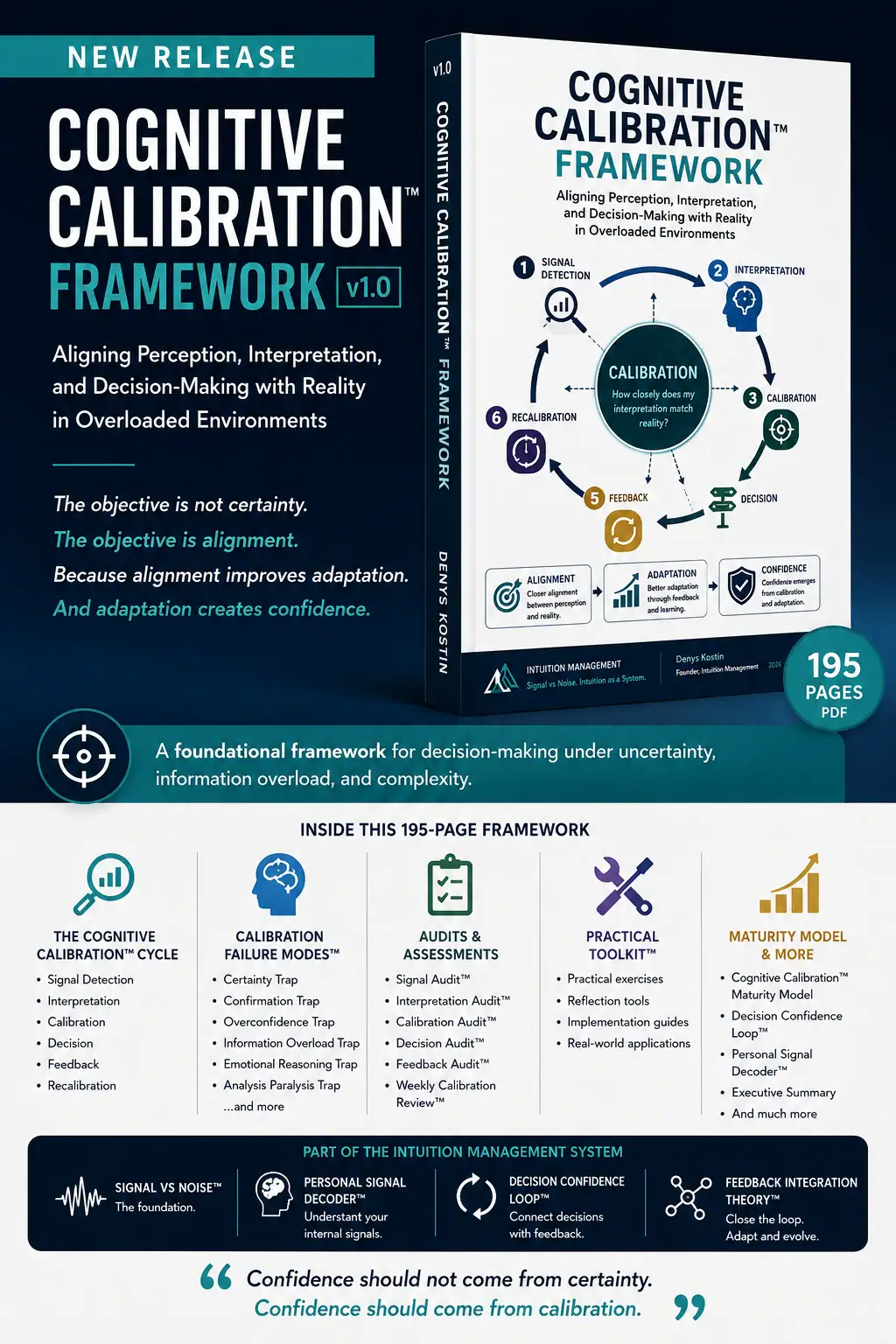
The framework consists of six interconnected stages.
- Signal Detection
- Interpretation
- Calibration
- Decision
- Feedback
- Recalibration
Together these stages create a continuous cycle of alignment, learning, and adaptation.
1. Signal Detection
Every decision begins with attention.
The challenge is identifying meaningful signals while filtering out noise.
Not every thought deserves attention.
Not every opinion deserves confidence.
Not every emotion requires immediate action.
Signal detection determines what enters the decision-making process.
If signal detection fails, everything that follows becomes less reliable.
You can explore this concept further using the Signal vs Noise Simulator.
2. Interpretation
Signals do not arrive with explanations attached.
People interpret information through assumptions, experiences, beliefs, emotions, expectations, and mental models.
The same signal can produce very different interpretations in different individuals.
Interpretation transforms information into meaning.
It is also where many distortions begin.
3. Calibration
Calibration is the center of the framework.
This stage evaluates whether confidence accurately reflects reality.
Confidence that exceeds evidence creates overconfidence.
Evidence that exceeds confidence creates underconfidence.
Calibration seeks alignment between confidence, evidence, interpretation, and reality.
4. Decision
Eventually action becomes necessary.
Waiting for certainty often creates analysis paralysis.
Calibrated individuals recognize that action itself generates information.
Every decision becomes an opportunity to learn.
5. Feedback
Reality responds to action.
Every outcome contains information.
Feedback reveals where understanding aligned with reality and where adjustments are needed.
Individuals who consistently integrate feedback tend to improve calibration over time.
6. Recalibration
New information updates future understanding.
Interpretations improve.
Confidence becomes more accurate.
Decision quality improves.
The cycle then begins again.
Confidence vs Certainty
Many people spend years pursuing certainty.
They believe confidence will arrive once every unknown disappears.
Unfortunately, uncertainty is a permanent feature of reality.
Reality changes.
Information changes.
Conditions change.
Waiting for certainty often means waiting forever.
Confidence should not come from certainty.
Confidence should come from calibration.
Confidence becomes sustainable when it is based on adaptation rather than prediction.
This idea connects directly with the Personal Signal Decoder™ and the Decision Confidence Loop™, which explores how confidence emerges through feedback, learning, and adaptation rather than certainty.
Common Calibration Failures
- Overconfidence — confidence exceeds evidence.
- Underconfidence — evidence exceeds confidence.
- Analysis Paralysis — waiting for certainty before acting.
- Emotional Reasoning — treating feelings as evidence.
- Information Overload — losing signal among excessive inputs.
- Attention Fragmentation — allowing noise to dominate attention.
Each of these patterns creates misalignment between perception and reality.
Frequently Asked Questions
What is cognitive calibration?
Cognitive calibration is the process of aligning perception, interpretation, confidence, and decision-making with reality under conditions of uncertainty.
Can cognitive calibration reduce overthinking?
Often, yes. Overthinking frequently results from attempting to achieve certainty in situations where certainty is unavailable. Calibration shifts attention toward alignment instead.
Does cognitive calibration help with decision fatigue?
Yes. By improving signal detection, prioritization, and attention management, calibration can reduce unnecessary cognitive effort and decision fatigue.
Why do intelligent people still make poor decisions?
Intelligence improves information processing. Calibration improves alignment with reality. A highly intelligent person can still become overconfident, ignore feedback, or misinterpret signals.
What is the difference between confidence and certainty?
Certainty attempts to eliminate uncertainty. Confidence emerges from adaptation, learning, and calibration despite uncertainty.
The Complete Cognitive Calibration™ Framework
The ideas presented in this article represent only a portion of the broader Cognitive Calibration™ Framework.
The complete framework expands these ideas into a practical system for improving decision-making under uncertainty, reducing overthinking, improving attention management, and developing confidence through adaptation rather than certainty.
The 195-page framework includes:
- The Cognitive Calibration™ Cycle
- Calibration Failure Modes™
- Signal Detection Audits
- Interpretation Audits
- Decision Audits
- Feedback Audits
- Weekly Calibration Review™
- Cognitive Calibration™ Maturity Model
- Practical implementation tools
- Advanced decision-making applications
The complete Cognitive Calibration™ Framework expands these ideas into a practical system for improving decision-making under uncertainty, reducing overthinking, improving attention management, and developing confidence through adaptation rather than certainty.
Access the Complete 195-Page Cognitive Calibration™ Framework:
Final Thought
The objective is not certainty.
The objective is alignment.
Better alignment improves decisions.
Better decisions create better feedback.
Better feedback creates better learning.
Better learning improves adaptation.
And adaptation creates confidence.
Confidence should not come from certainty.
Confidence should come from calibration.
Continue Exploring
- Why Decisions Feel Hard
- Why Am I Mentally Exhausted All the Time?
- Why Do I Overthink Everything?
- Something Feels Off
- The Personal Signal Decoder™
- Signal vs Noise Simulator
- Your Intuition Journey