Estimated reading time: 7 minutes
If you have ever wondered why decisions feel hard even when the options seem clear, you are not alone. Decision fatigue, overthinking, emotional interference, social pressure, and cognitive overload can make even simple choices feel heavier than they should.
Many people assume they need more information before they can decide. They research more, compare more, ask more people, and keep thinking through the same options again and again.
But sometimes the problem is not a lack of information.
Sometimes the problem is too much noise.
New here? Start with Your Intuition Journey, the central guide to decision clarity, signal recognition, and navigating uncertainty.
That is why building decision clarity starts with a different question: not “What should I choose?” but “What is interfering with my ability to see clearly?”
Why Decisions Feel Harder Than They Should
A difficult decision is not always difficult because the situation is complicated.
Sometimes it becomes difficult because the mind is overloaded, the body is tired, emotions are intense, or other people’s expectations are competing with your own sense of direction.
This is why two people can face the same choice and experience it completely differently. One person sees a clear next step. Another person feels stuck, anxious, tired, or unable to move.
The difference is not always intelligence. It is often the condition of the decision-maker.
Why Do Decisions Feel Hard Even When Nothing Is Wrong?
Sometimes nothing obvious is wrong, but something still feels off. You may be able to function, work, answer messages, and handle daily responsibilities, yet decisions feel strangely heavy.
You may think, “Why can’t I make a decision?” or “Why is it so hard to focus?” In many cases, this is not weakness. It is a sign of mental overload, decision fatigue, or too much internal and external noise.
When the nervous system is tired, the mind often interprets low capacity as uncertainty. When emotions are intense, a normal decision can feel risky. When social pressure is high, even a personal choice can feel like a public performance.
Common Signs of Decision Fatigue
Decision fatigue can show up quietly. It does not always feel dramatic. Often, it feels like ordinary confusion, procrastination, or mental heaviness.
- You keep researching but never decide.
- You revisit the same choice repeatedly.
- Every option feels equally uncertain.
- Small decisions feel strangely exhausting.
- You constantly seek reassurance.
- You feel stuck even when you know something needs to change.
- You confuse exhaustion with uncertainty.
- You wait for certainty before taking any step.
When this happens, the solution is not always to think harder. Sometimes thinking harder only increases the noise.
Signal vs Noise in Decision-Making
At Intuition Management, one of the core distinctions is signal vs noise.
Signal is information that helps you move forward.
Noise is information that interferes with movement.
Signal can appear as relief, curiosity, sustainable energy, reduced internal conflict, or a quiet sense that one direction deserves attention.
Noise can appear as overthinking, fear of judgment, perfectionism, exhaustion, urgency, comparison, or the need to keep convincing yourself.
The challenge is that noise often feels louder than signal. That is why tools like The Personal Signal Decoder exist: to help separate meaningful inner information from background interference.
You can also explore this distinction interactively through the Signal vs Noise Simulator, which helps test how decision-making changes under uncertainty.
The Hidden Sources of Decision Friction
When decisions feel hard, the obstacle usually belongs to one or more of these five areas:
1. Cognitive Noise
This includes overthinking, excessive research, analysis paralysis, and mental clutter. The mind keeps working, but clarity does not increase.
2. Emotional Interference
Fear, guilt, shame, regret, and self-doubt can distort how options appear. A reasonable risk can feel dangerous. A necessary step can feel impossible.
3. Social Pressure
Sometimes you are not choosing between options. You are trying to satisfy multiple audiences at once: family, colleagues, friends, partners, expectations, or past versions of yourself.
4. Somatic Noise
The body is part of the decision-making system. Fatigue, tension, stress, and nervous system overload can make ordinary choices feel much harder than they are.
5. Weak Signal Recognition
Sometimes the problem is not too much noise. Sometimes the deeper problem is that curiosity, relief, energy, and alignment have become difficult to notice.
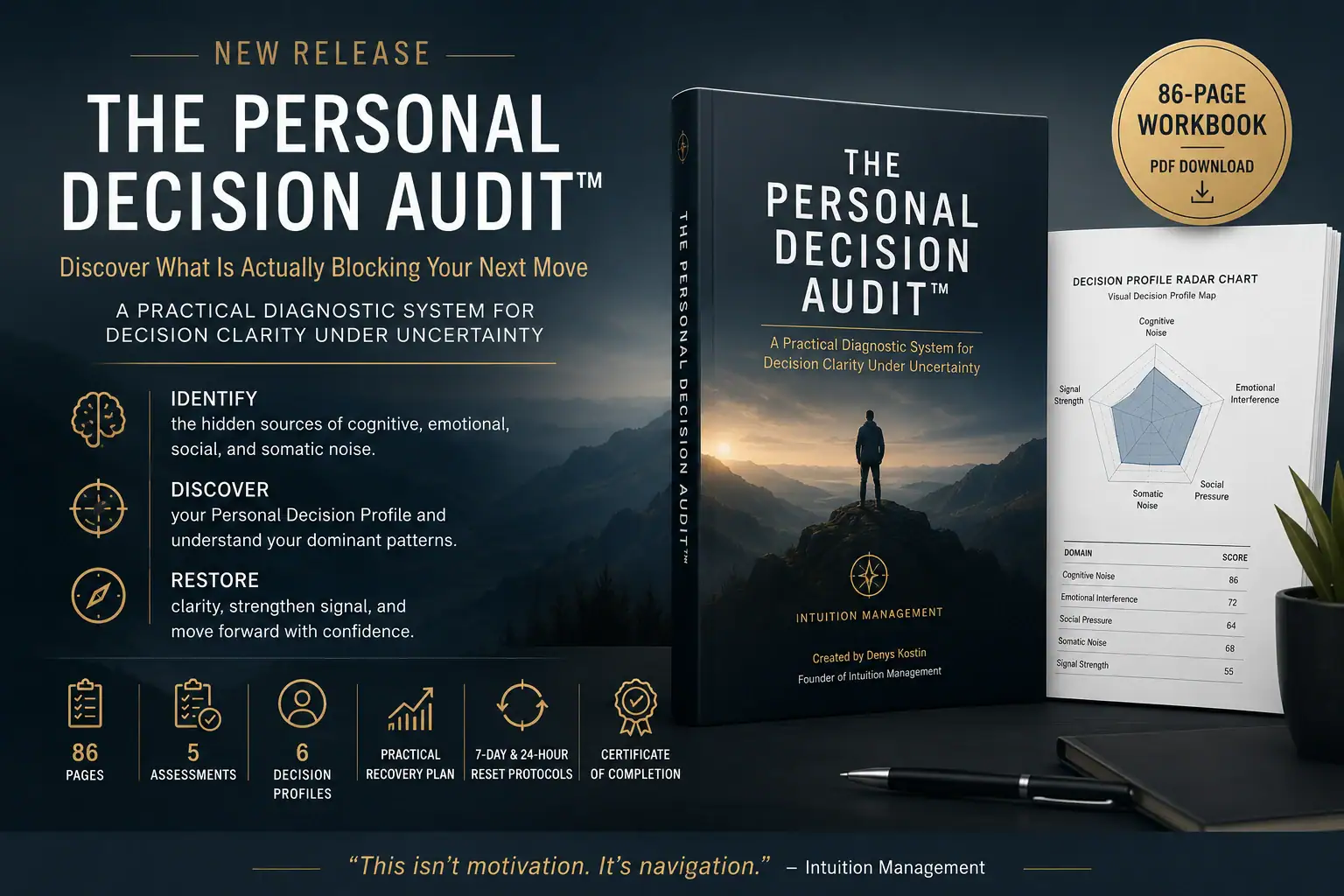
New Workbook: The Personal Decision Audit™
To help with this, I have released a new 86-page workbook on Patreon:
The Personal Decision Audit™: Discover What Is Actually Blocking Your Next Move
This is a practical diagnostic workbook for identifying the hidden sources of decision friction that may be affecting your clarity right now.
- 5-domain decision assessment
- Cognitive Noise Assessment
- Emotional Interference Assessment
- Social Pressure Assessment
- Somatic Noise Assessment
- Signal Strength Assessment
- Personal Decision Profile
- Recovery Plan
- 7-Day Clarity Reset
- 24-Hour Decision Reset Protocol
- Decision Profile Radar Chart
- Certificate of Completion
Discover Your Personal Decision Profile
The workbook helps you identify which pattern may currently be shaping your decisions:
- The Overthinker
- The Exhausted Navigator
- The Approval Seeker
- The Perfectionist
- The Avoider
- The Disconnected Observer
These are not permanent labels. They are snapshots of your current decision environment. And once a pattern becomes visible, it becomes easier to work with.
Who This Workbook Is For
The Personal Decision Audit™ may be useful if:
- You keep delaying an important decision.
- You feel stuck between several options.
- You constantly second-guess yourself.
- You feel mentally overloaded.
- You cannot tell whether you need more thinking or more rest.
- You feel pressure from other people’s expectations.
- You want more decision clarity under uncertainty.
The goal is not to eliminate uncertainty. The goal is to understand what is blocking your next useful move.
Related: Decision Fatigue and Intuition: How to Make Clear Choices · Why Simple Decisions Feel Exhausting
Related Reading
Your Next Step
If decisions have been feeling harder than they should, start by identifying the source of friction. The Personal Decision Audit™ was created to help uncover whether cognitive noise, emotional interference, social pressure, somatic overload, or weak signal recognition is creating the problem.
If decisions feel harder than they should, the answer is not always more effort. Sometimes the answer is identifying the cognitive noise, emotional interference, social pressure, or decision fatigue that is already affecting your judgment.
FAQ: Why Decisions Feel Hard
Why do decisions feel harder than they should?
Decisions often feel harder when cognitive overload, emotional stress, social pressure, or physical exhaustion interfere with clarity. The difficulty may not be the decision itself, but the condition from which the decision is being made.
Is overthinking a sign that I need more information?
Not always. Sometimes overthinking means you are searching for certainty that is not available. In that case, more information may create more noise instead of more clarity.
What is decision fatigue?
Decision fatigue is the decline in clarity, energy, and judgment that can happen after too many choices, too much mental effort, or prolonged uncertainty.
How can I stop second-guessing my decisions?
Start by identifying what kind of noise is driving the second-guessing. It may be cognitive noise, fear, social pressure, exhaustion, or weak signal recognition. Different sources of noise require different responses.
Why can’t I make a decision even when I know the options?
Many people struggle to make decisions not because they lack options, but because cognitive overload, emotional stress, or conflicting priorities create friction that makes every option feel uncertain.
Can intuition help with decision-making?
Yes, when intuition is understood as pattern recognition, embodied awareness, and sensitivity to meaningful signals. It should not replace logic, but it can help reveal information that analysis alone may miss.
Written by Denys Kostin, founder of Intuition Management, a framework for decision clarity under uncertainty.
This is not motivation.
It is navigation.