
Why do I feel like I don’t belong anywhere? Feeling like you belong nowhere does not necessarily mean that something is fundamentally wrong with you. It can emerge when your inner identity, the version of yourself you express, the responses you receive and the environments around you stop fitting together.
Quick answer: why you may feel like you belong nowhere
You may feel like you do not belong anywhere when your identity, social expression, relationships and environment no longer align. This can happen after repeated rejection, a major life change, chronic self-editing, stress, emotional disconnection, or spending time in relationships where only a limited version of you is known. The feeling is real, but it is not proof that you are incapable of connection or destined to remain alone.
You may be invited, included in a group chat, surrounded by colleagues, or sitting across from people who care about you—and still feel strangely absent from the connection around you. Nothing dramatic has to happen. No one has to openly reject you. The distance can be quieter than that.
You listen. You respond. You smile at the expected moments. Yet part of you remains outside the experience, watching other people connect while trying to understand why connection does not seem to reach you in the same way.
Sometimes the thought becomes global: I do not fit in here becomes I do not fit in anywhere. A disappointing friendship, an uncomfortable workplace, a family role that no longer fits, or a period of emotional exhaustion begins to look like evidence about your entire identity.
This article offers a different interpretation. Belonging is not a fixed personality trait that some people possess and others lack. It is an experience created through interaction between self-knowledge, authentic expression, reciprocal recognition and environmental fit. Research has long described the drive to form and maintain stable interpersonal bonds as a powerful human motivation.[1] Contemporary reviews also describe belonging as a subjective connection not only to people, but to groups, places and shared experiences.[2]
That means the question is not only, “What is wrong with me?” A more useful set of questions is:
- Do I know enough about myself to recognize what genuine connection would feel like?
- Can I show meaningful parts of myself without constant editing?
- Do the people around me respond with curiosity, respect and reciprocity?
- Am I trying to belong in environments that are genuinely compatible with who I am becoming?
How this article was developed: This guide draws on the linked peer-reviewed research and clearly separates research findings from Intuition Management’s proprietary editorial frameworks. It was reviewed for non-diagnostic wording, source attribution and practical usefulness. It provides education and reflection, not individualized assessment or treatment.
What feeling like you do not belong can feel like
Not belonging is not always the same as being physically alone. It often appears as a mismatch between what is happening socially and what you experience internally.
You may notice that:
- you are included in activities but do not feel truly part of them;
- you can speak to many people but rarely feel known;
- you change your tone, opinions or personality from one group to another;
- you monitor yourself so closely that conversation feels like performance;
- you assume other people understand social life in a way you do not;
- you leave interactions feeling invisible, tired or emotionally flat;
- you feel like a visitor in your own family, workplace, city or friendship group;
- you are more comfortable alone because self-monitoring temporarily stops;
- you want closeness but pull back when an opportunity for it appears;
- you keep finding groups that are “almost right” but never feel like home.
The experience can also become self-reinforcing. When you expect not to fit, you may enter a room looking for signs of distance. A neutral expression, a delayed reply or a conversation you were not part of becomes highly visible. Signs of interest, compatibility or warmth may receive less attention because the mind is already trying to answer a threat-based question: Where is the rejection?
This does not mean exclusion is imaginary. People can be genuinely ignored, marginalized, misunderstood or placed in environments that punish difference. Research on ostracism shows that exclusion can rapidly threaten belonging and other fundamental psychological needs.[3] The aim is not to explain every painful interaction as a thinking error. It is to separate three possibilities that are often mixed together:
- Actual exclusion: the environment repeatedly communicates that you are not welcome, respected or safe.
- Belonging uncertainty: ambiguous events are difficult to interpret, so the mind repeatedly asks whether acceptance is real or temporary.
- Internal disconnection: you are unsure what you need, value or want, making it difficult to identify where genuine fit might exist.
Several of these can operate at once. You might be in a poor-fit environment and carry expectations shaped by earlier rejection. You might have supportive people nearby and feel too exhausted or guarded to access the connection they offer.
What does belonging actually mean?
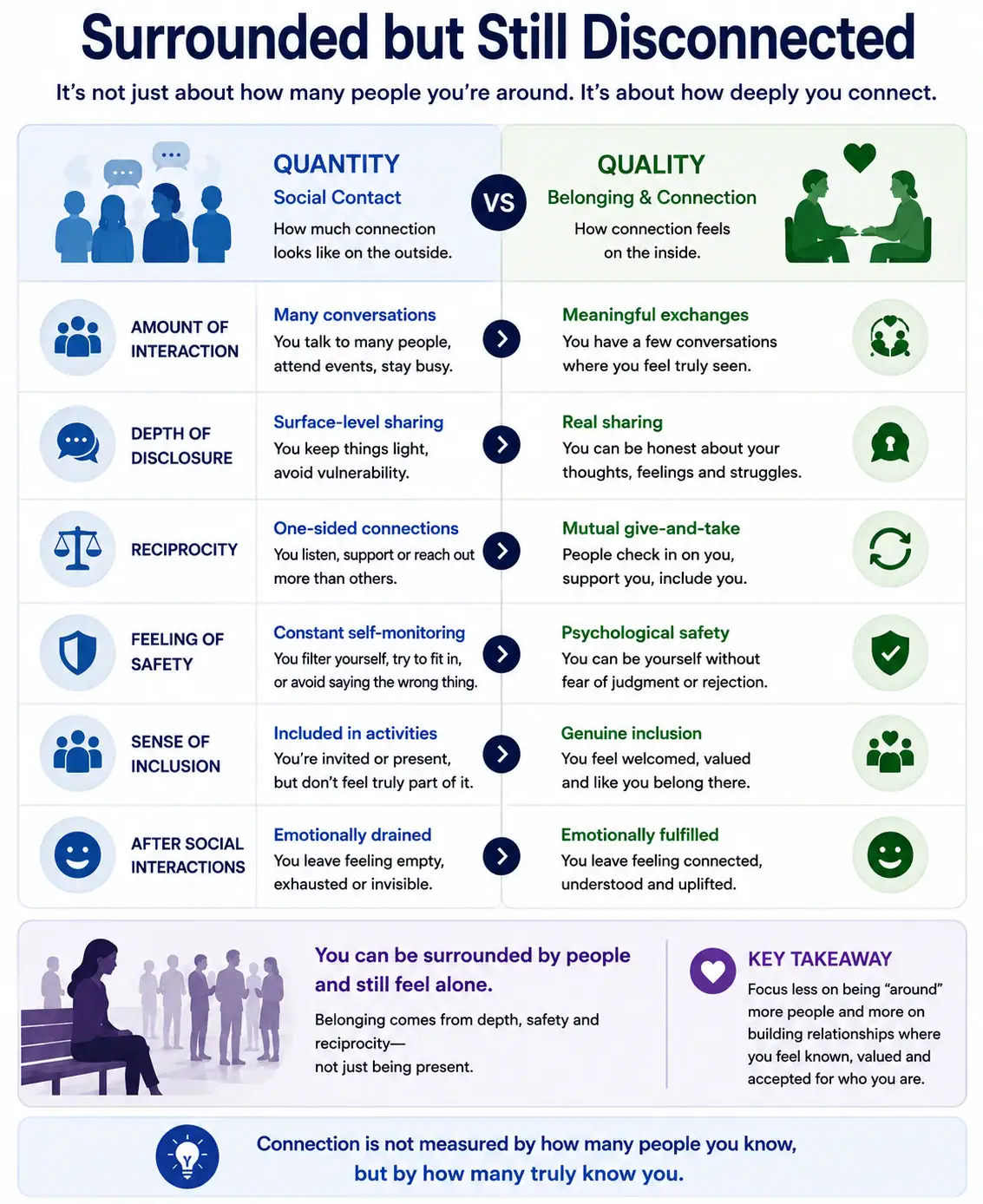
Belonging is more than proximity. It is more than being popular, receiving invitations, having followers or appearing socially busy. A person can have extensive social contact and still experience little emotional connection.
At its simplest, belonging is the experience that you are sufficiently accepted, recognized and able to participate without continuously abandoning yourself. It usually contains several elements:
Continuity
Contact occurs often enough for a relationship or group connection to become stable rather than accidental.
Recognition
Other people respond to who you are, not only to your usefulness, role or social performance.
Reciprocity
Interest, effort, care and disclosure move in both directions rather than being carried by one person.
Participation
You can influence, contribute and take up reasonable space instead of remaining a tolerated observer.
The foundational belongingness hypothesis emphasized frequent, generally positive interactions within ongoing relational bonds.[1] This is important because a single warm conversation may provide relief, but belonging usually develops through repeated evidence: someone remembers, follows through, includes you, makes room for disagreement and remains present after you show something real.
Belonging also has an environmental dimension. You may feel known by one friend but alienated at work. You may feel connected within a creative community but out of place in your family. You may belong through shared purpose in one setting and through emotional intimacy in another.
Belonging does not require fitting perfectly everywhere. It requires enough places where you can participate without repeatedly erasing yourself.
This is why belonging can be plural. No single person or community has to contain every part of you. A healthier system may include different forms of connection: one friend with whom you can speak honestly, a professional group that understands your work, a local activity that creates repeated contact, and a private relationship in which you can rest without performing.
9 reasons you may feel like you don’t belong anywhere
There is rarely one universal cause. The feeling usually reflects a pattern across identity, expression, relationships, expectations and environment. The following explanations are not diagnoses. They are possibilities you can compare with your own experience.
1. You have changed, but your relationships still reflect an older version of you
Life transitions alter the social roles through which you once recognized yourself. A move, career change, breakup, parenthood, migration, illness, graduation, loss, new belief system or major period of personal growth can weaken previous points of identification.
The difficult period is often not the moment you leave an old identity. It is the interval after the old role no longer feels true but before new relationships and routines have formed around the person you are becoming.
People who knew you earlier may continue responding to the old version. They expect the same reactions, priorities or level of availability. You may still be included, but the inclusion is addressed to a self you no longer fully inhabit.
This can feel like rejection even when no one intends harm. The deeper experience is misrecognition: I am here, but the version of me that is being responded to is no longer complete.
2. You adapt so much that no one encounters enough of the real you
Social adaptation is normal. Every relationship involves context, restraint and sensitivity. The problem begins when adaptation becomes so automatic that your internal position disappears.
You may scan for the safest answer before noticing what you think. You laugh to reduce tension, agree to avoid conflict, become useful to secure a role, hide preferences that could make you inconvenient, or present a consistently calm version of yourself while feeling uncertain inside.
Acceptance may then arrive—but it does not feel satisfying because you cannot tell whether the relationship would survive contact with more of you. Other people may genuinely like the person they meet. Your nervous system still asks, Would they stay if they knew what I actually felt?
This pattern is not a moral failure. Self-editing can develop as protection in environments where difference carried consequences. The question is not whether you should disclose everything to everyone. The question is whether there are any relationships in which meaningful parts of you can appear safely and gradually.
3. You expect rejection before enough current evidence exists
Repeated rejection teaches the mind to predict. Prediction is useful: it helps you avoid repeating painful situations. But a protective prediction can become overgeneralized.
A delayed message may feel like abandonment. Someone being distracted may feel like disinterest. A group with established friendships may feel permanently closed. A small social mistake may seem to reveal that you never belonged.
Research on belonging uncertainty shows how doubts about social fit can increase sensitivity to ambiguous social information in particular contexts.[7] This does not mean every concern is inaccurate. It means uncertainty can influence which interpretation feels most immediately believable.
A useful distinction is:
- Evidence: What did the person or group repeatedly do?
- Prediction: What do I expect they will eventually do?
- Meaning: What does this event appear to say about me?
Separating these layers does not eliminate pain. It prevents one ambiguous moment from becoming a total verdict on your capacity to belong.
4. Your relationships provide contact but little depth
You can know many people and still have no place where your internal life is received. The conversations may be frequent but highly functional: tasks, plans, jokes, updates and surface-level reactions.
Research using everyday-life measures found that both the quantity of interaction and aspects of interaction quality—such as conversational depth, disclosure and knowing one’s interaction partners—were associated with wellbeing and social connectedness, although the strength of associations varied by measure and level of analysis.[4]
This does not mean every conversation must be intense. Light contact matters. Shared routines matter. Casual friendliness can create the repeated familiarity from which deeper trust develops. The problem is when all connection remains at the surface and you have nowhere to place uncertainty, disagreement, grief, excitement, complexity or change.
5. The environment is genuinely incompatible
Not every belonging problem should be solved by becoming more open, patient or socially skilled. Some environments require chronic self-erasure.
A workplace may reward aggression that violates your values. A friendship group may use humiliation as bonding. A family system may allow only one role for you. A community may demand ideological conformity. A relationship may welcome you only when you remain useful, quiet or predictable.
In these cases, discomfort can be information. The important task is to distinguish the ordinary friction of difference from a structural lack of safety or compatibility.
Ask:
- Can people disagree here without punishment or contempt?
- Are differences treated with curiosity, indifference or hostility?
- Can I set a reasonable boundary without losing all relational security?
- Is acceptance connected to who I am, or mainly to what I provide?
- Does repeated contact make me less guarded—or more?
6. Chronic stress has reduced your psychological availability
Connection requires capacity. You need enough attention to notice another person, enough emotional access to respond, and enough internal safety to tolerate uncertainty.
When your system is overloaded, social contact can feel like another demand. You may want connection in principle but experience conversation as effort, disclosure as risk and invitations as obligations. The person in front of you may be safe, yet your body remains prepared for pressure.
This is one reason emotional distance can coexist with care. You may not have stopped valuing people. You may have less usable access to warmth, curiosity and responsiveness.
For a deeper explanation of this internal distance, read Why Do I Feel Disconnected From Everything? and Why Do I Feel Emotionally Numb?
7. You feel disconnected from yourself
To feel known, you need some access to what is there to know.
If your preferences, values, emotions and needs have become difficult to identify, social connection may feel vague. You can be appreciated and still wonder what exactly is being appreciated. You may mirror other people because your own signal is faint. You may search for “your people” without knowing which parts of life you want to share.
A 2026 review describes self-concept clarity as the degree to which self-beliefs are clearly and confidently defined, internally consistent and relatively stable, while also emphasizing important limits and unresolved questions in the evidence.[10] Earlier longitudinal work in adolescents found reciprocal links between aspects of self-concept clarity and relationship quality, with patterns depending on the relationship context.[6]
You do not need a perfectly defined identity before connecting. Identity also develops through relationships. But you may need enough self-recognition to detect which interactions create relief, curiosity, contraction, performance or genuine participation.
Related guides: Why Do I Feel Disconnected From Myself? and How to Feel Like Yourself Again.
8. You compare ordinary relationships with edited evidence
Other people’s connection is usually most visible at its most coherent: celebrations, group photos, shared jokes, public support and polished stories. The slow, awkward and uncertain parts of relationship formation are less visible.
If you compare your internal doubt with another group’s public surface, your own relationships may appear unusually weak. You do not see the missed messages, mismatched expectations, quiet repair, periods of distance or years of repeated contact that produced the moment being displayed.
The practical response is not necessarily to leave social media. It is to remember what kind of evidence you are viewing. Visibility is not the same as intimacy, and social fluency is not the same as belonging.
9. You have not had enough repeated contact
Many people search for an immediate sense of certainty: These are my people. I can relax now. When that feeling does not arrive quickly, they assume the environment is wrong.
Sometimes it is wrong. But sometimes the relationship is simply early.
Belonging often develops through ordinary repetition: seeing the same people, completing a shared task, remembering details, testing a small opinion, discovering a reliable response and returning again. Trust accumulates before it becomes emotionally obvious.
One intense conversation can create hope. Repeated contact reveals whether the connection can hold real life.
The Belonging Alignment Model™
The Belonging Alignment Model™ organizes the experience into four interacting conditions. Belonging becomes more likely when all four receive enough support—not when one condition becomes perfect.

1. Self-recognition
You have enough access to your values, preferences, needs, boundaries and developing identity to recognize what authentic connection would feel like.
Self-recognition does not require total certainty. It can begin with small signals: which conversations make you feel clearer, what you resent repeatedly, what kind of humour relaxes you, which values you cannot comfortably violate, or where your body becomes less guarded.
2. Safe expression
You can reveal meaningful parts of yourself without constant performance or fear. The expression can be gradual and selective. Safety does not mean saying everything. It means there is at least some room for honesty, preference and disagreement.
3. Reciprocal recognition
Other people respond with interest, inclusion, respect and enough give-and-take for you to feel seen rather than merely tolerated. They do not have to understand every part of you. They make a sincere effort to update their understanding.
Relationships and self-evaluation can influence each other over time. A large meta-analytic synthesis found reciprocal prospective associations between social relationships and self-esteem across development, while also acknowledging variation between studies.[5]
4. Environmental fit
The group, relationship, place or culture is sufficiently compatible with your values, communication style and psychological needs. Compatibility does not mean sameness. It means difference can exist without requiring continuous self-betrayal.
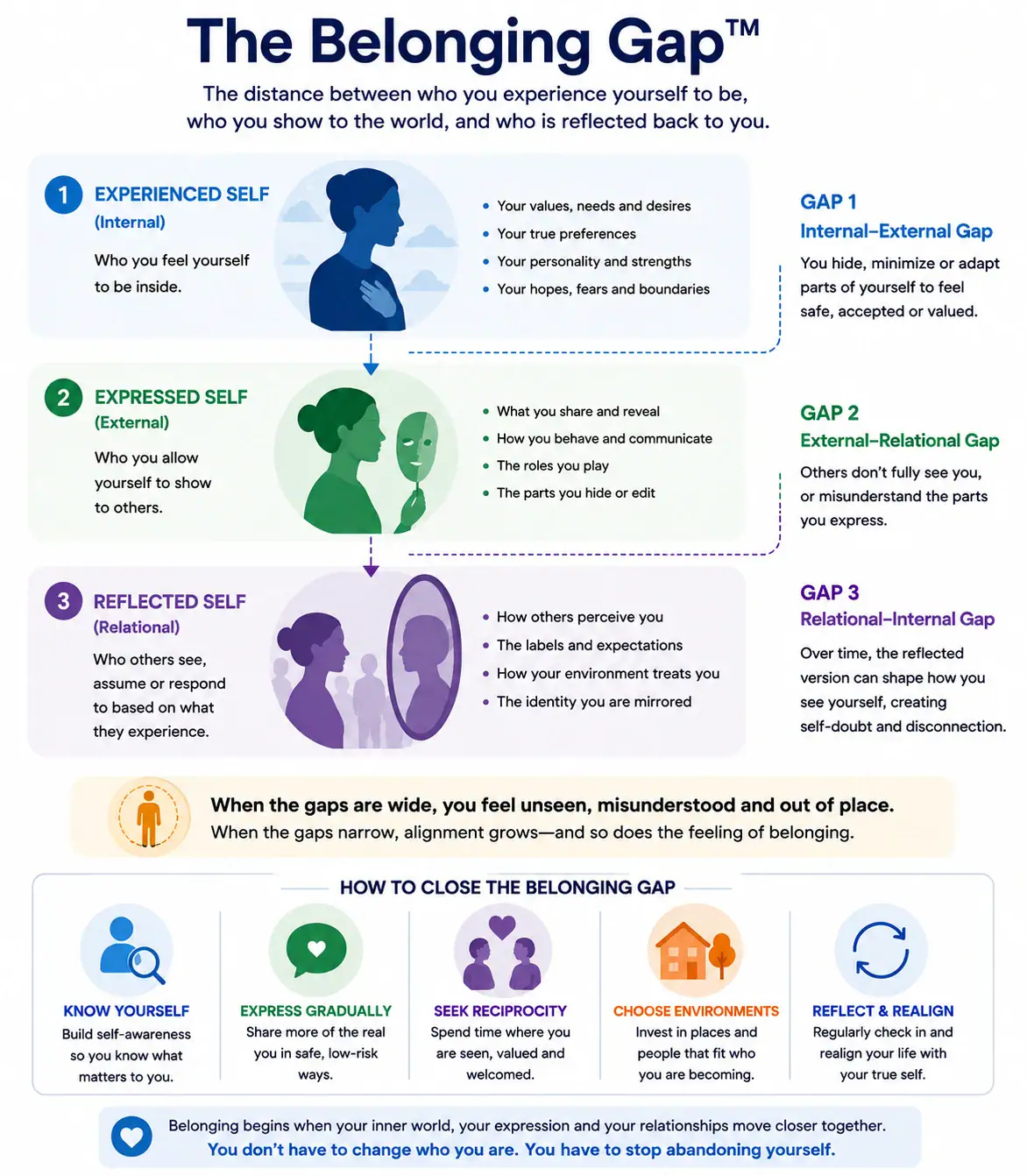
The Belonging Gap™: when your inner, expressed and reflected selves separate
The feeling of being unseen often grows from distance between three versions of self:
- Experienced self: who you feel yourself to be internally—your values, hopes, fears, preferences and boundaries.
- Expressed self: what you allow other people to see through words, behaviour, roles and choices.
- Reflected self: the version of you that other people and environments mirror back through their expectations, labels and responses.
The internal–external gap
You hide, minimize or adapt parts of yourself to feel safe, accepted or useful. The larger the gap becomes, the less certain you feel that acceptance is directed toward the real you.
The external–relational gap
You express something, but others misunderstand, ignore or respond only to a narrow part of it. You may speak honestly yet still feel unseen because the relationship does not update.
The relational–internal gap
Over time, repeated labels and expectations can influence how you see yourself. If an environment continually treats you as weak, difficult, unemotional, useful, irresponsible or “the strong one,” the reflected version may begin competing with your internal experience.
The goal is not total agreement between all three layers. No person can express every thought, and no relationship can reflect an identity perfectly. The goal is enough alignment that you recognize yourself in your own participation.
You do not have to be fully understood by everyone. You need enough relationships in which being known is possible.
Why do I feel alone even when I have friends?
Friendship status does not guarantee the experience of belonging. A relationship can be real, caring and valuable while still lacking the kind of connection you currently need.
You may have friends but feel alone because:
- you rarely share uncertainty or emotional reality;
- the relationship is organized around an activity that no longer fits;
- you are always the listener, planner, helper or stable person;
- your friends know your history but not your current inner life;
- you fear that disagreement will damage the relationship;
- contact is frequent but attention is divided and hurried;
- you have changed and have not yet communicated the change;
- the relationship contains affection but little reciprocity;
- you are emotionally exhausted and cannot fully access the connection.
The answer is not always to replace your friends. Sometimes the relationship needs a new conversation. A friendship that has remained functional may become deeper when one person takes a small, honest risk and the other responds well.
Try replacing the global conclusion—No one knows me—with a more precise question:
What part of me is currently unknown, and which relationship might be safe enough to know five percent more?
This protects against two extremes: hiding indefinitely and disclosing too much before trust has formed.
Not belonging versus loneliness, social anxiety and related experiences
Several experiences can overlap with feeling out of place. Distinguishing them can help you choose a more appropriate next step. These are educational descriptions, not diagnostic criteria.
| Experience | Central feeling | What may help clarify it |
|---|---|---|
| Not belonging | “I am present, but I do not feel included, recognized or meaningfully part of this.” | Examine identity, expression, reciprocity and environmental fit. |
| Loneliness | “I want more connection, closeness or companionship than I currently experience.” | Identify whether the gap concerns quantity, depth, a specific relationship or a missing community. |
| Social anxiety | “I expect judgment, embarrassment or rejection in social situations.” | Notice anticipatory fear, avoidance, physical anxiety and post-event rumination. |
| Introversion | “I usually prefer lower stimulation or need more recovery after interaction.” | Ask whether solitude restores you or leaves you feeling painfully disconnected. |
| Emotional numbness | “My emotional responses, including warmth and connection, feel muted or distant.” | Look at stress, overload, exhaustion and broader changes in emotional access. |
| Self-disconnection | “I have difficulty recognizing my own preferences, values, needs or identity.” | Rebuild contact with small internal signals before demanding major identity decisions. |
| Depersonalization or derealization-like experiences | “I feel detached from myself, or the world feels unreal, distant or dreamlike.” | Seek professional assessment when the experience is persistent, frightening or impairing. |
| Depressive symptoms | May include persistent low mood, loss of interest, hopelessness, fatigue or withdrawal. | Consider the broader pattern, duration and impact rather than inferring depression from belonging difficulty alone. |
You can experience more than one of these at the same time. Social anxiety may reduce authentic expression. Emotional numbness may make existing relationships feel inaccessible. A poor-fit environment may intensify self-doubt. The distinction is useful because the same advice does not solve every pattern.
For example, “meet more people” may not help if your central problem is chronic self-editing. “Be more authentic” may be unsafe in a coercive environment. “Rest more” may improve capacity but not create reciprocal relationships. Precision matters.
The Belonging Threat Loop™
When belonging feels uncertain, a protective loop can make the desired connection less available:
- You expect rejection.
- You increase self-monitoring.
- You reduce authentic expression.
- Other people receive a limited version of you and provide weaker relational feedback.
- You feel more excluded or unseen.
- The stronger feeling becomes evidence that rejection was inevitable.
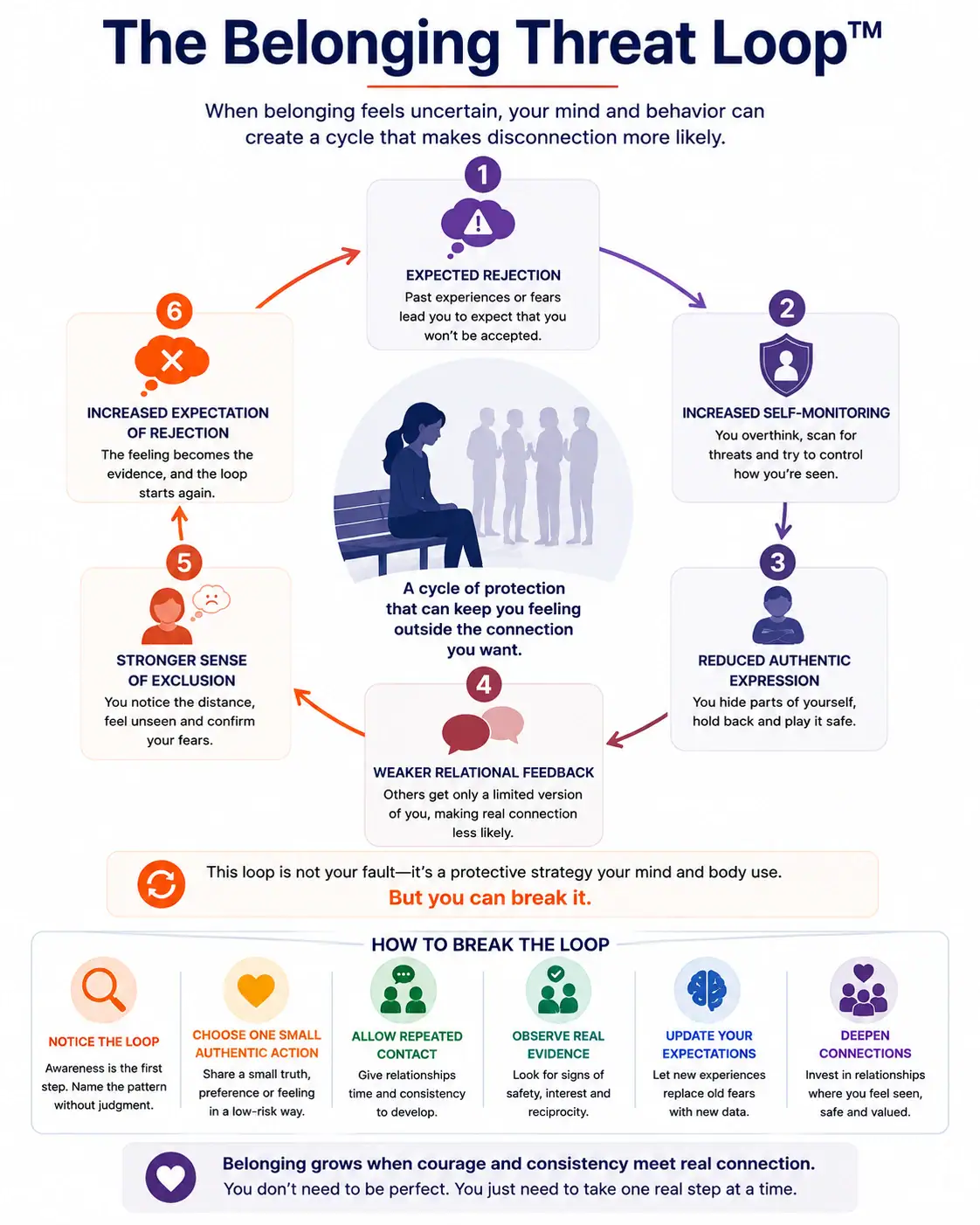
This loop is not your fault. It can be a protective strategy developed from real experience. It also does not describe everyone. The purpose of naming it is to locate interruption points.
You do not have to begin by becoming completely open. A safer interruption may be:
- noticing the prediction without treating it as confirmed;
- expressing one low-risk preference;
- returning to a group long enough for familiarity to develop;
- observing who responds with respect and follow-through;
- allowing new evidence to update an old expectation.
Belonging interventions in educational contexts have sometimes improved outcomes by reframing common social adversity as shared and potentially temporary, rather than as definitive evidence of non-belonging.[8] Long-term follow-up and broader multisite work also emphasize that effects depend on context and should not be treated as a universal solution.[9]
The practical lesson is modest: interpretation matters, but so does the environment. You are not required to reinterpret sustained hostility as harmless. New expectations should be built from real relational evidence.
The Belonging Audit™
The Belonging Audit™ helps you locate the strongest gap. It is a reflection exercise, not a validated scale. You can use the diagram as a visual worksheet or answer the questions below without scoring.
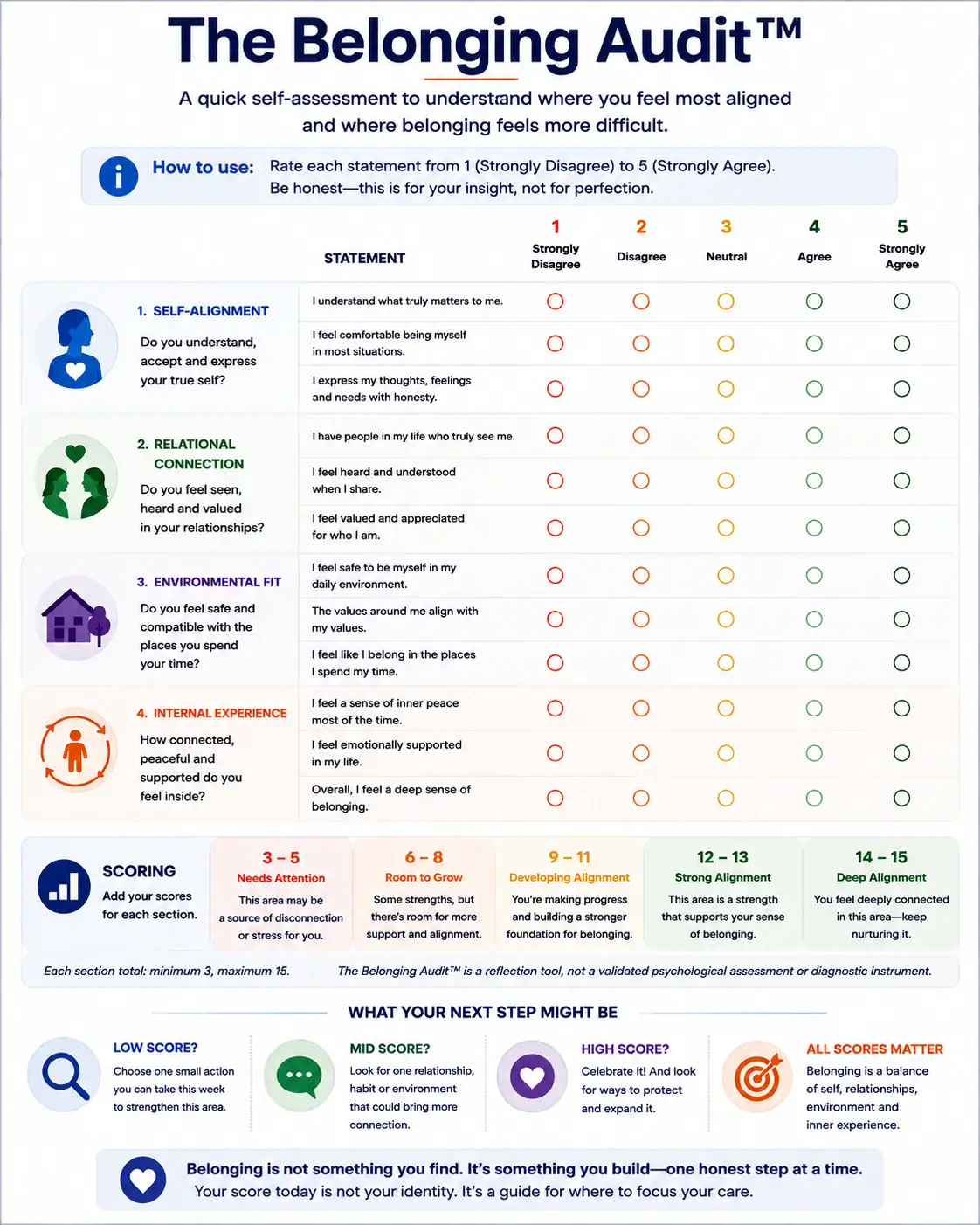
- Self-alignment: Do I understand what matters to me? Can I identify preferences and needs? Do I feel able to express them honestly in at least some situations?
- Relational connection: Do I have people who show curiosity about my experience? Is care reciprocal? Can I share without every conversation returning to the other person?
- Environmental fit: Do the places where I spend time respect important values and boundaries? Does familiarity reduce self-monitoring, or does the environment require more of it?
- Internal experience: Do I feel emotionally supported, peaceful or connected at least some of the time? Does solitude feel restorative, painful, or both?
Questions that often reveal the strongest constraint
- Where do I feel least performative?
- Who allows me to disagree without threatening the relationship?
- Which preferences do I hide before anyone has responded to them?
- Which environments repeatedly make me feel smaller?
- Am I being rejected, or am I withdrawing before connection can gather evidence?
- Have I outgrown a role without building a new one?
- Where am I valued mainly for being useful?
- Who remembers, follows through and initiates?
- Which relationship could safely receive one degree more honesty?
Do not turn the audit into another verdict. A low score is not an identity. It identifies an area where care, experimentation, support or environmental change may be useful.
How to rebuild a sense of belonging
Belonging is rarely restored by one dramatic decision. It usually grows through a sequence of small actions that generate better information: about yourself, other people and the environments available to you.
1. Start with one degree more honesty
Choose something real but manageable:
- state a genuine preference;
- say that you need time to think;
- admit that you do not understand;
- share a small concern;
- disagree without attacking;
- ask for a specific kind of support.
The goal is not maximum disclosure. It is to test whether the relationship has room for reality.
2. Choose environments with repeated contact
One-off events create opportunities, but recurring settings create evidence. Consider a class, volunteer role, professional community, local group, creative practice, sport, peer group or recurring online community with clear norms.
Choose based not only on the topic but on the structure. A shared activity reduces the pressure to create instant intimacy. Repetition allows people to recognize one another gradually.
3. Look for reciprocity rather than immediate chemistry
Instant chemistry can be meaningful, but it is not the only marker of fit. A safer guide is repeated reciprocity:
- Do they ask questions and listen to the answer?
- Do they remember something you said?
- Do they initiate sometimes?
- Can they tolerate a boundary?
- Do words and follow-through generally match?
- Does the relationship make space for both people?
4. Separate unfamiliarity from incompatibility
New environments often feel effortful because the rules, people and expectations are not yet predictable. That discomfort does not automatically mean you are in the wrong place.
Give a basically respectful environment enough repetitions to reveal its pattern. At the same time, do not use “give it more time” to rationalize contempt, coercion, discrimination or repeated boundary violations.
5. Reconnect with your own preferences
If constant adaptation has weakened your internal reference point, practice small self-directed choices:
- What do I actually want to eat, read, watch or do?
- Which conversation do I want more of?
- What drains me because it is difficult, and what drains me because it is wrong for me?
- What gives relief rather than only stimulation?
- Which value do I want my week to express?
The Personal Signal Decoder can help you separate a usable internal signal from pressure, habit, fear or noise.
6. Allow belonging to be distributed
You may not find one group that meets every need. One relationship may offer emotional honesty. Another may provide shared intellectual interests. A professional community may offer purpose. A local place may offer continuity and familiarity.
Distributed belonging can be more resilient than asking one person, group or identity to become your entire social home.
7. Stop trying to earn belonging only through usefulness
Helping, contributing and being reliable can strengthen connection. The problem begins when usefulness becomes the only secure role you know.
If you are always solving, organizing, supporting or absorbing, other people may appreciate you while having limited contact with your needs. Try allowing a small amount of receiving: accept help, name fatigue, let someone else plan, or remain present when you have nothing to provide.
8. Leave environments that require chronic self-erasure
Belonging cannot be built through indefinite abandonment of self. Some relationships may improve through communication and repair. Others reveal that the price of inclusion is too high.
You do not need everyone to approve of you. You do need enough environments where harmless difference, reasonable boundaries and personal growth do not threaten your basic place.
9. Update expectations through real evidence
Old expectations usually do not disappear because you argue with them. They change through repeated experiences that are different enough to matter.
Keep the experiment specific:
- Prediction: “If I express a preference, they will think I am difficult.”
- Action: State one low-risk preference.
- Evidence: Observe the actual response and what happens afterward.
- Update: Change the prediction only as far as the evidence supports.
This is not forced optimism. It is calibration.
10. Build connection as a loop, not a leap
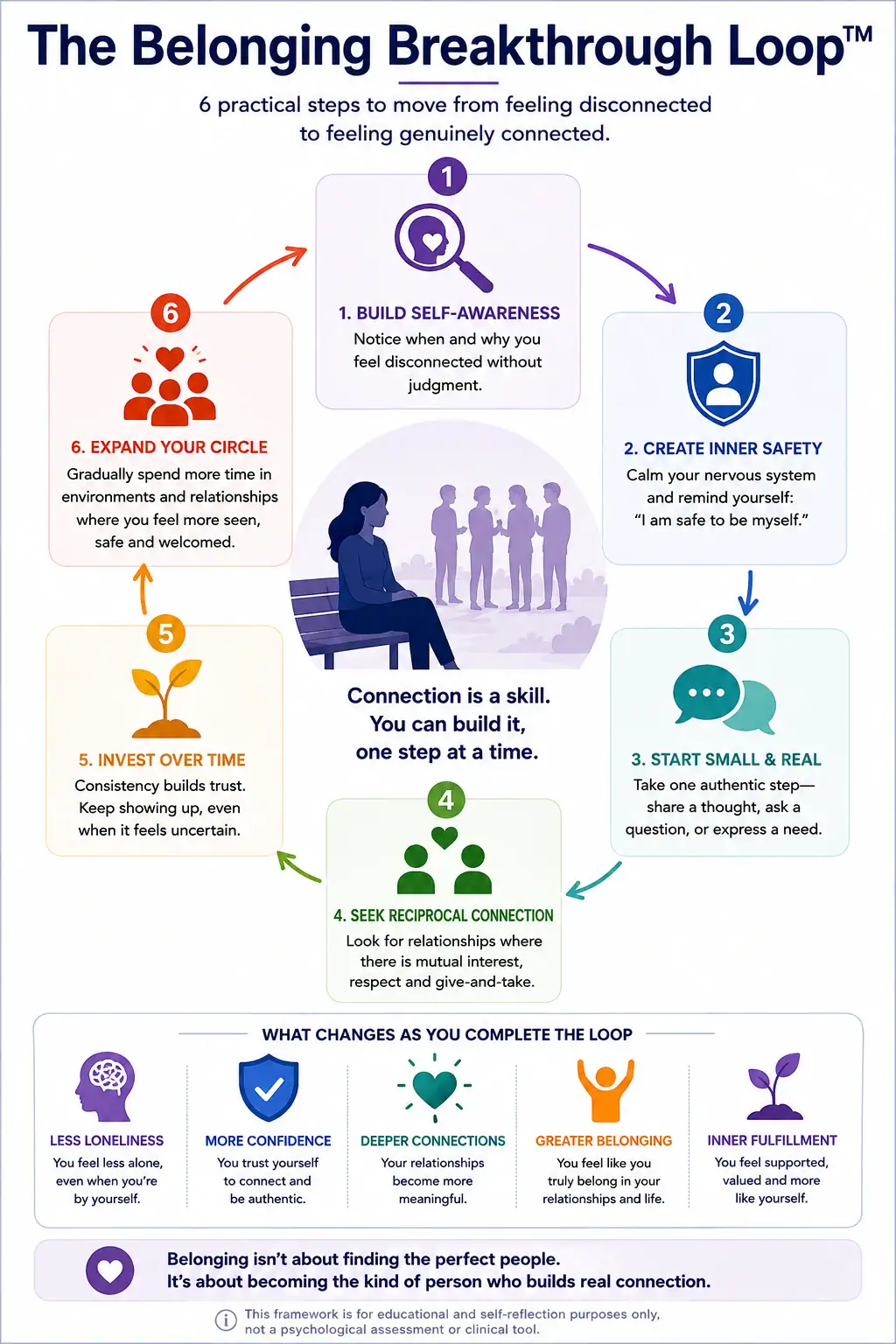
The Belonging Breakthrough Loop™ brings the practical process together:
- Build self-awareness.
- Create enough inner safety to remain present.
- Take one small authentic action.
- Seek reciprocal connection.
- Invest over time.
- Expand your circle toward people and places where you feel more seen, safe and welcomed.
Belonging is not the experience of fitting perfectly everywhere. It is the experience of being sufficiently known, sufficiently safe and sufficiently able to participate without continuously abandoning yourself.
Start smaller than your loneliness demands. Identify one place where you feel five percent less performative. Notice what makes that difference possible. Then make one action that allows the connection to become more real.
When professional support may help
Feeling out of place is common during change, stress and social transition. Professional support may be especially useful when the experience:
- persists for a long period or is becoming more intense;
- causes severe distress or major withdrawal;
- affects work, study, sleep, relationships or daily functioning;
- overlaps with panic, persistent low mood, trauma symptoms or intense social fear;
- includes frightening feelings of unreality or detachment;
- makes it difficult to care for yourself;
- includes thoughts of self-harm, suicide or not wanting to live.
Urgent support: If you may act on thoughts of harming yourself or someone else, contact local emergency services or an appropriate crisis service in your country now. If possible, move toward another person and tell them clearly that you need immediate help.
A qualified mental health professional can help distinguish between belonging difficulty, social anxiety, depression, trauma-related patterns, emotional numbness, depersonalization-like experiences and other possibilities. Seeking help does not mean the feeling is “all in your head.” It creates a setting where the pattern can be understood with more context than an article can provide.
Frequently asked questions
Is it normal to feel like I don’t belong anywhere?
Many people experience periods of weak belonging during transitions, stress, identity change, conflict or disconnection. The feeling deserves attention, but it is not proof that you are fundamentally incompatible with other people. Look for whether the strongest gap involves self-recognition, expression, reciprocity, environmental fit or current emotional capacity.
Why do I feel like an outsider in every group?
You may enter groups expecting rejection, edit yourself heavily, choose environments that do not fit, or leave before familiarity develops. You may also have experienced genuine exclusion. Rather than assuming one universal cause, compare the pattern across several groups and notice what stays the same and what changes.
Why do I feel alone even though I have friends?
Friendship can provide contact without enough depth, reciprocity or current understanding. Your friends may know your history but not the version of you that is emerging now. One carefully chosen, honest conversation may reveal whether the relationship can deepen.
Why do I feel more comfortable alone?
Solitude may reduce stimulation, performance and self-monitoring. That can be healthy and restorative. The question is whether time alone helps you return to connection more available—or becomes the only place where you feel safe enough to exist.
Can anxiety make me feel like I do not belong?
Yes. Anxiety can increase threat monitoring, fear of judgment and avoidance, making neutral social information feel more negative or uncertain. Anxiety does not explain every belonging problem, and a poor-fit or unsafe environment should not be ignored.
Can stress make me feel disconnected from people?
Stress can reduce attention, emotional access, patience and tolerance for uncertainty. You may care about people but have less capacity to feel or express that care. Recovery may require both reduced load and gradual re-entry into safe connection.
Why do I feel like I do not belong in my family?
Families often preserve long-standing roles and expectations. You may have changed while the system still responds to an earlier version of you. Differences in values, boundaries, communication or identity can also create real incompatibility. Belonging may require new boundaries, more accurate communication or support outside the family.
Can you outgrow a friendship or community?
Yes. Shared circumstances, roles and values can change. Outgrowing a relationship does not mean it was false. Before leaving, consider whether the connection can update through honest conversation. If continued belonging requires chronic self-erasure, distance may be appropriate.
Is not belonging the same as loneliness?
No. Loneliness concerns an unwanted gap in connection. Not belonging concerns feeling insufficiently included, recognized or able to participate as yourself. They often overlap, but you can be lonely without a specific group and feel you do not belong while surrounded by people.
Does feeling different mean I am in the wrong environment?
Not necessarily. Difference can exist within healthy belonging. A better question is how the environment responds to difference. Curiosity, respect and room for reasonable boundaries suggest potential fit. Contempt, coercion or punishment for harmless difference suggest a deeper problem.
How do I find people I genuinely connect with?
Choose recurring environments organized around a real interest, value, responsibility or practice. Allow repeated contact, take small authentic risks and observe reciprocity. Search less for instant certainty and more for evidence that people remember, respond, include and follow through.
How long does it take to develop a sense of belonging?
There is no universal timeline. Some connections feel easy quickly, but stable belonging usually requires repeated interaction and evidence of safety. Focus on whether the relationship is becoming more mutual and less performative over time rather than demanding immediate certainty.
Can hiding parts of myself prevent authentic connection?
It can, especially when most meaningful preferences, emotions or values remain hidden. Selective privacy is healthy. The problem is not withholding everything from everyone; it is having no relationship in which important parts of you can appear safely.
When should I speak with a therapist?
Consider professional support when the feeling is persistent, severe, linked to major avoidance or impairment, or overlaps with depression, panic, trauma symptoms, self-harm thoughts or frightening detachment. A therapist can help identify the pattern and build an appropriate plan.
Your next step does not have to be dramatic
Choose one signal, one relationship and one low-risk action. Connection becomes clearer when you can compare prediction with real feedback.
Use the Personal Signal Decoder Explore Your Intuition JourneyResearch sources
- Baumeister RF, Leary MR. The need to belong: desire for interpersonal attachments as a fundamental human motivation. Psychological Bulletin. 1995;117(3):497–529.
- Allen KA, Kern ML, Rozek CS, McInerney DM, Slavich GM. Belonging: a review of conceptual issues, an integrative framework, and directions for future research. Australian Journal of Psychology. 2021.
- Williams KD. Ostracism. Annual Review of Psychology. 2007;58:425–452.
- Sun J, Harris K, Vazire S. Is well-being associated with the quantity and quality of social interactions? Journal of Personality and Social Psychology. 2020;119(6):1478–1496.
- Harris MA, Orth U. The link between self-esteem and social relationships: a meta-analysis of longitudinal studies. Journal of Personality and Social Psychology. 2020;119(6):1459–1477.
- Becht AI, Nelemans SA, van Dijk MPA, et al. Clear self, better relationships: adolescents’ self-concept clarity and relationship quality with parents and peers across 5 years. Child Development. 2017;88(6):1823–1833.
- Walton GM, Cohen GL. A question of belonging: race, social fit, and achievement. Journal of Personality and Social Psychology. 2007;92(1):82–96.
- Walton GM, Cohen GL. A brief social-belonging intervention improves academic and health outcomes of minority students. Science. 2011;331(6023):1447–1451.
- Brady ST, Cohen GL, Jarvis SN, Walton GM. A brief social-belonging intervention in college improves adult outcomes for Black Americans. Science Advances. 2020;6(18).
- Manchiraju S. Self-concept clarity: a comprehensive and integrative review. Frontiers in Psychology. 2026;17:1822881.
Editorial and medical disclaimer: Intuition Management provides educational information and practical reflection frameworks. This article does not diagnose a condition, establish a therapeutic relationship or replace individualized medical or mental health care. Research findings are summarized cautiously and may not generalize to every person, population or environment.
Explore more evidence-informed guides in All Articles, or learn about the project and its editorial approach on About Intuition Management.