
What Is a Mental Model?
A mental model is an internal representation of how something works. In cognitive science, mental-model theory describes how people construct representations of possibilities in order to reason, make inferences, and test conclusions. In applied fields, the term is often used more broadly for interconnected assumptions and beliefs that shape expectations about people, systems, and future events.
That broader everyday meaning is useful as long as it is handled carefully. A mental model is not merely a positive or negative thought. It is a structure that connects several elements:
- What you expect: “When this happens, that usually follows.”
- What you notice: information that appears relevant to the model.
- What something means: the explanation assigned to an event.
- What you feel: the emotional and bodily response to that meaning.
- What you do: the action that appears sensible within the model.
For example, imagine receiving a short message from a manager: “Can we talk tomorrow?” The event is ambiguous. One model interprets it as a routine conversation. Another predicts criticism. A third sees it as a possible opportunity. The same words can therefore produce calm, dread, curiosity, avoidance, preparation, or rumination—not because the message itself changed, but because the working model changed.
For a deeper explanation of the concept, read What Are Mental Models?. The present guide moves from definition to concrete, everyday examples.
The Mental Model Loop: How an Assumption Becomes a Pattern
Mental models are powerful because they participate in a feedback loop. A model generates a prediction. That prediction influences attention and bodily readiness. The resulting signals are interpreted, a response is chosen, and the consequences become new evidence. When you mainly notice confirming evidence, the original model becomes stronger.

Suppose your model says, “People lose interest when I show uncertainty.” Before a conversation, you predict rejection. Your body becomes tense. You monitor the other person for signs of impatience, speak less openly, and end the conversation early. Their distance may then increase because the interaction feels guarded. That response appears to confirm the original model.
This does not mean every expectation is self-fulfilling. Other people have their own motives, circumstances, and agency. The point is narrower: your predictions influence the information you prioritize and the behavior you bring into a situation. Those behaviors can alter the feedback you receive.
The brain also uses prediction errors—the difference between expectation and incoming evidence—to revise models. But revision is not automatic. Evidence can be ignored, explained away, or treated as an exception. Updating becomes more likely when you deliberately compare the prediction with what actually happened.
15 Mental Model Examples From Everyday Life
The examples below are not diagnoses. They are common assumption patterns that can be useful in one setting and limiting in another. The goal is not to replace every uncomfortable thought with an optimistic one. The goal is to develop a model that fits the available evidence and supports effective action.
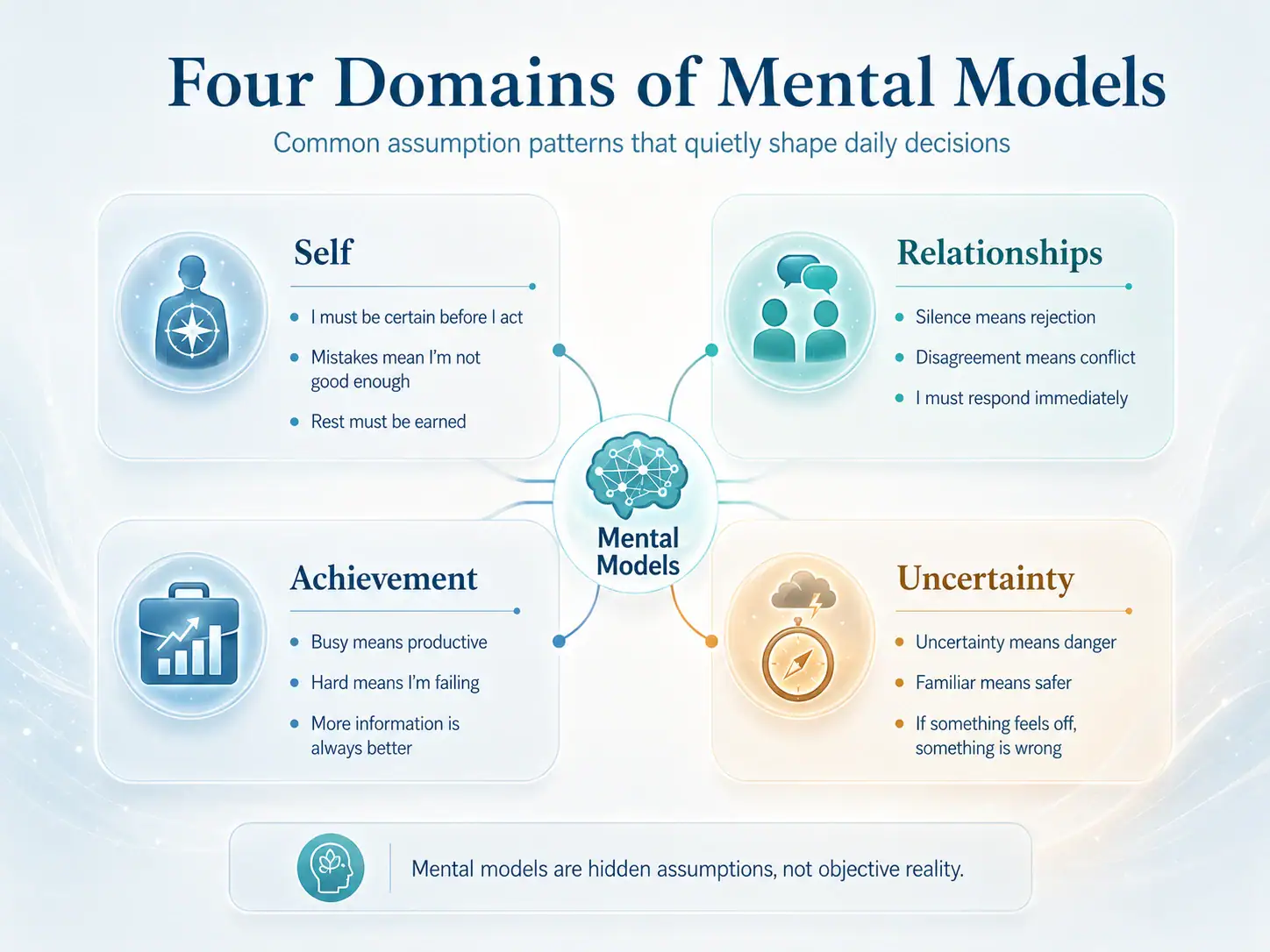
Models About Yourself
1. “I must be certain before I act.”
Hidden model: good decisions begin with confidence and complete clarity.
What it predicts: uncertainty means you are unprepared or likely to fail.
Common consequence: more research, more comparison, and less movement—even after the useful information has already been collected.
More accurate model: many decisions become clearer through reversible action, not through endless internal certainty.
Small test: define the smallest reversible step that could generate real feedback within 24 hours.
2. “Making a mistake means I am not good enough.”
Hidden model: performance is evidence of personal worth.
What it predicts: errors will expose a stable flaw rather than a temporary gap in knowledge or execution.
Common consequence: perfectionism, defensiveness, hiding problems, or avoiding work in which learning would be visible.
More accurate model: a mistake is information about a process, assumption, skill, or decision—not a complete judgment of the person.
Small test: after one error, write down what it reveals about the system before writing anything about yourself.
3. “Rest must be earned.”
Hidden model: recovery is a reward for completing everything.
What it predicts: stopping while work remains is irresponsible.
Common consequence: rest becomes delayed until exhaustion, yet exhaustion makes recovery less satisfying and future work harder.
More accurate model: recovery is part of maintaining attention, judgment, and sustainable performance.
Small test: schedule recovery before depletion and compare the quality of your next work period.
4. “If I feel it strongly, it must be true.”
Hidden model: emotional intensity is reliable evidence about external reality.
What it predicts: dread proves danger, guilt proves wrongdoing, and confidence proves correctness.
Common consequence: body signals are treated as verdicts rather than data that require context.
More accurate model: feelings contain information about needs, expectations, memories, and bodily states, but they do not identify the cause by themselves.
Small test: separate three statements: “What I feel,” “What I predict,” and “What I can verify.”
Models About Relationships
5. “Silence means rejection.”
Hidden model: a lack of immediate warmth or response signals loss of connection.
What it predicts: delayed replies, quiet expressions, or pauses mean the other person is withdrawing.
Common consequence: reassurance-seeking, repeated messaging, overexplaining, or pulling away first.
More accurate model: silence is ambiguous and can reflect attention, fatigue, workload, reflection, mood, or boundaries.
Small test: generate three neutral explanations before acting on the most threatening one.
6. “Disagreement means conflict.”
Hidden model: secure relationships depend on agreement.
What it predicts: a different view threatens belonging, respect, or cooperation.
Common consequence: self-silencing, indirect communication, or escalation when disagreement finally becomes unavoidable.
More accurate model: respectful disagreement can improve shared understanding and reveal information that agreement conceals.
Small test: state one difference using: “I see this differently because…” without trying to win the entire discussion.
7. “People are constantly evaluating me.”
Hidden model: social spaces function like continuous performance reviews.
What it predicts: small errors, pauses, or awkward moments remain important to other people.
Common consequence: attention moves inward toward monitoring appearance and performance, leaving fewer resources for the actual conversation.
More accurate model: most people divide attention among their own goals, concerns, and self-monitoring.
Small test: enter one conversation with an external task: learn one specific thing about the other person.
8. “I must respond immediately to remain valued.”
Hidden model: availability is proof of care, reliability, or professional worth.
What it predicts: delayed response will disappoint others or reduce your value.
Common consequence: fragmented attention, false urgency, and resentment toward demands you never clearly negotiated.
More accurate model: reliability depends on clear expectations and consistent follow-through, not constant interruption.
Small test: establish one response window and observe whether the feared consequence actually occurs.
Models About Work and Achievement
9. “Being busy means being productive.”
Hidden model: visible activity is a reliable measure of valuable output.
What it predicts: an empty calendar, a pause, or focused work on one thing means you are doing too little.
Common consequence: low-value tasks expand because they provide immediate evidence of effort.
More accurate model: productivity is the conversion of limited attention into meaningful outcomes.
Small test: define one outcome that would make the day useful, then protect the time needed to complete it.
10. “A good decision should feel completely clear.”
Hidden model: the right choice produces an unmistakable internal signal.
What it predicts: mixed feelings mean the decision is wrong or premature.
Common consequence: ambivalence is misread as failure, even when the choice involves genuine trade-offs.
More accurate model: strong decisions can include grief, fear, uncertainty, or competing values.
Small test: ask whether the discomfort comes from poor fit, real cost, or simply leaving a familiar option.
11. “More information always produces a better decision.”
Hidden model: uncertainty declines in proportion to the amount of information collected.
What it predicts: one more article, comparison, opinion, or spreadsheet may remove the remaining doubt.
Common consequence: information accumulates without changing the decision because the missing element is a criterion, priority, or experiment.
More accurate model: the value of information depends on whether it could change the choice.
Small test: before researching, write: “What new fact would make me choose differently?”
12. “If it feels difficult, I am probably doing it wrong.”
Hidden model: fit and competence should create ease.
What it predicts: friction indicates a bad path, insufficient talent, or a flawed decision.
Common consequence: normal learning costs are interpreted as a signal to quit, while familiar but unhelpful routines feel safer.
More accurate model: difficulty can indicate overload or poor strategy—but it can also indicate novelty, growth, and meaningful complexity.
Small test: classify the difficulty: harmful, unnecessary, temporary, or productive.
Models About Uncertainty and Control
13. “Uncertainty means danger.”
Hidden model: not knowing is itself a threat.
What it predicts: uncertain outcomes require immediate control, reassurance, or escape.
Common consequence: premature decisions are made to end uncertainty rather than improve the outcome.
More accurate model: uncertainty is a property of limited information; risk depends on probability, impact, reversibility, and available safeguards.
Small test: replace “This is dangerous” with “What exactly is uncertain, and what risk does it create?”
14. “Familiar means safer.”
Hidden model: known discomfort is less risky than unfamiliar possibility.
What it predicts: a familiar job, pattern, relationship, or routine is safer because its costs are predictable.
Common consequence: recurring costs become normalized, while new options are evaluated mainly through imagined risk.
More accurate model: familiarity reduces surprise, not necessarily harm.
Small test: compare the documented cost of staying with the plausible cost of changing.
15. “If something feels off, it must be a warning.”
Hidden model: unease is a direct detection system for hidden danger.
What it predicts: discomfort should be obeyed immediately, even when its source is unclear.
Common consequence: anxiety, fatigue, novelty, value conflict, sensory overload, and genuine pattern recognition are collapsed into one signal.
More accurate model: “off” is a prompt to investigate, not a final conclusion.
Small test: ask what specific cue produced the signal and whether the feeling changes after sleep, distance, or new evidence.

Mental Models vs Mental Filters vs Cognitive Biases
These concepts overlap, but they are not interchangeable. Keeping them separate makes self-observation more precise.
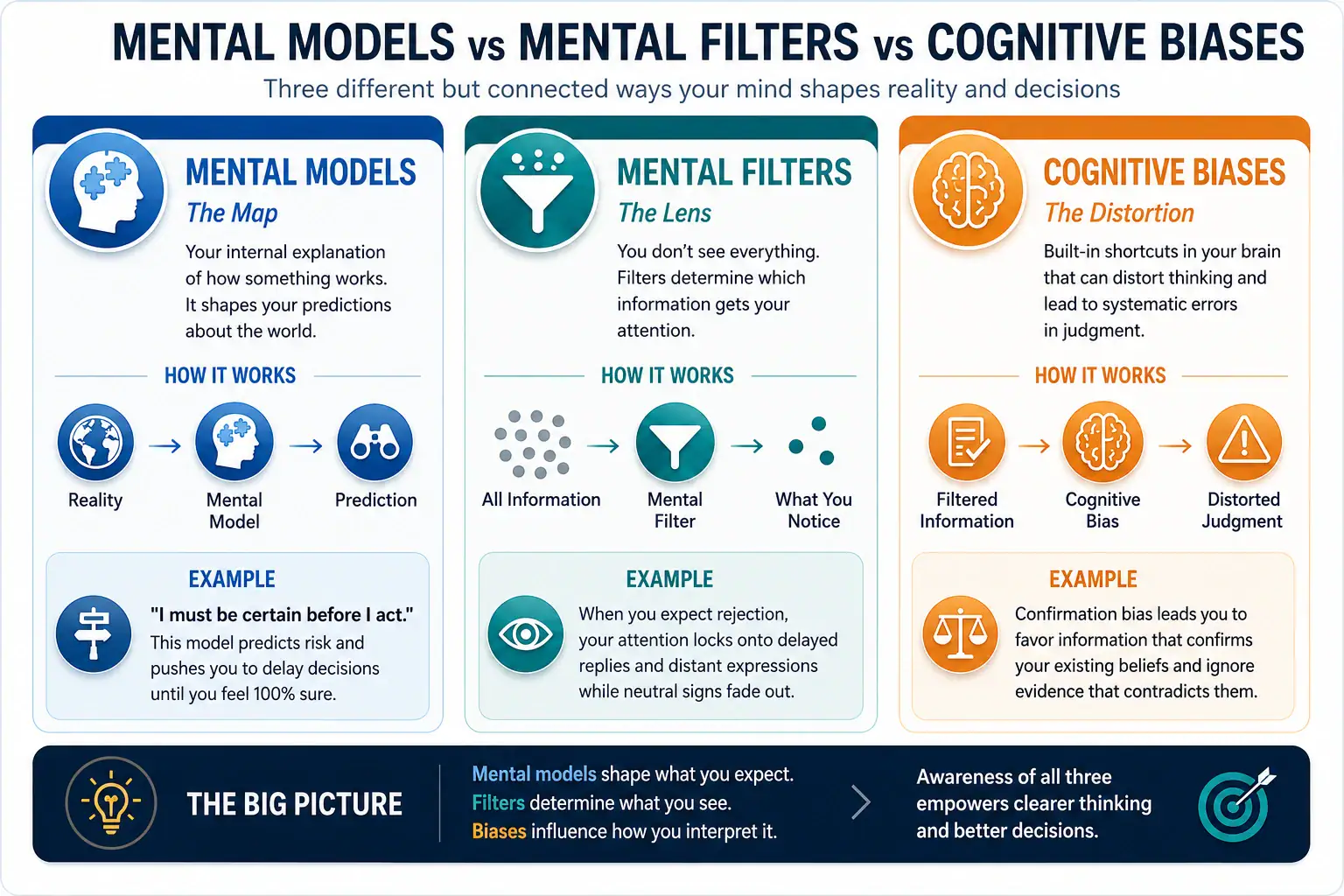
| Concept | Core function | Everyday question | Example |
|---|---|---|---|
| Mental model | A representation or explanation of how something works. | “What do I believe is happening and what will follow?” | “People become distant when I show uncertainty.” |
| Mental filter | A pattern of attention that makes some information more salient than other information. | “What details am I noticing or overlooking?” | You notice a delayed reply but overlook several warm interactions. |
| Cognitive bias | A systematic tendency that can skew judgment or evidence weighting. | “How might my reasoning be predictably distorted?” | You give more weight to evidence that confirms your initial conclusion. |
The three can form a chain. A mental model creates an expectation. Attention prioritizes compatible cues. Confirmation bias gives those cues greater weight. The resulting conclusion then strengthens the model.
Read What Are Mental Filters? for a fuller explanation of selective attention and interpretation. For the distinction between intuition and systematic error, see Intuition vs Bias: How to Recognize the Difference.
How Mental Models Influence Intuition
Intuition often arrives as a rapid sense of meaning before conscious reasoning is fully articulated. It can draw on learned regularities, tacit knowledge, bodily signals, and pattern recognition. Mental models help organize that accumulated experience, so they inevitably influence what feels plausible, dangerous, familiar, or important.
This produces two very different possibilities.
When the model is well calibrated
An experienced professional may recognize a pattern that is difficult to explain immediately. The signal can be useful when it comes from repeated exposure to a sufficiently regular environment with meaningful feedback. The model has been tested many times and adjusted through prediction error.
When the model is outdated or transferred into the wrong context
A response learned in one environment can continue after the environment changes. A person who learned that speaking openly produced punishment may experience caution in a safer team. The feeling is real, but the model generating the prediction may no longer fit the present situation.
When bodily activation is mistaken for external evidence
Interoception—the perception of signals from inside the body—contributes to emotion and decision-making. A racing heart, tight chest, heavy stomach, or sudden stillness can carry information about preparation, effort, memory, uncertainty, or threat. Yet the signal alone does not identify its cause. Interpretation is still required.
For more detail, see What Intuition Really Is: Pattern Recognition Under Uncertainty and Internal Model of Reality.
How a Mental Model Moves From Perception to Action
A model does not influence only the final decision. It can shape every stage between an event and a response:
- Perceive: attention is drawn toward cues the model treats as relevant.
- Interpret: those cues are assigned meaning using previous beliefs and context.
- Feel: the meaning produces emotional and bodily preparation.
- Decide: some options appear reasonable and others disappear from consideration.
- Act: behavior expresses the model through avoidance, approach, control, inquiry, or experimentation.
- Reinforce: feedback is incorporated—or selectively ignored—in a way that may strengthen the cycle.
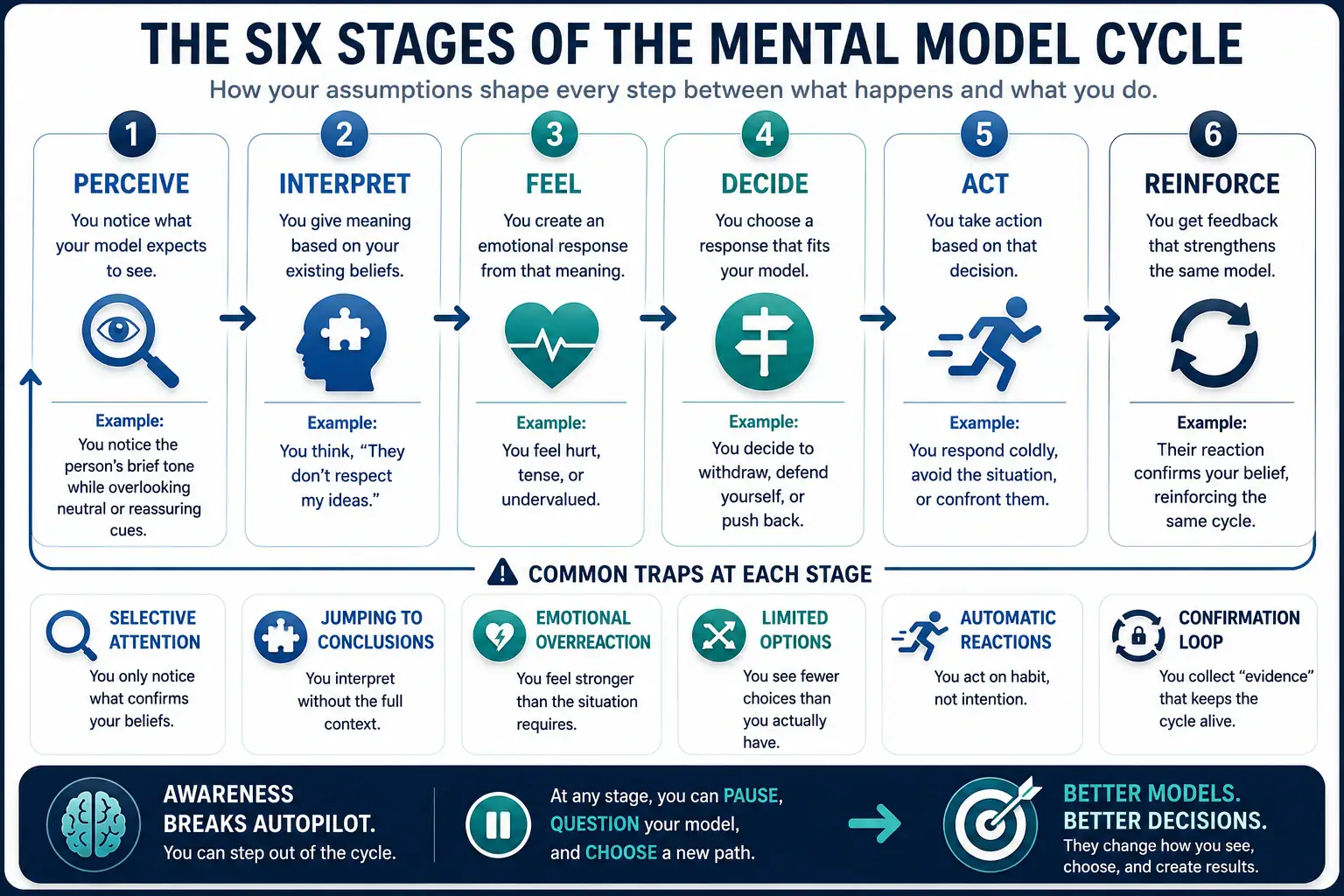
The most useful intervention depends on the stage. If the problem is selective attention, collect missing evidence. If interpretation is premature, generate alternatives. If bodily activation is high, create enough regulation to evaluate the situation. If action is habitual, introduce a small delay or a preselected response.
How to Identify the Mental Model Controlling a Decision
A mental model often remains invisible because it feels like a description of reality rather than an interpretation. The following questions make the model easier to see.
1. What am I predicting?
Turn vague discomfort into a specific forecast. “This feels wrong” might become “I predict they will reject the proposal,” “I predict I will regret choosing this,” or “I predict I will not cope if the plan changes.” Specific predictions can be tested.
2. What must I believe for this response to make sense?
Behavior becomes logical inside a model. Rechecking makes sense if mistakes are catastrophic. Immediate replies make sense if availability determines worth. Avoiding disagreement makes sense if difference threatens connection.
3. What information is receiving most of my attention?
Notice whether your mind is repeatedly selecting signs of danger, rejection, failure, urgency, or lost control. Then ask what data is receiving less attention.
4. What evidence would change my mind?
If no possible evidence could revise the conclusion, the model has become insulated from learning. A useful model remains open to correction.
5. Is this model about the present situation—or an older pattern?
Past learning is not irrational. It became available because it once helped predict outcomes. The question is whether the current environment has the same structure, incentives, risks, and relationships.
6. What action would I choose under a different model?
You do not have to believe the alternative completely. Temporarily adopt it as a hypothesis: “Suppose silence is ambiguous,” “Suppose difficulty is part of learning,” or “Suppose uncertainty can be reduced through a small experiment.” Then compare the available actions.
When thinking produces less certainty instead of more, the problem may not be insufficient analysis. It may be an unexamined model that keeps generating new doubts. See Why You Feel Less Certain the More You Think.
The Five-Step Mental Model Update Process
Updating does not mean forcing yourself to think positively. It means improving the fit between the model, the evidence, and the decisions you need to make.
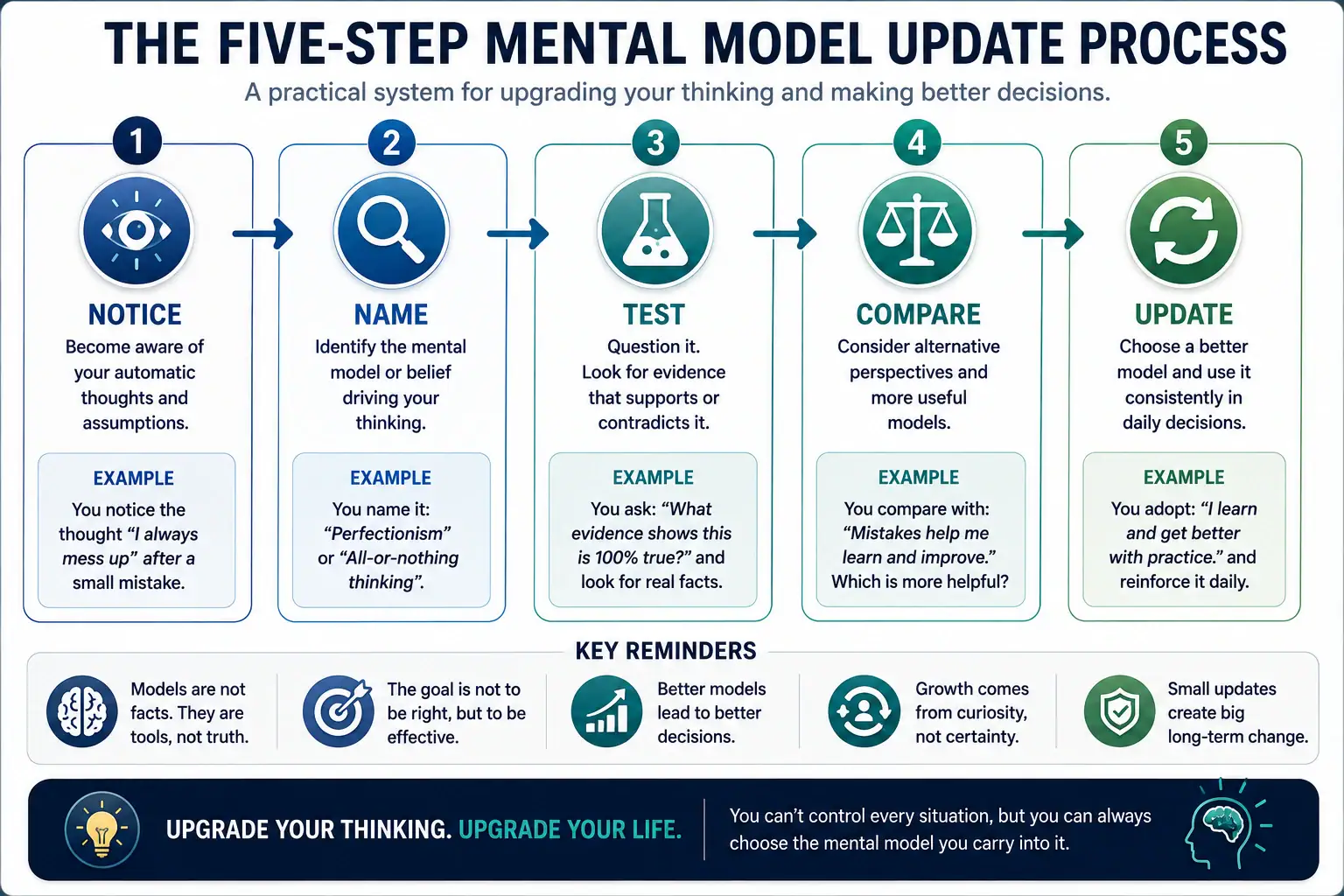
Notice the automatic pattern
Begin with a repeated emotional, attentional, or behavioral response. Look for situations in which your reaction seems faster, stronger, or more predictable than the available evidence would suggest.
Name the model
Write it as a conditional rule: “If X happens, Y probably means Z.” Avoid vague labels such as “I am insecure.” A model should be specific enough to test: “If someone disagrees, the relationship becomes less secure.”
Test the prediction
Search for supporting and contradicting evidence. Give greater weight to observable events than to repeated interpretations of the same event. Ask what a neutral observer could verify.
Compare alternative models
Create at least two plausible explanations. The goal is not to select the comforting explanation automatically. Compare which model explains more evidence with fewer unsupported assumptions.
Update through action and feedback
Use the revised model in a small, low-cost experiment. Record the prediction, action, and outcome. Repetition matters because an intellectual insight may not immediately change an automatic emotional prediction.
A worked example
Situation: a colleague gives brief feedback on a draft.
Automatic model: “Brief feedback means they are dissatisfied and do not respect the work.”
Prediction: the colleague will become more critical or stop involving you.
Evidence for: the reply was shorter than usual.
Evidence against: the feedback was specific, the deadline was close, and the colleague approved the next step.
Alternative model: “Communication length varies with workload; usefulness matters more than warmth in this exchange.”
Experiment: ask one clarifying question rather than withdrawing or overexplaining.
Update: compare the actual response with the prediction and retain whichever model explains the pattern better over time.
Metacognitive reflection can support belief updating, but reflection is not guaranteed to change a strongly protected belief. Real-world experiments, repeated evidence, and cognitive flexibility are important because a model is embedded in behavior as well as language.
From Autopilot to Adaptive Practice
Mental-model awareness is not a permanent achievement. People move between automatic and reflective thinking depending on fatigue, stress, familiarity, stakes, and time pressure. The purpose of a development framework is therefore not to label people by “level,” but to describe practices that become more available with repetition.

Adaptive practice includes several habits:
- treating confidence as a feeling rather than proof;
- seeking evidence that could disconfirm the preferred explanation;
- distinguishing bodily signals from the story assigned to them;
- using reversible experiments when analysis reaches diminishing returns;
- inviting perspectives from people who see different parts of the system;
- revisiting models when the environment, incentives, or relationships change.
Cognitive flexibility does not mean abandoning principles or changing opinions constantly. It means adapting thought and behavior when context changes or when better evidence becomes available.
When Mental Models Are Useful Rather Than Limiting
A mind without models would not be clearer. It would be overwhelmed. Models compress complexity, support planning, and make rapid action possible. The relevant question is not whether you have mental models, but whether a particular model is suitable for the task.
A useful mental model is appropriately simple
Every model leaves information out. Simplicity becomes a problem only when the omitted information is important to the decision.
A useful model has a defined domain
A model that works in one environment may fail elsewhere. “Move quickly and correct later” can be useful for reversible experiments and dangerous for irreversible decisions.
A useful model produces testable predictions
Models improve when they risk being wrong. A prediction such as “If I set a response window, this client will leave” can be compared with an outcome. “People do not value me” is too broad to test clearly.
A useful model updates with feedback
Good models do not need to be discarded after every exception. They do need to change when exceptions accumulate or when an alternative explains the evidence better.
A useful model improves action
The model should help you see relevant constraints, compare options, and choose an appropriate next step. A technically sophisticated explanation that produces no better decision may not be the model you need in that moment.
A 60-Second Mental Model Check
Use this check when you notice urgency, defensiveness, repeated doubt, or a strong sense that only one interpretation is possible:
- Event: What happened without interpretation?
- Model: What am I assuming this event means?
- Prediction: What do I expect to happen next?
- Attention: What evidence am I emphasizing or overlooking?
- Alternative: What other model fits at least some of the facts?
- Test: What small action could generate better evidence?
For a broader decision process, use How to Make the Right Decision. To practice distinguishing signal from noise under uncertainty, try the Signal vs Noise Simulator.
Frequently Asked Questions
What is a simple example of a mental model?
“If I make a mistake, people will trust me less” is a simple mental model. It connects an event, a predicted social consequence, and a likely response such as hiding errors or overchecking work.
Are mental models the same as beliefs?
Not exactly. A belief can be one component of a mental model. A model usually organizes several beliefs, causal relationships, expectations, and possible outcomes into a working representation of how a situation operates.
Are mental models conscious?
Some are explicit, such as a framework you deliberately use for a business decision. Others are implicit and become visible mainly through repeated predictions, emotions, attention patterns, and behavior.
Can mental models be changed?
Yes, but verbal insight alone may not be enough. Models are updated through prediction errors, reflection, disconfirming evidence, alternative explanations, and repeated action in situations that produce new feedback.
What is the difference between a mental model and a cognitive bias?
A mental model represents how something works. A cognitive bias is a systematic tendency that can distort judgment or evidence weighting. A model can be accurate or inaccurate; a bias describes a recurring direction of error.
How do mental models affect decision-making?
They influence which outcomes seem likely, which information appears relevant, how risks are interpreted, and which actions enter the option set. They can make decisions faster, but they can also hide alternatives.
Can intuition be based on an inaccurate mental model?
Yes. Intuitive signals can reflect genuine expertise, but they can also reproduce outdated learning, anxiety-linked predictions, or patterns transferred from a different context. The signal should be investigated and calibrated rather than automatically obeyed or dismissed.
How do I know whether a model is limiting?
A model may be limiting when it produces the same costly outcome across different situations, cannot be revised by any evidence, treats ambiguity as proof, or removes reasonable options before they are evaluated.
Should I replace a negative model with a positive one?
Replace it with a more accurate and useful one. “Nothing will go wrong” is not necessarily better than “Everything will go wrong.” A calibrated model identifies the actual risk, available safeguards, and next test.
How many mental models should I learn?
There is no ideal number. A small set of well-understood models used within their proper domains is more useful than collecting dozens of frameworks without testing when they apply.
Test the Decision Style Behind Your Models
Do you rely more heavily on analysis, rapid pattern recognition, emotional signals, or a combination of all three? Use the decision-style quiz as a starting point for reflection—not as a fixed label.
Final Perspective
You cannot think without mental models. They make a complex world navigable by turning experience into expectations and expectations into action. The problem begins when a map becomes invisible—when “This is how I interpret the situation” becomes “This is simply how reality is.”
The most important shift is not from negative thinking to positive thinking. It is from automatic certainty to testable understanding. Notice the model. Name its prediction. Look for missing evidence. Compare plausible alternatives. Then act in a way that allows reality—not only the old model—to answer.
Research Sources
This article uses “mental model” in both its cognitive-science sense and its broader applied sense. The following peer-reviewed sources support the article’s central distinctions and mechanisms:
- Johnson-Laird, P. N. (2010). Mental models and human reasoning.
- Holtrop, J. S., et al. (2021). The importance of mental models in implementation science.
- Khemlani, S. S., et al. (2014). Causal reasoning with mental models.
- den Ouden, H. E. M., et al. (2012). How prediction errors shape perception, attention, and motivation.
- Walsh, K. S., et al. (2020). Evaluating neurophysiological evidence for predictive processing.
- Zivony, A. (2024). Dissociating effects of expectations and selective attention.
- Lange, R. D., et al. (2021). Confirmation bias in perceptual decision-making.
- Kaanders, P., et al. (2022). Humans actively sample evidence to support prior beliefs.
- Khalsa, S. S., et al. (2018). Interoception and mental health: a roadmap.
- Dajani, D. R., & Uddin, L. Q. (2015). Demystifying cognitive flexibility.
- O’Leary, A. P., et al. (2024). Can metacognitive reflection encourage belief updating?
- Cortes, R. A., et al. (2023). Mental-model training and verbal reasoning.
Leave a Reply
You must be logged in to post a comment.