MENTAL MODELS · PERCEPTION · PREDICTION · DECISION-MAKING
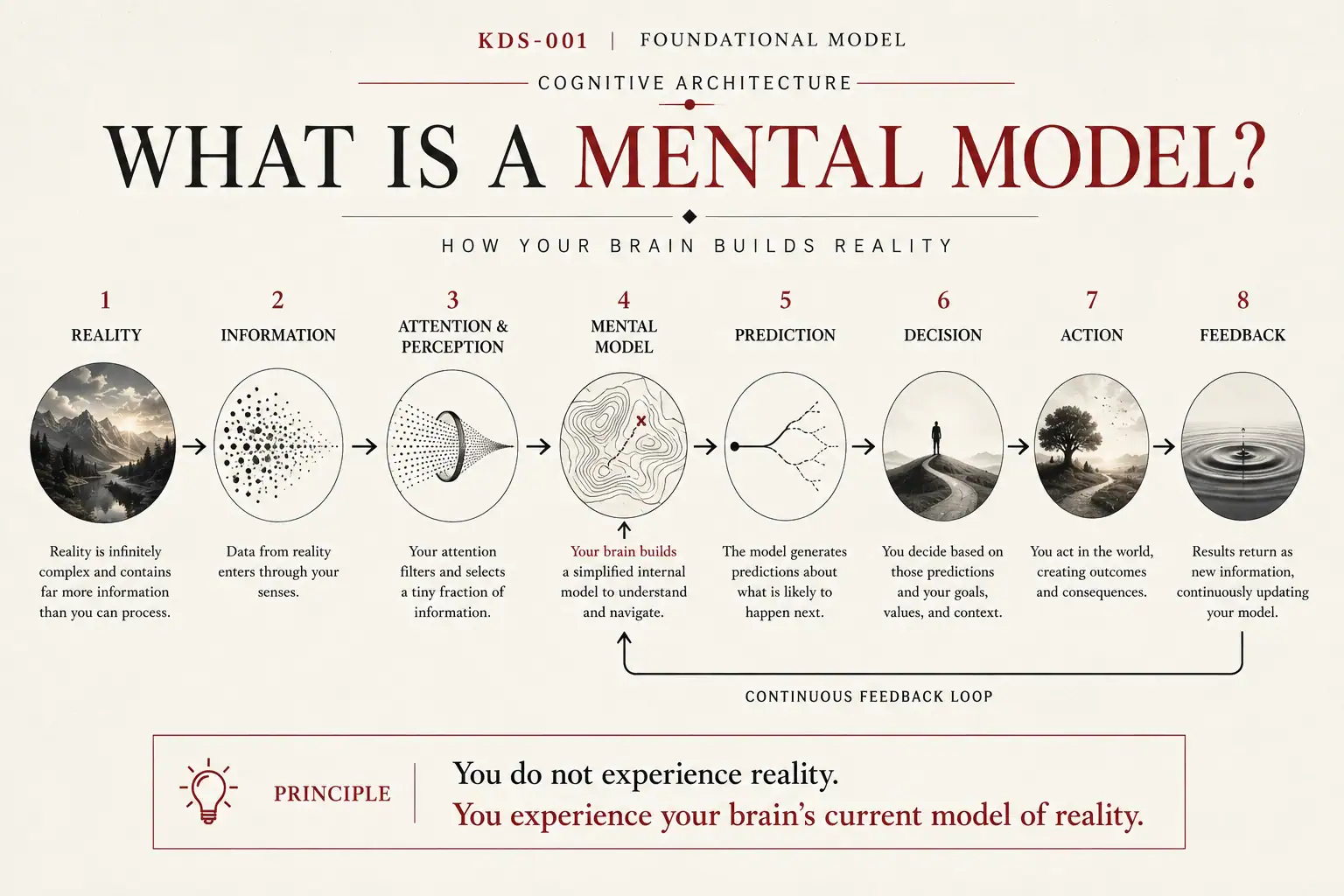
Mental models are the internal maps your brain uses to interpret reality, predict what will happen next, and decide what to do. You never experience the world in full. You experience a compressed, filtered, continuously updated model of it.

What are mental models?
A mental model is a simplified internal representation of how some part of reality works. It helps you decide what to notice, what something means, what is likely to happen next, and what you should do.
You use mental models constantly, even when you are not aware of them. You have models of other people, work, friendship, risk, success, trust, money, conflict, your body, your future, and yourself. You also have models for less visible questions:
- What kind of person am I?
- What happens when I make a mistake?
- Can other people be trusted?
- Is uncertainty dangerous?
- Does effort usually lead to progress?
- Are my feelings reliable signals?
These models are not stored as neat diagrams in your mind. They exist as networks of expectations, memories, associations, habits, emotional responses, and predictions. Together, they create an operating map of reality.
This does not mean the external world is imaginary. It means the world contains more information than any nervous system can process. Your brain must select, compress, interpret, and predict. The result is an internal model that is useful enough to guide action but always incomplete.
Why your brain needs mental models
Reality is too complex to process from scratch every second. At any moment, your senses are exposed to far more information than can enter conscious awareness. Your brain therefore has to reduce uncertainty quickly.
It does this by building models that answer four practical questions:
- What is happening?
- What does it mean?
- What is likely to happen next?
- What should I do?
A useful mental model compresses complexity without removing the information that matters most. It functions like a map. A map cannot contain every tree, stone, smell, sound, and movement in a landscape. If it did, it would become as difficult to use as the territory itself. The value of a map comes from selective simplification.
The same is true of your mind. A mental model is useful because it leaves things out.
Mental models reduce cognitive load
When a situation is familiar, your brain does not need to reconstruct its meaning from nothing. It activates an existing model. That model provides likely explanations, possible outcomes, and familiar responses.
This is efficient. It is also risky. The same shortcut that makes experience manageable can cause you to overlook information that does not fit your expectations.
Mental models make prediction possible
Your brain is not only reacting to the present. It is continually preparing for what may happen next. Mental models support this by turning past experience into expectations.
When the model is well calibrated, prediction feels like competence, intuition, timing, or good judgment. When the model is poorly calibrated, prediction may feel like anxiety, certainty without evidence, or repeated surprise.
This is why the quality of your decisions depends less on how much information you possess than on how well your internal model organizes that information.
For a deeper explanation of how perception is organized around prediction, see Internal Model of Reality.
What “mental model” means in psychology and cognitive science
The phrase mental model is used in several related ways. In reasoning research, it often refers to an internal representation of possibilities that allows a person to draw conclusions, imagine alternatives, and test whether a statement could be true—an approach associated especially with Philip Johnson-Laird’s mental-model theory.1 In applied psychology and implementation research, it may refer more broadly to an interconnected set of beliefs and expectations about how a system works.
These uses share a common idea: people do not reason only with isolated facts. They organize information into structures that preserve relationships—such as cause and effect, sequence, location, agency, risk, or dependency. Those structures can then be mentally simulated.
Mental models are not literal pictures in the head
A model may include visual imagery, but it does not have to. It can be spatial, verbal, causal, emotional, procedural, or partly embodied. Your model of a difficult conversation may contain expected phrases, remembered tone, bodily tension, likely reactions, and a prediction about the relationship. The representation is distributed across many forms of information rather than stored as one neat object.
Three useful levels of mental models
- Local models explain a specific situation: “This project is delayed because approvals are unclear.”
- Domain models organize a broader area: how teams coordinate, how relationships repair, or how markets respond to incentives.
- World models connect many domains into assumptions about people, causality, fairness, agency, risk, and change.
A local model can change without disturbing identity. A world model is harder to revise because many predictions depend on it. This is one reason contradictory evidence can feel merely interesting in one domain and personally threatening in another.
Mental models, schemas, and cognitive maps
A schema is usually understood as an organized pattern of knowledge that helps classify and interpret information. A cognitive map emphasizes relations among places, concepts, or states. A mental model emphasizes how elements interact and what follows from them. In everyday use, the boundaries overlap. The most useful question is not which label is perfect, but what structure is being represented and what predictions it supports.
How mental models form
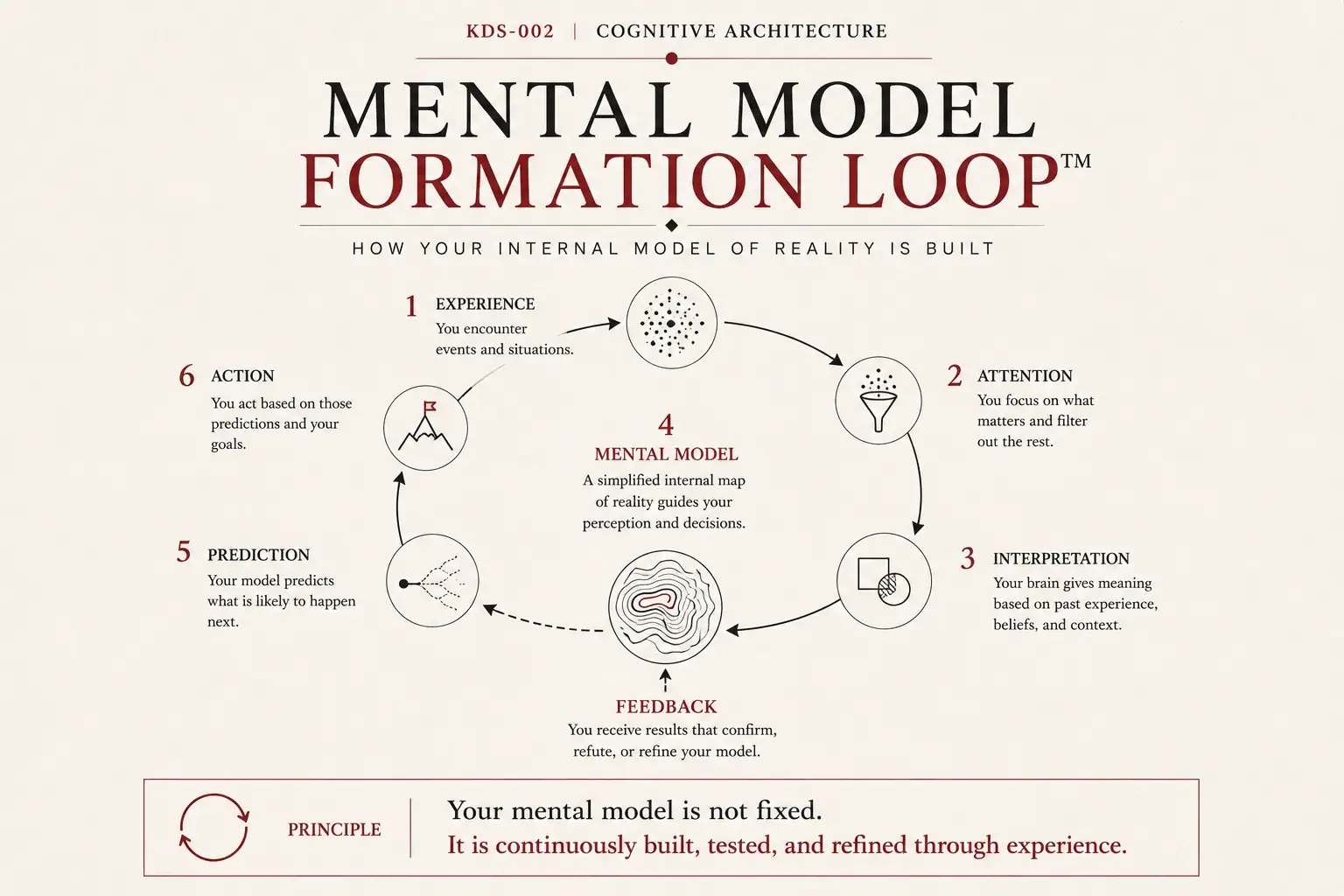
Mental models are built gradually. They emerge from repeated interaction between experience and interpretation.
A child who receives support after making mistakes may form a model in which error is part of learning. Another child who is humiliated for mistakes may form a model in which error threatens belonging. Years later, the same workplace feedback can activate completely different predictions in those two people.
The event is similar. The model is different.
Sources of mental models
- Direct experience: what happened to you and what followed.
- Repeated patterns: what seemed to happen again and again.
- Language: the categories and explanations available to you.
- Culture: what your environment defines as normal, desirable, or dangerous.
- Relationships: what others taught you about trust, conflict, care, and power.
- Emotion: what your nervous system marked as significant.
- Attention: what you repeatedly noticed and what you ignored.
- Feedback: whether your expectations matched actual outcomes.
Mental models become especially strong when an interpretation is emotionally intense, repeatedly confirmed, socially reinforced, or useful for avoiding uncertainty.
The Mental Model Formation Loop
Experience → Attention → Interpretation → Mental Model → Prediction → Action → Feedback
Each pass through the loop can strengthen, weaken, or revise the model. But revision is not automatic. People often reinterpret contradictory evidence to protect the model they already have.
Why early models can feel like facts
When a model forms before you have language to examine it, it may not feel like a belief. It may feel like reality itself.
- “People leave when I need them.”
- “Rest must be earned.”
- “If I am uncertain, I am unprepared.”
- “My value depends on being useful.”
- “Conflict always damages relationships.”
These statements may be understandable products of experience. But they are still models. They are interpretations that generate predictions—not complete descriptions of reality.
The five layers of reality construction
To understand why mental models have so much influence, separate the process into five layers.
1. Reality
Reality is everything that exists and occurs, including information outside your awareness. It is more complex than any person can fully perceive.
2. Perception
Perception is the tiny fraction of reality selected through your senses, attention, state, and existing expectations.
3. Interpretation
Interpretation gives meaning to what you noticed. It answers: “What is this?” and “What does it imply?”
4. Prediction
Prediction uses the interpretation to estimate what will happen next. This may be conscious reasoning or fast, implicit expectation.
5. Decision
Decision turns prediction into a chosen path. Action then changes the environment and generates new feedback.
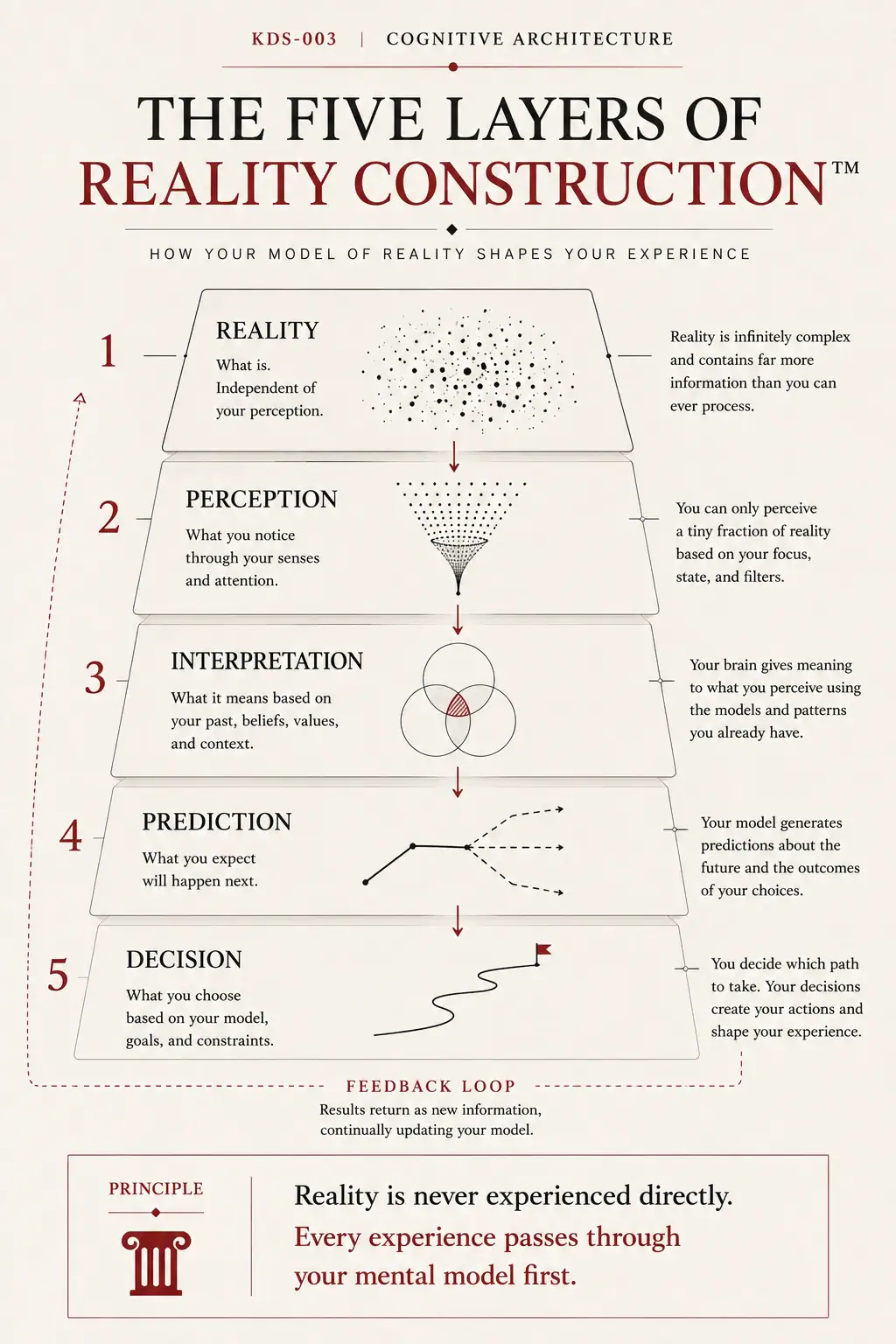
This model explains why a disagreement is rarely only about facts. People may differ at every layer: they notice different parts of a situation, assign different meanings, predict different consequences, and choose different actions.
Why two people can experience the same event differently
Imagine that a manager sends a message: “Can we talk tomorrow morning?”
One employee thinks: “They probably want an update.” Another thinks: “I must have done something wrong.” A third thinks: “This could be an opportunity.”
The message is the same. The predictions are not. Each prediction comes from a different model of authority, uncertainty, feedback, and self-worth.
| Event | Possible model | Likely prediction | Likely response |
|---|---|---|---|
| Someone replies slowly | “Distance means rejection” | “They are losing interest” | Checking, rumination, withdrawal |
| Someone replies slowly | “People have competing demands” | “They are probably occupied” | Wait, continue normally |
| A plan changes | “Control creates safety” | “This could go badly” | Resistance, overplanning |
| A plan changes | “Adaptation is normal” | “We can revise the route” | Reassessment, adjustment |
When people say, “I am just being realistic,” they often mean, “My current model makes this prediction feel obvious.” Accuracy must be evaluated through evidence, prediction, feedback, and revision—not through confidence alone.
Mental models and intuition
Intuition is one of the clearest expressions of a mental model operating below conscious explanation.
When experience has produced a well-developed model, the brain can recognize patterns and generate predictions quickly. The result may appear as a feeling, a sense of direction, a subtle warning, or an answer that arrives before reasoning catches up.
This is why intuition can be accurate in familiar environments. It draws on compressed learning. It is also why intuition can fail. A fast prediction is only as good as the model producing it.
Intuition is not the model itself
- Mental model: the internal structure representing how something works.
- Intuition: a rapid prediction generated from that structure.
- Emotion: a signal about significance, readiness, threat, reward, or priority.
- Decision: the chosen response.
For practical training, see How to Train Your Intuition. To distinguish useful signals from distortion, see Signal vs Noise and Intuition vs Anxiety.
Why expertise matters
Reliable intuition usually requires repeated exposure to meaningful patterns, feedback that reveals whether predictions were accurate, a sufficiently regular environment, and opportunities to revise the model. Without these conditions, confidence can grow faster than accuracy.
Predictive processing: a useful scientific lens, not a settled final theory
One influential family of theories proposes that perception and action depend heavily on prediction. In this view, the brain uses generative models to anticipate incoming sensory information and updates those models when prediction and input diverge.
This does not mean the brain invents whatever it wants to see. Sensory evidence constrains perception. The important point is that perception is not treated as a passive recording. It involves an interaction between incoming information and prior expectations.
Prediction error
A prediction error is the mismatch between what a model expected and what occurred. It can signal that the environment changed, that attention missed an important variable, or that the model was too confident. Learning depends partly on deciding which mismatches deserve an update.
Not every surprise should rewrite your worldview. A good calibration system considers the reliability of the evidence, the stability of the environment, and the number of observations. One unusual result may be noise. Repeated, well-measured contradiction is stronger evidence.
Precision and confidence
Predictive accounts often distinguish the content of a prediction from the confidence assigned to it. Two people can make the same prediction while holding it with different certainty. Calibration therefore has two targets:
- Is the prediction directionally accurate?
- Is confidence proportionate to the quality of evidence?
This distinction matters for intuition. A subtle impression may deserve attention without deserving immediate obedience. You can treat it as a hypothesis, gather more information, and preserve flexibility.
Mental models and emotions
Emotions do not arise from events alone. They arise from what your model predicts the event means for your needs, goals, identity, safety, and future.
The same uncertainty may produce curiosity in one person and dread in another. The difference is not uncertainty itself. It is the model used to interpret uncertainty.
Event → Interpretation → Expected consequence → Emotional response → Action tendency
- If disagreement predicts abandonment, conflict may trigger fear.
- If disagreement predicts learning, conflict may trigger interest.
- If rest predicts failure, free time may trigger guilt.
- If rest predicts recovery, free time may feel restorative.
This is why simply telling yourself to “calm down” often fails. The emotional response is supported by a model that still predicts danger, loss, or failure. To change the response, you often need new evidence, new interpretation, or repeated corrective experience.
Related guides include Why Do I Feel Emotionally Numb?, Why Does Everything Feel Uncertain?, and Why Can’t I Trust Myself Anymore?.
How memory, attention, and stress reshape mental models
Memory is reconstructive
People often imagine memory as a recording. In practice, remembering is reconstructive. Current goals, later information, emotion, and existing knowledge can influence what is retrieved and how it is interpreted. Because mental models are partly built from remembered patterns, distorted recall can reinforce distorted expectations.
This is not evidence that memory is useless. It means memory should be treated as data with uncertainty rather than as a perfect archive.
Attention changes the evidence available to the model
A model cannot update from information that never receives attention. When you repeatedly scan for rejection, threat, or proof of failure, your evidence stream becomes unbalanced. The model then appears increasingly confirmed because it helped choose the data used to evaluate itself.
Stress narrows the hypothesis space
Under pressure, people often rely more heavily on familiar interpretations and immediate action tendencies. This can be adaptive when time is limited. It can also reduce nuance, suppress alternative explanations, and make uncertainty feel intolerable.
When everything feels urgent, the model may be representing low capacity as high external danger. Before making a major interpretation, it is often useful to ask whether the environment changed or whether your available cognitive capacity changed.
That distinction is explored further in Why Does Everything Feel Urgent?, Decision Fatigue Symptoms, and Why Your Brain Feels Full.
How mental models become inaccurate
A mental model does not need to be completely false to become harmful. It can be partly accurate, useful in one context, and misleading in another.
1. The environment changes
A model that once protected you may become outdated. Hypervigilance may have been adaptive in an unpredictable environment but exhausting in a safer one.
2. The model is built from too little data
A single intense experience can become a general rule. One betrayal becomes “people cannot be trusted.” One failure becomes “I am not capable.”
3. Attention becomes selective
Once a model exists, attention tends to notice confirming evidence. Contradictory evidence may be ignored, minimized, or explained away.
4. Feedback is weak or delayed
Some environments make it difficult to know whether a prediction was correct. This allows confidence and narrative to replace calibration.
5. The model protects identity
A belief about reality may also protect a belief about who you are. Revising the model can then feel like losing coherence, status, belonging, or moral certainty.
6. Stress narrows the model
Under overload, the brain prioritizes immediate threat, familiar responses, and short-term control. Nuance becomes harder to access. This can make the world appear simpler, more urgent, and more dangerous than it is.
For recovery from that state, see Cognitive Overload Recovery and Why Does Everything Feel Like Too Much?.
How to calibrate a mental model
Calibration means improving the relationship between your prediction and reality. A calibrated model does not guarantee certainty. It produces expectations proportionate to the evidence and adjusts when outcomes differ.
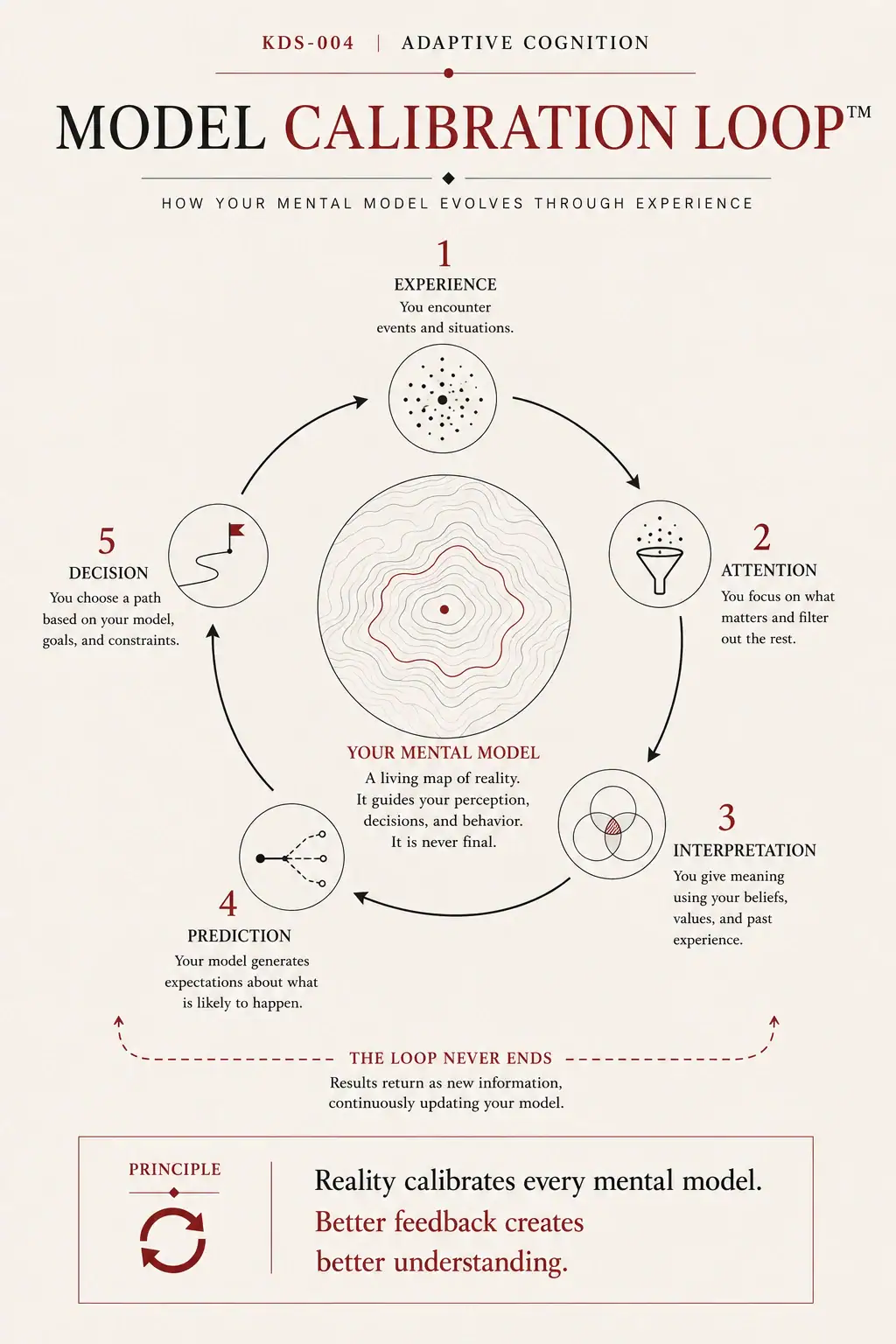
- State the prediction. What do you think will happen?
- Name the model. What assumptions are producing that prediction?
- Act or observe. Let reality provide information.
- Compare outcome and expectation. Where did the model match? Where did it miss?
- Revise proportionately. Update the model without overcorrecting from one result.
- Repeat. Calibration is cumulative.
When reality differs from expectation, the gap contains information. A prediction error does not automatically prove the whole model wrong. It identifies where the model may need refinement.
How to evaluate mental model quality
A useful mental model is not merely convincing. It should perform well.

Accuracy
How closely does the model reflect what is actually happening?
Relevance
Does the model focus on the variables that matter in this specific context?
Coherence
Does the model fit logically with reliable evidence and the rest of your understanding?
Simplicity
Is the model as simple as possible without removing what matters?
Adaptability
Can the model change when reality changes or new evidence appears?
Usefulness
Does the model improve prediction, decision, or action?
How to use mental models in real decisions
Understanding a model is not the same as using it. The value appears when the model improves a real decision.

Step 1: Question
Clarify the decision. Vague questions activate vague models.
Step 2: Model
Choose the model that fits the question. A relationship model may not help with a financial forecast. A productivity model may not help with grief.
Step 3: Predict
Use the model to generate expectations. What would you expect to observe if the model is accurate?
Step 4: Decide
Choose the best available path while acknowledging uncertainty.
Step 5: Act
Reality cannot test a decision you never implement.
Step 6: Learn
Review what happened. Keep the parts of the model that worked. Revise the parts that did not.
This process complements the Adaptive Action System and the Personal Signal Decoder.
The mental model filter: what you notice shapes what you can understand
Mental models do not only interpret information after it arrives. They influence which information receives attention in the first place.
Reality → Attention → Filtering → Interpretation → Prediction → Action
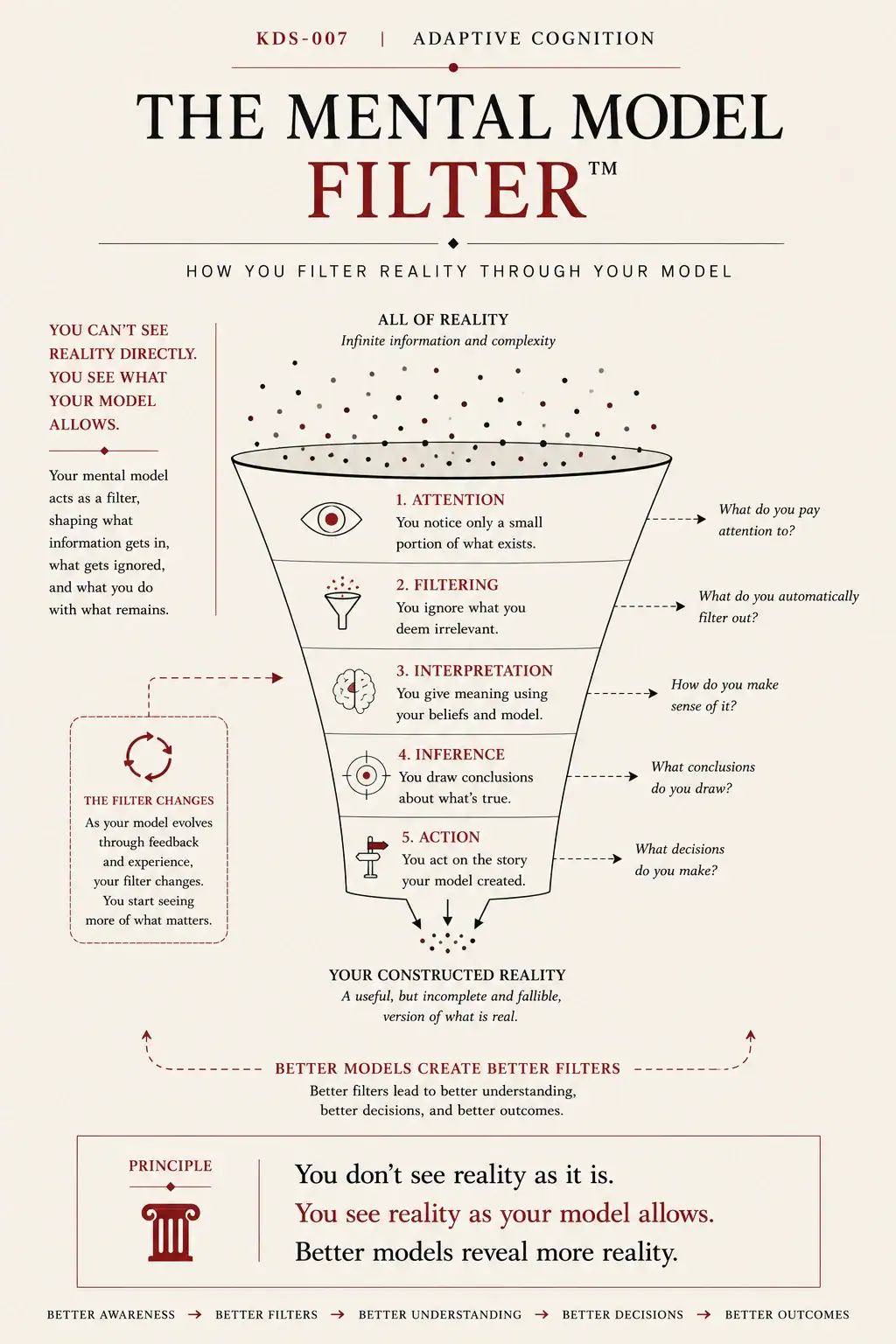
A model of leadership focused entirely on control may reveal coordination problems while hiding psychological safety. A model of relationships focused entirely on compatibility may reveal shared preferences while hiding the importance of repair. A model of productivity focused entirely on time may reveal scheduling inefficiency while hiding cognitive capacity.
How to widen the filter
- Ask what evidence would contradict your current explanation.
- Seek perspectives built from different experiences.
- Separate observation from interpretation.
- Notice which information triggers immediate defensiveness.
- Test more than one model against the same situation.
- Record predictions before outcomes are known.
Common mental model examples
Scarcity model
Core expectation: Important resources are limited and may disappear. It can support caution and preparation, but distort into chronic urgency or inability to rest.
Control model
Core expectation: Safety depends on preventing uncertainty. It can support planning, but distort into rigidity and micromanagement.
Growth model
Core expectation: Capability can improve through effort, feedback, and strategy. It can support learning, but should not be used to deny real constraints.
Trust model
Core expectation: People are generally reliable, unreliable, or reliable under specific conditions. The model influences cooperation and boundary setting.
Identity model
Core expectation: “I am the kind of person who…” Identity models create consistency but can also prevent change.
Failure model
Core expectation: Failure is evidence of incapacity, a cost of learning, or useful information. This model shapes whether challenge produces avoidance or experimentation.
Rest model
Core expectation: Rest is recovery, reward, danger, laziness, or lost time. The model changes whether stillness feels restorative or uncomfortable.
Related guides include Why Does Rest Feel Like Wasted Time?, Productivity Guilt, and Why Does Calm Feel Unfamiliar?.
How mental models shape everyday life
Relationships
Your relationship models influence what closeness means, how quickly you detect distance, what you expect after conflict, and whether another person’s independence feels safe or rejecting. A model can accurately detect a familiar pattern while still overgeneralizing it to a new person.
Work and leadership
A leader who models performance as individual effort will design different systems from a leader who models performance as an interaction among capability, incentives, information flow, workload, and coordination. The first may respond to failure with pressure. The second may investigate the system.
Money
Financial decisions are shaped by models of scarcity, risk, time, status, and security. Two people with the same income may experience it differently because one model predicts fragility while another predicts optionality.
Learning
A person who models confusion as evidence of inability is likely to avoid difficult material. A person who models confusion as a transition between old and new representations is more likely to persist and seek feedback.
Health and capacity
Models of the body shape how sensations are interpreted. Fatigue can be read as laziness, danger, normal recovery need, illness, or accumulated load. The interpretation changes the next action. This article does not replace medical assessment; it shows why the same sensation can lead to very different behavioral responses.
Identity
Identity is partly a model that predicts your own behavior. Statements such as “I am bad at decisions” or “I am the responsible one” compress many experiences into a stable expectation. Identity models can create consistency, but they can also make change harder to notice.
Mental Model Audit: a practical exercise
Use this audit when you are stuck, repeatedly surprised, emotionally activated, or uncertain why the same pattern keeps returning.
- Define the situation. Describe observable facts without explanation.
- Identify your interpretation. What did your mind say the event meant?
- Name the prediction. What do you expect will happen next?
- Find the underlying model. Complete: “In situations like this, I assume that…”
- Test model quality. Evaluate accuracy, relevance, coherence, simplicity, adaptability, and usefulness.
- Generate an alternative model. What else could explain the same facts?
- Make a testable prediction. What outcome would distinguish the two models?
- Review the result. Update the model based on evidence.
The architecture of understanding
Mental models do not operate alone. They interact with attention, perception, interpretation, prediction, intuition, emotion, decision, action, and feedback. Understanding emerges from the whole system.

A strong mental model does not remove uncertainty. It reduces uncertainty enough to support better prediction and wiser action.
Better awareness → Better filters → Better models → Better predictions → Better decisions → Better outcomes → Better understanding
Mental models vs beliefs, biases, heuristics, and worldviews
| Concept | What it is | Primary function | Example |
|---|---|---|---|
| Mental model | An internal representation of how something works | Interpretation and prediction | “Feedback improves performance when it is specific and actionable.” |
| Belief | A proposition accepted as true | Stability and meaning | “Most people want to do good work.” |
| Bias | A systematic tendency that distorts judgment | Fast processing, often with error | Noticing evidence that confirms an existing view |
| Heuristic | A practical shortcut or rule of thumb | Speed and efficiency | “When uncertain, compare at least three options.” |
| Worldview | A broad network of models and beliefs | Global orientation | A view of human nature, society, morality, and change |
Types of mental models
There is no single universally accepted list of mental-model types, because researchers use the concept for different tasks. For practical use, however, it helps to distinguish models by what they represent and what kind of prediction they support.
Causal models
Causal models represent what produces what. They answer questions such as: What causes delays? What makes trust increase or decrease? Which variable drives the result, and which variable merely accompanies it?
Causal models are powerful because they guide intervention. If you model poor performance as a motivation problem, you will respond differently than if you model it as unclear priorities, missing information, or excessive work in progress. The quality of action depends on whether the proposed cause is real, relevant, and changeable.
Spatial and relational models
These models represent where things are, how they are connected, and which paths lead from one state to another. A city map is an obvious example, but the same structure appears in knowledge: concepts can be close, distant, nested, or dependent.
Procedural models
A procedural model represents how to do something. It includes sequence, conditions, checkpoints, and recovery when a step fails. Skilled performance often depends on procedural models that become partly automatic through practice.
Social models
Social models represent people, roles, intentions, norms, status, trust, and likely responses. They help you predict what another person may understand, want, or do. Because social evidence is ambiguous, these models are especially vulnerable to projection and overconfidence.
Self-models
A self-model represents your abilities, needs, values, limits, history, and expected behavior. It supports continuity: you can make plans because you expect the person who wakes tomorrow to remain meaningfully connected to the person deciding today.
Self-models are useful but selective. “I am disciplined,” “I am bad with conflict,” and “I always have to be strong” may compress real patterns while hiding exceptions and future possibilities.
Normative models
Normative models represent how things should work. They include moral rules, professional standards, social expectations, and ideals of fairness. Conflicts often intensify when one person describes what is happening while another argues from a model of what ought to happen.
Probabilistic models
Probabilistic models represent uncertainty rather than one certain outcome. They are often more realistic than binary models because they permit several possibilities with different confidence levels.
Instead of “This will fail,” a probabilistic model asks: “What are the main failure modes, how likely is each one, and what evidence would change those estimates?”
How to build better mental models
Better models are not produced by collecting endless facts. They emerge from disciplined comparison between explanation, prediction, and outcome.
1. Separate observation from interpretation
Write down what a camera or transcript could verify. Then write the meaning your mind assigned. This prevents an interpretation from disguising itself as raw evidence.
2. Make the causal structure explicit
Ask what you believe causes the result. Then ask whether the cause is necessary, sufficient, merely contributory, or only correlated. This often reveals that a model is too simple.
3. Generate at least one competing model
A single explanation creates false certainty. A competing model forces you to identify discriminating evidence: what would look different if one model were true rather than the other?
4. Translate the model into a prediction
An explanation that cannot change what you expect is difficult to test. State the prediction before the outcome is known. Include a time frame and an observable result.
5. Track confidence
Use a percentage or a simple scale such as low, medium, and high confidence. Over time, compare confidence with accuracy. A person can make many correct predictions while still being poorly calibrated if confidence is consistently too high or too low.
6. Look for boundary conditions
A model may work in one environment and fail in another. Ask where it applies, where it stops, and which variable changes its usefulness.
7. Prefer reversible tests when uncertainty is high
When possible, test a model with a small action that produces information without creating unnecessary cost. This turns uncertainty into learning.
8. Update gradually
Do not protect a model against all evidence, but do not rebuild your worldview after one unusual event. The size of the update should reflect the reliability and repetition of the evidence.
9. Review outcomes without rewriting history
After an outcome is known, the result often feels obvious. Preserve the original prediction so you can learn from the real difference between expectation and reality.
10. Keep a model portfolio
No single model captures every useful variable. For difficult decisions, compare several lenses: incentives, capacity, information flow, time, uncertainty, relationships, and system constraints.
Common mistakes when working with mental models
Treating a memorable model as a universal law
Elegant models are easy to remember and easy to overuse. A model can be insightful without being sufficient.
Confusing description with explanation
“The team is disengaged” labels an observation. It does not yet explain what created disengagement or what would change it.
Using a model to protect certainty
A model should reduce uncertainty enough for action, not erase uncertainty through confidence. When a model makes every possible outcome count as confirmation, it has stopped being testable.
Ignoring the cost of the model
A model may produce accurate predictions while imposing unnecessary emotional or social cost. Suspicion can sometimes detect danger, but chronic suspicion may damage relationships and reduce access to corrective evidence.
Assuming more detail always means more accuracy
Complexity can improve a model, but it can also hide confusion. Extra variables are useful only when they improve explanation or prediction.
Using outcomes as the only measure of decision quality
A careful decision can be unlucky. A careless decision can succeed by chance. Evaluate the reasoning process over repeated cases, not only one result.
A seven-day mental model practice
This short practice is designed to make invisible models easier to notice. Use one real situation throughout the week.
Day 1: Observe
Describe the situation without interpreting it. Record only observable facts, timing, words, and actions.
Day 2: Interpret
List the meanings you assigned. Notice which interpretation appeared first and which alternatives required effort.
Day 3: Predict
Write what you expect to happen next and how confident you are.
Day 4: Trace the model
Ask what general rule would make your prediction reasonable. Identify where that rule came from.
Day 5: Challenge
Construct a competing model. Search for evidence that would support it.
Day 6: Test
Take one small, reversible action that helps distinguish between the models.
Day 7: Update
Compare prediction with outcome. Revise the model only as much as the evidence supports.
Repeated weekly, this practice builds a history of predictions and feedback. That history is more reliable than memory alone because it records what you believed before you knew the answer.
Limits and scientific cautions
“Mental model” is a useful concept, but it should not become an explanation for everything. Several cautions keep the framework intellectually honest.
1. A model is an explanatory tool, not a visible object
Researchers infer representations from behavior, reports, neural data, and performance. The boundaries of a particular mental model are rarely as clean as an editorial diagram suggests.
2. Different theories describe representation differently
Mental-model theory, schema theory, predictive processing, embodied cognition, ecological approaches, and connectionist models emphasize different mechanisms. They overlap, but they are not interchangeable.
3. Not every decision is produced by explicit simulation
Habit, reinforcement history, social rules, bodily state, and environmental affordances can guide action without a consciously accessible model.
4. Better models do not guarantee better outcomes
Chance, power, limited resources, and unstable environments matter. A good decision can still produce a bad result. Evaluate both process quality and outcome over repeated cases.
5. Introspection is incomplete
People can often describe a plausible reason for a decision without accurately identifying every process that produced it. Treat self-explanation as evidence, not final proof.
These cautions do not make the concept weak. They define where it is useful: as a disciplined way to examine representation, expectation, prediction, and revision without pretending the mind is simple.
Frequently asked questions about mental models
What is a mental model in simple terms?
A mental model is your mind’s simplified explanation of how something works. It helps you interpret information, predict outcomes, and decide what to do.
What are examples of mental models?
Examples include models of trust, risk, success, failure, money, relationships, leadership, learning, identity, control, and uncertainty.
Are mental models the same as beliefs?
No. A belief is something you accept as true. A mental model is a broader structure that connects beliefs, experiences, causes, expectations, and possible outcomes.
Are mental models conscious?
Some are explicit, but many operate automatically. You may notice them only when a prediction fails or a repeated pattern creates difficulty.
Can mental models be wrong?
Yes. Every model is incomplete. A model becomes problematic when it consistently misrepresents reality, ignores important evidence, or produces poor predictions and decisions.
Can mental models change?
Yes. They change through new experience, reflection, contradiction, emotional learning, and feedback. Models connected to identity or safety may resist revision.
How do mental models affect perception?
They guide attention toward some information and away from other information. They also influence how selected information is interpreted.
How do mental models affect decision-making?
They generate expectations about consequences. Decisions are then made from those expectations, even when the underlying model remains unconscious.
What is the relationship between mental models and intuition?
Intuition is often a fast prediction produced by a mental model built through experience and pattern recognition.
Can mental models cause anxiety?
A model that repeatedly predicts danger, rejection, failure, or loss can contribute to anxious responses. The feeling is real even when the prediction is based on an outdated or incomplete model.
Why do people see the same situation differently?
They attend to different information, interpret it through different experiences and beliefs, and generate different predictions.
What makes a mental model useful?
A useful model is accurate enough for the task, relevant, coherent, simple without becoming simplistic, adaptable, and capable of improving prediction or action.
How can I identify my own mental models?
Notice repeated predictions, emotional reactions, assumptions, and phrases such as “People always…,” “I have to…,” or “If this happens, then…”
How can I improve a mental model?
State its prediction, gather evidence, compare expectation with outcome, seek contradictory information, test alternative explanations, and revise proportionately.
What is model calibration?
Model calibration is the process of aligning confidence and prediction with actual outcomes.
Are mental models useful under uncertainty?
Yes. Their main purpose is to reduce uncertainty enough to guide action. A good model does not pretend uncertainty is gone; it makes uncertainty more manageable.
Can two conflicting mental models both be useful?
Sometimes. Different models may highlight different variables or operate at different levels. The question is which model best fits the current purpose and context.
Is a mental model the same as reality?
No. A mental model is a representation of reality. It can be useful and accurate without being complete.
Why is feedback important?
Feedback reveals whether a model’s prediction matched the outcome. Without feedback, confidence can grow without accuracy.
What happens when a mental model becomes outdated?
You may keep making decisions that were once adaptive but no longer fit the current environment. Repeated surprise, frustration, or mismatch can be signs that revision is needed.
Sources and further reading
The explanations above draw on several related research traditions. The sources below are selected for conceptual importance and accessibility. The KDS diagrams are original editorial syntheses and should not be mistaken for standardized scientific taxonomies.
- Johnson-Laird, P. N. “Mental models and human reasoning.” Proceedings of the National Academy of Sciences (2010). Open-access article.
- Khemlani, S. S., Barbey, A. K., and Johnson-Laird, P. N. “Causal reasoning with mental models.” Frontiers in Human Neuroscience (2014). Open-access article.
- Bubic, A., von Cramon, D. Y., and Schubotz, R. I. “Prediction, cognition and the brain.” Frontiers in Human Neuroscience (2010). Open-access review.
- Sprevak, M. “An introduction to predictive processing models of perception and decision-making.” (2023). PubMed record.
- Keller, G. B., and Mrsic-Flogel, T. D. “Predictive processing: a canonical cortical computation.” Neuron (2018/2019). Open-access article.
- Peelen, M. V., and colleagues. “Predictive processing of scenes and objects.” Nature Reviews Psychology (2024). Publisher page.
- Holtrop, J. S., and colleagues. “The importance of mental models in implementation science.” Frontiers in Public Health (2021). Open-access article.
- Fleming, S. M., and colleagues. “Metacognition and confidence: a review and synthesis.” Annual Review of Psychology (2024). Publisher page.
- Keil, F. C. “Explanation and understanding.” Annual Review of Psychology (2006). Publisher page.
Final principle
You do not navigate reality directly.
You navigate through models of reality.
The quality of those models shapes what you notice, what you expect, what you choose, and what becomes possible next.
A mental model is not a prison. It is a working map. Maps can be examined, compared, tested, expanded, and redrawn.
The goal is not to build a model that contains everything. The goal is to build models that reduce uncertainty, remain open to correction, and help you make wiser decisions.