
Estimated reading time: 15 minutes
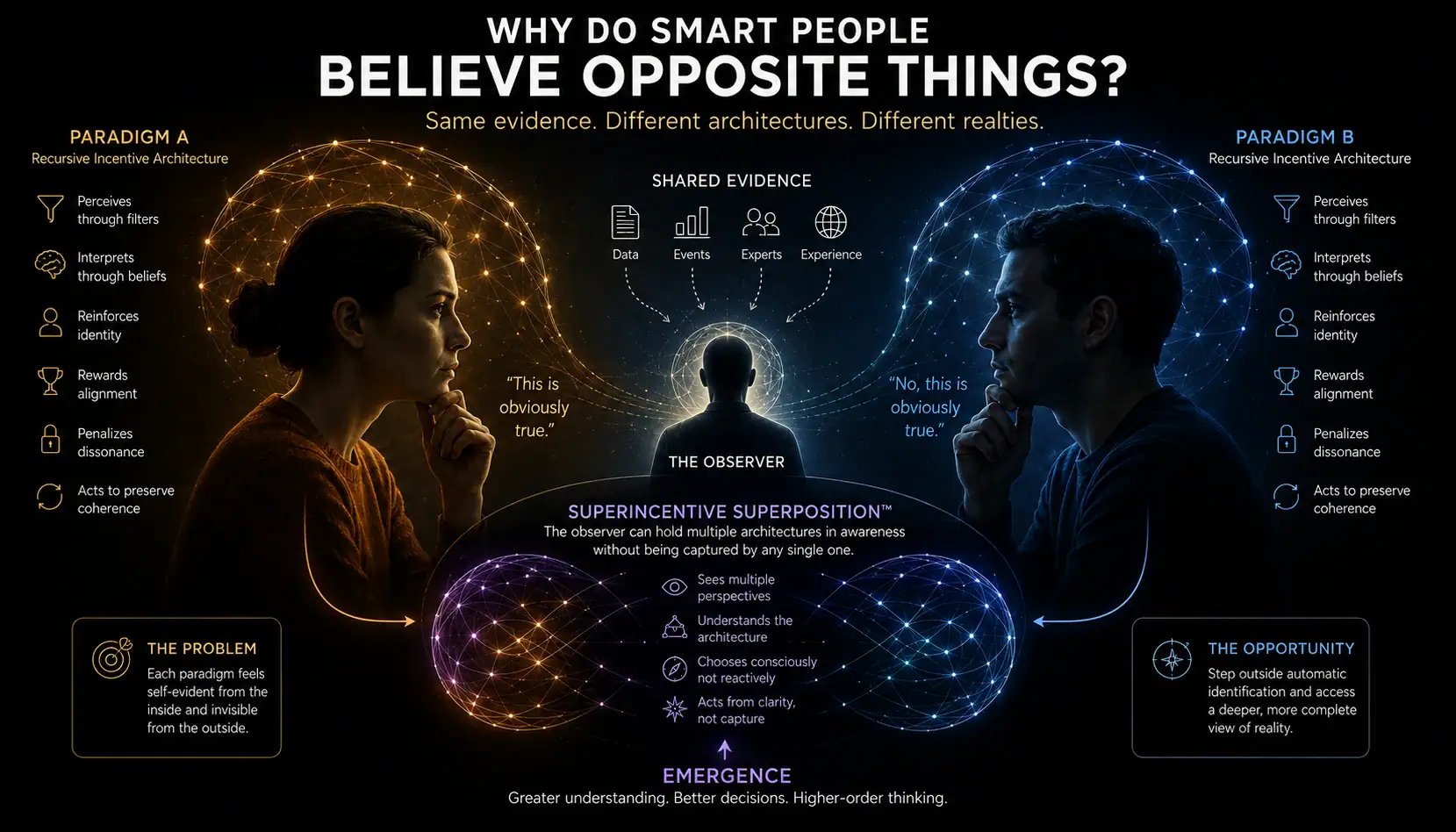
Why do smart people believe opposite things? It is one of the most puzzling questions about human thinking. Two intelligent people can study the same research, observe the same events, and examine the same evidence, yet arrive at completely different conclusions. If intelligence alone determined judgment, this should happen far less often than it does.
Instead, disagreements appear everywhere.
Scientists debate scientific theories.
Business leaders disagree about strategy.
Doctors sometimes recommend different treatments.
Friends interpret the same conversation in opposite ways.
The obvious explanation is that someone must be irrational.
Reality is usually more complicated.
People rarely perceive information directly.
Instead, information is interpreted through cognitive architectures that determine what appears important, trustworthy, threatening, or obvious.
Why Do Smart People Believe Opposite Things? Short Answer
Smart people often believe opposite things because intelligence operates inside interpretive frameworks rather than outside them. These frameworks organize attention, assign meaning, reinforce identity, and shape how evidence is evaluated. As a result, equally intelligent individuals may process identical information through different cognitive architectures and reach very different conclusions.
The disagreement is therefore not always about facts.
It is often about the invisible structures that decide what those facts mean.
People usually disagree less about reality than about the architecture through which reality is interpreted.
This article explores why intelligent people reach opposite conclusions, how recursive cognitive architectures influence perception, and why the ability to recognize multiple interpretive frameworks may represent an important step toward clearer thinking.
The Same Evidence, Different Conclusions
Imagine two experienced professionals reviewing the same report.
They read the same numbers.
See the same charts.
Understand the same terminology.
Yet one concludes:
“This clearly proves we should expand.”
The other concludes:
“This clearly proves we should become more cautious.”
Neither person necessarily ignored the evidence.
Instead, each interpreted that evidence through a different mental architecture that prioritized different risks, opportunities, assumptions, and incentives.
This helps explain why disagreement often persists even after everyone has access to the same information.
Why Intelligence Alone Doesn’t Prevent Bias
We often imagine intelligence as a tool that automatically corrects mistakes.
In reality, intelligence is remarkably effective at building consistent explanations inside whatever framework is currently organizing perception.
The more intelligent someone is, the better they may become at explaining why their existing interpretation is correct.
This does not mean intelligence is a problem.
It means intelligence and interpretation are different processes.
Reasoning helps us navigate within a framework.
It does not automatically reveal the framework itself.
The mind is often better at defending a coherent interpretation than questioning the architecture that created it.
Why Facts Alone Rarely Change Minds
Many people believe that disagreement persists because one side simply lacks information.
But information rarely enters an empty mind.
Every new observation is immediately evaluated through existing expectations.
Questions arise automatically:
- Is this trustworthy?
- Does it fit what I already know?
- Does it threaten my identity?
- Does it confirm my previous experience?
- How should this information be interpreted?
These evaluations usually occur long before deliberate reasoning begins.
This is one reason why cognitive overload can make interpretation even more rigid. Under sustained mental pressure, the brain increasingly relies on familiar patterns instead of carefully evaluating every new situation.
If this sounds familiar, you may also find these articles helpful:
- Cognitive Overload Recovery
- Why Do I Overthink Everything?
- Signal vs Noise
- Intuition and Consciousness
- Why Do We Get Stuck in One Way of Thinking?
The greatest disagreements often begin before either person consciously starts thinking.
The Invisible Architecture Behind Every Belief
Most discussions focus on what people believe.
Far fewer ask a deeper question:
What produced that belief in the first place?
Every stable worldview contains more than ideas.
It also contains a hidden architecture that organizes perception long before conscious reasoning begins.
This architecture influences:
- what immediately captures attention,
- which facts appear trustworthy,
- what feels emotionally important,
- what seems morally obvious,
- how uncertainty is interpreted,
- which actions feel natural.
Two people can therefore examine identical evidence while operating inside completely different interpretive systems.
The disagreement is often not about intelligence.
It is about the architecture through which intelligence is operating.
Intelligence explains reality.
Architecture determines which reality appears to require explanation.
Recursive Incentive Architectures
One useful way to understand this process is to think of every paradigm as a recursive incentive architecture.
Each architecture continuously reinforces itself.
A simplified cycle looks like this:
- Perception filters experience.
- Interpretation assigns meaning.
- Meaning strengthens identity.
- Identity influences future decisions.
- Those decisions reinforce future perception.
Because every cycle strengthens the next, the architecture gradually becomes more stable over time.
Eventually it becomes so familiar that it no longer feels like an interpretation.
It simply feels like reality.
The strongest paradigms are usually the ones that become invisible to the people living inside them.
Why Evidence Rarely Speaks for Itself
We often hear the phrase:
“The facts speak for themselves.”
In practice, they rarely do.
Facts require interpretation.
Interpretation requires a framework.
And frameworks are influenced by incentives, identity, experience, and expectations.
This explains why the same scientific paper, financial report, political speech, or personal conversation can generate completely different conclusions.
The disagreement begins before the evidence is consciously evaluated.
Evidence does not arrive in an empty mind.
It arrives inside an existing architecture of meaning.
Recursive Superinterception: Why Paradigms Defend Themselves
Understanding individual cognition naturally leads to a broader systems question:
Why do organizations, cultures, political movements, and entire societies often resist change even when strong evidence exists?
A systems-level explanation is presented in Recursive Superinterception.
The central idea is that paradigms do not simply preserve ideas.
They preserve themselves.
Recursive incentive structures reward interpretations that reinforce the existing architecture while discouraging interpretations that threaten it.
This helps explain why disagreement often feels personal.
When a recursive architecture becomes closely connected with identity, questioning the framework itself can feel like questioning the person.
People often defend the architecture that creates meaning long before they defend individual beliefs.
Superincentive Superposition™
If recursive architectures explain why intelligent people disagree, another question follows naturally.
How can someone understand multiple paradigms without becoming permanently captured by any one of them?
This is where Superincentive Superposition™ becomes useful.
Instead of collapsing into one dominant interpretive architecture, the observer develops the ability to understand several architectures simultaneously while recognizing each as a partial model rather than reality itself.
This does not eliminate disagreement.
It changes the nature of disagreement.
Emergence begins when the observer can examine multiple architectures without being completely owned by any one of them.
Instead of asking, “Who is right?” the observer begins asking:
- What assumptions organize this interpretation?
- What incentives keep it stable?
- What does this architecture reveal?
- What might it prevent me from seeing?
This shift transforms disagreement from a battle between conclusions into an exploration of the structures that produce those conclusions.
How Cognitive Calibration™ Helps You Think More Clearly
If recursive incentive architectures explain why intelligent people often disagree, Cognitive Calibration™ explains how individuals can reduce their influence without pretending to become completely objective.
The goal is not eliminating beliefs.
It is becoming increasingly aware of the structures that produce those beliefs.
Most people automatically ask:
- Who is right?
- Which argument is stronger?
- What evidence supports my position?
- How do I convince the other person?
Cognitive Calibration™ encourages different questions.
- What assumptions organize my interpretation?
- What information am I ignoring?
- Which incentives make this explanation attractive?
- How would someone using another framework understand the same evidence?
- What would become visible if I temporarily suspended my current interpretation?
These questions do not guarantee agreement.
They improve the quality of perception before conclusions are formed.
Clearer thinking begins not by finding better answers, but by seeing the framework that generates the answers.
A Practical Exercise for Recognizing Hidden Frameworks
The next time you strongly disagree with someone, resist the temptation to immediately evaluate who is correct.
Instead, work through these questions:
- What evidence are both of us looking at?
- Where do our interpretations begin to diverge?
- Which assumptions am I making without noticing them?
- Which assumptions might the other person be making?
- What incentives encourage each interpretation?
- What identity would become threatened if either interpretation proved incomplete?
- What perspective becomes visible only when both frameworks are considered together?
This exercise does not require abandoning your conclusions.
Its purpose is to make the architecture behind those conclusions visible.
Why This Matters Beyond Debate
Understanding recursive cognitive architectures is valuable far beyond politics or public disagreement.
The same mechanisms influence:
- leadership decisions,
- relationships,
- career choices,
- innovation,
- organizational change,
- conflict resolution,
- personal growth.
Many situations that appear to involve poor judgment are actually examples of different interpretive architectures producing different perceptions of the same reality.
Recognizing this distinction creates space for curiosity where certainty previously dominated.
The greatest breakthroughs often begin when we stop asking which interpretation is correct and start asking why different interpretations emerged in the first place.
Frequently Asked Questions
Why do intelligent people disagree so often?
Intelligence helps people reason effectively, but reasoning operates inside interpretive frameworks. When different frameworks organize perception, equally intelligent people can reach opposite conclusions from the same evidence.
Why don’t facts change people’s minds?
Facts require interpretation. Existing beliefs, incentives, identity, and previous experiences all influence how new information is understood before conscious reasoning begins.
What is Superincentive Superposition™?
Superincentive Superposition™ describes the ability to recognize and understand multiple recursive incentive architectures without becoming completely identified with any one of them. This creates the conditions for higher-order perception and individual emergence.
Can two opposite beliefs both contain truth?
Yes. Different frameworks often highlight different aspects of the same reality. Understanding how each framework organizes perception can reveal insights that remain hidden when only one perspective is considered.
How does this relate to intuition?
Intuition improves when perception becomes less constrained by automatic interpretive architectures. Cognitive Calibration™ helps distinguish genuine signals from assumptions created by existing frameworks.
Final Thought
Smart people do not believe opposite things because intelligence has failed.
They often disagree because intelligence is working inside different recursive architectures that organize attention, meaning, and identity in different ways.
The deeper challenge is not collecting more information.
It is recognizing the invisible structures that determine how information becomes knowledge.
When those structures become visible, disagreement changes.
It becomes less about defeating another perspective and more about understanding the architectures that produce different ways of seeing the world.
The highest form of intelligence may not be proving one paradigm correct.
It may be understanding why different paradigms make different realities appear equally obvious.
Continue Exploring
- Why Do We Get Stuck in One Way of Thinking?
- Cognitive Overload Recovery
- Signal vs Noise
- The Personal Signal Decoder™
- Signal vs Noise Simulator
- Intuition and Consciousness
- Why Do I Overthink Everything?
- Why Do I Second Guess Myself?
- Why Can’t I Prioritize Anything?