Mental load, cognitive overload, and the invisible work your brain carries
When one email, one decision, or one small task feels impossibly heavy, the task may not be the real weight. Your mind may already be carrying more unfinished processing than you can see.

What you will learn
- What mental load is—and how it differs from visible workload.
- Why small tasks can suddenly feel disproportionately difficult.
- How working memory, attention, uncertainty, and unfinished decisions compete for limited capacity.
- Why physical rest does not always produce cognitive recovery.
- How the Cognitive Capacity System™, Processing Debt™, and Mental Load Reset™ provide a practical way forward.
You open your laptop.
There is one unread email. Nothing about it looks dramatic. It is not marked urgent. You already know the reply will probably take less than a minute.
Yet instead of clicking Reply, you stare at the screen. Then you close the laptop. A few minutes later, you pick up your phone—not because you want to scroll, but because scrolling somehow feels easier than answering one simple message.
The email is not difficult. So why does it feel so heavy?
This is often the moment self-criticism begins. You wonder whether you have become lazy, undisciplined, unmotivated, or less capable than you used to be. You remember another version of yourself—the version that answered messages between meetings, made decisions without endless hesitation, and finished ordinary tasks before they became mental burdens.
But the visible task tells only a small part of the story.
Your brain does not respond only to how much you have to do. It also responds to how much unfinished processing it must keep available.
That distinction explains why the same email can feel effortless on Monday and impossible on Thursday. The task did not change. Your intelligence did not disappear. The condition of the cognitive system receiving the task changed.
What Is Mental Load?
Mental load is the invisible cognitive effort required to remember, monitor, organize, anticipate, decide, and keep everyday life functioning. It includes visible responsibilities, but it also includes unfinished decisions, emotional processing, future simulations, and the effort of trying not to forget what still matters.
Your workload is what appears on the calendar: meetings, errands, messages, deadlines, appointments, and projects. Mental load is what your brain must continue carrying around those responsibilities.
- Remembering what needs to happen next
- Keeping track of unfinished tasks
- Anticipating possible problems
- Monitoring other people’s needs and expectations
- Holding choices open while waiting for more information
- Regulating emotions while continuing to function
- Switching attention between competing contexts
- Trying not to forget something important
This is why a day can look quiet from the outside while feeling exhausting from the inside. The visible workload may be moderate, but the internal coordination burden can be enormous.
Mental load is not simply “being busy”
Two people can have nearly identical schedules and experience completely different levels of overwhelm. One may be carrying few unresolved concerns. The other may be tracking family uncertainty, unfinished conversations, financial worries, several delayed decisions, and dozens of reminders.
The calendar looks the same. The available mental bandwidth does not.
This is also why feeling busy does not always produce meaningful progress. When attention is fragmented across too many active processes, you can spend the whole day reacting while still feeling that nothing important moved forward. That pattern is explored more deeply in Why Do I Feel Busy but Get Nothing Done?
Why Does Everything Feel Like Too Much?
Everything begins to feel like too much when the amount of active cognitive processing exceeds the capacity currently available to handle it. The problem is not necessarily one dramatic responsibility. More often, ordinary demands are arriving in a system that is already crowded.
An unread email may instantly activate questions such as:
- Is this urgent?
- What exactly do they want?
- Will replying create more work?
- Do I have enough information?
- What if I respond incorrectly?
- What happens if I wait?
One visible task has already become several invisible processes. Add the bill you still need to pay, the conversation you are postponing, tomorrow’s meeting, the message you forgot, and the decision you have delayed for weeks. The email is no longer entering an empty system.
It is entering a crowded one.
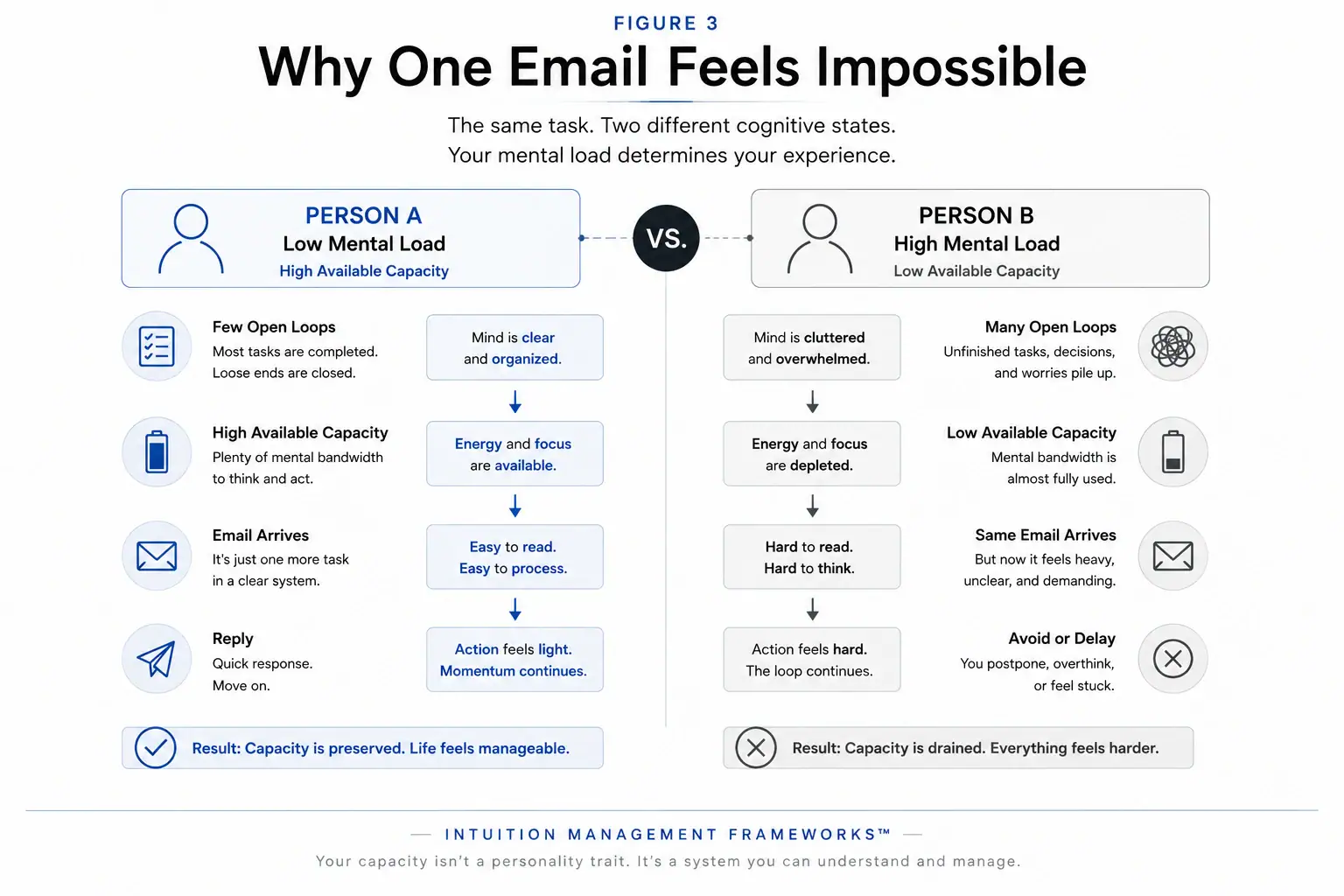
Executive Insight: A small task often feels heavy because of everything it represents—future work, social evaluation, uncertainty, decision-making, and the risk of forgetting—not because of the physical action required to complete it.
The Cognitive Capacity System™
The Cognitive Capacity System™ is an educational framework for understanding how life demands, active processing, recovery, and available mental bandwidth interact. It does not replace established cognitive psychology. It organizes familiar concepts—attention, working memory, uncertainty, decision-making, emotional regulation, and cognitive load—into a practical model for everyday experience.
Its core principle is simple:
Life begins to feel overwhelming when active processing consumes more cognitive capacity than the mind can comfortably sustain.
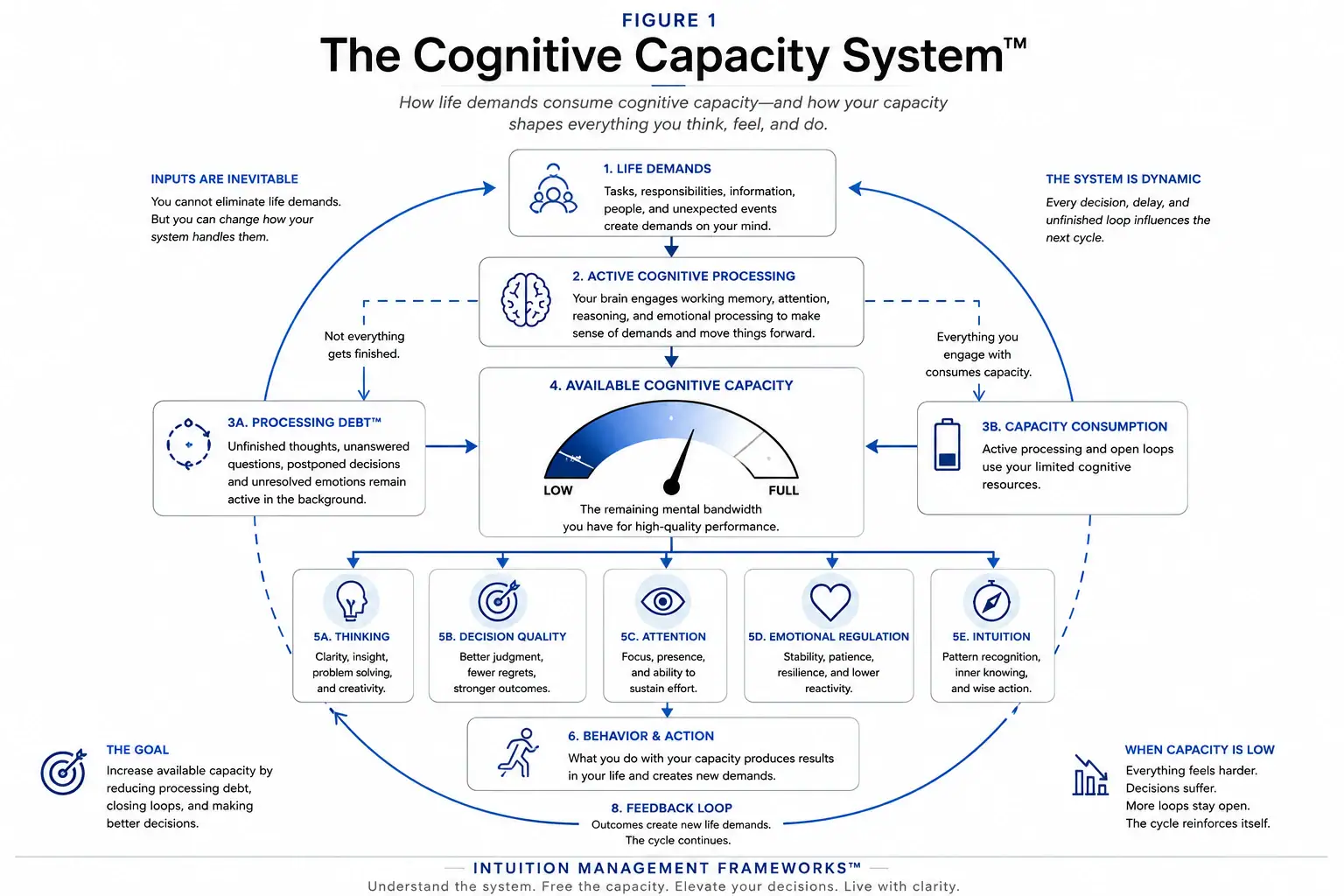
Attention is limited
Your attention cannot fully process everything at once. Incoming information competes for priority, and each interruption requires the brain to shift context. Frequent context switching creates friction because part of the previous task remains active while the next context is loaded.
This is why focus can become difficult even when you genuinely want to concentrate. The problem may not be a lack of interest. Too many processes may already be competing for the same attentional resources.
Working memory is limited
Working memory allows you to hold and manipulate information for a short period. It supports reading, planning, comparing options, following conversations, and solving problems. When it becomes crowded, you may lose your place, forget what you were doing, reread the same paragraph, or feel as though your brain is full.
Executive function becomes more expensive under load
Executive functions help you prioritize, inhibit distractions, begin tasks, switch strategies, and complete goal-directed actions. These skills are not simply present or absent. They become harder to access when sleep, stress, emotional strain, and active processing have already consumed much of your usable capacity.
This helps explain why prioritizing can feel impossible precisely when you have the most to organize.
Cognitive capacity changes from day to day
Cognitive capacity is dynamic, not fixed. Sleep, physical health, stress, environmental noise, relationships, emotional strain, and recovery can all change how much usable attention is available. Even positive events consume capacity because they require adjustment, planning, and new predictions.
| When capacity is relatively available | When capacity is heavily occupied |
|---|---|
| Choices feel manageable | Simple decisions feel exhausting |
| Attention returns after interruption | Every interruption breaks momentum |
| Uncertainty feels tolerable | Uncertainty feels urgent or threatening |
| Small tasks remain small | Small tasks feel disproportionately heavy |
| Subtle signals are easier to notice | Everything competes at the same volume |
The Mental Load Pyramid™
The Mental Load Pyramid™ shows how overwhelm accumulates through several interacting layers. The upper layers are easier to notice. The deeper layers are often less visible but can consume more capacity.
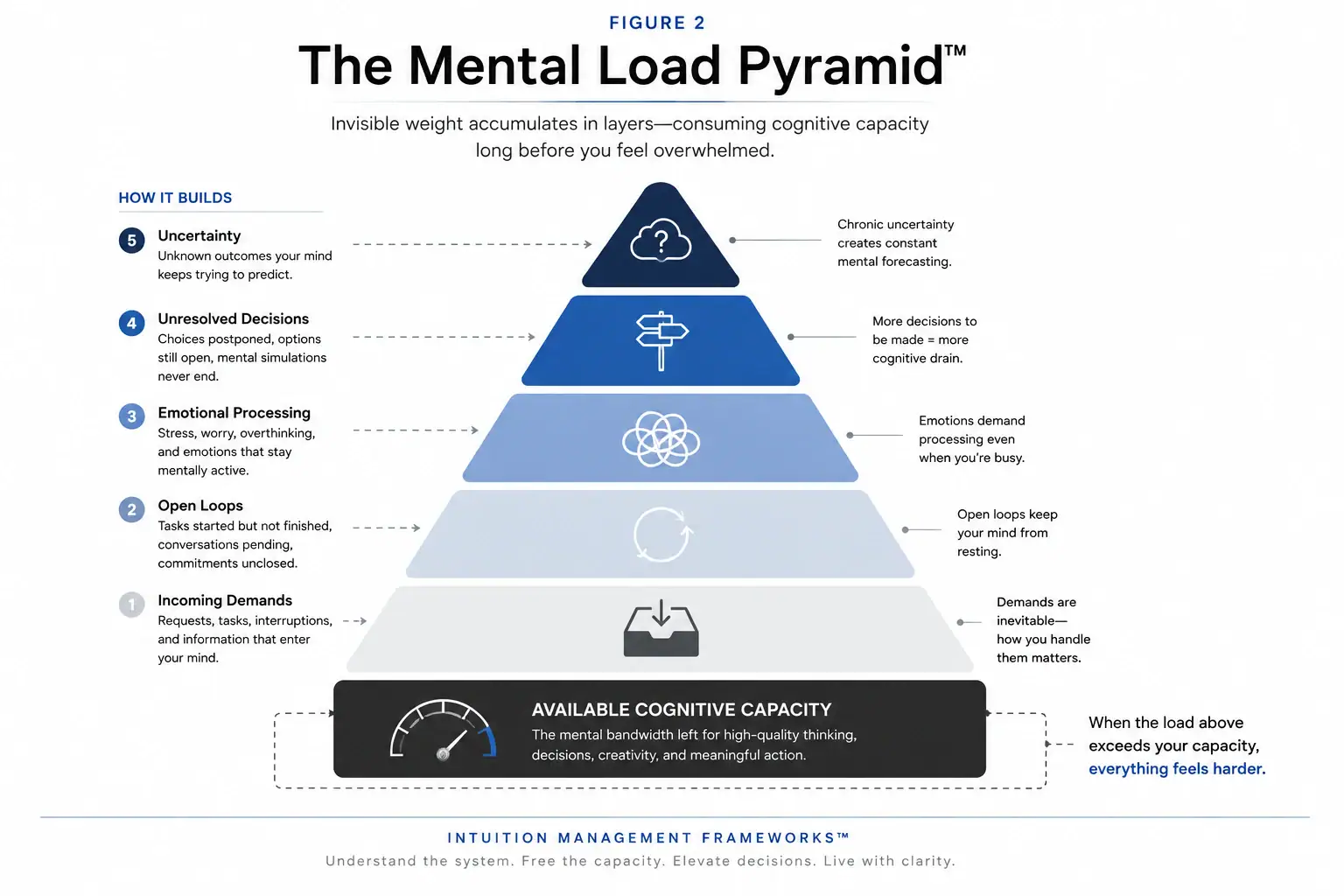
1. Incoming demands
Every message, request, notification, deadline, and interruption asks your brain to act, remember, postpone, or decide whether it matters. Even ignoring something requires a small act of evaluation.
Modern communication systems amplify this layer by making people continuously reachable. When you feel that you must always be available or respond immediately, the demand remains active before you have even read the message. See Why Do I Feel Like I Have to Be Available? and Why Do I Feel Like I Have to Respond Immediately?
2. Open loops
An open loop is anything your brain still considers unfinished. It may be an unanswered message, an unmade decision, a delayed task, an unfinished conversation, or a concern that has not found resolution. Open loops often remain active because the brain does not know when it can safely release them.
This helps explain why writing something into a trusted system can create immediate relief. The task has not disappeared, but the brain no longer has to rehearse it constantly to prevent forgetting.
3. Emotional processing
A difficult conversation, disappointment, guilt, relationship tension, or fear about the future can remain active long after the event itself has ended. Emotional regulation is cognitive work even when nobody else can see it.
Sometimes this burden does not feel like sadness. It may appear as irritability, emotional flatness, distraction, or the sense that everything feels difficult.
4. Unresolved decisions
Every unresolved choice requires comparison, prediction, and risk assessment. When too many choices remain active, even routine decisions can become exhausting. This is one reason decision fatigue symptoms often appear alongside mental overload.
5. Identity pressure
Tasks become heavier when they are tied to who you believe you must be: reliable, productive, available, calm, helpful, successful, or always in control. An unanswered message becomes evidence that you are disappointing someone. Rest becomes evidence that you are falling behind.
This is how productivity guilt turns recovery into another performance test.
6. Hidden uncertainty
Uncertainty is expensive because it prevents the brain from finishing its predictions. The mind keeps scanning for new information, rehearsing alternatives, and checking whether conditions have changed. This can make everything feel urgent even when very little is truly urgent.
7. Available cognitive capacity
All of these layers depend on the amount of usable attention, working memory, and self-regulation currently available. When that foundation becomes depleted, ordinary demands feel heavier and the mind has less flexibility for planning, creativity, and recovery.
Processing Debt™: Why Unfinished Thinking Stays With You
Processing Debt™ is the accumulation of cognitive work that has not been completed, resolved, accepted, or safely externalized. It is an explanatory model, not a clinical diagnosis or scientific measurement.
The distinction between unfinished tasks and unfinished processing matters. Two people may both postpone the same email until tomorrow. One writes it into a trusted system and stops thinking about it. The other repeatedly remembers it, imagines possible replies, worries about forgetting, and continues delaying the decision.
Both have one unfinished task. They are carrying very different amounts of Processing Debt™.
Why Processing Debt™ accumulates
Unfinished processes begin activating one another. The email reminds you of tomorrow’s meeting. The meeting reminds you of the report. The report reminds you of a difficult client. The client reminds you of an unpaid invoice. In seconds, one thought activates an entire network.
This is why overwhelm often appears sudden even though the accumulation happened gradually. The final task did not create the burden. It exposed it.
Why overthinking creates more processing debt
Thinking can solve problems, but repeated thinking without new information often creates additional simulations rather than better decisions. You compare the same options, replay the same conversation, and search for certainty that is not currently available.
This is one reason overthinking can leave you less certain rather than more prepared.
Why working harder does not always solve it
Working faster can reduce workload without reducing unfinished processing. You might clear twenty minor messages while continuing to carry one major unresolved decision. Conversely, making one clear decision can create more relief than completing a dozen small tasks.
Your brain may be searching for closure, not more productivity.
Why Small Tasks Suddenly Feel Impossible
A task’s difficulty is determined not only by the task itself but by the relationship between its demands and the capacity available to meet them. This is why small tasks can feel so hard during periods of overload.
One email added to an empty system feels light. The same email added to a system already carrying dozens of open loops may become the final drop that causes overflow.
The visible trigger receives the blame. The invisible accumulation deserves it.
This can create a self-reinforcing cycle:
- A small task feels unexpectedly heavy.
- You postpone it to reduce immediate discomfort.
- The unfinished task becomes another open loop.
- Self-criticism adds emotional processing.
- Less capacity remains for the next task.
What looks like procrastination can therefore be a protective response from a system trying to avoid additional processing. That does not mean avoidance is always helpful. It means the solution may require reducing the system’s burden, not merely increasing pressure.
Signs Your Mental Load Is Too High
- Everything feels urgent, even when it is not.
- You keep forgetting ordinary details.
- Simple choices feel strangely exhausting.
- You avoid tasks despite genuinely wanting to complete them.
- You reread information without absorbing it.
- You feel busy but make little meaningful progress.
- You scroll because beginning anything else feels harder.
- You become unusually irritable, impatient, or emotionally flat.
- You struggle to relax even when nothing is immediately wrong.
- Rest does not feel restorative.
These signs can overlap with stress, anxiety, depression, ADHD, burnout, sleep problems, and other health conditions. A framework about mental load should not be used to self-diagnose. Persistent or severe symptoms deserve professional evaluation.
If mental exhaustion has become your normal state, Why Am I Mentally Exhausted All the Time? offers a more focused exploration of chronic cognitive fatigue.
Mental Load vs. Stress, Burnout, Cognitive Overload, and Decision Fatigue
These terms overlap, but they describe different parts of the experience. Distinguishing them helps you choose a more appropriate response.
| Concept | What it describes | Primary focus |
|---|---|---|
| Mental load | The invisible cognitive work required to remember, monitor, organize, and anticipate. | What the mind is carrying. |
| Stress | A psychological and physiological response to demands or perceived threat. | How the system responds to pressure. |
| Cognitive overload | A condition in which information-processing demands exceed available capacity. | The mismatch between demand and capacity. |
| Decision fatigue | Reduced decision quality or increased decision difficulty after repeated choices. | The cost of sustained decision-making. |
| Burnout | A broader pattern of chronic exhaustion, reduced effectiveness, and detachment, commonly discussed in relation to prolonged work stress. | Long-term depletion. |
High mental load can contribute to stress. Repeated unresolved choices can increase decision fatigue. Prolonged stress and insufficient recovery can contribute to burnout. Cognitive overload describes the moment processing demands exceed available resources. None of these terms should be treated as interchangeable.
For practical recovery from information and attention saturation, see Cognitive Overload Recovery.
Why Rest Does Not Always Help
Rest and recovery are not the same thing. Rest means reducing activity. Recovery means restoring capacity.
You can stop working while continuing to replay conversations, plan tomorrow, monitor notifications, and rehearse unresolved decisions. Your body rests while the cognitive system keeps working.
This explains why you may be unable to relax even when nothing is wrong, why rest can feel like wasted time, or why calm can feel unfamiliar. The external activity stopped, but the internal monitoring did not.
Why silence can feel uncomfortable
When external stimulation decreases, previously hidden processing becomes easier to notice. The phone call you postponed, the decision you avoided, and the uncertainty about the future move into awareness. Silence did not create these thoughts. It removed enough noise for you to hear them.
This helps explain why phone checking can become automatic. Distraction temporarily competes with unfinished processing, even though it may also create new interruptions and open loops.
Recovery restores capacity
True recovery often begins when open loops are captured, decisions are completed or deliberately postponed, uncertainty is accepted, and attention is protected from continuous interruption. Free time is useful, but free time without mental space may still feel crowded.
The Mental Load Reset™
The Mental Load Reset™ is a practical framework for reducing unnecessary cognitive burden and restoring available capacity. Its goal is not to help you carry more. It is to help your mind carry only what genuinely needs to remain active.
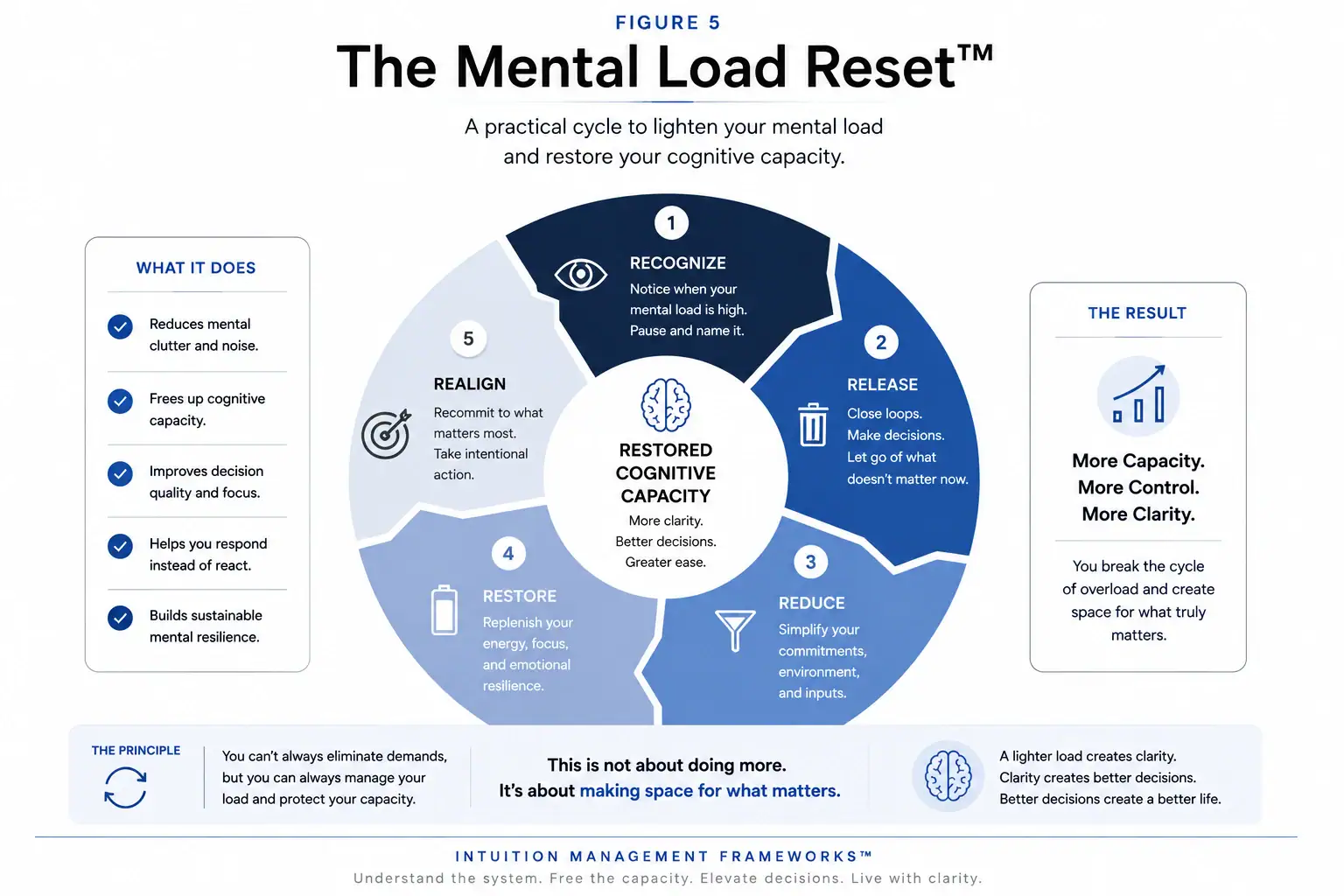
1. Recognize what your mind is carrying
List open loops, unresolved decisions, emotional concerns, future worries, and recurring reminders. Do not organize the list yet. The first objective is visibility. Mental load is easier to change once it stops being invisible.
2. Release what does not need to stay in working memory
Write it down, schedule it, delegate it, archive it, or deliberately decide that it no longer deserves attention. Your brain must trust that it does not have to keep rehearsing the information.
3. Reduce unnecessary demands
Reduce repeated choices, avoidable interruptions, context switching, and simultaneous commitments. This does not mean eliminating responsibility. It means protecting attention from demands that do not deserve immediate access.
4. Restore cognitive capacity
Create recovery that genuinely reduces processing. This may include sleep, walking, writing, quiet reflection, time in nature, prayer, meditation, creative work, or a conversation that brings emotional clarity.
5. Realign attention with what matters
Return your available attention to the priorities, relationships, and decisions that deserve it. The goal is not an empty mind. It is an intentional mind—one that can distinguish meaningful signal from unnecessary noise.
This is not about doing more. It is about making space for what matters.
A Five-Minute Mental Load Reset
- Write down every open loop currently repeating in your mind.
- Choose one loop to close through action, a clear decision, or deliberate scheduling.
- Silence new inputs for five minutes: notifications, messages, and unnecessary tabs.
- Name one uncertainty that cannot be resolved today and consciously stop rehearsing it.
- Choose one meaningful next action rather than trying to solve the entire day.
This exercise will not solve every source of stress. It can, however, reduce the number of active processes competing for attention right now.
How Mental Load Affects Focus, Decisions, Relationships, and Intuition
Mental load changes more than productivity. It influences attention, working memory, emotional regulation, creativity, relationships, and decision quality.
Decision-making
When capacity is available, you can compare options, tolerate uncertainty, notice consequences, and think beyond the immediate moment. When capacity is scarce, the urgent crowds out the important. Immediate relief becomes more attractive than long-term value.
Relationships
Listening, patience, and empathy all require attention. When your mind is already carrying dozens of active processes, a simple question from someone you care about may feel like another demand. Understanding the mechanism does not excuse harmful behavior, but it can help you create conditions for a better response.
Creativity
Creativity requires enough mental space to form unexpected connections. An overloaded system narrows its focus toward immediate problems and risk reduction. Many people do not lose creativity; they lose access to the capacity creativity requires.
Intuition
Intuition is often subtle. It depends on recognizing patterns and distinguishing meaningful internal signals from background noise. When every open loop is demanding attention, everything begins to feel equally important.
Reducing cognitive noise does not manufacture intuition. It creates the conditions in which existing signals become easier to notice. Explore Signal vs. Noise, what intuition really is, and the role of your internal model of reality.
When to Seek Professional Support
Mental load is a useful explanatory concept, but it is not a diagnosis. Persistent difficulty concentrating, severe anxiety, prolonged low mood, significant sleep disruption, inability to manage ordinary responsibilities, or symptoms that interfere with school, work, relationships, or self-care deserve assessment from a qualified healthcare professional.
Seeking support does not mean the framework failed. It means you are responding appropriately to a problem that may involve more than ordinary cognitive overload.
Frequently Asked Questions About Mental Load
Why does everything suddenly feel like too much?
This often happens when active cognitive processing exceeds your available capacity. Unfinished tasks, unresolved decisions, emotional strain, uncertainty, and interruptions may accumulate gradually until an ordinary demand reveals that the system is already overloaded.
What is mental load in simple terms?
Mental load is the invisible thinking required to keep life functioning: remembering, planning, monitoring, anticipating, deciding, and trying not to forget unfinished responsibilities.
Can mental load cause brain fog?
High mental load can contribute to difficulty concentrating, forgetfulness, slower thinking, and the subjective feeling commonly described as brain fog. These symptoms can have many causes, so persistent difficulties should be discussed with a healthcare professional.
Why do simple tasks feel impossible when I am overwhelmed?
Simple tasks enter a system that may already be carrying many active processes. The task itself remains simple, but the capacity available to handle it has decreased.
Is mental load the same as stress?
No. Mental load describes the invisible cognitive work being carried. Stress describes the psychological and physiological response to demands. High mental load can contribute to stress, but the concepts are not identical.
Is mental load the same as burnout?
No. Burnout is a broader pattern of chronic exhaustion, reduced effectiveness, and detachment, usually discussed in relation to prolonged occupational stress. Mental load can contribute to burnout but can also occur without it.
What is the difference between mental load and cognitive overload?
Mental load describes the ongoing cognitive work a person is carrying. Cognitive overload describes the point at which processing demands exceed available cognitive resources. Mental load can accumulate without immediate overload, but it raises the likelihood of reaching it.
Why does rest not always reduce mental load?
Physical activity can stop while unresolved cognitive processing continues. Rest becomes restorative when the mind has fewer open loops, decisions, uncertainties, and interruptions to keep active.
How can I reduce mental load quickly?
Externalize every open loop, then close or deliberately schedule one meaningful unresolved issue. Reduce incoming notifications for a short period and identify one uncertainty that cannot be solved today. The goal is to remove unnecessary active processing.
Can reducing mental load improve decision-making?
Reducing unnecessary cognitive demands can free attention and working memory for comparing options, considering consequences, and noticing relevant signals. It does not guarantee a correct decision, but it can improve the conditions under which decisions are made.
Can mental load affect memory?
When attention and working memory are heavily occupied, it can become harder to encode new information, remember intentions, and retrieve details. This does not necessarily indicate permanent memory loss; it may reflect limited available capacity.
How long does mental overload last?
The duration depends on the causes. A short period of overload may improve after sleep, closure, and reduced demands. Persistent overload may continue until chronic stressors, health issues, emotional concerns, or environmental demands are addressed.
Glossary
- Mental load
- The invisible cognitive effort required to remember, monitor, organize, anticipate, and decide.
- Cognitive capacity
- The amount of usable attention, working memory, and self-regulation currently available.
- Open loop
- An unfinished task, decision, conversation, or concern that the mind still considers active.
- Processing Debt™
- Accumulated cognitive work that has not been completed, resolved, accepted, or safely externalized.
- Cognitive Capacity System™
- An educational framework showing how life demands, active processing, recovery, and available mental resources interact.
- Mental Load Reset™
- A five-stage practice—Recognize, Release, Reduce, Restore, and Realign—for reducing unnecessary cognitive burden.
Key Takeaways
- Mental load is invisible cognitive work, not merely a long to-do list.
- Your brain carries unfinished processing around tasks, not only the tasks themselves.
- Processing Debt™ helps explain why unresolved thinking continues consuming capacity.
- Small tasks feel heavier when they enter a system with little available bandwidth.
- Rest restores capacity only when unnecessary processing decreases.
- The Mental Load Reset™ helps you recognize, release, reduce, restore, and realign.
The Weight Was Never Just the Email
Return to the email from the beginning.
It still takes less than a minute to answer. Nothing about it has changed. But now you know that the email was never carrying all the weight.
Your mind was carrying unfinished conversations, unresolved decisions, future simulations, uncertainty, and invisible work that nobody else could see.
Feeling overwhelmed does not automatically mean you are weak, lazy, or failing. Sometimes it means your cognitive system has been carrying more active processing than it can comfortably sustain.
And unlike the email, the way your mind carries the world can change.
Not everything that asks for your attention deserves a place in your mind.
Continue Your Intuition Journey
Continue with Cognitive Overload Recovery, explore why you overthink everything, or follow the guided Intuition Journey. For a broader introduction to the site, begin at Start Here.