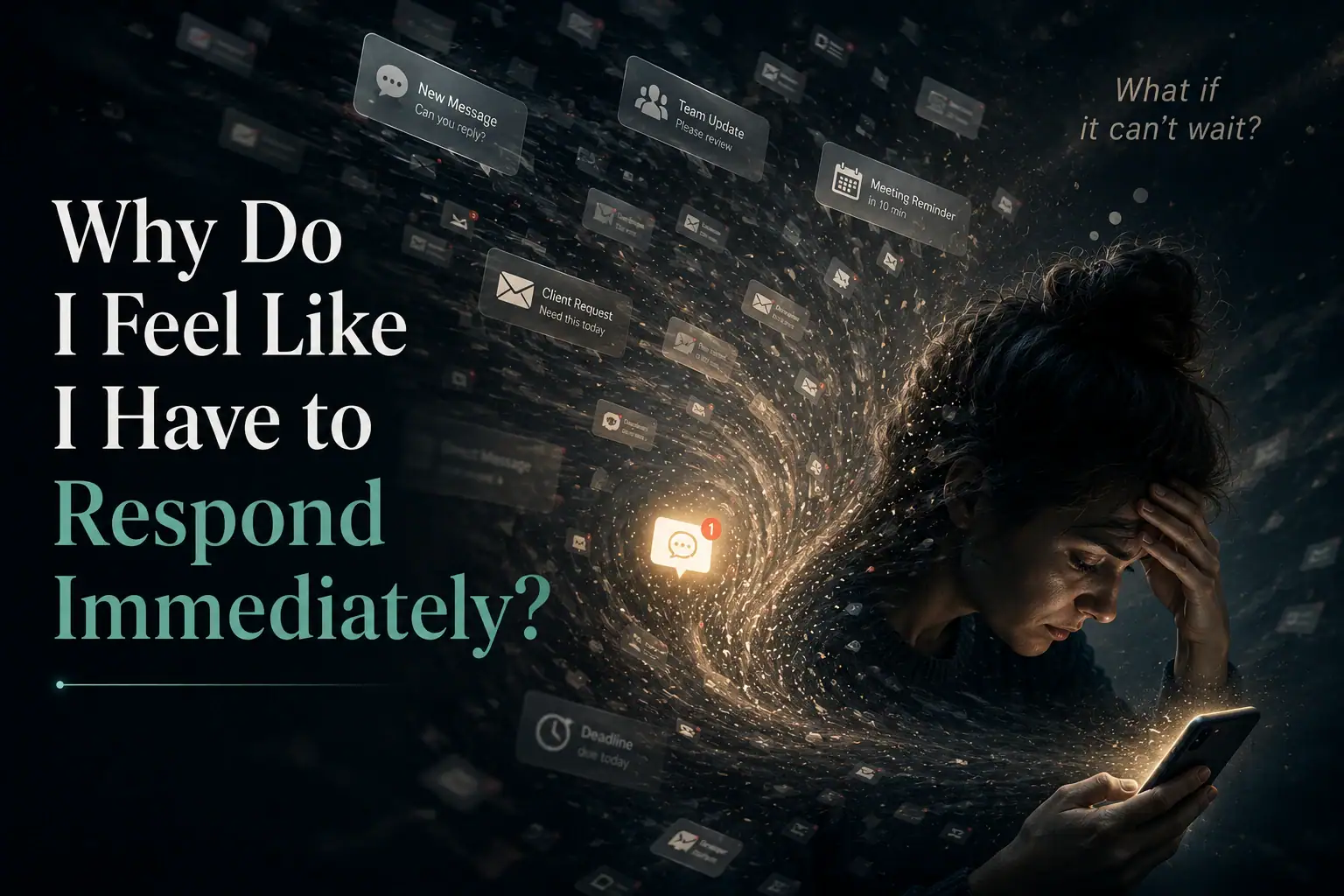
The Immediate Response Loop™: how notifications, uncertainty, social expectations, and cognitive overload train the mind to believe every message cannot wait. Why do I feel like I have to respond immediately?
Estimated reading time: 20–23 minutes
Your phone vibrates.
You notice the reaction before you even read the message.
Your attention shifts.
Your body becomes slightly more alert.
Part of your mind begins preparing a response before you have consciously decided whether the message matters.
An email arrives while you are working.
You tell yourself you will answer later.
Yet the email remains active somewhere in the background of your attention.
A friend sends a message.
A colleague asks a question.
A group chat becomes active.
Nothing is necessarily wrong.
Still, leaving the messages unanswered begins to feel uncomfortable.
Many people are not responding to the importance of the message.
They are responding to the discomfort of leaving it unresolved.
At first, this can look like responsibility.
Good manners.
Professionalism.
Reliability.
Sometimes it is.
But when every message begins feeling impossible to leave unanswered, something deeper may be happening.
Your attentional system may have learned to interpret delayed responses as unresolved cognitive or social threats.
Within Intuition Management, I call this learned pattern the Immediate Response Loop™.
It describes a simple but powerful cycle:
- A notification or message appears.
- The message creates uncertainty or anticipated social pressure.
- Attention shifts toward the unresolved interaction.
- You respond quickly.
- The discomfort temporarily disappears.
- The brain learns that immediate replies are the safest way to remove uncertainty.
- The next message becomes even harder to ignore.
The Immediate Response Loop™ trains attention to seek relief before it evaluates importance.
This article explores how that loop forms, why unread messages remain mentally active, why delayed replies can produce guilt, and how constant responsiveness contributes to cognitive overload.
It also examines a deeper question.
When did communication stop being something we chose—and become something our attention obeyed?
Why Delayed Responses Feel So Uncomfortable
Most people assume the pressure comes from the person waiting for a reply.
Sometimes that is true.
A workplace may reward immediate availability.
A relationship may contain unspoken expectations.
A genuinely urgent situation may require fast communication.
But often, the strongest pressure comes from inside the cognitive system itself.
The human mind is naturally sensitive to unfinished situations.
An unanswered message is not simply stored and forgotten.
It often remains partially active.
The brain keeps monitoring it.
It anticipates possible consequences.
It rehearses potential replies.
It tries to predict what the other person might think.
An unread message is rarely just information.
It can become an unresolved prediction waiting for closure.
This connects directly with the Adaptive Reality Model™.
The mind continuously builds an internal model of reality through perception, prediction, action, and feedback.
When a conversation remains unfinished, the expected feedback has not yet arrived.
The model remains incomplete.
Attention continues allocating small amounts of cognitive energy toward monitoring what might happen next.
One unanswered message may require almost no effort.
Dozens of open conversations create a different cognitive environment.
Email threads.
Group chats.
Direct messages.
Work platforms.
Comments.
Reminders.
Each remains a small unresolved demand competing for limited attention.
The modern problem is not merely that communication is constant.
It is that unfinished communication can remain cognitively active all day.
Why Notifications Feel Stronger Than They Should
A notification is a tiny event.
A sound.
A vibration.
A red badge.
A message preview.
Yet these tiny events can redirect an entire stream of thought.
The reason is not simply distraction.
Notifications introduce uncertainty.
Something has changed.
Someone may need something.
A problem may have appeared.
An opportunity may be waiting.
Your brain does not yet know which possibility is true.
That uncertainty is precisely what makes the signal difficult to ignore.
A notification captures attention not because it is important, but because its importance is still unknown.
This helps explain why people sometimes check their phones automatically.
The message itself is not always the reward.
The reward is resolving uncertainty.
You check.
You discover what happened.
The open prediction closes.
The discomfort decreases.
The brain remembers that sequence.
Over time, it begins preparing the checking response before you have consciously decided to act.
This is why the behavior explored in Why Can’t I Stop Checking My Phone? can feel almost automatic.
The expectation of interruption can become almost as demanding as the interruption itself.
The Attention Economy Rewards Immediate Reactions
Modern communication systems are built around a scarce resource.
Your attention.
Every unread badge asks to be cleared.
Every typing indicator creates anticipation.
Every vibration interrupts the current model of reality with the possibility that something new matters more.
Most interruptions last only a few seconds.
The cognitive effects often last much longer.
Attention does not switch between tasks as cleanly as a computer changes windows.
Part of the previous task remains active.
Part of the new message becomes active.
The mind must then reconstruct the context it abandoned.
This repeated reconstruction contributes to attention fragmentation.
The greatest cost of constant responsiveness is rarely the number of minutes it consumes.
It is the attention it repeatedly breaks apart.
When this happens dozens of times each day, deep thinking becomes increasingly difficult.
You may sit at a desk for hours.
Answer many messages.
Complete many small tasks.
Yet still wonder why you feel busy but get nothing meaningful done.
This pattern is explored more deeply in Why Do I Feel Busy but Get Nothing Done?
The problem is not a lack of activity.
It is that attention never remains stable long enough to support meaningful integration.
Constant responsiveness creates the appearance of productivity while quietly reducing the conditions required for important work.
When Responsiveness Becomes Part of Your Identity
Responding quickly can eventually become more than a habit.
It can become part of how you define yourself.
- “I am the person people can always rely on.”
- “I should never keep anyone waiting.”
- “Good professionals answer immediately.”
- “If I do not respond, I am being irresponsible.”
- “If I reply late, they may think I do not care.”
These beliefs can develop through workplace culture, family expectations, relationships, or years of repetition.
Eventually, delayed communication no longer feels like a neutral choice.
It feels like a violation of your identity.
The pressure becomes internal.
You may feel guilty even when nobody expected an immediate answer.
You may apologize for normal delays.
You may interrupt your own rest to prove that you remain available.
The strongest demand for immediate responsiveness often comes from standards you taught yourself to obey.
This distinction matters because changing the pattern requires more than silencing the phone.
It requires updating the assumptions through which your mind interprets availability, responsibility, and personal value.
Healthy boundaries begin when the internal model stops equating immediate availability with reliability.
Why Delayed Replies Can Feel Socially Dangerous
Communication is not merely informational.
It is relational.
A delayed reply can therefore trigger more than unfinished-task discomfort.
It can activate predictions about relationships.
- Will they think I am ignoring them?
- Will they be disappointed?
- Will they interpret the delay as rejection?
- Will I miss an opportunity?
- Will the problem become worse?
None of these consequences may actually occur.
But the brain does not need certainty to create pressure.
Possibility is often enough.
When attention is already overloaded, imagined social consequences can feel almost as urgent as confirmed ones.
The mind often responds to the possibility of social cost before it knows whether any cost exists.
This is especially powerful when communication platforms reveal that a message has been delivered, read, or left unanswered.
The interaction becomes measurable.
Delay becomes visible.
Visibility creates the feeling that silence now requires explanation.
The mind begins treating every pause as a social signal.
Sometimes it is.
Often it is simply a pause.
The Immediate Response Loop™
The Immediate Response Loop™ becomes powerful because it contains its own reward.
The reward is relief.
A message appears.
Uncertainty rises.
You imagine possible consequences.
You respond.
The unresolved feeling disappears.
The brain learns that immediate action successfully removed discomfort.
Notification → uncertainty → response → relief → stronger expectation of immediate response.
Each repetition slightly strengthens the association.
Eventually, the behavior requires less conscious choice.
Your hand reaches for the phone.
You open the message.
You reply.
Only afterward do you realize that you interrupted something more important.
The loop has begun deciding before conscious reasoning participates.
The Immediate Response Loop™ does not train you to communicate better.
It trains attention to remove uncertainty as quickly as possible.
This is also how the loop connects with the broader False Urgency Loop™.
When many messages create repeated urgency, attention becomes increasingly fragmented.
Fragmented attention reduces the ability to evaluate which messages actually matter.
Reduced discrimination makes even more messages feel urgent.
The two loops begin reinforcing one another.
Why Immediate Responses Feel Responsible
Immediate replies are often associated with positive qualities.
- Responsibility.
- Respect.
- Professionalism.
- Reliability.
- Kindness.
Those qualities matter.
But they are not identical to instant availability.
A thoughtful answer tomorrow may be more responsible than an impulsive answer today.
A focused hour of meaningful work may contribute more than twenty reactive replies.
A delayed response can preserve clarity, reduce misunderstanding, and prevent decisions made under pressure.
Responding immediately and responding responsibly are not always the same thing.
This distinction becomes especially important during decision fatigue at work.
When mental capacity is already reduced, rapid communication can create more mistakes, unclear commitments, and avoidable misunderstandings.
Speed may satisfy the Immediate Response Loop™.
It does not guarantee a useful response.
How Constant Availability Changes Attention
A mind that expects constant communication gradually becomes organized around interruption.
It becomes harder to sustain focus.
Silence feels less natural.
Rest begins feeling incomplete.
The brain keeps anticipating the next message even when no message has arrived.
This helps explain why some people struggle to relax even when nothing is wrong.
The external environment may be quiet.
The internal model remains prepared for interruption.
That state is explored further in Why Can’t I Relax Even When Nothing Is Wrong?
A mind trained to expect interruption eventually becomes restless even when nothing is interrupting it.
Over time, attention can begin jumping between possibilities before any external demand appears.
You check one platform.
Then another.
Then return to the first.
The checking pattern becomes self-generated.
Technology no longer needs to interrupt you.
Your learned expectations begin interrupting you from within.
How to Break the Immediate Response Loop™
If the loop developed through learning, it can also weaken through learning.
The goal is not to ignore people.
It is not to become unreliable.
It is not to delay genuinely urgent communication.
The goal is to restore choice.
The healthiest response system is not the fastest one.
It is the one that can still decide when speed is necessary.
1. Separate the message from the feeling
When a notification appears, notice two different things.
- The message itself.
- The urgency your nervous system attaches to it.
They are not always the same.
A message can be real without being urgent.
An urgent feeling can be intense without accurately representing the message’s importance.
Ask:
Does this require an immediate response, or does it merely create the feeling that I should respond immediately?
2. Introduce small, deliberate delays
You do not need to begin with long periods of disconnection.
Small pauses are enough to create new evidence.
Wait several minutes before answering a non-urgent message.
Finish the paragraph you are writing.
Complete the current thought.
Allow the conversation in front of you to finish before checking another one.
Each pause teaches the brain that delay does not automatically create danger.
Recovery begins when reality repeatedly demonstrates that immediate action was unnecessary.
3. Define genuine response thresholds
Not every communication channel should receive the same priority.
You might decide that:
- Calls from selected people may indicate genuine urgency.
- Work chat can wait until scheduled review periods unless a clear emergency exists.
- Email rarely requires instant attention.
- Social notifications are optional rather than operational.
A clear threshold reduces the number of decisions attention must repeatedly make.
The mind no longer needs to evaluate every message from zero.
4. Replace apology with expectation
Many people reinforce the loop by apologizing for perfectly normal response times.
Constant apologies teach both you and others that delay is a failure.
When appropriate, communicate expectations instead.
You can explain that you check messages at particular times, protect focused work, or respond when you can give the conversation proper attention.
Clear expectations reduce uncertainty without requiring constant availability.
5. Let important communication remain important
When every message is treated as urgent, genuinely important communication loses contrast.
Protecting attention is not neglecting communication.
It is preserving the capacity to recognize which communication truly deserves care.
The Signal vs Noise™ Perspective
The Immediate Response Loop™ becomes easier to understand through the Signal vs Noise™ framework.
Every notification is a signal to your device.
It is not automatically a meaningful signal for your attention.
A signal is information that genuinely improves your understanding of reality or supports an important decision.
Noise is information that consumes attention without meaningfully improving that understanding.
False urgency often disguises noise as signal.
The message feels immediate.
The notification feels impossible to ignore.
Yet responding now may produce no better outcome than responding later.
The question is not whether a message deserves a response.
The question is whether it deserves your attention right now.
This distinction allows communication to become intentional again.
Messages can still matter.
People can still matter.
Responsibility can still matter.
But attention no longer needs to treat every incoming demand as an instruction.
Key Takeaways
- The pressure to respond immediately often reflects learned cognitive habits rather than genuine urgency.
- Unread messages remain mentally active because the brain monitors unfinished and uncertain situations.
- Notifications capture attention partly because their importance is initially unknown.
- Quick replies create temporary relief, reinforcing the Immediate Response Loop™.
- Constant availability fragments attention and contributes to cognitive overload.
- Immediate responsiveness is not always the same as responsibility.
- Healthy communication depends on preserving the freedom to decide when a response is genuinely needed.
- Small, deliberate pauses help recalibrate the brain’s expectations about delay.
- Every notification is a device signal, but not every notification is a meaningful signal for attention.
Frequently Asked Questions
Why do I feel like I have to respond immediately?
You may feel pressure to respond immediately because the brain has learned to associate unanswered messages with unresolved uncertainty, possible social consequences, or unfinished responsibility. Repeated quick replies then create relief, reinforcing the expectation that immediate action is the safest response.
Why do unread messages make me anxious?
Unread messages can remain mentally active because the brain naturally monitors unfinished situations. Until the interaction feels resolved, part of your attention may continue anticipating what the message contains or what the other person expects.
Is responding immediately more productive?
Not necessarily. Some situations require a fast reply, but constant responsiveness often fragments attention and reduces the ability to complete deep or meaningful work. Productive communication depends more on relevance, clarity, and timing than on speed alone.
Why do notifications interrupt my thinking so easily?
Notifications introduce uncertainty and the possibility that something important has changed. The brain shifts attention toward resolving that uncertainty, even before it knows whether the message is relevant.
Can cognitive overload make communication feel more stressful?
Yes. When attention is already overloaded, every additional message becomes another demand that must be interpreted, prioritized, and remembered. Ordinary communication can therefore begin feeling disproportionately urgent or mentally expensive.
Why do I feel guilty for replying late?
Replying late may create guilt when your internal model equates rapid responsiveness with respect, reliability, or personal value. Repeated experiences of healthy delayed communication can gradually weaken that assumption.
Will turning off notifications solve the problem?
Reducing notifications can help protect attention, but it may not fully change the learned expectation that every message deserves an immediate reply. Long-term improvement also requires recalibrating how you interpret uncertainty, delay, and responsibility.
How can I stop responding automatically?
Create a brief pause before opening or answering non-urgent messages. Ask whether the communication genuinely requires immediate action or merely creates an urgent feeling. Small repeated delays help restore conscious choice.
About the Immediate Response Loop™
The Immediate Response Loop™ is a conceptual framework developed as part of Intuition Management. It is not presented as a clinical diagnosis or a formal scientific theory.
The framework integrates established ideas from attention research, cognitive load, predictive processing, habit formation, decision-making, and digital communication into a practical model for understanding why messages and notifications can begin feeling impossible to leave unanswered.
Its central sequence is:
Notification → uncertainty → immediate response → temporary relief → stronger expectation of immediate response.
Within the wider Intuition Management system, the Immediate Response Loop™ connects with the False Urgency Loop™, the Adaptive Reality Model™, and Signal vs Noise™.
A useful framework does not replace evidence.
It organizes evidence into a form that helps people recognize patterns, ask better questions, and make more intentional decisions.
Final Thought
Perhaps the greatest illusion of modern communication is not that we receive too many messages.
It is that every message appears to deserve immediate attention.
Every unread badge creates an open possibility.
Every vibration asks whether something has changed.
Every typing indicator creates anticipation.
Each quietly asks the same question.
“Will you give me your attention now?”
The goal is not to reject communication.
It is to recover the freedom to decide.
To decide what is urgent.
To decide what can wait.
To decide when a thoughtful response is more valuable than a fast one.
Every intentional pause teaches the mind something important.
Not every delay creates a problem.
Not every unanswered message damages a relationship.
Not every notification deserves the moment it requests.
Over time, attention becomes less reactive.
Communication becomes more deliberate.
Thinking becomes clearer.
And responsiveness returns to what it was always meant to be.
A choice—not a reflex.
The goal is not to answer every message faster.
The goal is to remain free to decide when your attention is truly needed.
Continue Exploring
- Why Does Everything Feel Urgent?
- Why Can’t I Stop Checking My Phone?
- Cognitive Overload Recovery
- How the Mind Builds an Internal Model of Reality
- Signal vs Noise™
- Decision Fatigue at Work
- Why Can’t I Relax Even When Nothing Is Wrong?
- Your Intuition Journey