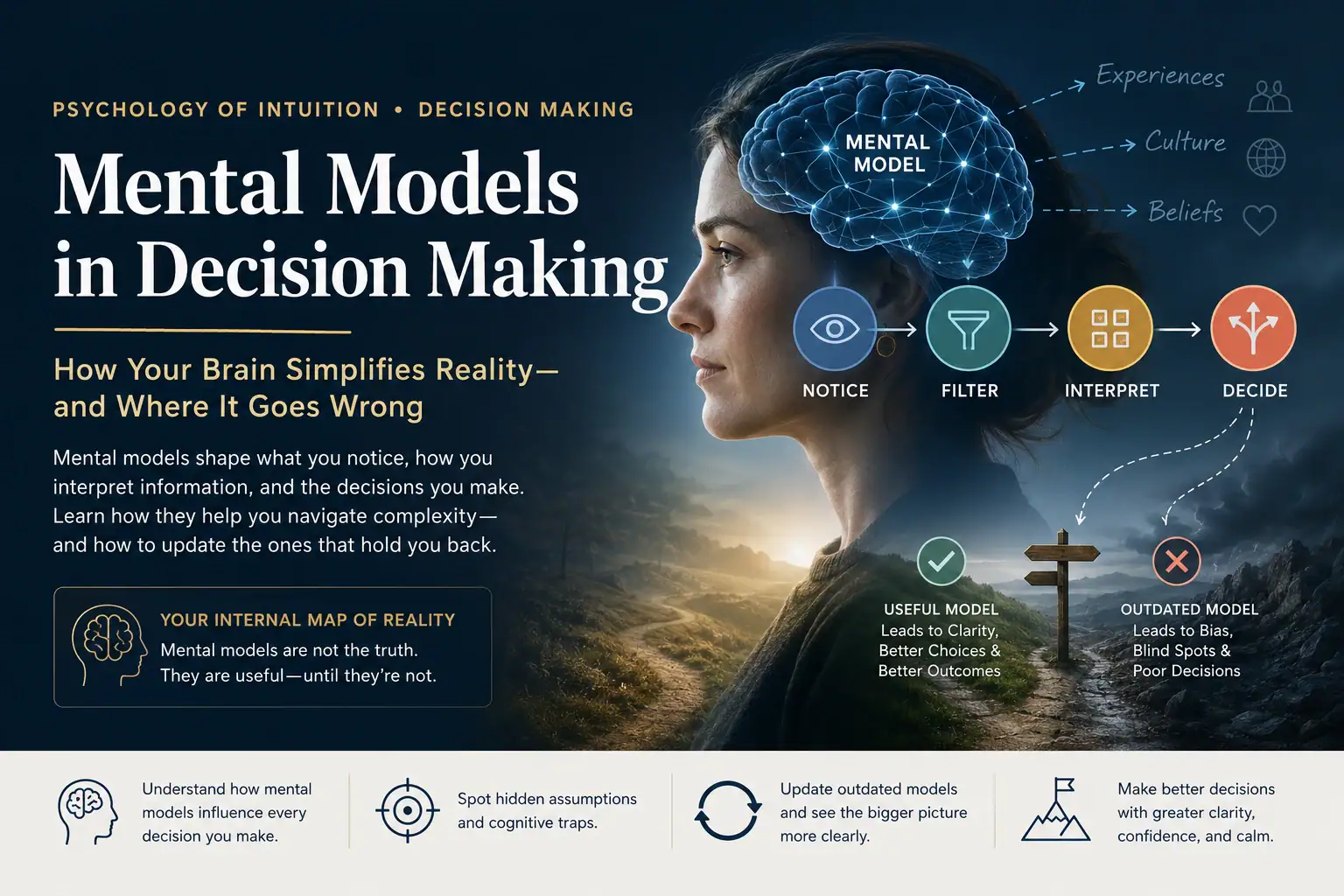
Every decision begins with more than the facts in front of you. Your brain interprets those facts through an internal picture of how the world works—a mental model. Mental models in decision making help you move quickly through complexity, but they can also quietly distort what you notice, expect, and choose.
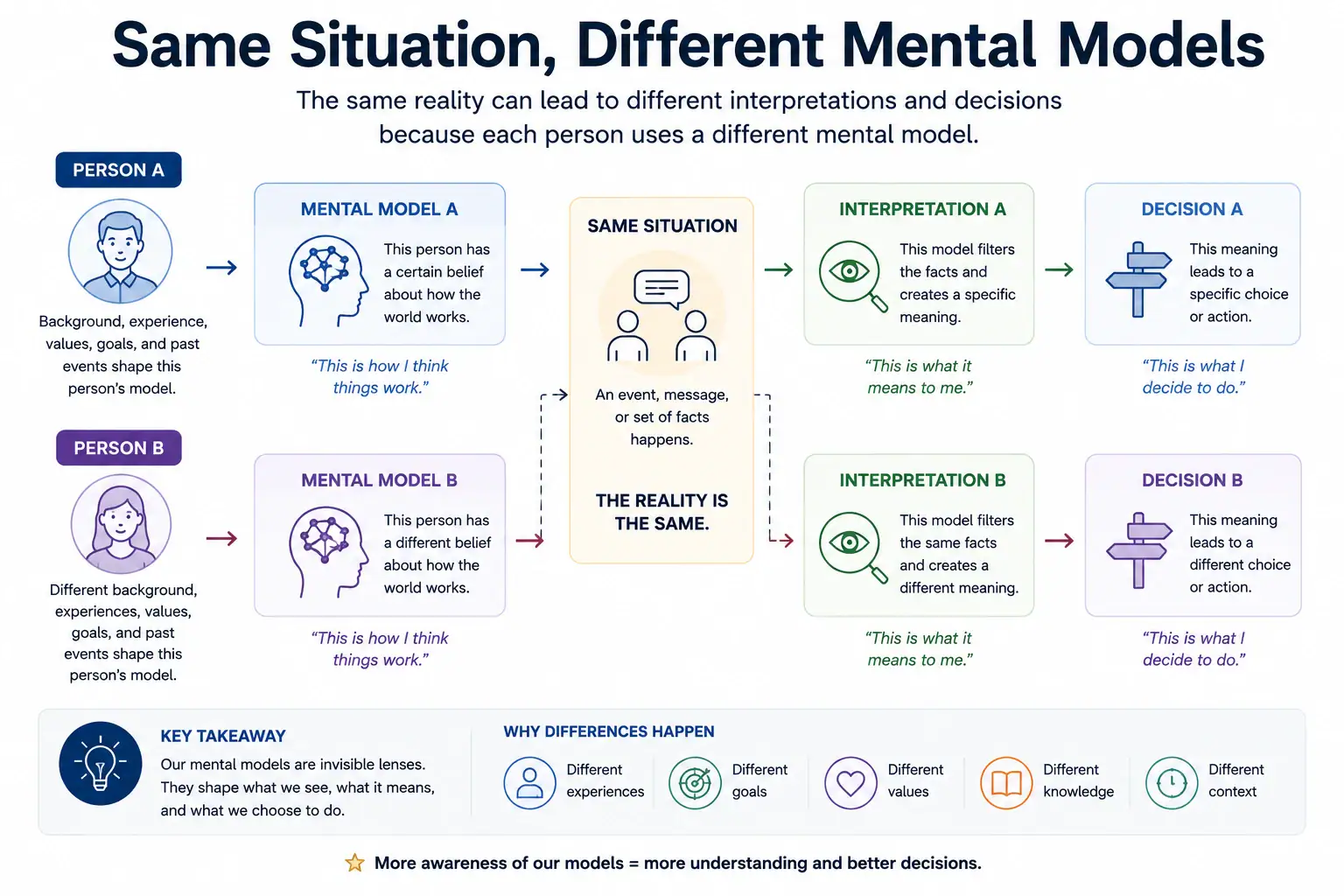
Imagine two people receiving the same short message from a manager: “Can we talk later?” One reads it as routine. The other immediately assumes something is wrong. The message is identical. The difference lies in the model each person brings to the situation.
Mental models influence decision making by shaping how you interpret information, what outcomes you expect, and which actions seem reasonable. They simplify complex reality into a workable internal representation. When the model fits the environment, it can improve judgment; when it is outdated or incomplete, the same shortcut can create blind spots and biased choices.
This guide explains how mental models form, how they interact with attention and intuition, why outdated models become cognitive traps, and how to update them when reality no longer fits.
What Are Mental Models in Decision Making?
A mental model in decision making is a simplified internal representation of how a situation, system, person, or cause-and-effect relationship works. It helps you interpret what is happening, anticipate what may happen next, and choose a response without rebuilding your understanding from zero every time.
The concept has a long history in cognitive science. Philip Johnson-Laird’s work on mental models proposed that reasoning can depend on constructing representations of possible states of affairs rather than merely applying abstract rules. His 2010 review describes reasoning as involving possibilities consistent with what a person perceives, remembers, or is told. Johnson-Laird, 2010.
In everyday life, your models are rarely explicit diagrams in your head. They are more often working expectations such as: “People who answer quickly are more reliable,” “If I am uncertain, I should wait,” or “This kind of project always runs late.” Some models are useful. Some are incomplete. Some were once accurate but no longer fit the environment you are in.
Why Your Brain Needs Mental Models
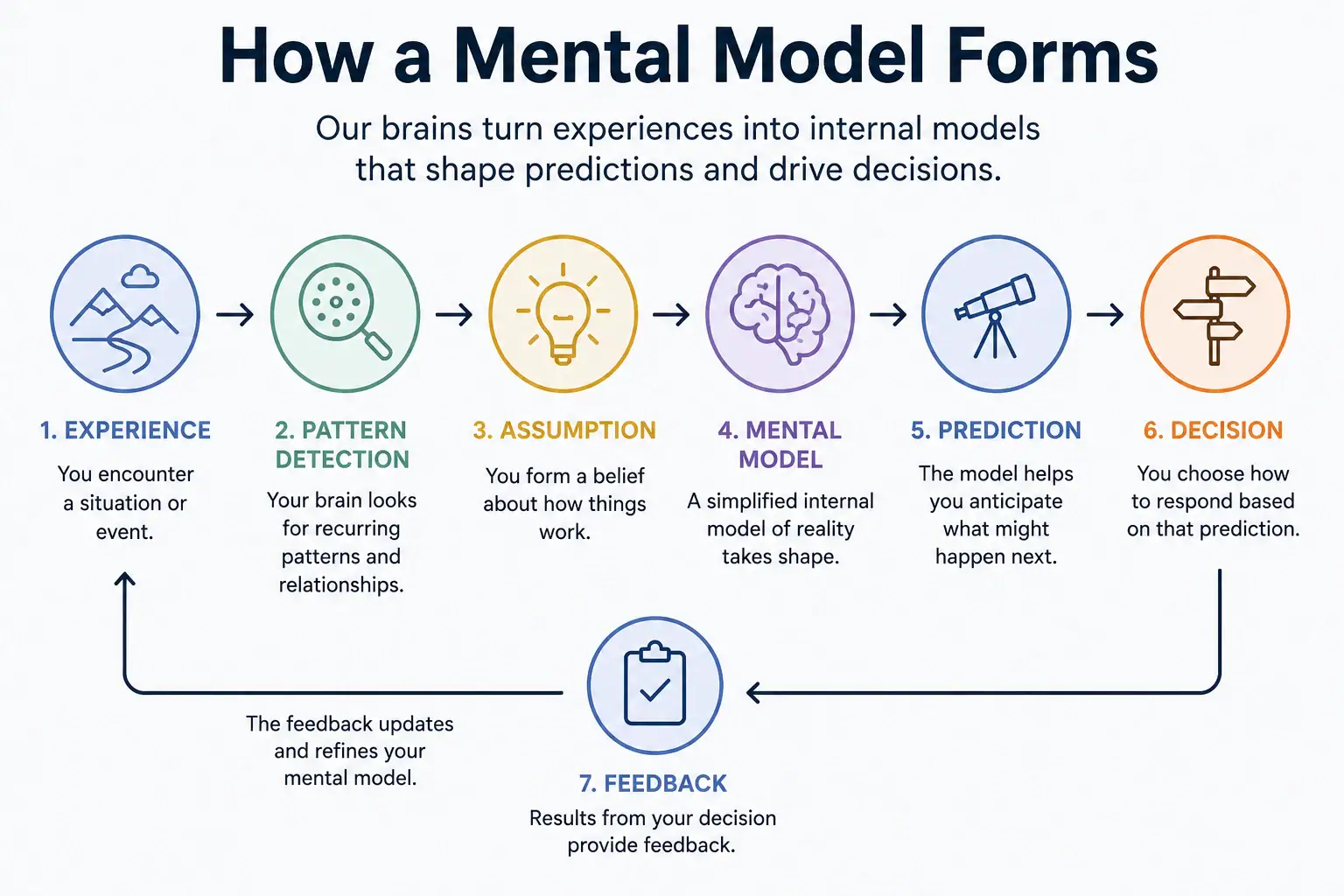
Reality contains more information than you can consciously analyze in any given moment. Decision making therefore depends on compression. You recognize familiar patterns, reuse previous knowledge, infer missing details, and make predictions from partial evidence.
Mental models are useful because they reduce cognitive effort. They help you:
- organize complex information into a workable structure;
- recognize recurring relationships and causes;
- predict likely consequences before acting;
- interpret ambiguous or incomplete situations;
- transfer lessons from previous experience into new decisions.
This is adaptive. If every ordinary decision required a complete analysis of every possible interpretation, action would become impossibly slow. The problem is not that people use mental models. The problem begins when a model becomes invisible to the person using it.
When you stop seeing the model as a model, it can start feeling like the only possible description of reality.
How Mental Models Shape What You Notice
People often assume perception works like a camera: information enters, then the mind interprets it. In practice, expectations and attention interact with incoming information. Research on perceptual decision making shows that expectations can bias processing before a stimulus occurs and can influence decision signals. Expectation and attention are related but distinct: expectation concerns what is likely, while selective attention concerns what is relevant. Summerfield & de Lange, 2014.
This matters because your existing model can influence which features of a situation feel important. If your model says “uncertainty means danger,” ambiguous information may stand out more strongly as a threat. If your model says “uncertainty is normal during learning,” the same ambiguity may be interpreted as incomplete information rather than evidence of failure.
That is one reason two people can look at the same evidence and walk away with different conclusions.
For the broader mechanism of selective interpretation, see What Are Mental Filters? and Internal Model of Reality.
Mental Models vs Mental Filters
Mental models and mental filters overlap but aren’t the same: a filter affects what information gets your attention, while a model determines what that information means. The two can reinforce each other — a model shapes what you expect, which shapes what you notice, which then seems to confirm the model.
For the full breakdown, see What Are Mental Filters?
Mental Models vs Cognitive Biases
A mental model is a representation you use to understand or predict a situation. A cognitive bias is a systematic tendency that can skew judgment. The distinction matters because mental models are not inherently errors: many are useful and can become more accurate through experience and feedback.
Bias enters when the way information is selected, interpreted, remembered, or weighted systematically favors a particular conclusion. A rigid model can interact with those biases—for example, by directing attention toward confirming evidence and away from disconfirming evidence. The practical goal is therefore not to eliminate models, but to make them visible enough to test.
Your Brain Uses Mental Models to Predict What Happens Next
A useful mental model does more than describe the present. It generates expectations about the future. You predict whether someone will respond, whether a plan will work, whether a situation is safe, or whether a choice will produce a desired result.
Modern work on predictive processing treats prediction as an important organizing idea in perception and cognition, although researchers continue to debate the exact neural implementation. A 2026 review argues that evidence supports predictive influences across multiple levels while cautioning against assuming one single canonical cortical mechanism. Auksztulewicz et al., 2026.
That distinction matters. It is reasonable to say that prior expectations influence perception and learning; it is less responsible to claim that every mental process is explained by one simple “prediction machine” metaphor.
Prediction also gives us a practical way to evaluate a mental model: what did the model lead you to expect, and what actually happened?
If the difference between prediction and outcome is meaningful, that mismatch can become information for learning. Prediction error is broadly defined as a discrepancy between expected and actual outcomes and plays an important role across learning, perception, cognition and action. Corlett, Mollick & Kober, 2022.
This predictive perspective also connects directly to intuition. See What Intuition Really Is: Pattern Recognition Under Uncertainty, Cognitive Intuition: How the Brain Predicts the Future, and Intuition in Decision Making.
When a Useful Mental Model Becomes a Cognitive Trap
A mental model can be useful when it forms and misleading later. Environments change. People change. Your role changes. New evidence appears. Yet a model may continue operating because it has become familiar.
Consider a few examples:
- “Fast replies mean competence.” This may work in one environment and fail in another where careful work requires slower response.
- “If someone disagrees with me, they do not understand the problem.” This model can turn disagreement into evidence of ignorance rather than useful feedback.
- “Past success proves this strategy will work again.” A formerly effective model can become a liability when conditions change.
- “Feeling uncertain means something is wrong.” This can transform ordinary ambiguity into a false danger signal.
The danger grows when selective attention starts protecting the model. You notice evidence that fits and overlook evidence that does not. This resembles the broader family of confirmation effects: people can seek, interpret, or remember information in ways that favor existing beliefs.
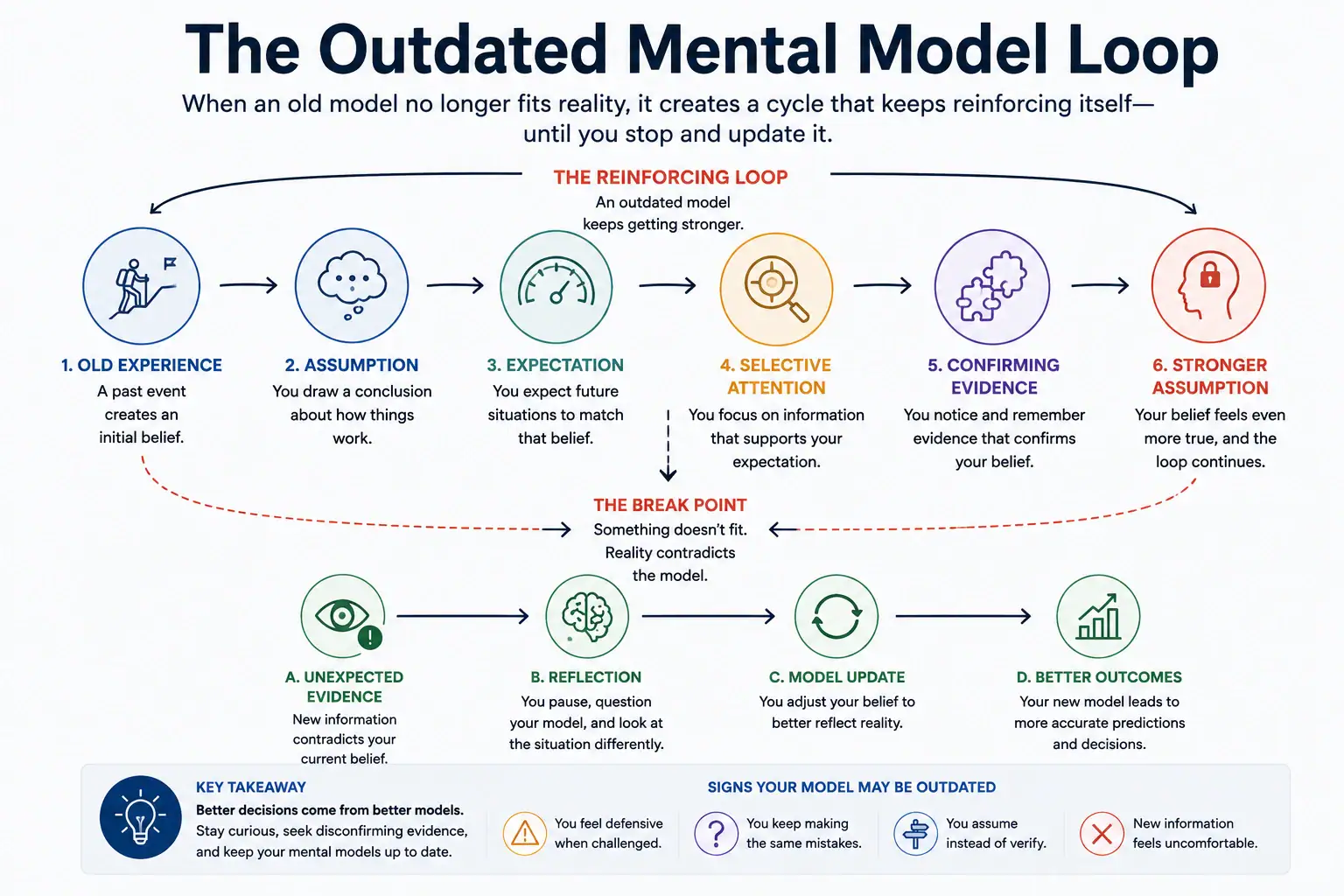
When a model explains everything, ask whether it is truly accurate—or simply filtering out what would challenge it.
7 Examples of Mental Models Affecting Everyday Decisions
The goal here is not to catalog famous business frameworks. For a broader library, see Mental Model Examples. Instead, look at how ordinary internal models alter real decisions.
1. Reading an ambiguous email
Model: “Short messages mean irritation.” The decision may be to become defensive before any actual conflict exists.
2. Speaking in a meeting
Model: “A good idea must be fully formed before I share it.” The result can be silence, even when early input would improve the idea.
3. Evaluating another person
Model: “Confidence signals competence.” This can make presentation style outweigh actual evidence.
4. Changing direction
Model: “Changing course means the original decision was a failure.” That belief can make adaptation feel like defeat rather than learning.
5. Interpreting uncertainty
Model: “If I am not certain, I should not act.” This can produce analysis paralysis in situations where certainty is impossible.
6. Trusting intuition
Model: “A strong feeling must be meaningful.” Intensity and accuracy are not the same. A strong response can come from expertise, habit, fear, memory, or bias.
7. Using data or AI
Model: “More information automatically leads to a better decision.” More information helps only when the underlying interpretation is sound. A flawed model can process more data and still reach the wrong conclusion.
Why Two Intelligent People Can See the Same Reality Differently
Disagreement does not always mean that one person is irrational. Two people can start with the same facts yet use different models to organize them.
Their models may differ because of:
- previous experiences;
- knowledge and expertise;
- goals and incentives;
- values;
- social or organizational context;
- assumptions about cause and effect.
So the same evidence can produce two coherent but incompatible interpretations. This is especially important in teams, relationships, and leadership. Before debating conclusions, it can be more productive to ask: “What model would make their conclusion make sense?”
For a deeper exploration, see Why Do Smart People Believe Opposite Things? and Why Do We Get Stuck in One Way of Thinking?.
Mental Models and Intuition
Intuition is often described as the opposite of deliberate reasoning, but that distinction can be misleading. Experienced intuitive judgments may depend on patterns learned over time. In environments with enough regularity and valid feedback, people can develop reliable intuitive expertise; in less predictable environments, confidence may outrun accuracy.
Daniel Kahneman and Gary Klein reached an important point of agreement after comparing the heuristics-and-biases and naturalistic-decision-making traditions: the likely quality of intuitive judgment depends heavily on the predictability of the environment and the opportunity to learn its regularities through feedback. They also cautioned that subjective confidence is not itself a reliable indicator of accuracy. Kahneman & Klein, 2009.
That leads to a better question than “Should I trust my gut?” Ask:
Sometimes intuition is experienced pattern recognition. Sometimes it is an old prediction being applied to a new situation. Sometimes it is anxiety, habit, or a bias that feels familiar enough to be mistaken for insight.
Use the distinctions in Intuition vs Bias and Intuition or Anxiety? when the signal itself is difficult to interpret.
How to Identify the Mental Model Driving a Decision
The most useful mental models are often invisible while you are using them. The following five-question check is designed to make hidden assumptions visible before an important choice.
1. What do I currently believe is happening?
Describe the situation in one or two sentences. Separate observable facts from interpretation.
2. What am I assuming must be true?
Look for the rule underneath your reaction: “People like this always…”, “If X happens, it means Y…”, or “I cannot act until…”.
3. What evidence supports the assumption?
List concrete observations rather than feelings of certainty. A model deserves more confidence when it repeatedly predicts outcomes well.
4. What evidence would contradict it?
This is the harder question. Ask what you would expect to see if your current model were wrong. Then actively look for that information.
5. What alternative model also fits the facts?
Generate at least one explanation that does not depend on the same assumption. The purpose is not to force a positive interpretation. It is to widen the hypothesis set.
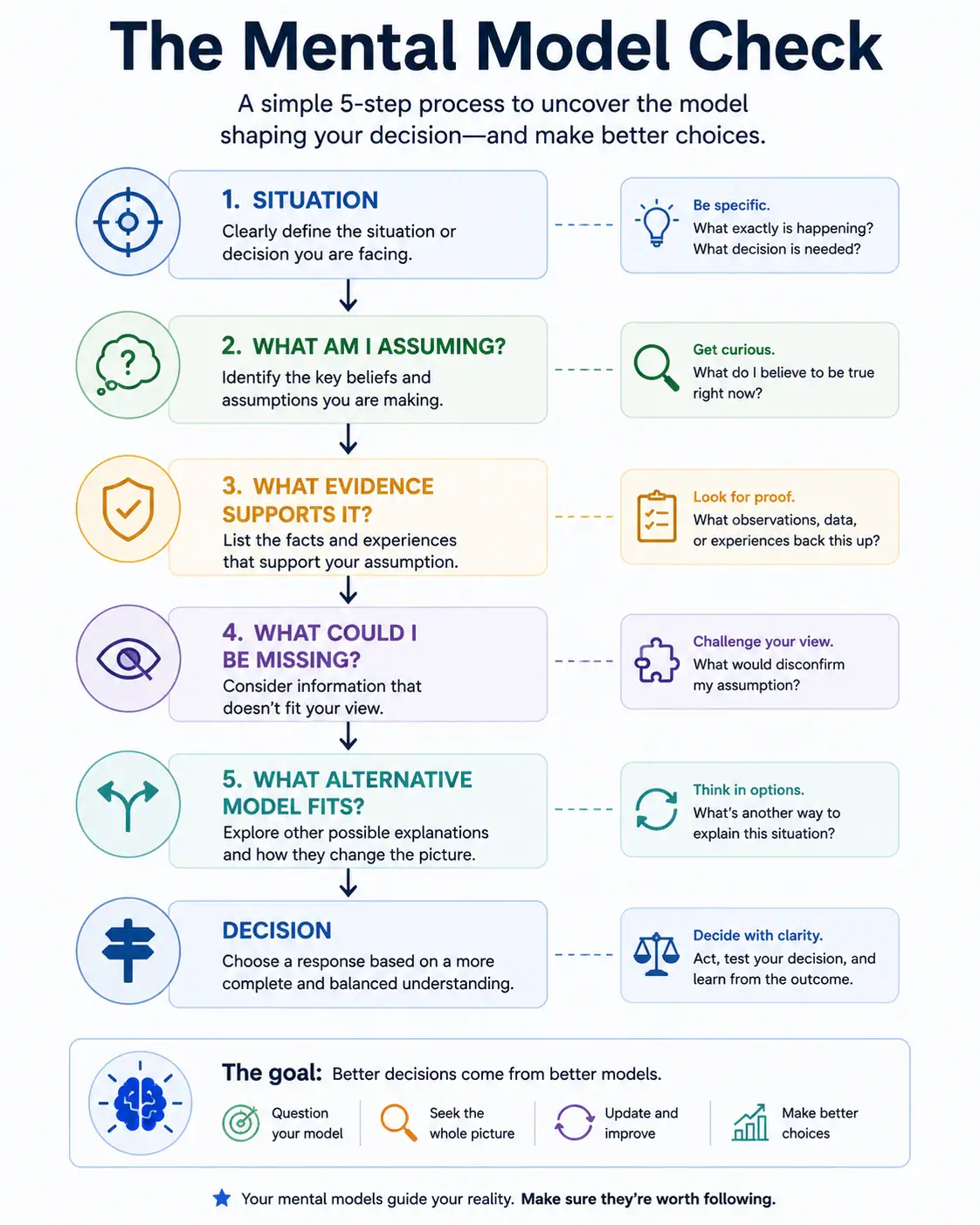
Once you can name the model, you gain a choice you did not have before: continue using it, modify it, or replace it.
How to Update an Outdated Mental Model
Updating a mental model is not the same as replacing a negative belief with a positive one. The goal is not optimism. The goal is a model that predicts reality more accurately and supports better decisions.
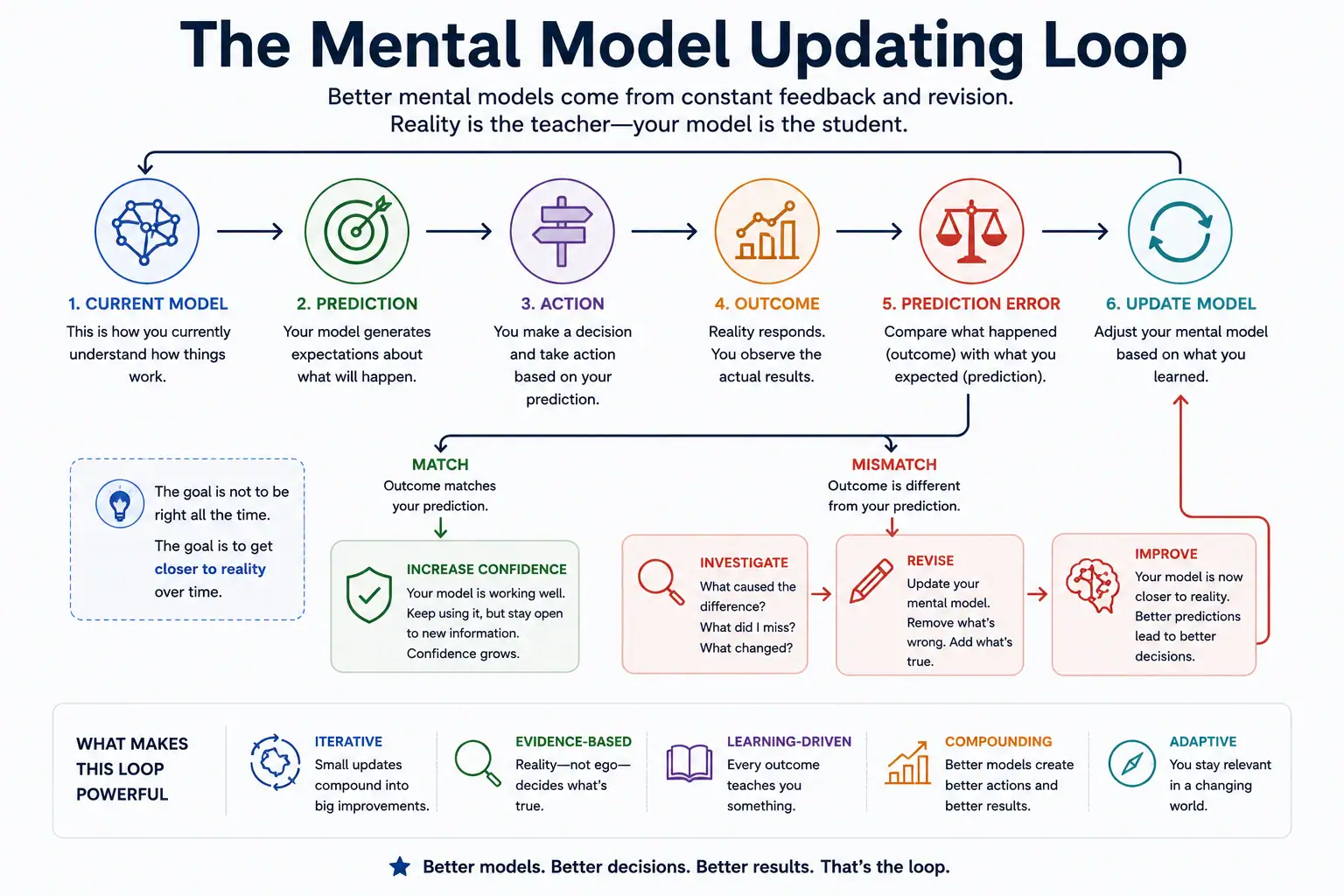
A practical updating cycle looks like this:
Notice → predict → act → observe → compare → revise.
Suppose your current model is: “I need certainty before acting.” That model predicts that waiting for more information will improve the decision. You can test it. If waiting repeatedly adds little value while delaying useful action, that mismatch is evidence.
An alternative model might become: “I need enough information to choose the next reversible step.” You then test that model against outcomes rather than accepting it because it sounds better.
A large meta-analysis of human neuroimaging studies found prediction-error-related signals across reward, punishment, cognition, perception, action and social inference, while also identifying domain-specific patterns. Corlett, Mollick & Kober, 2022.
This does not mean every mismatch should force a model change. A single surprising event may be noise. Better updating asks whether the evidence is reliable, whether the environment changed, and whether the new model performs better across repeated observations.
Better Decisions Require Better Models, Not Just More Information
Modern decision making often treats information as the scarce resource. Frequently, it is not. The harder problem is interpretation.
You can have more dashboards, more reports, more opinions, more AI-generated analysis, and still make a poor choice if the model connecting those inputs to meaning is wrong.
A useful decision process therefore asks two kinds of questions:
- Information questions: What do I know? What evidence is missing? How reliable is it?
- Model questions: What assumptions make this evidence meaningful? What am I predicting? What would change my mind?
This is also why mental flexibility does not mean abandoning conviction. A good model can deserve strong confidence when it has survived repeated tests. The discipline is keeping that confidence proportional to the evidence.
If you want to continue, explore What Are Mental Models?, Mental Model Examples, and How to Make the Right Decision.
Frequently Asked Questions
What is a mental model in decision making?
A mental model is a simplified internal representation of how a situation or system works. In decision making, it helps you interpret evidence, generate expectations, anticipate consequences, and choose a response. Mental models are useful because they reduce complexity, but they can mislead you when their assumptions no longer match reality.
How do mental models influence decisions?
Mental models influence what you expect, which information seems important, how you interpret ambiguous evidence, and which outcomes appear likely. Because decisions depend on those interpretations, two people can receive the same facts and choose differently if their underlying models differ.
What is the difference between a mental model and a cognitive bias?
A mental model is a representation used to understand or predict something. A cognitive bias is a systematic tendency that can distort judgment. A mental model is not automatically biased; it may be accurate and useful. But a flawed or rigid model can interact with biases such as selective attention or confirmation effects.
Can mental models be wrong?
Yes. All mental models simplify reality, so none is complete. A model becomes especially problematic when it repeatedly produces poor predictions, ignores contradictory evidence, or continues to be applied after the environment has changed. The goal is not a perfect model but one that is useful, testable, and open to revision.
How can I identify my mental models?
Start with a decision or strong interpretation and ask: What do I believe is happening? What am I assuming? What evidence supports that assumption? What evidence would contradict it? What alternative explanation could also fit the facts? These questions make an implicit model easier to examine.
How do you change an outdated mental model?
Turn the model into a prediction, compare that prediction with real outcomes, investigate meaningful mismatches, and revise the underlying assumption. Then test the revised model again. Repeated feedback is more useful than replacing one untested belief with another.
Research Sources
- Johnson-Laird PN. Mental models and human reasoning. Proceedings of the National Academy of Sciences. 2010. doi:10.1073/pnas.1012933107.
- Summerfield C, de Lange FP. Expectation in perceptual decision making: neural and computational mechanisms. Nature Reviews Neuroscience. 2014. doi:10.1038/nrn3838.
- Kahneman D, Klein G. Conditions for intuitive expertise: a failure to disagree. American Psychologist. 2009. doi:10.1037/a0016755.
- Corlett PR, Mollick JA, Kober H. Meta-analysis of human prediction error for incentives, perception, cognition, and action. Neuropsychopharmacology. 2022. doi:10.1038/s41386-021-01264-3.
- Auksztulewicz R, De Martino F, Kotz SA, Trübutschek D. From errors to beliefs and routes: Rethinking cortical inference. Neuroscience & Biobehavioral Reviews. 2026. doi:10.1016/j.neubiorev.2026.106870.