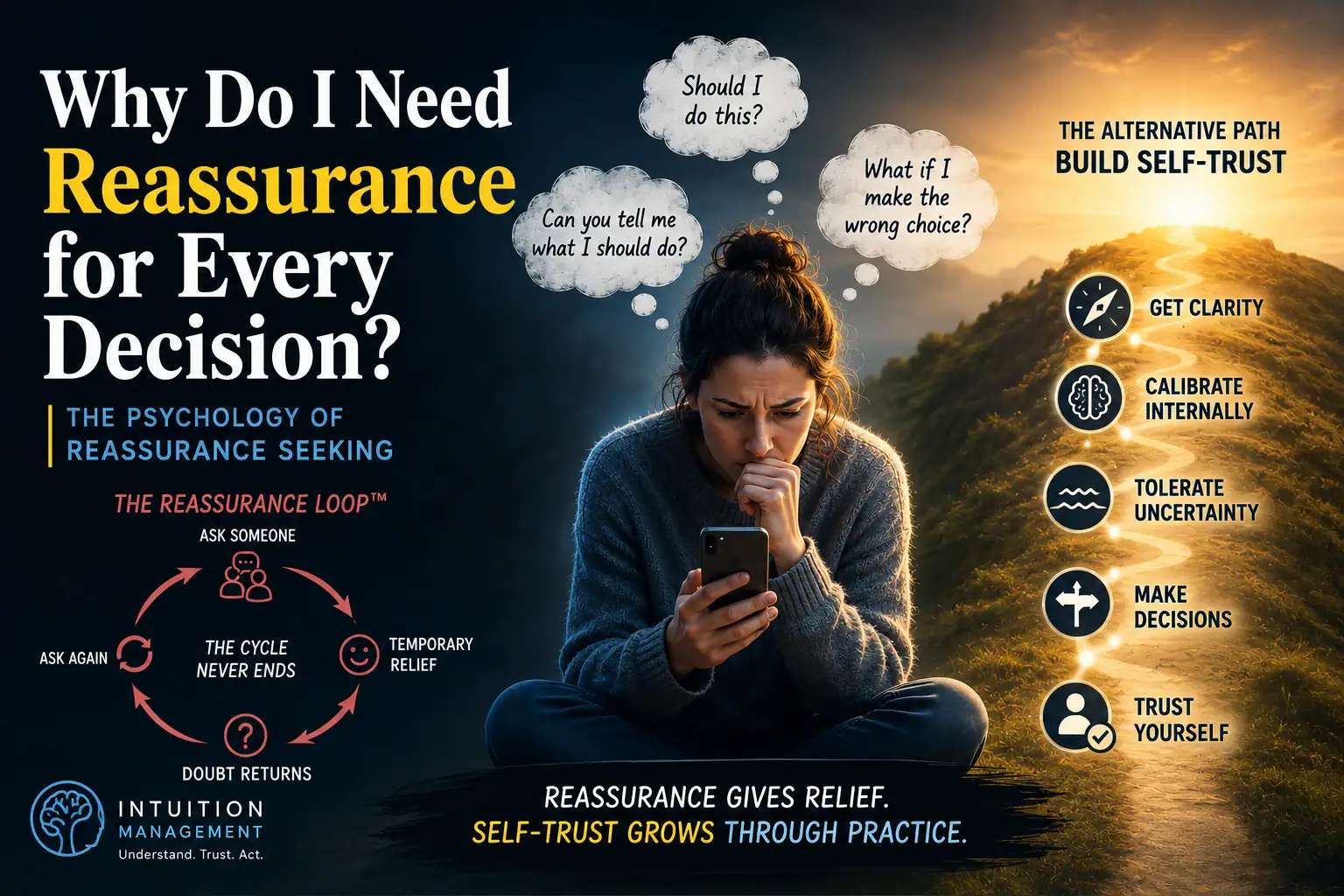
If you need reassurance for nearly every decision, you may not actually be missing information. You may be trying to make the uncertainty disappear. Another person’s approval can briefly make a choice feel safer, but if you repeatedly rely on that relief, ordinary decisions can begin to feel harder to trust on your own.
The important distinction is this: asking for advice is not the problem. Good decisions often improve when we consult people with relevant knowledge or experience. Reassurance becomes less useful when the real goal shifts from learning something new to hearing, once again, that you are making the “right” choice.
This article explains why that pattern can happen, how to distinguish useful information-seeking from certainty-seeking, and how to build decision confidence through a repeatable process of choosing, observing, learning and calibrating.
Why reassurance feels so helpful
Uncertainty is uncomfortable because a decision is not only a choice between options. It is also a prediction about a future you cannot fully see. Your mind has to act before all outcomes are known.
That gap between “I have to choose” and “I cannot know exactly what will happen” creates room for doubt. Reassurance can temporarily close that gap. When someone says, “Yes, I think that is the right choice,” your brain receives something that feels like additional certainty.
Research on excessive reassurance seeking has found that reassurance can reduce perceived threat and uncertainty in the short term. In clinical research, reassurance seeking is also associated with repetitive checking and with attempts to reduce distress around feared outcomes. These findings come largely from studies of obsessive-compulsive and related symptoms, so they should not be used to label ordinary advice-seeking as a disorder. They do, however, help explain why reassurance can become repetitive: the immediate relief is real even when the underlying uncertainty has not disappeared.
The practical question is therefore not, “Do I ever ask other people what they think?” It is:
“Does this conversation give me useful information, or am I using another person’s confidence to make my discomfort go away?”
The Reassurance Loop™
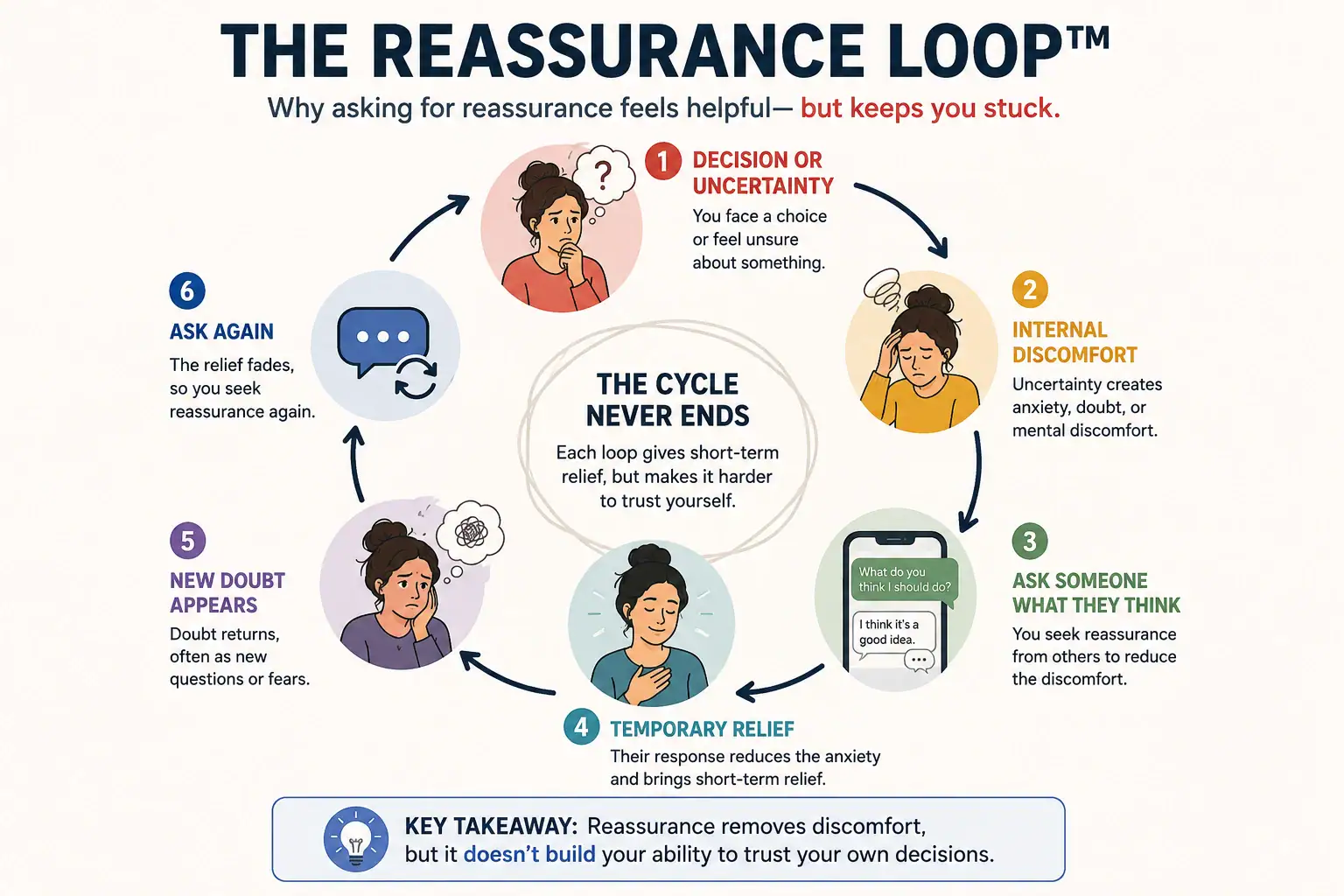
A common reassurance pattern looks like this:
Decision or uncertainty → internal discomfort → ask someone what they think → temporary relief → new doubt appears → ask again.
The loop is not inevitable. Nor does every request for reassurance weaken self-trust. The important pattern is repetition without meaningful new information.
Imagine that you are choosing between two jobs. You have compared salary, role scope, manager quality, commute and growth potential. You ask a trusted colleague for perspective and learn something useful about one company’s culture. That is information seeking.
But then you ask another friend, your partner, two coworkers, an online forum and an AI assistant—without receiving facts that materially change the decision. Each answer helps for a few minutes, yet a new question appears: “But what if they are wrong?” “What if I regret it?” “What if the other option was actually better?”
At that point, the activity may no longer be improving the decision. It may be functioning primarily as a way to regulate uncertainty.
Information seeking vs certainty seeking

The easiest way to understand reassurance seeking is to separate two goals that can sound almost identical in conversation.
Information seeking asks: “What am I missing?”
Certainty seeking asks: “Can you make me feel sure?”
Information seeking has a natural stopping point. When you obtain the relevant fact, the question is answered. Certainty seeking can continue even after the decision contains enough information, because no amount of advice can provide complete control over the future.
A useful test is to ask yourself four questions before requesting another opinion:
- What specific piece of information am I trying to obtain?
- Would this person realistically know something I do not?
- Could their answer change the decision, or only change how I feel about it?
- If they reassure me, how long do I expect the relief to last?
If you cannot identify a missing fact, you may be looking for permission rather than information.
Why you can know the answer and still need someone to confirm it
Sometimes the most confusing form of reassurance seeking happens when you already know what you want to do.
You may have a preferred option, good reasons for choosing it and no major missing information—yet you still feel compelled to ask, “What would you do?”
The hidden question may be different from the spoken question.
“What do you think?” can mean:
- “Will I be okay if I choose this?”
- “Can you guarantee I will not regret it?”
- “Will you still support me if this goes badly?”
- “Can I blame the decision less if you agree with me?”
- “Can you remove the uncomfortable feeling I have right now?”
This is one reason important decisions can remain emotionally difficult after the rational work is finished. A decision can be reasonable without feeling certain.
That distinction matters because feelings of doubt are not always evidence that a choice is wrong. Sometimes they are simply what uncertainty feels like.
If you notice that thinking more makes you feel less certain rather than more informed, see Why You Feel Less Certain the More You Think. If you repeatedly reopen choices after making them, Why Do I Second Guess Myself? explores that pattern directly.
The Confidence Outsourcing Effect™
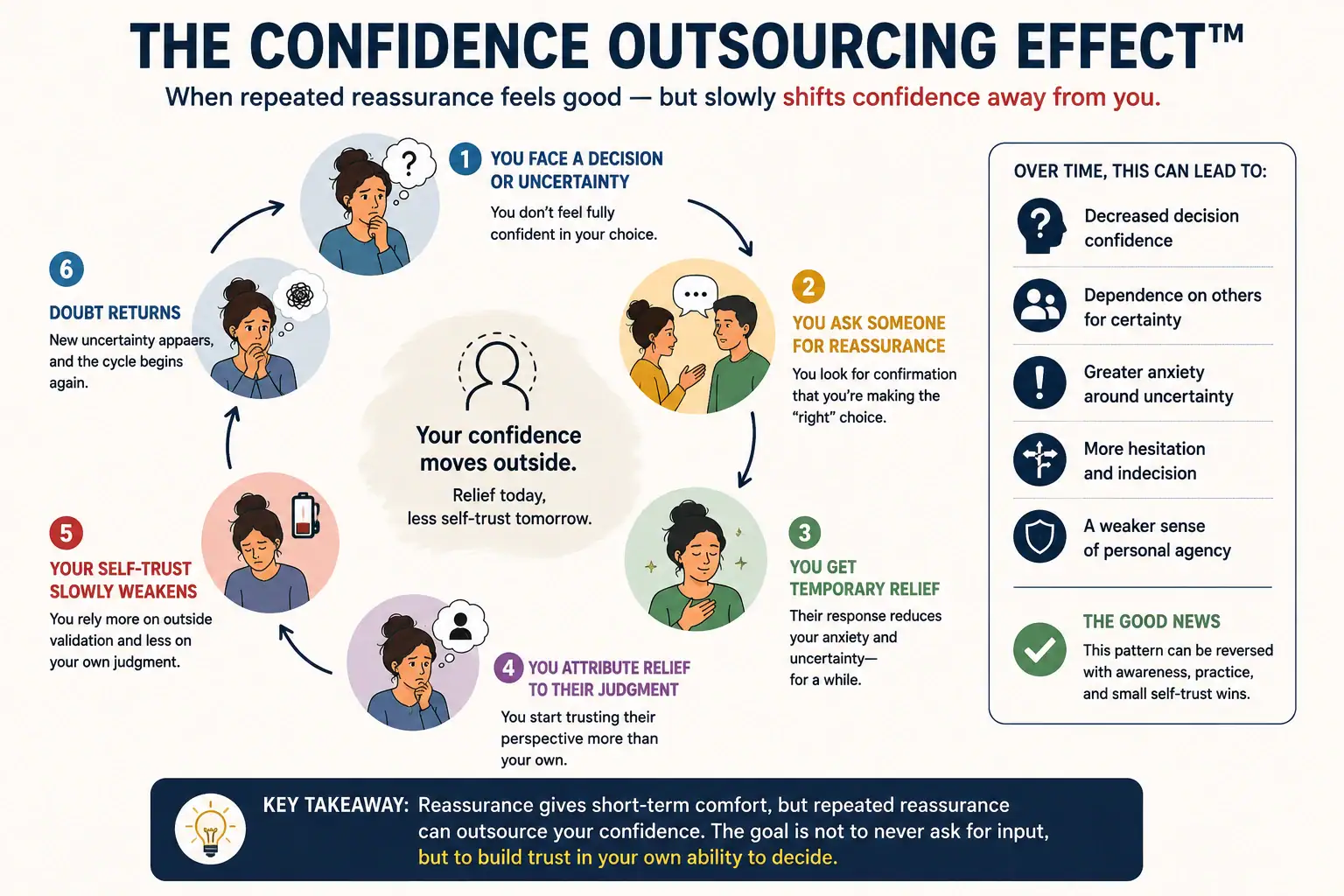
When someone else reassures you, two things can happen at once: you feel better, and you may attribute that relief to their judgment.
If this becomes your default way of making uncertainty tolerable, confidence can begin to feel as though it lives outside you. Instead of thinking, “I considered the evidence and chose,” you may start thinking, “I can trust this choice because other people approved it.”
That shift does not happen automatically, and ordinary consultation is not harmful. The concern is dependence on external confirmation as the main source of decisional safety.
Over time, the internal rule can subtly change:
“Other opinions help me think” → “Other opinions help me feel safe” → “I do not feel safe unless someone confirms my choice.”
This is why rebuilding decision confidence is not mainly about forcing yourself to “be more confident.” It is about giving your own decision process repeated opportunities to work.
For a deeper look at the broader self-trust problem, see Why Can’t I Trust Myself Anymore? and Why You Don’t Trust Your Decisions.
Why more opinions can create more uncertainty

More advice does not always mean better advice.
A second perspective can reveal a blind spot. A specialist can identify a risk you did not know existed. Multiple qualified opinions can be essential in high-stakes medical, legal, financial or technical decisions.
But in ordinary decisions, there is a point at which additional opinions stop adding meaningful information and start adding variables.
One person says choose A because it is safer. Another says B because it has more upside. A third values flexibility. A fourth values prestige. A fifth projects their own past experience onto your situation. None of them is necessarily wrong; they may simply be using different criteria.
Your original two-option problem has now become a five-person values-comparison problem.
This is especially difficult when you are not clear about your own decision criteria. If you have not defined what matters most to you, every confident outside opinion can temporarily become the new standard.
A better rule is:
Gather perspectives for insight, not votes.
Ask qualified people what they see, then return to the decision criteria that actually belong to you.
Reassurance, anxiety and intuition are not the same thing
Reassurance seeking can be especially confusing when you are also trying to listen to intuition.
Intuition is not the same as certainty. A gut feeling may provide a directional signal—something attracts you, something feels inconsistent, a pattern stands out—but it does not guarantee an outcome.
Anxiety, by contrast, often keeps generating possibilities. The mind asks what could go wrong, then tries to eliminate the discomfort by collecting more analysis, checking or confirmation.
Reassurance can temporarily quiet that discomfort. But quiet is not necessarily evidence that the reassurance was correct; it may simply mean the uncertainty became easier to tolerate for a moment.
This is why Intuition Management treats inner signals as something to calibrate, not obey blindly. If you are unsure whether a feeling is a useful signal or anxiety, see Intuition or Anxiety?. The broader Signal vs Noise framework can also help separate meaningful information from cognitive and emotional noise.
A better way to decide: the One-Check Decision Protocol™
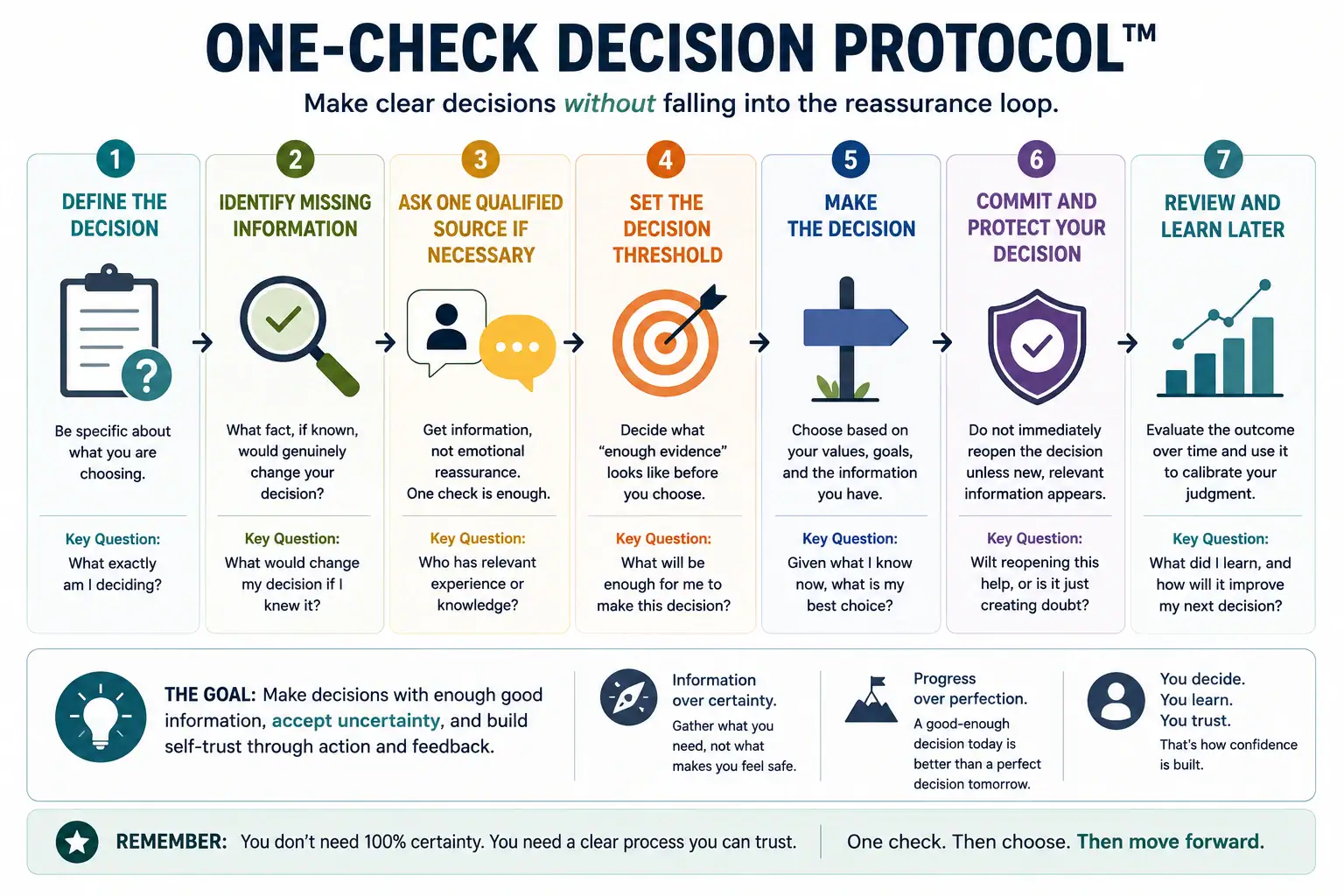
For ordinary decisions, one deliberate check can be a useful way to separate genuine consultation from reassurance loops. High-stakes decisions may require several qualified sources; the principle is not literally “one person only.” The principle is that consultation should have a defined purpose and a stopping point.
1. Define the decision
State exactly what you are choosing. Vague decisions create vague anxiety. “What should I do with my life?” is not one decision. “Should I accept this role or remain in my current job for the next six months?” is.
2. Identify the missing information
Ask: What fact, if known, would genuinely change my choice? If you cannot identify one, more searching may not be improving the decision.
3. Ask one qualified source if necessary
Choose someone because they have relevant knowledge, not simply because they are available to reassure you. Ask a specific question.
4. Set the decision threshold
Define what “enough evidence” looks like before you continue searching. Almost no meaningful decision comes with 100% certainty.
5. Make the decision
Choose using the information you have, the trade-offs you understand and the values that matter to you. If the difficulty is primarily choosing between alternatives, How to Choose Between Two Options offers a more focused decision framework.
6. Protect the decision from unnecessary reopening
Do not immediately restart the entire analysis because discomfort returns. Reopen the decision when new, relevant information appears—not simply because certainty faded.
7. Review and learn later
After enough time has passed, compare what you expected with what actually happened. This is where decision confidence becomes evidence-based rather than motivational.
The protocol transforms decision-making from a search for certainty into a feedback process.
What self-trust actually means
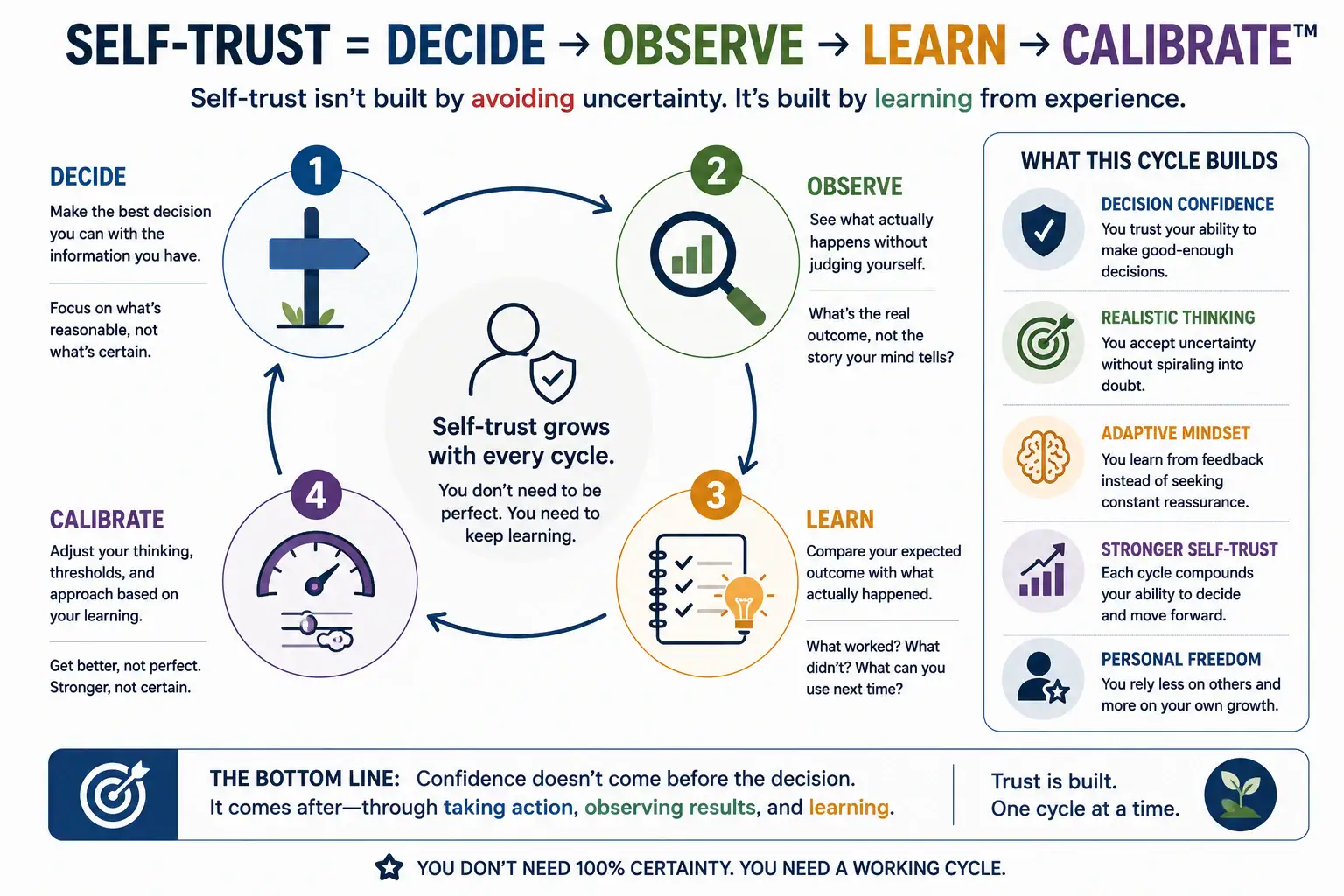
Self-trust is often misunderstood as a feeling of confidence before you act.
A more durable definition is:
Self-trust is confidence in your ability to make a reasonable decision, tolerate uncertainty, observe what happens, learn from the outcome and adjust.
That means you do not need to prove that your first judgment is always correct.
You need a working cycle:
Decide → Observe → Learn → Calibrate.
You decide with the information available. You observe reality rather than judging yourself immediately. You compare what you predicted with what happened. Then you update your thresholds, assumptions or process.
This is also how intuition becomes more reliable. Intuition improves when predictions meet feedback. Without feedback, a gut feeling is difficult to calibrate; with feedback, you can begin to learn where your instincts are useful and where bias, fear or wishful thinking distort them. If you want to develop that capacity deliberately, see How to Train Your Intuition.
Do you want information—or permission?
Before asking someone what you should do, try one question:
“If everyone I asked disagreed with the choice I already believe is right for me, would I feel informed—or trapped?”
If disagreement would simply give you useful evidence to consider, you are probably seeking information.
If disagreement would make you feel unable to act despite having no new facts, you may be seeking permission.
Permission feels safer because it shares psychological responsibility. But most adult decisions cannot be fully delegated. Advice can improve your thinking; it cannot remove the reality that you are the person who eventually has to choose.
The goal is not to stop asking people
Independence is not the same as isolation.
Good judgment often depends on other people: mentors, specialists, friends, partners and colleagues can see things you cannot. The goal is not to eliminate consultation. It is to use it more precisely.
Use other people to improve your information—not to temporarily carry your uncertainty for you.
That one shift preserves the benefits of advice while reducing the pressure to collect endless approval.
When reassurance seeking may need more attention
Reassurance seeking exists on a spectrum. Asking a friend for perspective before an important decision is ordinary. Repeated reassurance can become more concerning when it feels difficult to resist, consumes substantial time, repeatedly disrupts work or relationships, or becomes tied to intrusive fears and checking rituals.
Clinical research has found a close relationship between interpersonal reassurance seeking and checking in people with obsessive-compulsive disorder. That does not mean that needing reassurance implies OCD. It means that repetitive reassurance can sometimes be part of a broader clinical pattern, and the context matters.
If reassurance seeking is causing significant distress or interfering with daily life, a qualified mental-health professional can help you understand what is maintaining the pattern and what type of support is appropriate.
Frequently asked questions
Why do I constantly need reassurance from other people?
You may be using reassurance to reduce uncertainty rather than to obtain new information. Another person’s agreement can create short-term relief, especially when you fear regret or making a mistake. The key question is whether each conversation adds a useful fact or mainly restores a feeling of safety.
Why can’t I make decisions without asking someone else?
If external confirmation has become part of your normal decision process, acting without it can feel unusually risky. Start by distinguishing decisions that genuinely require expertise from ordinary choices where you already have enough information. Then practice making small decisions, observing the outcome and learning from feedback.
Is reassurance seeking the same as asking for advice?
No. Advice seeking aims to improve understanding or reveal missing information. Reassurance seeking aims primarily to reduce doubt or obtain confirmation. The behaviors can look identical from the outside, so the best clue is the purpose of the question and whether you can stop once you have enough useful information.
Why do I still doubt myself after someone reassures me?
Reassurance can change how certain you feel without changing the underlying uncertainty of the decision. When the emotional relief fades, the unresolved possibility of being wrong is still present, so the mind may generate another question and seek another confirmation.
How do I stop asking everyone what I should do?
Do not aim to stop all consultation. Instead, define what information you need, choose a qualified source, decide in advance what will count as enough evidence, make the choice and avoid reopening it unless relevant new information appears. Review the outcome later and use that feedback to improve your next decision.
Does needing reassurance mean I have anxiety?
Not necessarily. People seek reassurance for many reasons, including uncertainty, low decision confidence, fear of regret or the genuine need for advice. If reassurance seeking is intense, repetitive, difficult to control or tied to significant distress, discussing it with a qualified professional may be useful.
Can reassurance seeking affect self-confidence?
It can if repeated external confirmation becomes the main way you decide whether your judgment is trustworthy. The alternative is not blind confidence. It is learning to make reasonable choices, observe results and update your judgment from experience.
How can I trust my own decisions more?
Build trust through feedback rather than certainty. Make appropriately sized decisions, state what you expect, observe what happens, notice where your prediction was accurate or inaccurate, and adjust. Over time, you develop evidence about how your judgment actually performs.
The bottom line
If you need reassurance for every decision, the problem may not be that you lack answers. You may be trying to obtain something no decision can provide: complete certainty about the future.
Reassurance can be useful when it brings information, perspective or expertise. It becomes less useful when the same choice repeatedly needs another person’s approval before it feels safe enough to hold.
You do not build decision confidence by eliminating every possibility of being wrong. You build it by learning that you can think, choose, observe, adapt and recover.
The goal is not perfect certainty. It is a decision process you can trust.
Framework transparency: The Reassurance Loop™, Information Seeking vs Certainty Seeking™, Confidence Outsourcing Effect™, One-Check Decision Protocol™, and Decide → Observe → Learn → Calibrate™ are Intuition Management explanatory frameworks. They synthesize the research and decision-making principles discussed in this article; they are not validated clinical scales, diagnostic tools, or formally established psychological theories.
Research and further reading
Starcevic V, Berle D, Brakoulias V, et al. “Interpersonal reassurance seeking in obsessive-compulsive disorder and its relationship with checking compulsions.” Psychiatry Research. 2012;200(2-3):560-567. PubMed.
Champion SM, Grisham JR. “Excessive reassurance seeking versus compulsive checking in OCD: Comparing implicit motivators and mechanisms.” Journal of Behavior Therapy and Experimental Psychiatry. 2022;75:101720. doi:10.1016/j.jbtep.2021.101720. PubMed.
Birrell J, Meares K, Wilkinson A, Freeston M. “Toward a definition of intolerance of uncertainty: a review of factor analytical studies of the Intolerance of Uncertainty Scale.” Clinical Psychology Review. 2011;31(7):1198-1208. PubMed.
Parrish CL, Radomsky AS. “Why do people seek reassurance and check repeatedly? An investigation of factors involved in compulsive behavior in OCD and depression.” Journal of Anxiety Disorders. 2010;24(2):211–222. doi:10.1016/j.janxdis.2009.10.010. PubMed.
Editorial note: Intuition Management provides educational information, not diagnosis or individualized mental-health treatment. Clinical research is used here to explain mechanisms that may also appear in everyday decision-making, without implying that ordinary reassurance seeking is itself a disorder.