Presence, emotional distance, and reconnection
Reading time: approximately 13–15 minutes
Feeling as though I’m watching my life instead of living it can be deeply unsettling. You may be physically present, completing tasks and talking to people, yet feel emotionally distant, detached from reality, or as though you are living on autopilot. The world may look normal while somehow feeling remote. Your own reactions may seem muted. Days may pass without leaving a clear emotional trace.
This experience does not automatically mean that something is fundamentally wrong with you. It can arise during periods of stress, anxiety, exhaustion, sleep disruption, emotional overload, depression, trauma-related responses, or dissociation. One useful way to understand it is that psychological distance may emerge when your system has too little capacity to remain fully engaged with everything happening inside and around you.

Key Takeaways
- Feeling like you are watching your life can occur during stress, anxiety, exhaustion, burnout, depression, sleep disruption, or dissociative experiences.
- The experience does not automatically mean that you have a mental health disorder.
- Psychological distance may reduce your sense of presence, emotional connection, and participation.
- Repeated self-monitoring can make the feeling stronger by keeping attention fixed on the symptom.
- Reconnection usually develops through small moments of grounding, reduced overload, meaningful action, and participation.
- Persistent, intense, sudden, or disabling symptoms should be discussed with a qualified healthcare professional.
Contents
- What does this feeling mean?
- Why do I feel disconnected from life or like I’m living on autopilot?
- Common signs of observer mode
- Why life can start feeling distant
- The Protective Distance Loop
- Is it depersonalization or derealization?
- How conscious experience is formed
- Why recovery is faster for some people
- Common myths and facts
- How to reconnect with your life
- When to seek professional help
- Frequently asked questions
What Does It Mean to Feel Like You’re Watching Your Life?
You may be doing everything you are supposed to do. You wake up, answer messages, complete tasks, talk to people, and move through the day. Yet the experience does not feel fully yours. You can see yourself participating, but you do not feel deeply inside the moment.
People often describe the experience as:
- feeling like an observer of their own life,
- watching life pass by without fully participating,
- feeling emotionally disconnected from people or events,
- moving through the day on autopilot,
- feeling as though the world is distant, foggy, or dreamlike,
- knowing that life is real while not feeling connected to it.
This experience exists on a spectrum. At one end, you may simply be distracted, tired, or preoccupied. Farther along, you may feel emotionally numb, disconnected from yourself, or detached from your surroundings. In some cases, the experience resembles depersonalization or derealization—forms of dissociative experience in which a person feels detached from themselves or the world while usually retaining the understanding that the sensation is subjective.
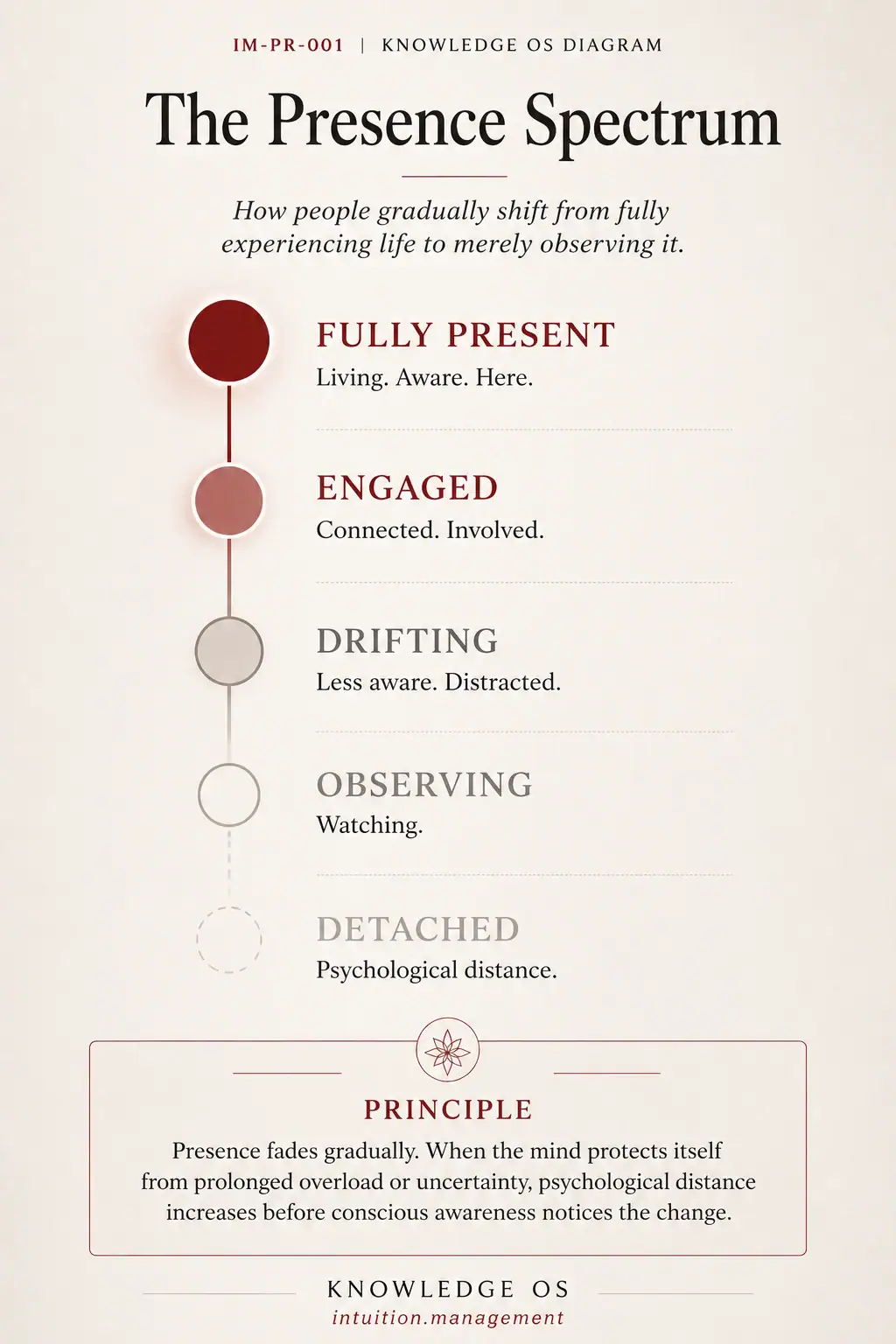
Presence is not an on-or-off switch. You can be physically present while your attention, emotions, and sense of participation are partly withdrawn. This is why the experience can feel confusing: nothing obvious has changed, but the quality of being alive has.
Why Do I Feel Disconnected From Life or Like I’m Living on Autopilot?
Living on autopilot is often the mind’s low-effort mode. Familiar routines require less conscious attention than novel or emotionally demanding experiences. When capacity is reduced, routine can keep life moving even when active participation feels difficult.
Autopilot is not always harmful. It helps you perform well-practised actions efficiently. The problem begins when automatic functioning becomes your dominant state and you stop registering the moments you are moving through. Days blur together, conversations feel thin, and life starts to feel as though it is happening somewhere just beyond your reach.
This can overlap with feeling disconnected from yourself, emotional numbness, or the sense that everything feels like too much. When uncertainty is also high, the mind may remain preoccupied with prediction and threat monitoring, which can make everything feel uncertain even when nothing dramatic is happening in the moment.
The overlap does not mean that all these experiences have the same cause. It means they may share reduced psychological availability: less capacity to feel, interpret, and respond to life with full presence.
Common Signs of Observer Mode
“Observer mode” is not a clinical diagnosis. It is a descriptive model for the experience of monitoring or managing life more than directly inhabiting it.
You function, but the day does not register
You complete tasks and conversations, but later they feel thin or difficult to remember. The events happened, yet they did not become vivid experiences.
Your emotions feel muted
You may understand intellectually that something matters without feeling the expected emotional response. Numbness is not always complete; it can feel more like emotional distance or reduced access.
Life feels unreal or far away
Places may look familiar but feel emotionally remote. Time may seem unusually fast, slow, or fragmented. The world can appear visually normal while lacking its usual immediacy.
You monitor yourself instead of participating
During conversations, you may analyse how you sound, how you look, what you should say next, or whether you are behaving normally. The more attention turns towards self-monitoring, the less remains available for direct experience. This can also contribute to replaying interactions later, as described in Why Do I Keep Replaying Conversations in My Head?
You rely heavily on routine
Familiar actions reduce immediate demand. This may help you keep functioning, but it can also make days feel repetitive, unregistered, and detached from meaning.
Why Can Life Start Feeling Distant?
There is no single explanation that fits everyone. Similar feelings can arise from different combinations of stress, anxiety, exhaustion, trauma-related responses, low mood, sleep disruption, medication effects, substance use, migraine, or other physical and neurological conditions. Persistent, intense, or sudden symptoms deserve professional assessment rather than self-diagnosis.
1. Chronic stress narrows attention
When stress remains high, attention becomes more selective. Your mind may prioritise what appears urgent, threatening, or necessary for immediate functioning. Curiosity, reflection, pleasure, and emotional nuance can receive less processing capacity.
This can happen even when you are no longer in an obvious crisis. The system may continue acting as though something still requires monitoring. That is one reason some people cannot relax even when nothing is wrong.
2. Cognitive overload reduces psychological availability
Too many unresolved demands can make attention feel permanently occupied. Even during quiet moments, part of your mind may still be tracking messages, deadlines, unfinished tasks, uncertainty, and possible problems.
3. Anxiety increases self-monitoring
Anxiety can pull attention away from the present and towards internal surveillance: Am I safe? Am I acting correctly? What if something goes wrong? This monitoring can make you feel like an observer of your own actions. Feelings of unreality can also occur during intense anxiety or panic.
4. Emotional suppression can reduce the whole emotional range
When people try to suppress painful emotion, they may also notice less joy, connection, motivation, and meaning. The mind does not always reduce only the feeling you want to avoid.
5. Exhaustion makes experience more automatic
Severe tiredness, prolonged sleep disruption, burnout, or constant availability can leave too little energy for active engagement. You may continue functioning through routine while feeling increasingly absent from what you are doing.
6. Dissociation can create psychological distance
Dissociation describes disruptions in the usual integration of awareness, memory, identity, emotion, perception, or bodily experience. It can be brief and situational or persistent and distressing. Depersonalization and derealization are two recognised forms of dissociative experience.
Not every moment of distraction or autopilot is dissociation. The distinction is usually found in intensity, persistence, distress, and impact on everyday functioning.
The Protective Distance Loop
One useful conceptual model is that psychological distance may function as a protective adaptation during prolonged overload. This is not a universal clinical explanation, but it can help describe how the experience sustains itself:
- Overload rises. Stress, uncertainty, or excessive input increases demand.
- Protection activates. Emotional and attentional involvement decreases.
- Distance grows. Experience becomes less immediate.
- Observer mode appears. You watch yourself function instead of fully participating.
- Life provides less emotional feedback. Moments feel flatter and less meaningful.
- More stress follows. Worry about the disconnection can intensify the cycle.

Psychological distance may be the mind’s attempt to reduce overload. Reconnection begins by reducing the conditions that keep the loop active.
Is This Depersonalization or Derealization?
The terms are often used together, but they describe different aspects of detachment.
Depersonalization
A feeling of detachment from yourself—your body, thoughts, emotions, actions, or identity. You may feel like an outside observer of your own life.
Derealization
A feeling of detachment from the world around you. People, places, and objects may seem dreamlike, foggy, artificial, or emotionally unreal.
Someone can experience one, the other, or both. Brief episodes can occur during stress, panic, exhaustion, or trauma-related responses. A disorder is considered only when symptoms are persistent or recurrent, cause significant distress, interfere with functioning, and cannot be better explained by another condition or substance.
People experiencing depersonalization or derealization generally retain reality testing: they recognise that the feeling is a change in their experience rather than proof that reality has literally changed.
Do Not Diagnose Yourself From One Symptom
Similar feelings can occur with anxiety, depression, migraine, sleep deprivation, medication effects, substance use, and neurological or other medical conditions. A qualified clinician can assess the full pattern.
How Conscious Experience Is Formed
You do not consciously process every detail around you. A simplified Knowledge OS model describes experience as passing through several stages:
- Reality: more information exists than you can take in.
- Attention: your mind selects a limited portion.
- Mental filters: expectations, stress, relevance, and learned priorities influence selection.
- Internal model: memory, beliefs, predictions, and context shape interpretation.
- Conscious experience: you experience the interpreted result, not an unfiltered copy of the world.
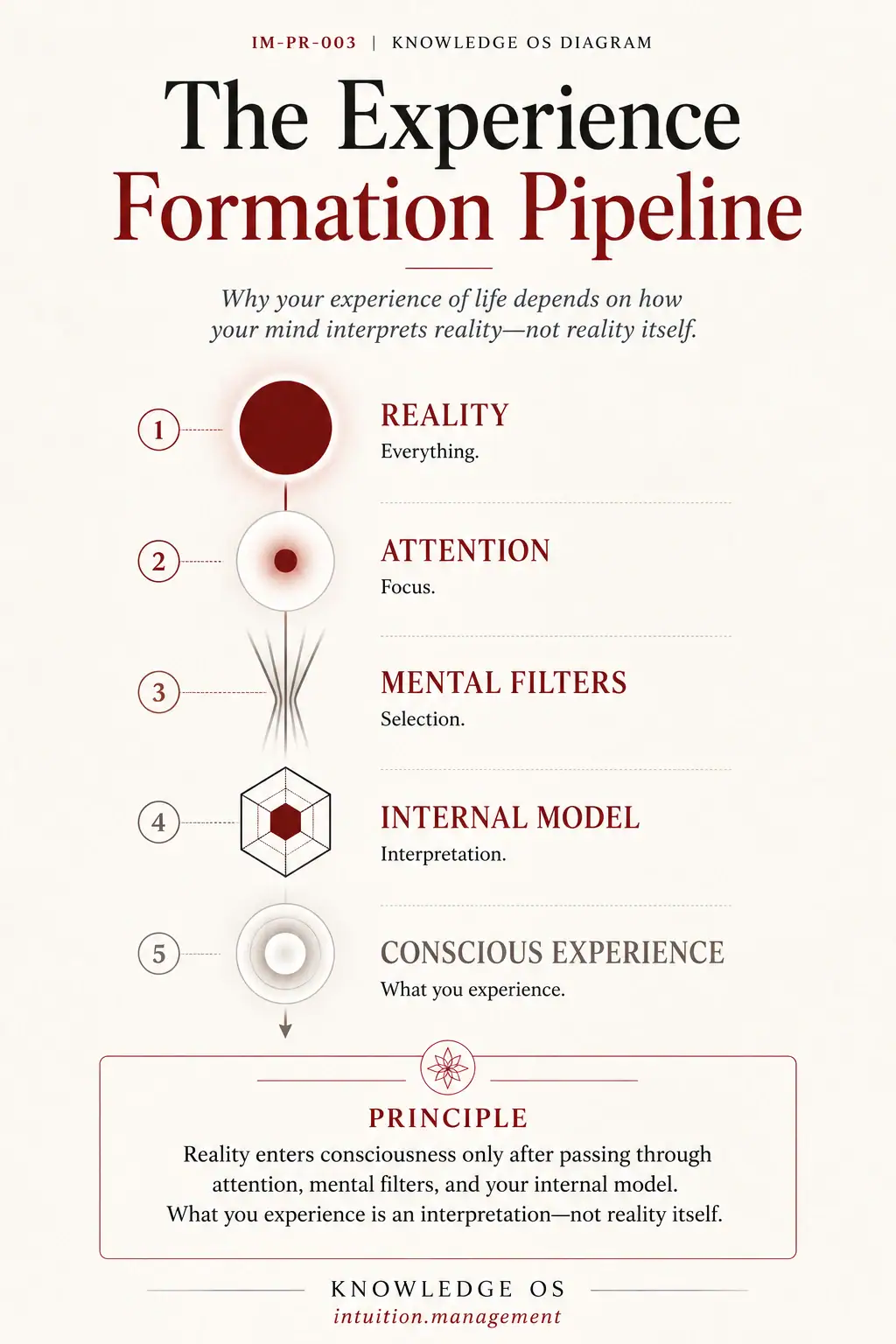
Under prolonged stress, attention may narrow and filters may prioritise threat, urgency, or self-monitoring. Two days with similar external events can therefore feel completely different because the system interpreting them is in a different state.
This is also why self-trust can decline. When your internal signals feel weak, inconsistent, or difficult to interpret, you may begin to question your own reactions. That process is explored further in Why Can’t I Trust Myself Anymore?
Explore the related models in Internal Model of Reality, What Are Mental Filters?, and What Are Mental Models?
Why Do Some People Reconnect Quickly While Others Stay Stuck?
The duration of this experience varies because the maintaining conditions vary. A brief episode caused by acute stress or sleep loss may improve when the immediate trigger resolves. A longer pattern may continue when several factors reinforce one another.
The source of overload is still active
If work pressure, conflict, caregiving demands, uncertainty, or constant digital input remains unchanged, the system may have little reason to reduce its protective distance.
The feeling itself becomes a threat
Some people become frightened by every moment of distance and begin checking whether they feel real, present, or normal. This turns the symptom into a new source of anxiety. The more closely you monitor it, the more central it becomes.
Sleep and physical health remain disrupted
When sleep, pain, medication effects, substance use, hormonal changes, migraine, or another physical factor contributes, psychological strategies alone may not fully resolve the problem. Medical assessment can be important.
Meaningful participation has become too limited
Presence often depends on feedback from real participation: relationships, movement, creativity, challenge, rest, and purposeful action. If life contains very little that feels chosen or meaningful, reconnection may need more than symptom management.
The nervous system has learned a persistent pattern
Repeated stress can make protective responses easier to trigger. This does not mean the pattern is permanent. It means recovery may require repeated experiences of safety, regulation, and participation rather than one moment of insight.
Common Myths and Facts
Myth: If life feels unreal, I must be losing touch with reality
Fact: People experiencing depersonalization or derealization usually recognise that the sensation is subjective. The experience can feel frightening without being the same as a loss of reality testing.
Myth: Feeling detached means I no longer care
Fact: Reduced emotional access is not the same as absence of care. Stress, exhaustion, depression, anxiety, and dissociation can make feelings harder to access or express.
Myth: I should force myself to feel normal
Fact: Forcing or repeatedly checking the feeling can increase pressure. Reconnection is usually supported by reducing overload and increasing grounded participation.
Myth: Autopilot is always unhealthy
Fact: Automatic processes are essential for efficient daily functioning. The concern is not routine itself, but a persistent loss of presence, emotional connection, or choice.
How to Reconnect With Your Life
Trying to force a feeling of reality can create more monitoring and pressure. A gentler approach is to rebuild participation through small, concrete moments.
1. Notice without interrogating the feeling
Use a neutral sentence such as, “I feel distant right now.” Try not to turn the sensation into an emergency or repeatedly test whether you feel normal yet.
2. Reduce immediate input
Put one device away, close unnecessary tabs, delay non-urgent responses, and choose one task instead of holding the whole day in mind.
3. Use simple grounding
Direct attention towards concrete information in the present. Name things you can see, hear, and physically feel. Hold a textured object, feel your feet against the floor, or describe the room aloud. Grounding is a way to orient attention, not a test you must pass.
4. Return to the body gently
Unclench your jaw, adjust your posture, stretch, walk, or slow your exhale. If inward attention increases anxiety, keep the exercise simple and externally focused.
5. Choose one meaningful action
Presence often returns through participation rather than analysis. Send one honest message, step outside, prepare food, make something, or complete one small action connected to your values.
6. Protect sleep and recovery
Sleep disruption can worsen concentration, anxiety, emotional regulation, and feelings of unreality. A consistent sleep routine and professional support for persistent insomnia can help address a major maintaining factor.
7. Reduce repeated symptom checking
Do not measure recovery every few minutes. Constant checking keeps attention fixed on the absence of a feeling rather than on the life happening around you.

8. Move from observation to participation
The lasting shift is not from discomfort to perfect calm. It is from standing outside your experience to taking part in it again. Participation may initially be small: staying in a conversation, choosing a meal deliberately, noticing music, finishing one meaningful task, or allowing one emotion to be present without immediately analysing it.
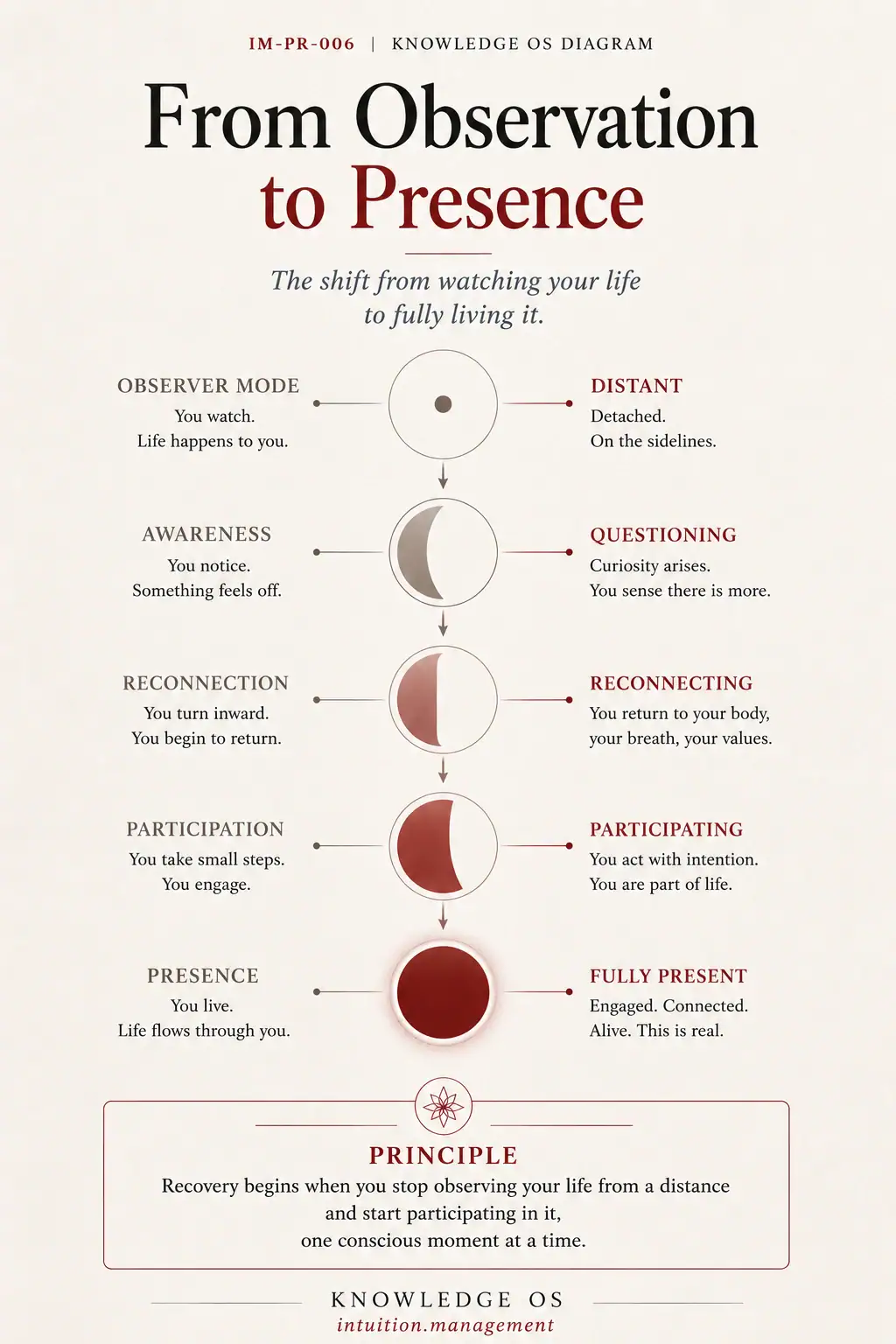
The direction matters more than the intensity. One conscious moment is not trivial. It is how your system begins learning that engagement is possible again.
What Research and Clinical Guidance Suggest
Clinical guidance recognises that feelings of detachment can occur in dissociative conditions and may also appear alongside anxiety, panic, trauma-related conditions, depression, sleep disruption, substance use, and some medical or neurological problems. The same symptom can therefore reflect different underlying causes.
The most reliable assessment looks at the complete pattern: when the feeling began, how long it lasts, what triggers it, whether reality testing remains intact, how much distress it causes, and whether there are medication, substance, sleep, physical health, or neurological factors. This is why one symptom alone is not enough for diagnosis.
Grounding, stress reduction, sleep support, and talking therapies are commonly discussed as part of care, but treatment should be matched to the cause. Persistent symptoms are best evaluated by a qualified professional.
When Should You Seek Professional Help?
Speak with a doctor or qualified mental health professional when the feeling:
- persists or repeatedly returns,
- causes significant fear or distress,
- interferes with school, work, relationships, sleep, or everyday functioning,
- begins after a medication change or substance use,
- appears with panic, depression, trauma symptoms, or severe anxiety,
- follows a head injury, or
- comes with new confusion, fainting, weakness, severe headache, vision changes, or other sudden neurological symptoms.
A clinician may review sleep, stress, physical health, medicines, substance exposure, mood, anxiety, trauma history, and neurological symptoms. Treatment depends on the underlying cause. Talking therapies are commonly used for persistent depersonalization or derealization, while associated anxiety, depression, sleep problems, or medical conditions may require their own treatment.
You do not need to wait until the experience becomes unbearable. Early support can reduce fear and help identify what is maintaining the feeling.
Frequently Asked Questions
Why do I feel like I am watching myself from outside my body?
This can resemble depersonalization, a dissociative experience involving detachment from your body, thoughts, feelings, or actions. It can occur temporarily during stress or anxiety, but persistent or distressing symptoms should be assessed professionally.
Why does life feel unreal even though I know it is real?
This can resemble derealization. The world may feel dreamlike, distant, foggy, or emotionally unreal while you still understand that reality itself has not changed.
Is feeling like I am watching my life a sign of burnout?
It can occur alongside burnout or severe exhaustion, especially when emotional and cognitive capacity is depleted. The feeling is not specific to burnout, so persistent symptoms deserve broader assessment.
Can anxiety make me feel detached from reality?
Yes. Intense anxiety and panic can produce feelings of unreality or detachment. Anxiety can also increase self-monitoring, making direct participation in the present more difficult.
Why do I feel emotionally absent around people I care about?
Stress, overload, depression, anxiety, emotional suppression, or dissociation can reduce emotional access. Feeling absent does not necessarily mean that you no longer care.
How do I stop living on autopilot?
Begin with one intentional interruption: notice where you are, reduce competing input, connect with one sensory detail, and take one action you deliberately choose. Repeated participation is more useful than demanding an immediate emotional breakthrough.
Is this the same as losing touch with reality?
Not usually. People experiencing depersonalization or derealization typically recognise that the strange feeling is subjective. Any major change in perception, thinking, or functioning should still be discussed with a qualified professional.
Can this feeling improve?
Many people improve when contributing factors such as anxiety, overload, sleep disruption, trauma responses, depression, or medical issues are addressed. The right approach depends on the cause.
Continue Exploring
- Why Do I Feel Disconnected From Myself?
- Why Do I Feel Emotionally Numb?
- Why Does Everything Feel Like Too Much?
- Why Can’t I Relax Even When Nothing Is Wrong?
- Internal Model of Reality
- The Personal Signal Decoder
Your Next Step
You do not have to force yourself to feel fully alive in one leap. Begin by noticing one real detail, choosing one deliberate action, and participating in one moment without evaluating whether it feels perfect.
For a structured way to distinguish meaningful internal signals from overload and noise, continue with The Personal Signal Decoder.
Leave a Reply
You must be logged in to post a comment.