What intuition feels like is often misunderstood. Not the idea of it. Not the phrase “trust your gut.” But the real signal — in your body, in your perception, in the moment you have to decide.
Most people don’t lack intuition. They struggle because they can’t distinguish it from everything else — fear, habit, anxiety, desire. The result is predictable: we either ignore the signal entirely, or follow it blindly and call the outcome “intuition.”

This guide is not about believing in intuition. It is about recognizing it. You’ll learn what real intuition feels like, how it differs from reactive signals, and how to build a reliable internal reference for decision-making.
Why We Misread Intuition
Intuition is subtle. Most of modern life is not. We are trained to prioritize speed, logic, and external validation, while daily cognitive noise keeps attention fragmented. Add emotional residue from past experience, and the signal becomes hard to isolate. The mind fills the gap, and we mistake intensity for accuracy.
Understanding what intuition feels like is less about belief and more about learning to recognize signal quality in real time.
Where Intuition Actually Shows Up
Intuition is not a thought. It is a pattern-recognition signal that appears through the body and perception.
- Somatic cues: shifts in tension, breath, posture
- Perceptual clarity: something feels resolved without explanation
- Emotional neutrality: not excitement, not fear — just alignment
- Quiet certainty: no argument needed
It does not push. It does not negotiate. It simply appears.
What Intuition Feels Like in Practice
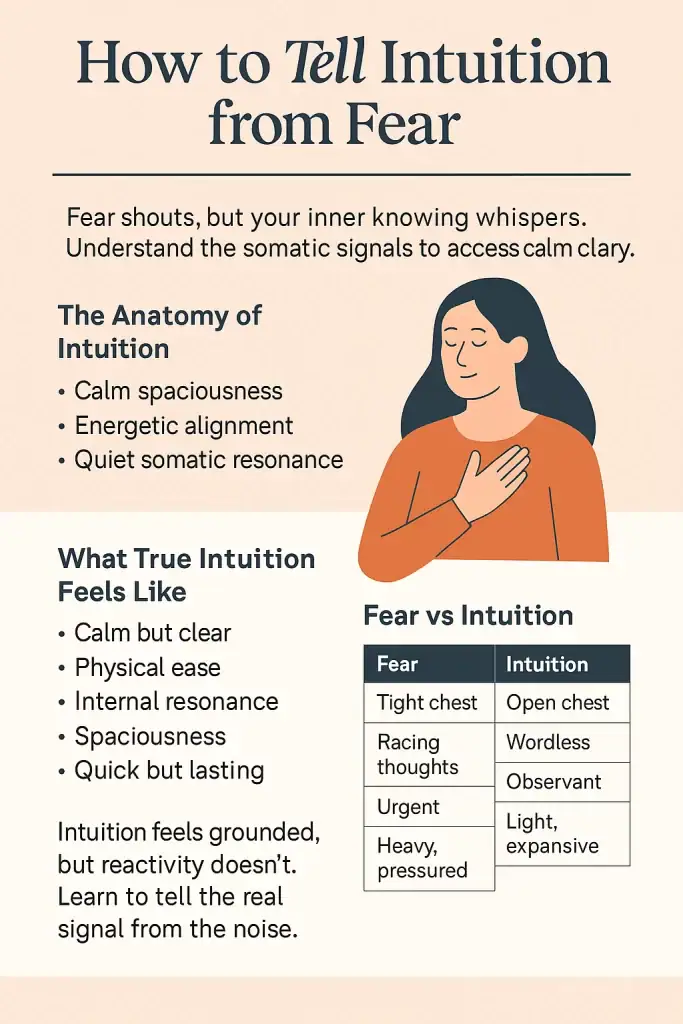
Across different contexts, intuition tends to share a consistent signature.
- Calm, not urgent
- Clear, not complex
- Embodied, not abstract
- Fast, but not rushed
- Stable over time
It often feels like a simple internal shift: “this is right” or “this is not it.” Not loud. Not dramatic. But difficult to ignore once noticed.
What Gets Mistaken for Intuition
Most errors do not come from lack of intuition. They come from mislabeling.
- Fear: tight, urgent, narrowing
- Anxiety: repetitive, analytical, unresolved
- Desire: exciting, future-focused, attached
- Habit: familiar, automatic, unexamined
- Impulse: fast, emotional, shallow
The simplest distinction is this: intuition expands perception, while reactivity contracts it.
Fear vs Intuition
| Fear | Intuition |
|---|---|
| Tight, pressured | Open, steady |
| Racing thoughts | Minimal thoughts |
| Urgency | Clarity |
| Avoidance-driven | Direction-driven |
| Inconsistent | Stable |
Use this contrast as a fast calibration tool. If the signal feels tight and urgent, it is probably not intuition. If it feels steady and spacious, it is more likely to be real.
What Intuition Sounds Like Internally
Intuition rarely arrives as a full explanation. When translated into language, it often sounds simple and direct.
- "Wait."
- "Not this."
- "Now."
- "This is right."
Short. Clear. Without internal debate.
How to Build Intuition Literacy
You do not activate intuition. You learn to recognize its signature more accurately.
- Body check: where is there tension versus ease?
- Yes/No contrast: notice the physical difference between the two
- Micro-decisions: practice in low-risk situations
- Track outcomes: connect felt signal with real result
Over time, this builds a personal reference system. Not belief — calibration.
The Inner Triangle: Intuition vs Fear vs Desire
Three internal signals often get confused.
- Intuition: grounded, quiet, stable
- Fear: protective, urgent, narrowing
- Desire: energizing, forward-moving, attached
All three can influence action. But only one provides direction without distortion.
This aligns with research on somatic markers, where the body encodes decision-relevant signals before conscious reasoning.
Related: Signal or Noise? A Short Game to Recognize Real Intuition · What Intuition Really Is · Intuition vs Anxiety
Final Thought: Intuition Is a Signal, Not a Story
Intuition does not explain itself. It does not argue. It does not try to convince you. It appears as a signal — and waits for recognition.
The skill is not trusting blindly. The skill is learning to distinguish. Once you do, decisions become quieter — but far more precise.
Want more grounded tools for intuitive clarity? Explore the full library.