Intuition under pressure is where most decisions break down. Not in theory. Not in calm reflection. But in the moment — when time compresses, pressure rises, and the cost of being wrong becomes real.
Understanding how intuition under pressure works is the difference between reacting fast and deciding clearly.

Pressure doesn’t remove intuition. It tests whether you can still hear it. In this guide, you’ll learn how intuition behaves under pressure, why it becomes distorted, and how to access clear, embodied decision-making — even when everything feels urgent.
Why Intuition Under Pressure Breaks Down
Under pressure, your system doesn’t become more intelligent — it becomes faster and narrower. The nervous system shifts into survival mode. Cortisol rises. Breathing shortens. Attention collapses. You don’t lose decision-making. You lose access to depth.
- Old habits take over
- Emotional memory overrides context
- Fear narrows perception
- Reaction replaces reflection
The difficulty is subtle: all of this can feel like certainty. But it isn’t intuition — it’s compression.
The Neuroscience of Intuition Under Stress
Clear intuition requires integration. Different systems need to stay online at once: the insula (internal sensing), the prefrontal cortex (context and judgment), and the amygdala (threat detection). Under high stress, this balance collapses. The amygdala dominates. Subtle signals disappear. What remains is urgency — without clarity. The goal is not to remove stress. It’s to stay open inside it.
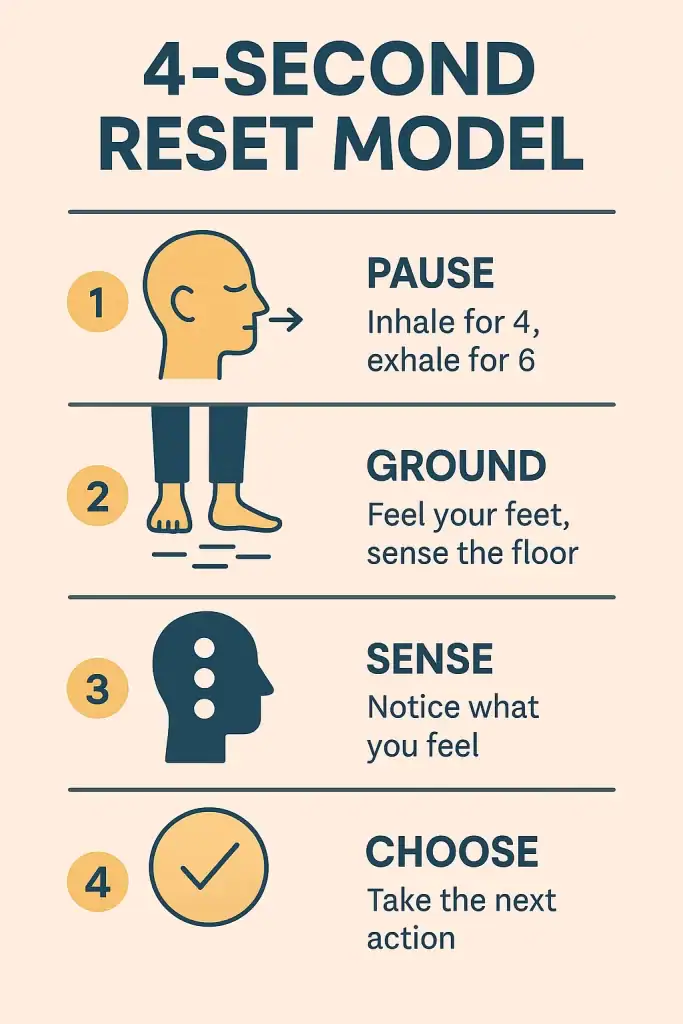
The 4-Second Reset: Restoring Access
You don’t need a long ritual. You need a reliable interruption.
- Pause: inhale 4, exhale 6
- Ground: feel your feet, shift your weight
- Sense: “What am I feeling — not thinking?”
- Choose: act from that signal
This takes seconds — but restores something critical: space. And intuition requires space.
The Real Skill: Meta-Intuition
High-level decision-makers don't just use intuition. They evaluate it. This is meta-intuition — the ability to ask: is this signal calm or urgent? Is this grounded or reactive? Is this consistent over time? Without this layer, intuition becomes risk. With it, it becomes leverage.
A 5-Step Framework for High-Stakes Moments
- Interrupt the reaction. One breath is enough. Without a pause, you are reacting, not deciding.
- Locate the signal. Notice where it appears in your body. Tightness and clarity feel different.
- Reality-check it. What evidence supports or contradicts it?
- Pressure-test it. Would the signal hold if you had more time?
- Commit cleanly. Indecision compounds risk more than imperfect action.
When to Trust Your Gut — and When Not To
Not every strong feeling is guidance.
- Intuition feels: quiet, grounded, simple
- Distortion feels: urgent, tight, repetitive
Ask yourself: Is this opening perception — or closing it?
Training Intuition Under Pressure
You don’t build this capacity in crisis. You bring it into crisis.
- Practice under time pressure
- Train nervous system range
- Reflect after decisions
- Use daily micro-decisions
Clarity under pressure is not a trait. It’s conditioning.
This is why training intuition under pressure matters more than trying to eliminate stress.
This aligns with research on fight-or-flight response, where stress narrows perception and accelerates reaction patterns.
Where Data Still Matters
This is not intuition vs logic. It is integration. Use data to understand the landscape. Use intuition to navigate it. For the combined model, see the Data + Intuition Framework.
Final Thought: Pressure Reveals Your Training
Pressure doesn’t destroy intuition. It reveals whether you’ve learned to stay connected to it. When everything speeds up, your advantage is not speed — it’s internal steadiness. That’s where real decisions come from.