Intuitive leadership is not about ignoring data. It is the ability to sense direction, read emerging signals, and build a culture where intuition becomes part of strategy.
Most leaders don’t have a data problem. They have a perception problem.
For the foundations behind this approach, see What Intuition Feels Like and Team Intuition.
In a world saturated with dashboards, KPIs, and predictive models, something unexpected is happening: the more information leaders have, the harder it becomes to decide. Because in moments of real uncertainty, data stops being enough. Patterns break. Context shifts. And logic—while still useful—loses its authority.

This is where intuitive leadership begins. Not as a belief or personality trait, but as a capability—and ultimately, as a culture you can build.
This is not about “trust your gut.” It’s about operationalizing inner intelligence inside organizations—so intuition becomes something teams can use, not just individuals who happen to have it.
What Is Intuitive Leadership Really?
Intuitive leadership is the ability to sense direction before it becomes obvious. It integrates pattern recognition, somatic awareness, emotional intelligence, and context sensitivity into real-time decision-making.
- Analytical leaders ask: “What do the numbers say?”
- Intuitive leaders also ask: “What is emerging that the numbers can’t yet see?”
This is not softness. It is advanced perception.
Why Intuition Must Become Cultural—Not Personal
Most organizations treat intuition as an individual trait. Some leaders have it. Others don’t. But that assumption is flawed—because intuition is not rare. It is suppressed.
People already sense misalignment, risk, or opportunity—but they don’t speak it. Not because they lack intuition, but because the culture has no place for it. When intuition is not legitimized, organizations lose access to their own intelligence.
What Changes When You Build an Intuitive Culture
- Decisions accelerate — clarity increases
- Meetings deepen — less performance, more signal
- Innovation grows — ideas move before full proof
- Trust rises — perception becomes valid input
People stop waiting for permission to see what is already obvious.
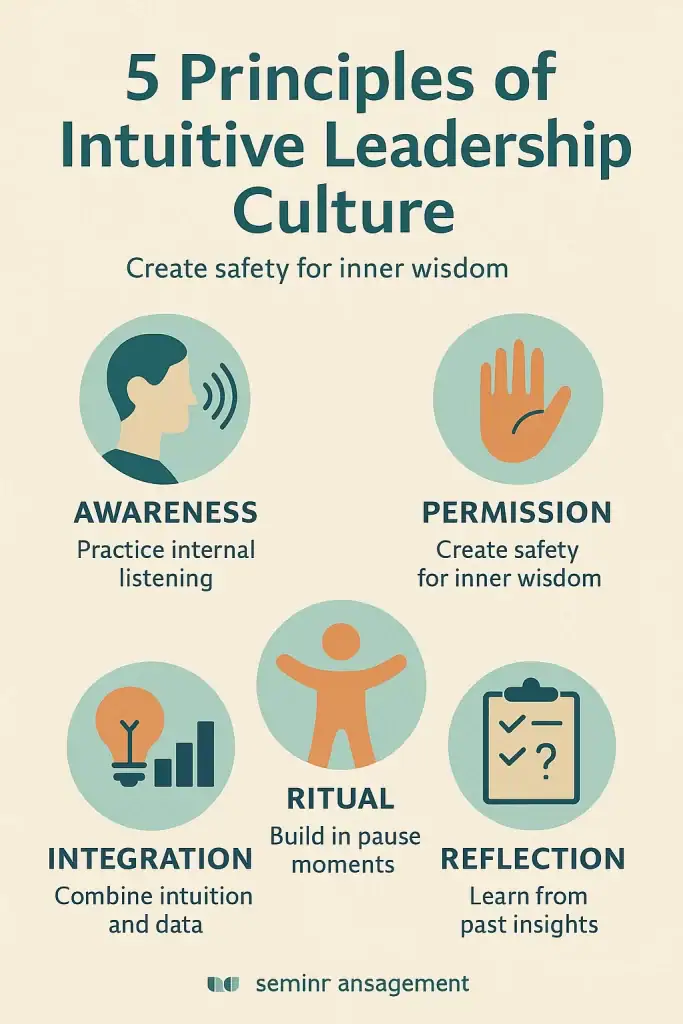
The Cost of Ignoring Intuition
- Burnout increases — no space to pause
- Innovation slows — only proven ideas survive
- Misalignment grows — early signals ignored
- Engagement drops — perception disconnects
Everything may look efficient. But the system loses coherence.
How to Build an Intuitive Culture
The goal is not to replace data. The goal is to expand what counts as valid input.
1. Normalize Intuitive Language
- “What’s your sense of this?”
- “Does anything feel off?”
- “What are we not seeing yet?”
2. Create Space Before Decisions
Add short pauses—30–60 seconds of silence—before key decisions. This signals that thinking is not the only way to know.
3. Separate Reaction from Intuition
Teach teams the difference between reactivity (fear, urgency) and intuition (calm, clarity). Without this, intuition becomes noise. With it, it becomes signal.
4. Reward Insight, Not Just Output
Recognize early signals, not just results. This reinforces deeper perception.
Start Here: A Weekly Practice
- Begin a meeting with 60 seconds of silence
- Ask: “What’s your intuitive read?”
- Allow non-rational responses
- Reflect: “What did we notice beyond data?”
The Future of Leadership
AI will handle analysis. Systems will handle optimization. But only humans can sense timing, misalignment, and meaning.
And that is where leadership moves next.
This connects with research on collective intelligence, where group performance depends on how well people share and integrate signals.
Final Thought
Every organization already has intuition. It shows up in hesitation, tension, and quiet knowing. The question is not whether it exists—but whether your culture can hear it.
This isn’t motivation. It’s navigation.