Data intuition decision making is not about choosing between numbers and gut instinct. It is a practical way to combine analytics, pattern recognition, and fast testing when strategic choices feel unclear.
For deeper support, see The Intuition Data Feedback Loop and Hybrid Intelligence.
Are you relying too much on numbers — or not enough?
Most leaders won’t admit it, but they feel it: the more data they have, the less certain they become.
Dashboards multiply. Metrics improve. Forecasts get sharper. And yet, something essential is missing — clarity.
This is the modern decision paradox: data increases precision, but not always direction.

At the same time, relying on instinct alone feels risky — even unprofessional. So leaders oscillate between over-analysis and quiet doubt, rarely trusting either fully.
The real skill is not choosing between intuition and analytics. It’s knowing when each one is leading — and when it’s misleading.
This guide introduces a practical framework for integrating both — so your decisions are not just correct, but aligned, timely, and forward-moving.
Why Data Alone Stops Working
Data is excellent at answering one kind of question:
“What has already happened?”
It can reveal patterns, optimize performance, and reduce uncertainty in stable systems. But the moment the environment shifts — new markets, new behaviors, new dynamics — data begins to lag behind reality.
Because data is always retrospective. Leadership is not.
- Data captures the past. Intuition senses emergence.
- Data explains patterns. Intuition detects shifts.
- Data optimizes. Intuition reorients.
Over-reliance on data creates a hidden risk: you become precise about things that no longer matter.
Why Intuition Alone Is Not Enough
Intuition is not guesswork. It is rapid pattern recognition built from experience, memory, and embodied perception.
But intuition without calibration is dangerous.
- Bias disguises itself as certainty
- Stress turns signals into noise
- Attachment distorts perception
This is why many leaders quietly stop trusting their intuition — not because it’s wrong, but because they’ve never learned to refine it.
The answer is not to suppress intuition.
The answer is to integrate it with structure.
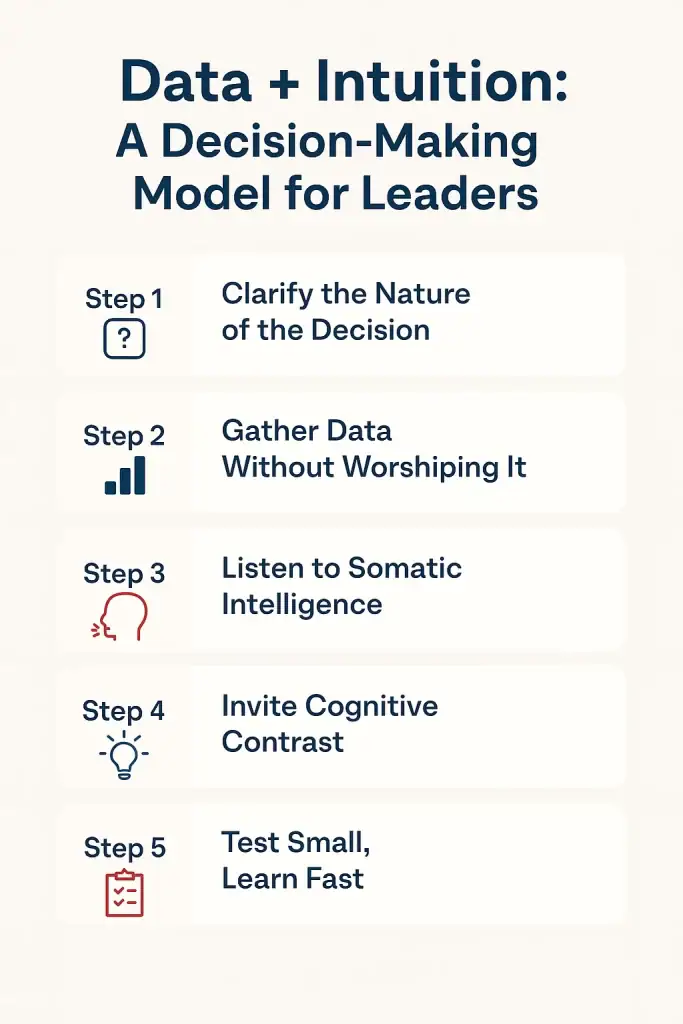
Data Intuition Decision Making: The Integration Framework
This is not a theory. It’s a working model used by leaders who operate in uncertainty without freezing or overcorrecting.
Step 1: Define the Type of Decision
Before choosing tools, identify the terrain.
- Optimization problem → use data
- Emergent problem → use intuition
Most mistakes happen when leaders apply data to problems that haven’t stabilized yet.
Step 2: Expand the Data — Don’t Obey It
Data should widen your perspective, not narrow your options.
Ask:
- What is missing here?
- What has changed since this data was collected?
- What does this data not capture?
Data is a lens — not a verdict.
Step 3: Read the Body Signal
Before the mind concludes, the body reacts.
That reaction is not random — it is accumulated intelligence.
- Expansion → alignment
- Contraction → friction
- Neutral clarity → readiness
This is not emotion. It is pre-verbal evaluation.
Step 4: Create Productive Tension
Now place data and intuition side by side.
If they agree → move.
If they don’t → that’s where the real insight is.
Misalignment is not a problem. It’s information.
Step 5: Test Instead of Debate
Do not resolve uncertainty intellectually. Resolve it experimentally.
- Prototype the intuitive direction
- Validate the data-driven assumption
- Measure real-world response
This converts doubt into movement.
Case Study: Seeing Before the Data
When Starbucks expanded into China, the data said: low coffee consumption, uncertain demand.
But Howard Schultz saw something else — a shift in lifestyle, identity, and aspiration.
The data described the present. His intuition sensed the direction.
That difference created a market.
The “Gut + Graph” Decision Tool
- 📊 What does the data clearly show?
- 💡 What does my body signal?
- ❓ Where is the tension between them?
- 🌀 What might be emerging?
- 🛠️ What can I test immediately?
This is how modern decisions are made: not by choosing certainty — but by navigating it.
Where This Already Works
In medicine, AI assists diagnosis, but doctors still decide, because reality is not purely statistical. Sometimes the data looks correct but something feels wrong. That gap is exactly where this framework operates.
Common Failure Modes
This framework fails in three predictable ways: over-trusting the data, over-trusting the signal, and skipping the reflection step entirely. It works when both are held in tension, not when one side wins by default.
Practical Tools to Support This
A few habits make the framework easier to sustain: use AI or data for generating options rather than making the final call, build in a brief somatic check-in before deciding, keep a short decision journal, and revisit past decisions to close the reflection loop. These are not extra techniques. They are basic decision hygiene.
Final Thought: Alignment Beats Accuracy
Most people try to be right.
The best leaders try to be aligned with what is actually unfolding.
Data helps you see clearly.
Intuition helps you move correctly.
When both work together, decisions stop feeling heavy — and start becoming obvious.
This isn’t motivation. It’s navigation.
This connects with research on decision-making, where quality improves when evidence, context, and judgment are integrated.