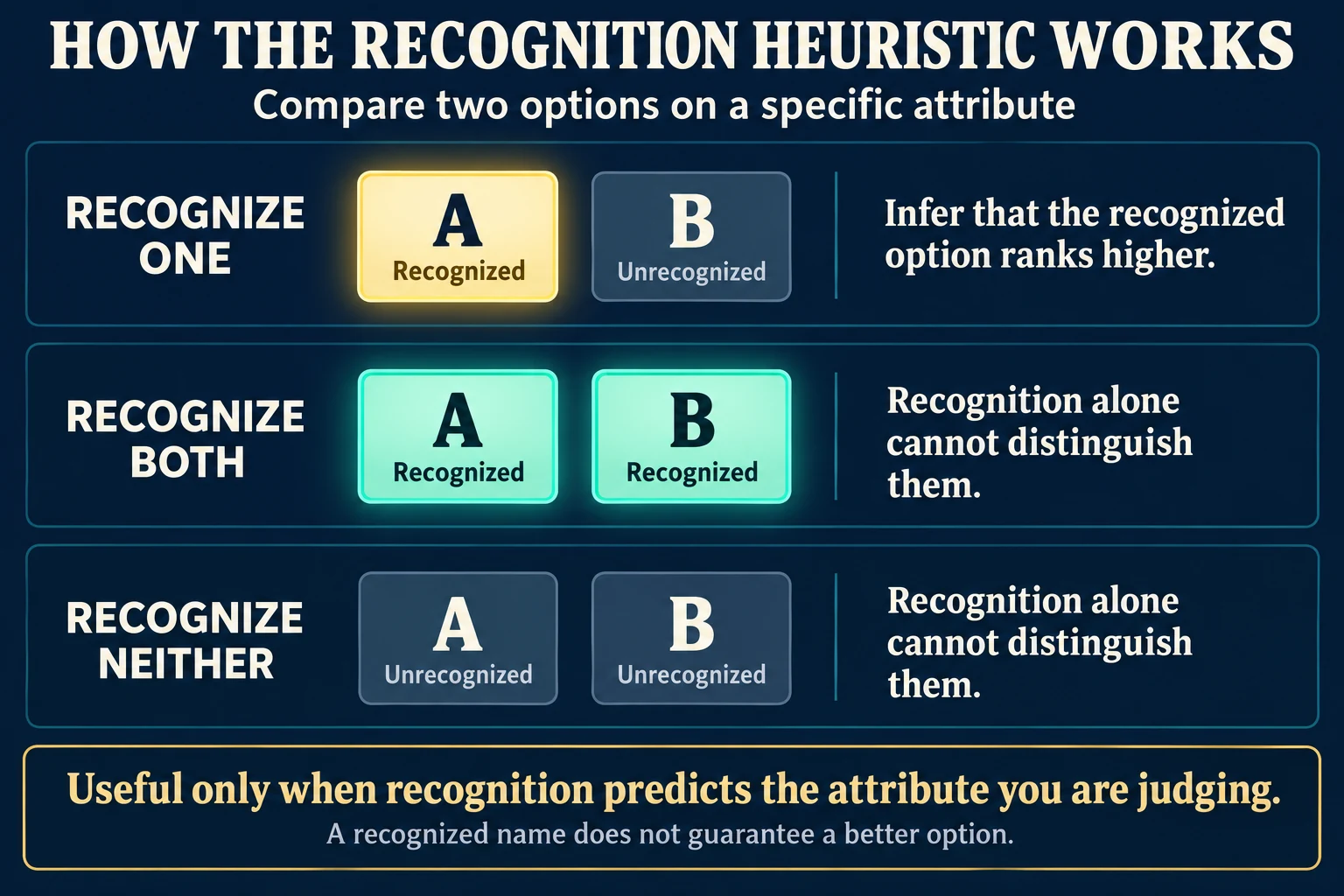
The recognition heuristic is a decision shortcut: when you recognize one of two alternatives but not the other, you infer that the recognized alternative ranks higher on the attribute being judged. It can help when recognition is informative about that attribute. A familiar name alone does not establish accuracy.
Imagine seeing two suppliers on a shortlist. You have heard of one; the other is new to you. Before checking either proposal, you suspect the familiar company is bigger. A moment later, that impression becomes “probably more reliable.” You have moved between two different claims without collecting new evidence.
This guide explains the shortcut, its limits, and a practical way to examine that move. The workplace scenarios and checklist are original illustrations and reflection aids, not validated assessments.

What is the recognition heuristic?
Goldstein and Gigerenzer’s classic model concerns a specific inference: use the recognized member of a pair to predict a higher value on a criterion. That criterion might be population or another measurable attribute. The model is narrower than a general preference for familiar things. See their original research on the recognition heuristic.
Keep the sentence complete: “I recognize A, so I infer that A has more what?” Replacing that final word with “quality,” “size,” or “reliability” creates a different judgment. “Better” is too vague to tell you whether the inference is useful.
For the broader family of simplifying strategies, read heuristic thinking. For their relationship to fast impressions, see intuition vs heuristics.
How the recognition heuristic works
The classic two-option rule has a clear boundary:
- Recognize one option: recognition can distinguish the pair; the rule predicts the recognized option ranks higher.
- Recognize both: this basic rule cannot separate them.
- Recognize neither: it cannot separate them either.
Choosing the recognized option does not, by itself, prove that someone used recognition alone. Other knowledge can support the same choice. Researchers distinguish agreement with a prediction from evidence about the process behind it. Pachur and colleagues discuss this testing problem.
These are conditions of the model, not instructions to stop gathering information. In a real decision, checking records afterward changes the basis of your judgment. You are then using more than recognition alone.
Recognition heuristic examples
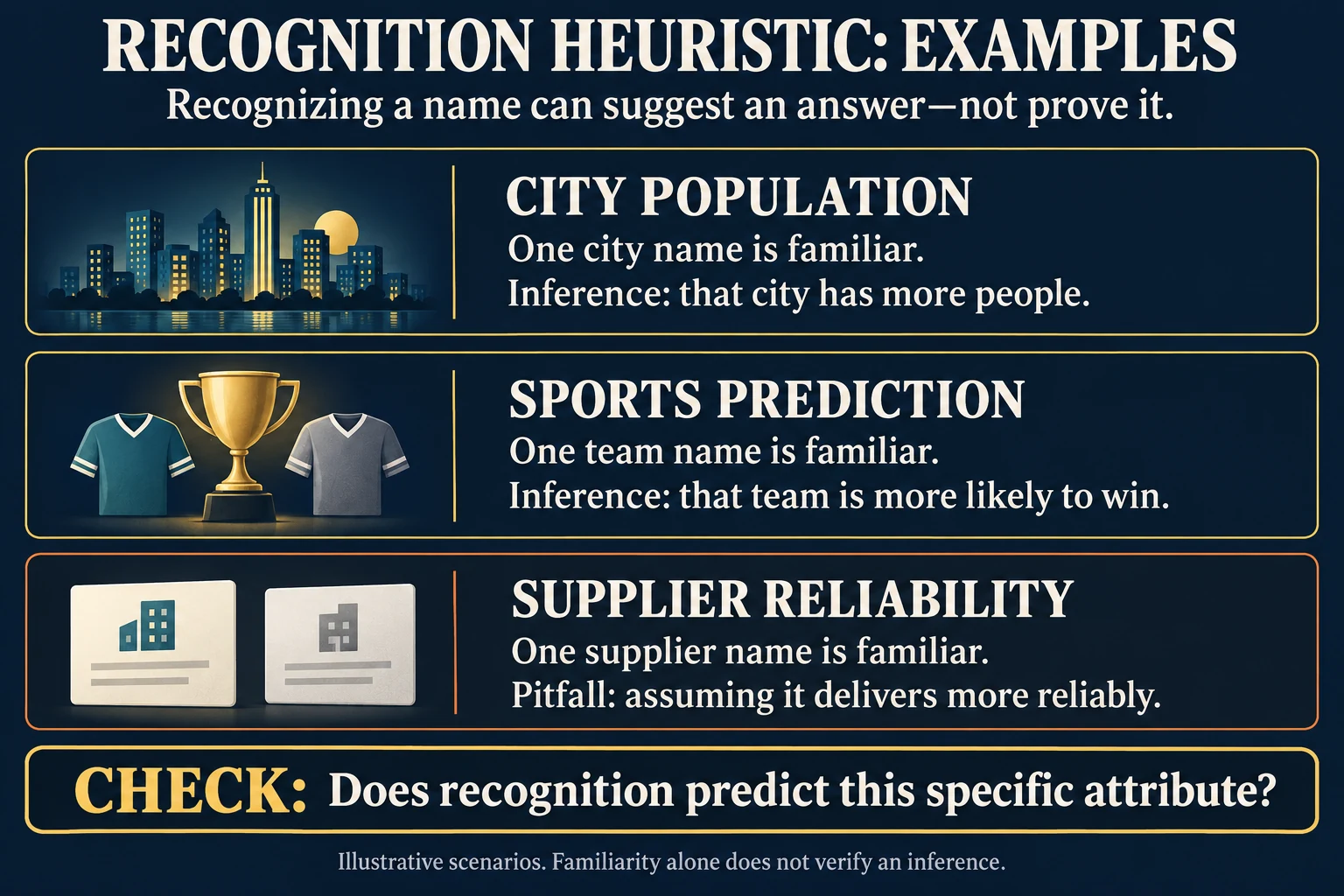
City population: the research setting
Goldstein and Gigerenzer studied population comparisons using city-name recognition. The question was whether a recognized city could be inferred to have more inhabitants than an unrecognized one. This illustrates an inference about population, not a recommendation about where to live or travel. Historical examples in the paper should not be treated as current population rankings.
Sports prediction: an illustrative scenario
Suppose you recognize one team in a pairing and have never heard of its opponent. You predict the familiar team will win. That is the shape of a recognition-based inference; the example does not establish that it is accurate.
Now change one detail: you know the name because the team’s mascot went viral. Would you still expect that recognition to tell you much about the upcoming match? The exercise is to identify the reason for recognition and ask whether it supports the forecast. No prediction or betting recommendation follows from this illustration.
Supplier reliability: a possible misuse
You recognize a supplier from conference sponsorships and infer that it delivers projects reliably. The missing step is evidence connecting its visibility to delivery performance. You can investigate the company without granting it a favorable reliability assessment in advance.
Ask the same questions of both candidates. Otherwise, the familiar supplier may receive the benefit of assumptions while the unfamiliar one must prove every claim.
When does recognition help?
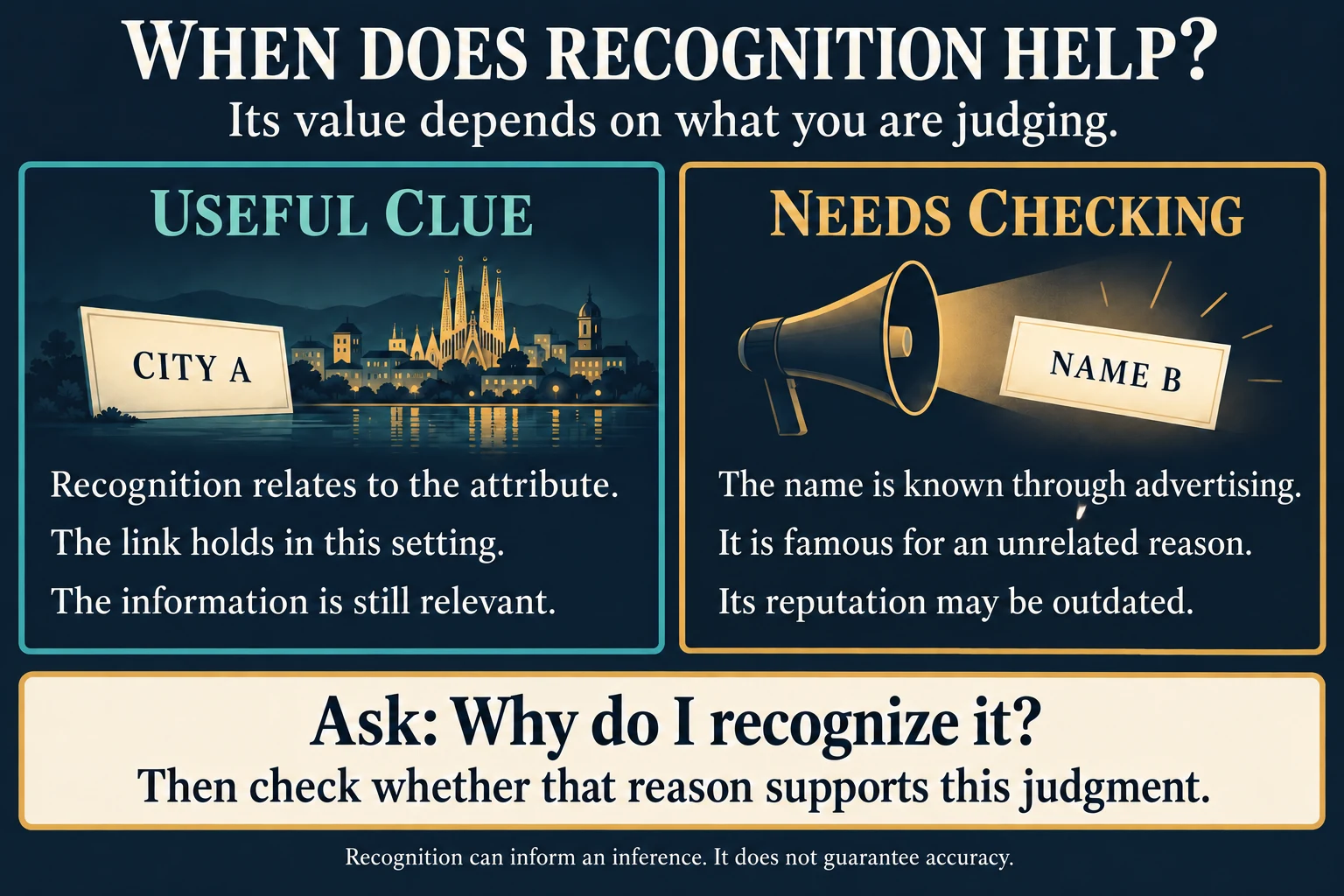
Recognition validity describes how often the recognized option ranks higher among pairs where only one option is recognized. It depends on the attribute and the set of objects being compared. It is not a personal confidence score. The review by Pachur and colleagues explains these boundaries.
For practical use, make your proposed connection explicit. “I recognize this organization because it operates many local branches” offers something to investigate when judging local coverage. It offers much less when judging whether a particular employee has the specialist knowledge you need.
Can less knowledge produce a better inference?
The research describes a conditional “less-is-more” effect: partial recognition can sometimes outperform more extensive knowledge when recognition is the more accurate guide. It is not a general argument for ignorance. Later research discusses limits to this effect and variation in whether people rely on recognition alone. Pachur et al., 2011.
Do not turn this finding into a reason to discard useful records. In your own work, compare a recognition-based prediction with the relevant evidence. If you cannot establish the connection, record the inference as unverified rather than inventing a confidence percentage.
When does recognition mislead?
The following are practical situations to investigate, rather than a claim that every familiar option is misleading:
- Publicity without relevant performance evidence. A visible campaign tells you the name has been promoted. Ask what supports the claim you actually need to assess.
- Fame for an unrelated reason. A venue may be famous for its architecture. You still need to check its accessibility and capacity.
- Outdated familiarity. You remember an organization from years ago. Check whether the people, services, and operating conditions relevant to your decision have changed.
- A shifting criterion. “Large,” “experienced,” and “suitable for this job” can slip into one another during a discussion. Write each claim separately.
A useful meeting question is: “What would we ask if neither name were familiar?” Use the answer to establish comparable checks. That does not require pretending the candidates are identical; it helps make the reasons for treating them differently visible.
Recognition vs related concepts
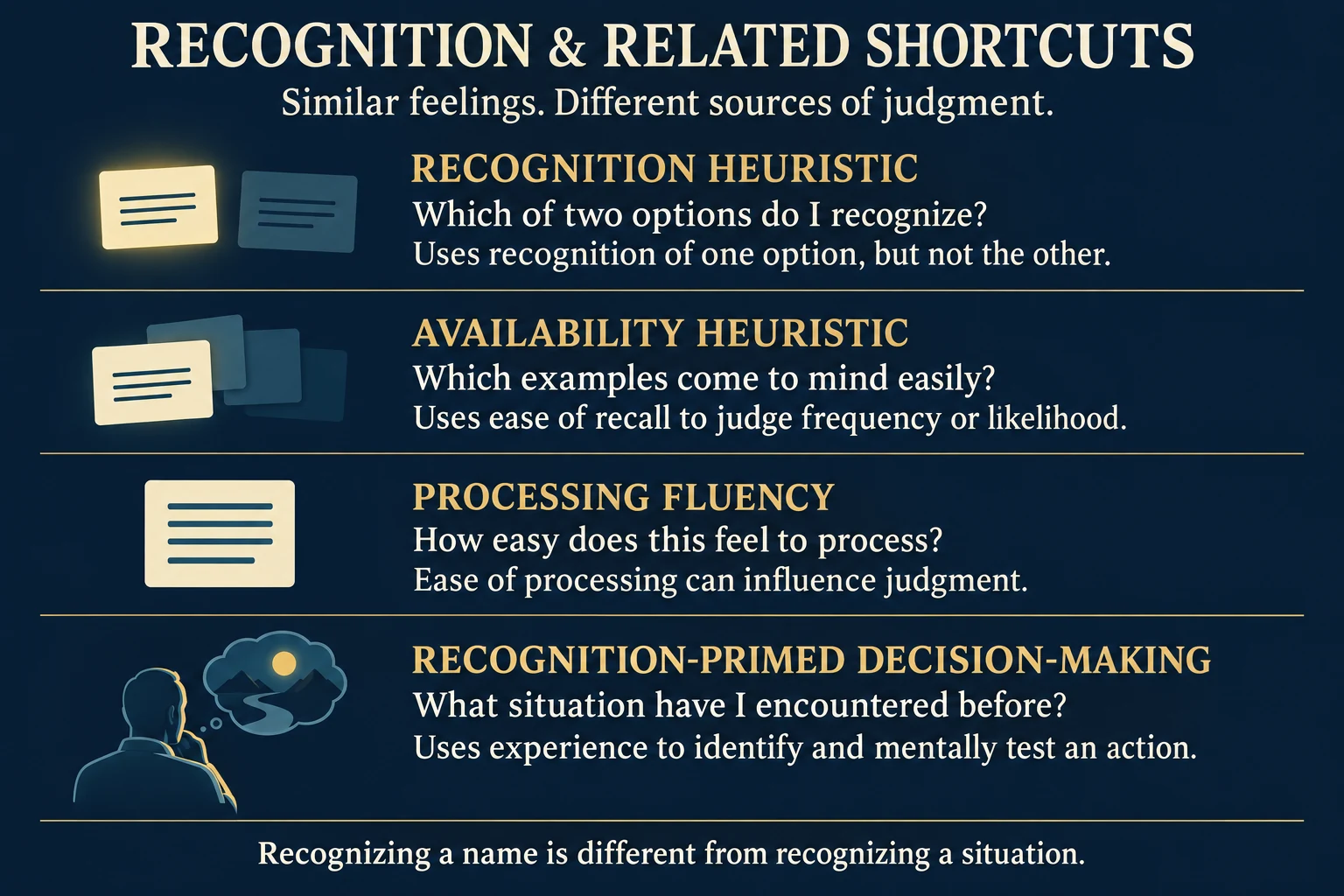
Similar impressions can arise from different processes. Availability concerns the ease of bringing examples or scenarios to mind when judging likelihood or frequency, as discussed by Tversky and Kahneman. Recognition concerns whether an option is known at all.
| Concept | Basis | Example question |
|---|---|---|
| Recognition heuristic | Recognizing one option but not the other | Which name have I encountered? |
| Availability heuristic | Ease of recalling or imagining examples | How easily can I recall a delivery failure? |
| Processing fluency | Subjective ease of processing information | Does this claim feel easy to take in? |
| Recognition-primed decision-making | Experience identifying a situation and plausible response | What action fits this familiar situation? |
Processing fluency is a broader concept. The specific fluency heuristic uses recognition speed to distinguish recognized alternatives; it is not the same as the recognition rule. Pachur and colleagues compare these mechanisms.
Gary Klein’s recognition-primed decision model concerns experienced people generating a plausible action. Its focus is recognizing a situation, rather than recognizing a name. Our guide to recognition-primed decision-making explains situation assessment and evaluating a response in more detail.
Worked example: a familiar supplier
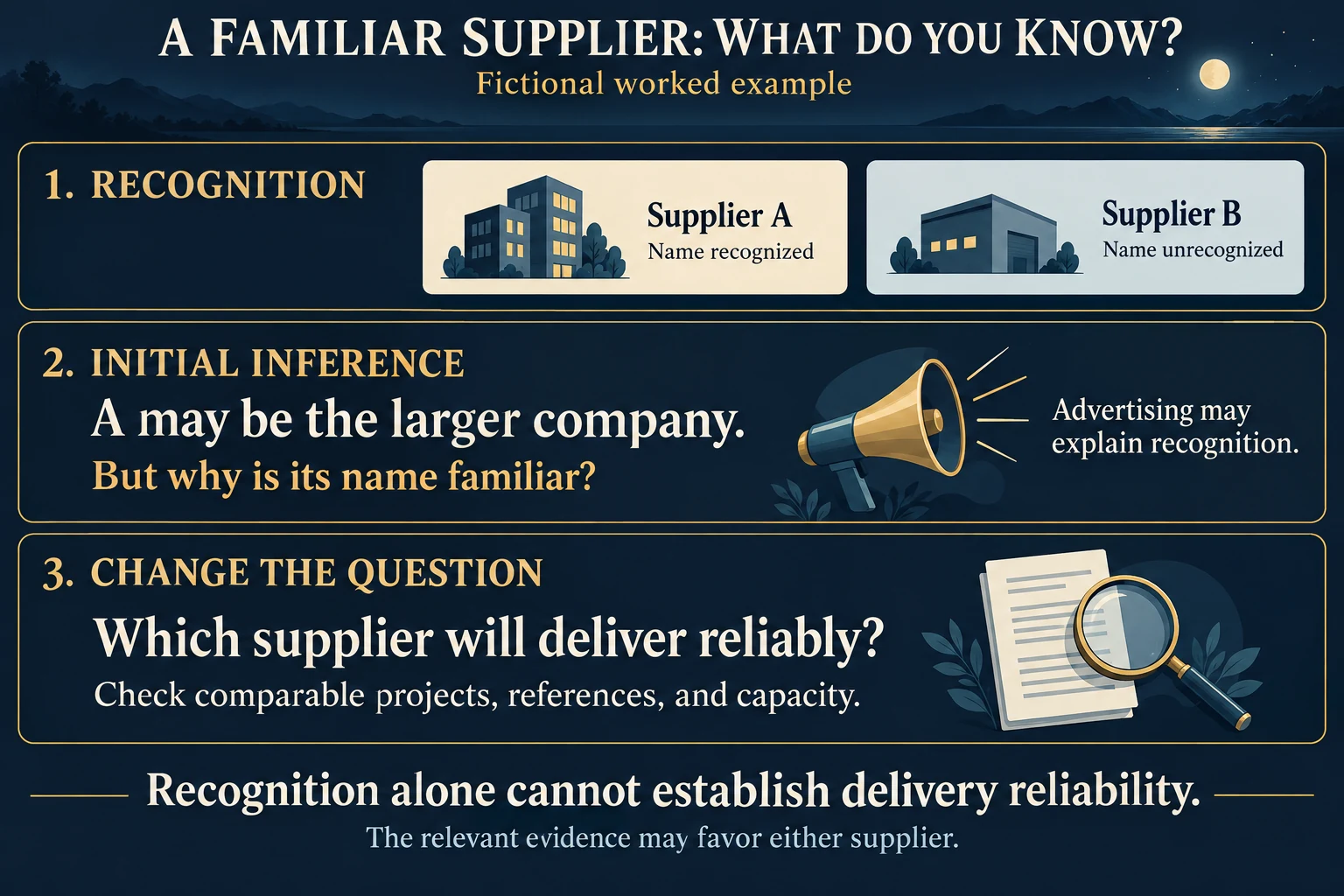
Fictional scenario: you need a supplier for a time-sensitive migration. You recognize Supplier A from industry advertising. You have not encountered Supplier B before. The two building illustrations below are conceptual; they provide no evidence of actual company size.
Step 1: record the initial inference
You write: “A may be the larger company because I recognize its name.” That is an inference about size, not a verified fact. You also record the source of familiarity: advertising.
Step 2: define the actual requirement
The decision is about completing this migration reliably. Your requirements are relevant migration experience, an available delivery team, and a credible plan for the required dates. Company size might inform a question about resources, but it does not settle those requirements.
Step 3: obtain comparable evidence
In this fictional case, A supplies general company credentials but has not confirmed an available specialist team. B supplies relevant project references and confirms the proposed team’s availability. You verify the references and examine the delivery plan against the same requirements you gave A.
Step 4: make a conditional decision
The immediate decision is which supplier to advance to final due diligence, not which supplier to award the contract. You advance B because its evidence currently addresses the requirements more directly. A remains eligible if it can supply the missing information. You have not proved that B will succeed or that A will fail; you have explained why B merits the next step.
Reverse the evidence and the conclusion should be able to reverse too. If A demonstrates stronger relevant capability and B cannot substantiate its claims, familiarity should not prevent you from advancing A. The exercise is about the basis of the decision, not rewarding unfamiliarity.
Five questions before relying on recognition
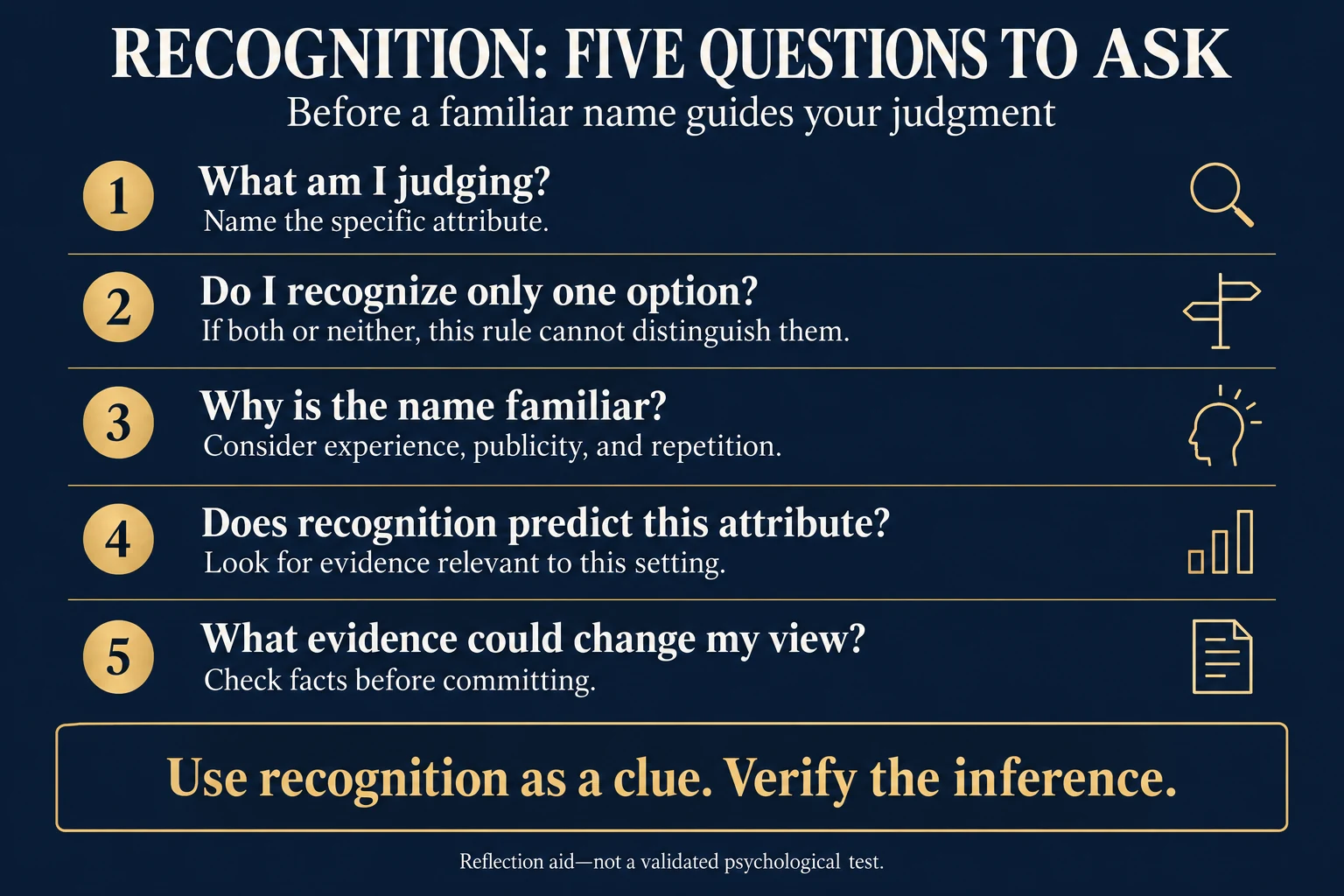
Use this original reflection aid when a familiar name influences a judgment. It has no validated score or pass threshold.
- What am I judging? State an attribute that can be checked. Replace “best supplier” with the requirements that matter.
- Do I recognize only one option? If both or neither are recognized, the basic recognition rule cannot distinguish them.
- Why is the name familiar? Identify the source if possible. If you cannot, record that uncertainty.
- Does recognition predict this attribute? Ask what relevant evidence supports the connection in this setting.
- What evidence could change my view? Name the check and the finding that would make you reconsider.
Frequently asked questions
Is the recognition heuristic a cognitive bias?
A heuristic is a simplifying strategy; a bias is a systematic pattern of error. A recognition-based inference can be correct or incorrect. For practical review, ask whether the cue supports the specific claim rather than assuming that every shortcut must be a mistake.
Is recognition the same as intuition?
No. Recognition can contribute to a fast impression, but intuition includes other forms of judgment. Recognizing a company name does not establish expertise in assessing its work. For the experience-based side of the topic, see expert intuition.
What if both options are familiar?
The classic recognition rule does not distinguish that pair. You need another basis for the judgment. In the supplier example, relevant project evidence and confirmed availability provide things to compare.
Does a familiar brand mean better quality?
Familiarity alone leaves that question unanswered. Define the quality you need, then check evidence such as relevant performance, specifications, and support. A recognized brand may meet the requirements, but recognition is not the verification.
Apply it to your next decision
Before comparing two options, write three short lines: my initial inference; why this name is familiar; the evidence I still need. Keep the note until after the decision so you can see what changed your view.
For a team discussion, ask each person to identify one claim that remains unverified. Agree on a proportionate next check rather than filling the gap with confidence. Start with the missing information most likely to change which option qualifies.
Research references
- Goldstein, D. G., & Gigerenzer, G. (2002). Models of ecological rationality: The recognition heuristic. Psychological Review, 109(1), 75–90.
- Pachur, T., Todd, P. M., Gigerenzer, G., Schooler, L. J., & Goldstein, D. G. (2011). The recognition heuristic: A review of theory and tests. Frontiers in Psychology, 2, 147.
- Tversky, A., & Kahneman, D. (1974). Judgment under uncertainty: Heuristics and biases. Science, 185(4157), 1124–1131.
- Klein, G. Recognition-primed decision model. Author’s overview.