Intuition and impulse can both arrive fast, feel internal, and push into awareness before you have a fully formed explanation. But they are not the same process. Intuition is a rapid judgment or sense that may draw on learned patterns and experience. Impulse is an urge toward action, often shaped by emotion, immediate reward, urgency, or reduced deliberation.
The practical problem is that both can feel convincing in the moment. A sudden urge to leave, send a message, buy something, confront someone, or change direction can be meaningful information—or simply a strong desire to end discomfort quickly. The goal is not to distrust every fast feeling. It is to learn how to separate the signal from the pressure to act.
Quick answer: Intuition tends to function more like information: “Something about this matters.” Impulse functions more like pressure: “Do something now.” The distinction becomes clearer when you pause, identify any immediate reward or relief, examine your experience, and see whether the underlying signal remains coherent after the urgency decreases.

Intuition vs Impulse: The Difference at a Glance
The simplest distinction is this: intuition is primarily a judgment or signal; impulse is primarily an urge toward action. Neither is automatically correct or incorrect. A useful intuitive impression can be mistaken. An impulse can occasionally lead to a good outcome. What differs is the process you need to evaluate.
| Intuition | Impulse |
|---|---|
| Rapid recognition, impression, or judgment | Rapid urge toward a behavior or action |
| May draw on learned patterns and experience | May be strongly influenced by emotion, reward, or urgency |
| Can remain relevant after a pause | May weaken, change, or lose force after delay |
| Does not necessarily demand immediate action | Often creates pressure to resolve something now |
| Should be checked against context and evidence | Especially benefits from a pause before irreversible action |

This distinction also explains why the phrase “trust your gut” can be incomplete. A gut feeling may deserve attention, but attention is not the same as obedience. If you want a deeper foundation, see what intuition feels like and how to distinguish a signal from surrounding mental noise.
Why Intuition and Impulse Feel So Similar
Intuition and impulse are easy to confuse because conscious reasoning is not always first in line. Both can appear before you can explain where the feeling came from. Both can create bodily sensations. Both can be emotionally charged. Both can feel obvious.
Speed, therefore, is not enough to identify intuition. A fast judgment may reflect genuine pattern recognition, a cognitive shortcut, emotional activation, habit, or some combination of them. This is one reason intuition and cognitive bias need to be distinguished rather than treated as opposites.
Research on expert judgment is useful here. Daniel Kahneman and Gary Klein concluded that skilled intuition is most likely to develop when an environment contains learnable regularities and the person has enough opportunity to learn them through experience and feedback. Crucially, they also argued that the subjective feeling of confidence is not by itself proof that the intuition is accurate.
What Intuition Actually Is
Intuition is often described as “knowing without knowing why.” A more practical definition is rapid judgment that occurs without fully conscious step-by-step analysis. Sometimes that judgment reflects patterns you have learned so thoroughly that recognition occurs before explanation.
An experienced designer may sense that a layout is wrong before identifying the spacing problem. A manager may notice that a project update does not fit the team’s usual pattern before discovering the missing dependency. A friend may notice a subtle change in someone’s behavior before being able to name what changed.
That does not make intuition magical. It makes it compressed. Your conscious explanation can lag behind recognition.
Experience improves intuition only under the right conditions
Repeated experience is not sufficient if the environment is chaotic or the feedback is misleading. Intuition becomes more defensible when three things are present:
- there are meaningful patterns to learn;
- you have encountered enough relevant situations;
- you received feedback that helped you discover what was actually accurate.
This is why intuition can be excellent in one domain and unreliable in another. Expertise does not automatically transfer. For a broader explanation of this mechanism, read what intuition really is: pattern recognition under uncertainty.
Intuition can still be wrong
A rapid judgment can be shaped by incomplete information, memory distortions, expectations, stereotypes, previous emotional experiences, or patterns that no longer apply. That is why calibrated intuition is different from unquestioned intuition. The dedicated guide on when intuition is wrong explores those failure modes in more depth.
What an Impulse Actually Is
An impulse is not simply a “bad decision.” It is an urge or tendency toward action that can occur with little deliberation. Psychological research treats impulsivity as multidimensional rather than as one single trait. Models such as UPPS-P distinguish pathways including urgency, lack of premeditation, lack of perseverance, and sensation seeking.
That matters because the urge to send an angry text, make a spontaneous purchase, abandon a difficult task, or say yes to an exciting opportunity may arise for different reasons. Some impulses seek relief from unpleasant emotion. Others seek excitement, reward, novelty, or fast resolution.

Why immediate reward matters
One established form of impulsive choice is delay discounting: the tendency to value a smaller or sooner reward more highly relative to a larger or later reward as the delay increases. This does not explain every impulse, but it illustrates an important principle: what feels valuable now can dominate what matters later.
The “reward” does not have to be money or pleasure. It can be relief from uncertainty, reassurance, escape from discomfort, a sense of control, validation, or the satisfaction of doing something immediately.
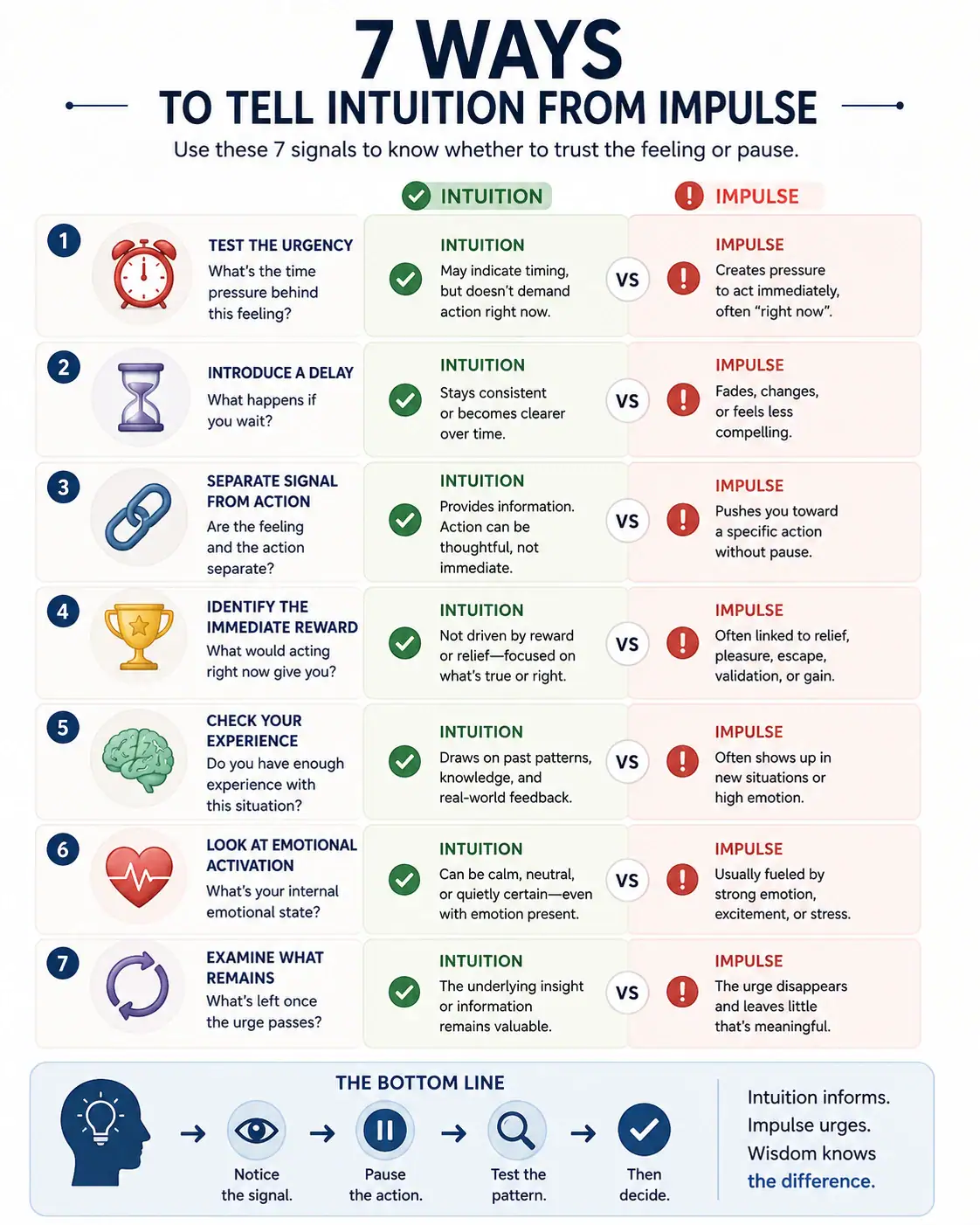
7 Ways to Tell Intuition from Impulse
No single test can prove that a feeling is intuition. The goal is to collect several signals and evaluate them together.
1. Test the urgency
Ask: What is the time pressure inside this feeling? An impulse often contains a strong demand for immediate resolution: send it now, buy it now, quit now, answer now, check now.
Intuition can also be urgent—especially when something genuinely dangerous is happening—so urgency is not a disqualifier. But in ordinary decisions, pressure to act immediately deserves examination.
2. Introduce a delay
If the decision is not time-sensitive, create space. Ten minutes may be enough for a message. A few hours may help with a conflict. A day or more may be appropriate for a purchase or major commitment.
Then observe what changes. Does the feeling disappear? Does the pressure decrease while the underlying concern remains? Does the interpretation become more precise? Delay is useful because it separates the original information from the immediate emotional momentum surrounding it.
3. Separate the signal from the action
This is one of the most important distinctions.
Signal: “Something about this interaction feels inconsistent.”
Action urge: “I need to confront them right now.”
The signal may deserve investigation even if the proposed action is impulsive. You can respect an intuitive warning without accepting the first behavior that follows it.
4. Identify the immediate reward
Ask: What would acting right now give me?
Common answers include relief, certainty, excitement, reassurance, revenge, escape, attention, pleasure, or validation. The more the action is organized around an immediate payoff, the more useful it becomes to slow down and compare that payoff with the wider consequences.
5. Check your experience
Ask whether you actually have relevant patterns to draw on. If you have spent years working with a particular type of problem and received good feedback, a fast judgment may contain learned information. If the situation is entirely unfamiliar, you should be more cautious about assuming that certainty equals expertise.
6. Look at emotional activation
Strong emotion does not automatically invalidate intuition. Fear can accompany a real warning. Excitement can accompany a genuinely good opportunity. Anger can arise in response to a real boundary violation.
The useful question is: Would I still interpret the situation similarly if the emotional intensity were lower? If possible, regulate first and reassess second.
7. Examine what remains after the urge passes
Once the immediate push weakens, notice what remains. A coherent observation, concern, or pattern may still be worth investigating. If only the urge disappeared and no meaningful information remains, impulse may have played a larger role.
The 60-Second Intuition-or-Impulse Test
When you cannot tell whether a feeling deserves trust, use these six questions. They are designed to separate information from action pressure rather than to label the feeling instantly.
- What exactly am I sensing? Name the specific feeling, observation, hunch, or inconsistency.
- What action do I suddenly want to take? Make the urge explicit rather than letting it remain fused with the feeling.
- Do those two things actually have to be connected? Could you take the signal seriously without taking that action now?
- What immediate reward or relief would acting give me? Identify what the action provides in the short term.
- What happens if I wait? Does the signal become clearer, weaker, stronger, or different after the pressure drops?
- What evidence or past pattern might my intuition be recognizing? Identify the experience, cues, or feedback that could support the judgment.
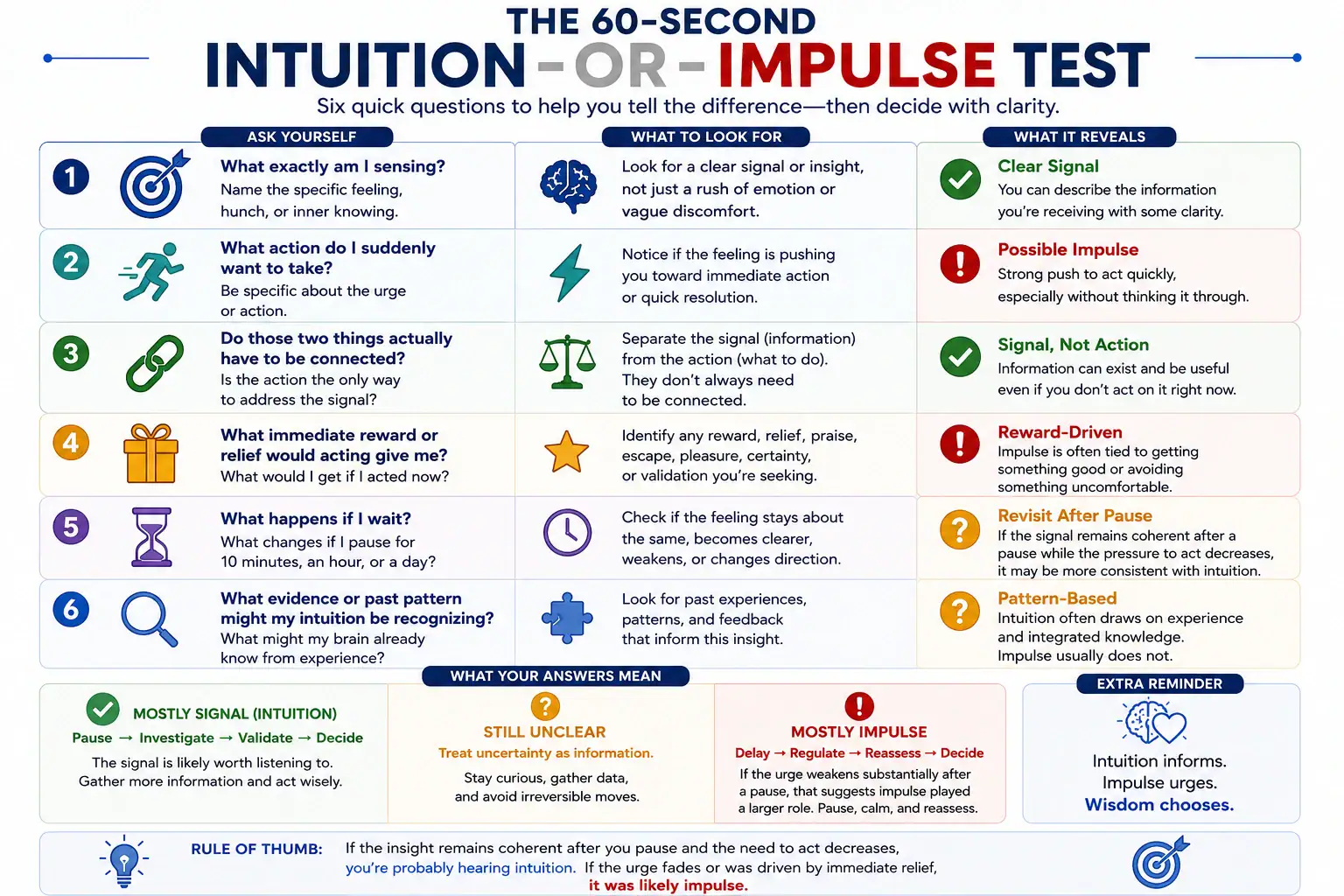
If the answer is mostly signal
Pause → investigate → validate → decide. The signal may be useful, but collect enough information to determine what action actually fits.
If it still feels unclear
Treat uncertainty as information. Stay curious. Gather data. If possible, avoid irreversible choices until the situation becomes clearer.
If it is mostly impulse
Delay → regulate → reassess → decide. You do not need to suppress the feeling. You need to reduce the pressure enough to choose rather than merely discharge it.
This logic overlaps with the broader Signal vs Noise Decision System, which is designed to help separate useful internal information from competing cognitive and emotional inputs.
Real-Life Examples: Same Feeling, Different Decision
The easiest way to understand intuition versus impulse is to stop treating a feeling and an action as the same thing.
Relationship: “Something feels off”
You notice unusual distance after a conversation. Your chest tightens and you want answers immediately.
Possible signal: their behavior changed in a way that does not fit the normal pattern.
Possible impulse: demand reassurance, check their phone, send several messages, or confront them while activated.
Calibrated response: notice the change, regulate the immediate anxiety, observe whether the pattern continues, then ask a clear question.
The signal can be worth respecting while the first action urge is worth delaying.
Work: “I really do not want to do this”
Resistance to a task can contain several kinds of information. You may be tired. The task may be poorly defined. You may fear failure. Or your experience may be noticing a genuine problem with the plan.
Possible impulse: avoid the task, distract yourself, or rush through it simply to end the discomfort.
Calibrated response: ask what the resistance refers to. Is the task wrong, or is the discomfort about effort? Break the problem down and test the interpretation.
Purchase: “I suddenly need this”
Scarcity, novelty, excitement, and imagined relief can create powerful action pressure.
Possible impulse: purchase immediately and rationalize afterward.
Calibrated response: delay, check the budget, ask what problem the purchase solves, and see whether the desire remains once the promotional pressure is gone.

Can an Impulse Ever Be Right?
Yes. Fast action is not synonymous with error. Sometimes an immediate choice is appropriate, harmless, or even necessary. The fact that a response is impulsive describes something about how the decision was made; it does not guarantee a bad outcome.
The reverse is equally important: intuition is not synonymous with truth. An intuitive judgment can be biased, outdated, overconfident, or based on misleading experience.
So the useful distinction is not:
intuition = correct
impulse = wrong
It is:
intuition = information that needs calibration
impulse = action pressure that especially benefits from a pause
Intuition vs Impulse vs Anxiety
These experiences can overlap, but they point to different questions.
| Experience | Typical function | Useful question |
|---|---|---|
| Intuition | Rapid judgment or recognition | What pattern or information might I be noticing? |
| Impulse | Urge toward action | What do I want to do right now, and what reward or relief would it give me? |
| Anxiety | Threat-oriented anticipation | What danger am I predicting, and what evidence supports that prediction? |
Anxiety may produce impulses. Intuition may trigger anxiety. An impulse can emerge in response to a legitimate intuitive observation. These categories are not sealed boxes; the task is to identify which component is doing what.
For a dedicated treatment of that distinction, see intuition vs anxiety.
When You Should Act Immediately
Pausing is a decision tool, not an absolute rule. If you perceive an immediate threat to physical safety, the cost of waiting may be too high. Move toward safety first and analyze the signal afterward.
In ordinary, reversible decisions, however, a short pause is often cheap. The larger and less reversible the decision, the more valuable it becomes to separate observation from urgency.
How to Make Intuition Easier to Distinguish from Impulse
Build experience in the domain
Intuition becomes more useful when your mind has relevant patterns to recognize. Seek repeated exposure to the kinds of problems you want to judge well.
Create feedback loops
Do not merely remember the occasions when your gut was right. Record predictions before outcomes are known, then compare your judgment with what happened. Feedback is how confidence becomes calibration.
Reduce emotional noise before high-stakes decisions
If possible, avoid making irreversible choices at peak activation. Sleep, distance, a walk, a written reflection, or a calm conversation can change the quality of the information available to you.
Separate noticing from acting
This is the central skill. You can say, “I am taking this feeling seriously” without saying, “I must obey the first urge that followed it.”
Compare intuition with deliberate reasoning
Intuition and analysis do not need to compete. In many decisions, the best process is sequential: notice the fast impression, inspect the evidence, check for bias, then make the decision. The article on intuition vs instinct can help clarify another common source of confusion.

A Better Rule Than “Trust Your Gut”
“Trust your gut” sounds decisive, but it skips the most important step: calibration.
This rule preserves what is useful about intuition without turning every internal feeling into a command. It also gives impulses room to fade, reveal their reward, or become a deliberate choice.
If you want to strengthen the underlying skill rather than simply follow feelings, intuitive thinking and the types of intuition provide useful next steps.
Frequently Asked Questions
Is intuition the same as impulse?
No. Intuition is a rapid judgment, impression, or recognition that may draw on learned patterns. An impulse is an urge toward action. They can occur together, which is why people often confuse them.
How can I tell whether I am intuitive or impulsive?
Do not rely on one feeling characteristic. Check urgency, immediate reward, relevant experience, emotional activation, and what happens after a pause. The more you separate the signal from the action, the easier the distinction becomes.
Does intuition feel urgent?
It can. A genuine danger signal may be urgent. But in ordinary decisions, intense pressure to act immediately is a reason to examine the feeling rather than automatically treating urgency as proof of intuition.
Can intuition be emotional?
Yes. Emotion and intuition are not mutually exclusive. Emotional activation can accompany useful pattern recognition, but strong emotion can also distort interpretation. The important question is whether the underlying judgment remains coherent when the intensity changes.
Why do impulses feel so convincing?
Impulses can be tied to immediate relief, reward, certainty, or escape. That short-term payoff can make action feel especially compelling even when the longer-term consequences are uncertain.
Does intuition get stronger if you wait?
Not necessarily. Some intuitive impressions remain stable, some become clearer, and some disappear. Waiting is useful because it helps reduce urgency and gives you another observation point; persistence alone does not prove accuracy.
Can intuition be wrong?
Yes. Intuition is most reliable when it develops in environments with meaningful patterns, relevant experience, and useful feedback. Bias, poor feedback, and unpredictable situations can all make intuitive judgment less reliable.
Is a gut feeling intuition or anxiety?
It can be either, or a combination. Instead of judging by bodily sensation alone, examine the information, the predicted threat, your experience, and the pressure to act. The dedicated intuition vs anxiety guide goes deeper.
Research Sources
- Kahneman, D., & Klein, G. (2009). Conditions for intuitive expertise: A failure to disagree. American Psychologist, 64(6), 515–526.
- Berg, J. M., Latzman, R. D., Bliwise, N. G., & Lilienfeld, S. O. (2015). Parsing the heterogeneity of impulsivity: A meta-analytic review of the behavioral implications of the UPPS for psychopathology.
- Review of impulsivity processes and delay discounting: Impulsivity as a determinant and consequence of drug use: a review of underlying processes.
- Review and meta-analysis of delay discounting: Delayed reward discounting and addictive behavior.