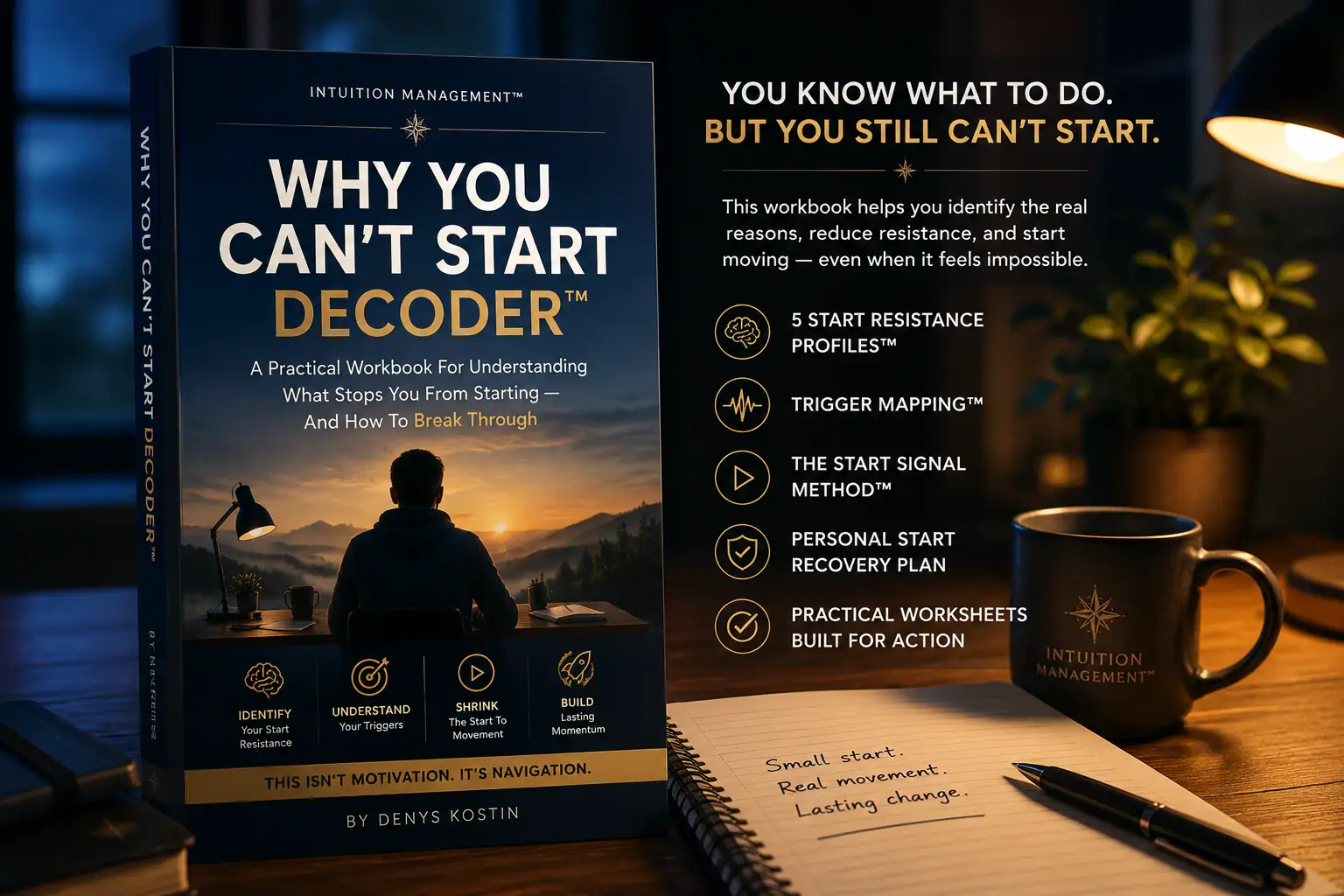
Why can’t I start tasks? If you have ever stared at an email, project, message, goal, workout, application, or important decision and wondered why beginning feels so hard, you are not alone.
You may know what needs to be done.
You may even want to do it.
But something inside does not move.
Many people call this laziness, procrastination, lack of discipline, or poor motivation. But in many cases, the inability to start is not a character flaw. It is a signal. Your brain may be detecting hidden resistance, cognitive overload, uncertainty, perfection pressure, emotional weight, or decision fatigue before you consciously understand what is happening.
Quick answer: You may be unable to start tasks because your system is detecting hidden friction. Common causes include cognitive overload, task paralysis, decision fatigue, fear of doing it badly, emotional resistance, uncertainty, low energy, or too many open loops. The solution is not always more motivation. Often, the first step is identifying what is making the start feel unsafe, unclear, too large, or too demanding.
This article explains why starting can feel so difficult, what your resistance may be trying to tell you, and how the Why You Can’t Start Decoder™ can help you move from hesitation into action.
Why Can’t I Start Even When I Want To?
When people ask “why can’t I start?”, they usually assume the answer is motivation.
They think:
- I need more discipline.
- I need to push harder.
- I need to stop being lazy.
- I need to force myself.
- I need a better productivity system.
Sometimes structure helps. But when task paralysis is active, pressure often makes the problem worse.
If everything feels harder than it should, the issue may be bigger than motivation. You may also want to read Why Does Everything Feel Harder Than It Should?, because difficulty starting often appears when your mental system is already overloaded.
There is also a quieter version of the same pattern. Sometimes you cannot begin because something feels off. Not dramatic. Not dangerous. Just slightly wrong. That feeling may be connected to uncertainty, overload, anxiety, or a signal you have not interpreted yet.
When that happens, the answer is not to immediately trust the feeling or dismiss it. The better move is to investigate it. That is the same principle explored in Why Something Feels Off.
Task Paralysis Is Not Always Laziness
Task paralysis is the experience of wanting or needing to do something while feeling unable to begin. It can happen with large goals, but it can also happen with very small tasks.
You may freeze before sending a message.
You may avoid opening a document.
You may delay a decision you already know matters.
You may keep preparing, researching, organizing, or thinking without actually beginning.
From the outside, this can look like procrastination. From the inside, it often feels like an invisible wall.
That wall usually has a structure.
7 Hidden Reasons You Can’t Start Tasks
Starting becomes easier when you stop treating resistance as one thing. There are different kinds of resistance, and each one requires a different response.
1. Cognitive Overload
Your mind may simply be carrying too much. Too many tasks, decisions, messages, tabs, expectations, and unfinished loops can make even simple action feel heavy.
When cognitive overload is high, the brain does not always need more information. It may need reduction. For a deeper explanation, read Why Decisions Feel Hard.
2. Uncertainty
Sometimes you cannot start because the next step is unclear. The task is too abstract. “Fix my website” is hard to begin. “Open the homepage draft” is easier. The brain handles visible actions better than vague projects.
This is why task initiation often improves when you stop asking, “How do I finish this?” and start asking, “What is the first visible movement?”
3. Perfection Pressure
If the task feels like it must be done perfectly, starting becomes risky. The first step begins to feel like a test of your ability, intelligence, talent, or identity. In that state, avoidance may feel safer than beginning badly.
4. Emotional Resistance
Some tasks carry emotional weight. You may avoid them because they involve disappointment, conflict, visibility, judgment, grief, shame, or fear. The resistance is not about the task itself. It is about what the task makes you feel.
5. Low Capacity
When your energy is low, the same task feels larger. A task that would take 10 minutes on a clear day can feel impossible when you are depleted. This is why starting problems often increase during burnout, stress, poor sleep, or decision fatigue.
6. Too Many Open Loops
An open loop is anything unfinished that keeps occupying attention. When too many loops stay active, your brain has less available capacity for the next action. You are not starting from zero. You are starting while already mentally loaded.
7. Fear-Based Noise
Sometimes resistance comes from anxiety. Your mind starts forecasting negative outcomes before you begin: What if I fail? What if it is not good enough? What if I choose wrong? What if people judge it?
This does not mean the fear is useless. It means it needs interpretation. You may find Intuition or Anxiety? useful if you often confuse useful signals with fear-based noise.
Example: When Procrastination Is Really Visibility Pressure
Imagine someone delaying a presentation for two weeks.
They keep telling themselves they are procrastinating.
They open the file, close it, check messages, reorganize notes, and promise to start later.
At first, it looks like a motivation problem.
But after investigating the resistance, the real pattern becomes clearer: they are not avoiding the work. They are avoiding being seen. The presentation is connected to judgment, visibility, and the possibility of doing badly in front of others.
The solution changes immediately.
More discipline is not the best first step. A smaller, safer entry point is better:
- Open the presentation.
- Write one rough slide.
- Do not polish it.
- Do not rehearse yet.
- Just create movement.
The task did not become easy. But the doorway became smaller. And sometimes that is enough to begin.
Interactive Check: What Kind of Starting Resistance Do You Have?
Quick Starting Resistance Check
When you cannot start, what feels most true?
□ I feel overwhelmed by too many things.
□ I do not know exactly where to begin.
□ I am afraid I will do it badly.
□ The task feels emotionally heavy.
□ I feel tired before I even start.
□ I keep thinking, researching, or preparing instead of acting.
□ I am waiting to feel motivated, confident, or ready.
Your answer may reveal the type of resistance your brain is detecting. The goal is not to judge the resistance. The goal is to identify it clearly enough to reduce it.
The Real Question Is Not “How Do I Force Myself?”
When you cannot get started, the most useful question is usually not:
How do I force myself to do this?
A better question is:
What is making this hard to begin?
That question changes the entire problem.
Instead of attacking yourself, you investigate the system. Instead of demanding motivation, you look for friction. Instead of trying to become stronger than the resistance, you learn how to make the entry point smaller, clearer, and easier to approach.
This is also why Intuition Management focuses on practical pattern recognition under uncertainty. If you want a guided path through the broader framework, start with Your Intuition Journey.
How to Start When You Feel Stuck
Before you reach for another productivity trick, try reducing the resistance itself.
Here is a simple starting framework you can use now.
- Name the resistance. Is it overload, uncertainty, fear, perfection pressure, emotional weight, or low energy?
- Make the task visible. Replace the project with one concrete action.
- Shrink the first step. Make it small enough that it no longer feels threatening.
- Begin before you feel ready. Readiness often appears after movement, not before it.
- Stop after the smallest start if needed. The first success condition is beginning.
This does not solve every deeper issue immediately. But it creates information. And information creates clarity.
In practical terms, action paralysis often improves when you reduce the size of the first move. Executive function works better when the next step is concrete, visible, and low-friction. If the task is emotionally or cognitively loaded, your first job is not completion. Your first job is creating a start small enough to happen.
A New Resource: Why You Can’t Start Decoder™
To explore this problem in depth, I created the Why You Can’t Start Decoder™.
This workbook is a practical system for understanding why action feels blocked, why task paralysis appears, and how to create movement without relying on motivation alone.
Inside the workbook, you will find:
- The Five Start Resistance Profiles™ to identify your dominant resistance pattern.
- Trigger Mapping™ to understand when starting becomes hardest.
- The Start Signal Method™ to reduce resistance and create movement.
- Personal Start Recovery Planning to build a system that makes starting easier.
- Worksheets and visual tools for turning awareness into action.
The goal is not to become a more pressured version of yourself.
The goal is to understand what your resistance is actually communicating.
Why More Motivation Often Does Not Help
Motivation is useful when the path is clear and capacity is available.
But motivation is unreliable when the system is overloaded, unclear, depleted, or emotionally activated.
That is why many people can feel inspired at night and still freeze the next morning. The desire is real, but the resistance is still there.
When resistance is hidden, motivation becomes a temporary spark. When resistance is understood, action becomes more navigable.
Related Reading
If this topic feels relevant, these articles continue the same decision-clarity path:
- Why Decisions Feel Hard
- Why Does Everything Feel Harder Than It Should?
- Intuition or Anxiety?
- The Personal Signal Decoder
- Your Intuition Journey
FAQ: Why Can’t I Start Tasks?
Why can’t I start tasks even when they are important?
You may be experiencing hidden resistance rather than low motivation. Important tasks often create pressure, uncertainty, fear of mistakes, or emotional weight. The more important the task feels, the more your brain may treat the start as risky.
Is procrastination always laziness?
No. Procrastination can come from overload, decision fatigue, anxiety, perfectionism, unclear next steps, emotional resistance, or low capacity. Calling it laziness often hides the real pattern.
Why do simple tasks feel overwhelming?
Simple tasks can feel overwhelming when your mental capacity is already occupied. Open loops, stress, exhaustion, constant input, and decision fatigue can make small actions feel much larger than they are.
What causes task paralysis?
Task paralysis often appears when a task feels too unclear, too large, too emotionally charged, too visible, or too risky. It can also appear when your nervous system is overloaded or your energy is low.
How do I stop freezing before I begin?
Start by identifying the source of resistance. Then make the next action smaller and more visible. Instead of trying to complete the task, create one tiny movement: open the document, write one sentence, send one message, or set one timer.
What should I do if I keep waiting for motivation?
Try shifting from motivation to navigation. Ask what is making the start difficult, reduce that friction, and choose the smallest possible beginning. Motivation often follows movement rather than causing it.