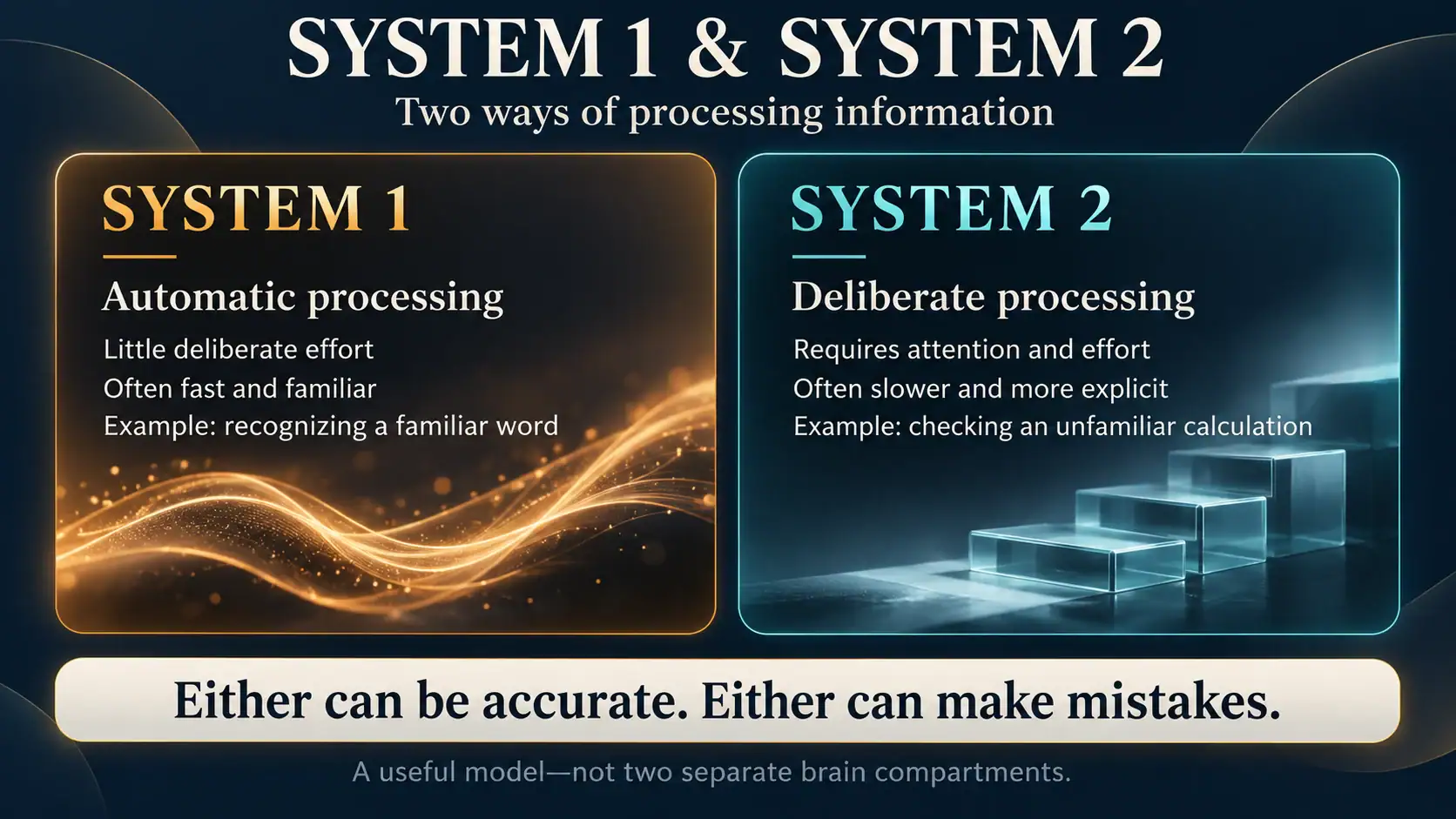
System 1 and System 2 thinking describe automatic and deliberate ways of processing information. System 1 produces responses with little deliberate effort. System 2 involves effortful attention, such as comparing evidence or working through a calculation. “Fast” and “slow” are useful shorthand, but speed alone does not tell you whether an answer is correct.
You recognize a familiar word without sounding out each letter. A moment later, you reread a confusing sentence to work out what it means. That ordinary shift captures the appeal of this model: it gives us language for different kinds of mental work. It does not divide the brain into two compartments or divide people into two personality types.

This guide explains the differences, walks through seven everyday examples, and offers a practical way to decide when your first response deserves a closer look.
What Are System 1 and System 2 Thinking?
The terms belong to the family of dual-process accounts of cognition. Daniel Kahneman popularized them in Thinking, Fast and Slow. Researchers also use “Type 1” and “Type 2” to emphasize kinds of processing without implying two self-contained mechanisms.
System 1: automatic processing
System 1 is the familiar label for responses that arise with little deliberate control. Recognizing a word, noticing an expression, and retrieving a well-practiced answer can feel immediate. You encounter something and a response becomes available without consciously constructing every step.
For the reader, the useful distinction is how the answer arrives. An immediate impression can be a starting point, but its ease does not establish its truth. For the broader explanation of judgments that emerge without visible step-by-step reasoning, see intuitive thinking.
System 2: deliberate processing
System 2 refers to more effortful mental work: holding information in mind, comparing possibilities, calculating, and considering an alternative to the first response. It becomes especially noticeable when a task cannot be completed by a familiar response alone.
In their review, Evans and Stanovich (2013) distinguish autonomous Type 1 processing from Type 2 processing that draws on working memory and supports hypothetical thinking. That distinction is more precise than treating speed, emotion, or correctness as a complete definition.
System 1 vs System 2: Key Differences
The table summarizes typical contrasts. The same task can require different amounts of effort depending on familiarity.
| Feature | System 1 | System 2 |
|---|---|---|
| Control | Response arises relatively automatically | Attention is directed toward the task |
| Effort | Little deliberate effort | Requires deliberate mental effort |
| Typical speed | Often fast | Often slower; speed is not the definition |
| Working memory | Less dependent on active working-memory resources | Draws on working memory |
| Illustration | Recognizing a familiar word | Interpreting an ambiguous sentence |
| Potential contribution | Makes a response available quickly | Makes comparisons and assumptions more explicit |
| Accuracy | Can be accurate or mistaken | Can be accurate or mistaken |
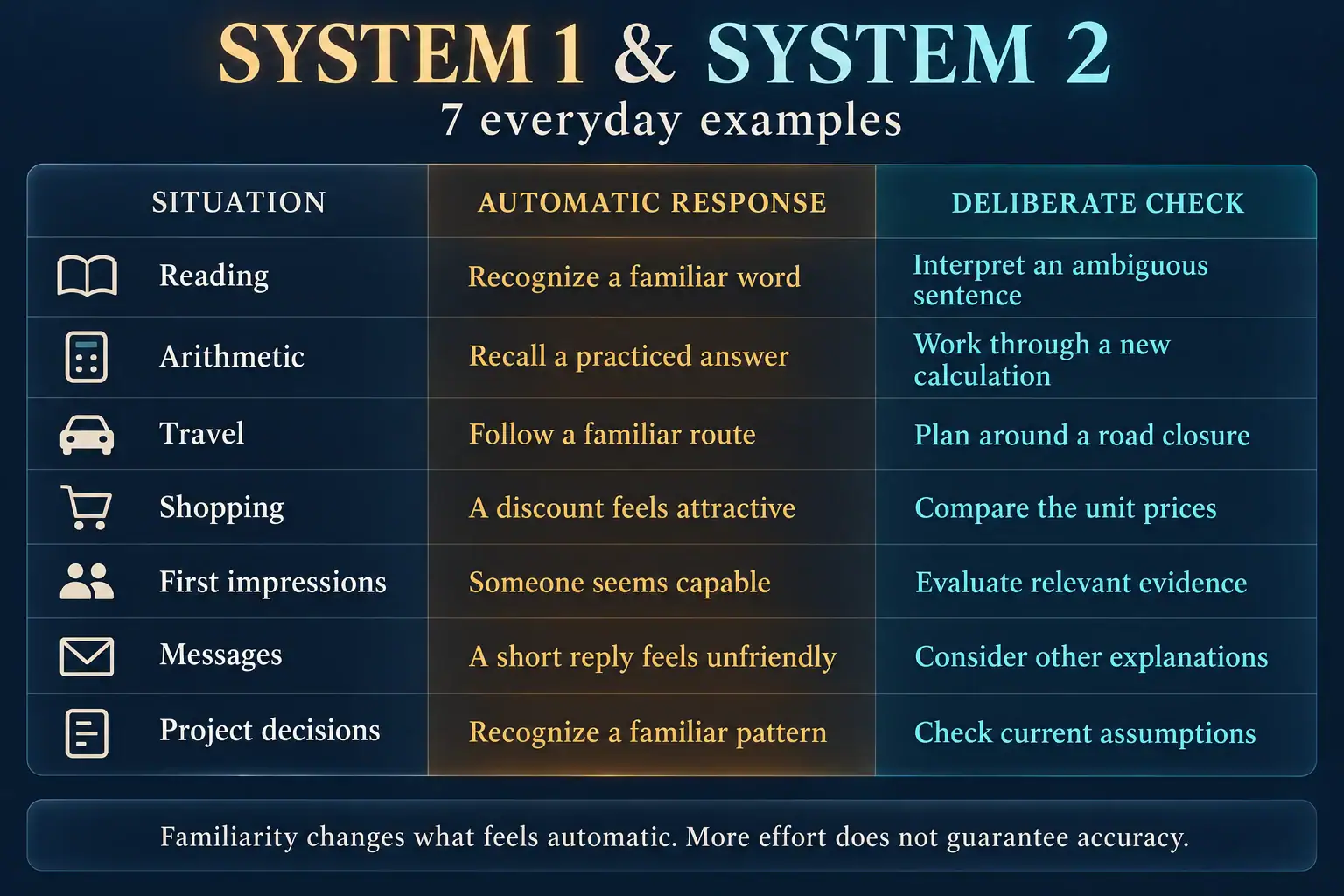
7 Examples of System 1 and System 2 Thinking
The following are everyday illustrations. Practice can change how an answer is produced: Compton and Logan (1991) studied the transition from calculation-like procedures to memory retrieval in an alphabet-arithmetic task. Their findings support a role for retrieval during trained performance; they do not establish that repetition improves every kind of judgment.
1. Reading a word and interpreting a sentence
Automatic response: You see the word “window” and recognize it without intentionally spelling it out.
Deliberate work: You read “I saw her duck” and examine the surrounding sentence to decide whether “duck” refers to a bird or an action.
What the comparison shows: The extra work addresses a specific ambiguity. You do not need to slow down for every familiar word to read well.
2. Recalling an answer and doing a new calculation
Automatic response: You retrieve a practiced answer such as 6 × 7 = 42.
Deliberate work: You calculate 17 × 24 by breaking it into 17 × 20 and 17 × 4, then adding 340 and 68 to get 408.
What the comparison shows: Writing the steps makes the calculation inspectable. If 17 × 24 is already memorized, however, that same question may require little deliberate work.
3. Taking a familiar route and responding to a closure
Automatic response: At a familiar intersection, you recognize your usual turn with little conscious comparison.
Deliberate work: A road is closed, so you compare alternative routes, travel times, and where each road leads.
What the comparison shows: The changed condition creates a reason to reconsider the routine. This illustration does not mean driving requires no attention.
4. Reacting to a discount and comparing value
Automatic response: A large sale label makes a product feel like a good deal.
Deliberate work: You compare a 750 g pack costing $6 with a 1 kg pack costing $7. The first costs $8 per kilogram; the second costs $7.
What the comparison shows: The calculation answers a defined question about unit price. You still need to consider whether you need the larger quantity or will waste some of it.
5. Forming an impression and checking capability
Automatic response: A confident, fluent speaker seems capable during an interview.
Deliberate work: You compare work samples and answers against the same role-relevant criteria used for other candidates.
What the comparison shows: The check asks whether the initial impression matches relevant evidence. A good conversation and demonstrated capability are different observations.
6. Interpreting a short message
Automatic response: A colleague replies “Fine.” and the brevity feels unfriendly.
Deliberate work: You consider whether they are busy, usually write briefly, or have actually said something that indicates a problem. If the meaning matters, you ask.
What the comparison shows: The aim is to separate an interpretation from what is known. Repeatedly rereading the message without new evidence may add effort without resolving the ambiguity.
7. Recognizing a project pattern
Automatic response: A familiar-looking dashboard and a confident team create a quick impression that a launch is ready.
Deliberate work: You examine the actual readiness criteria, test evidence, dependencies, and unresolved issues.
What the comparison shows: A familiar presentation can prompt useful questions, but the current project still needs its own evidence. We develop this scenario below.
How System 1 and System 2 Work Together
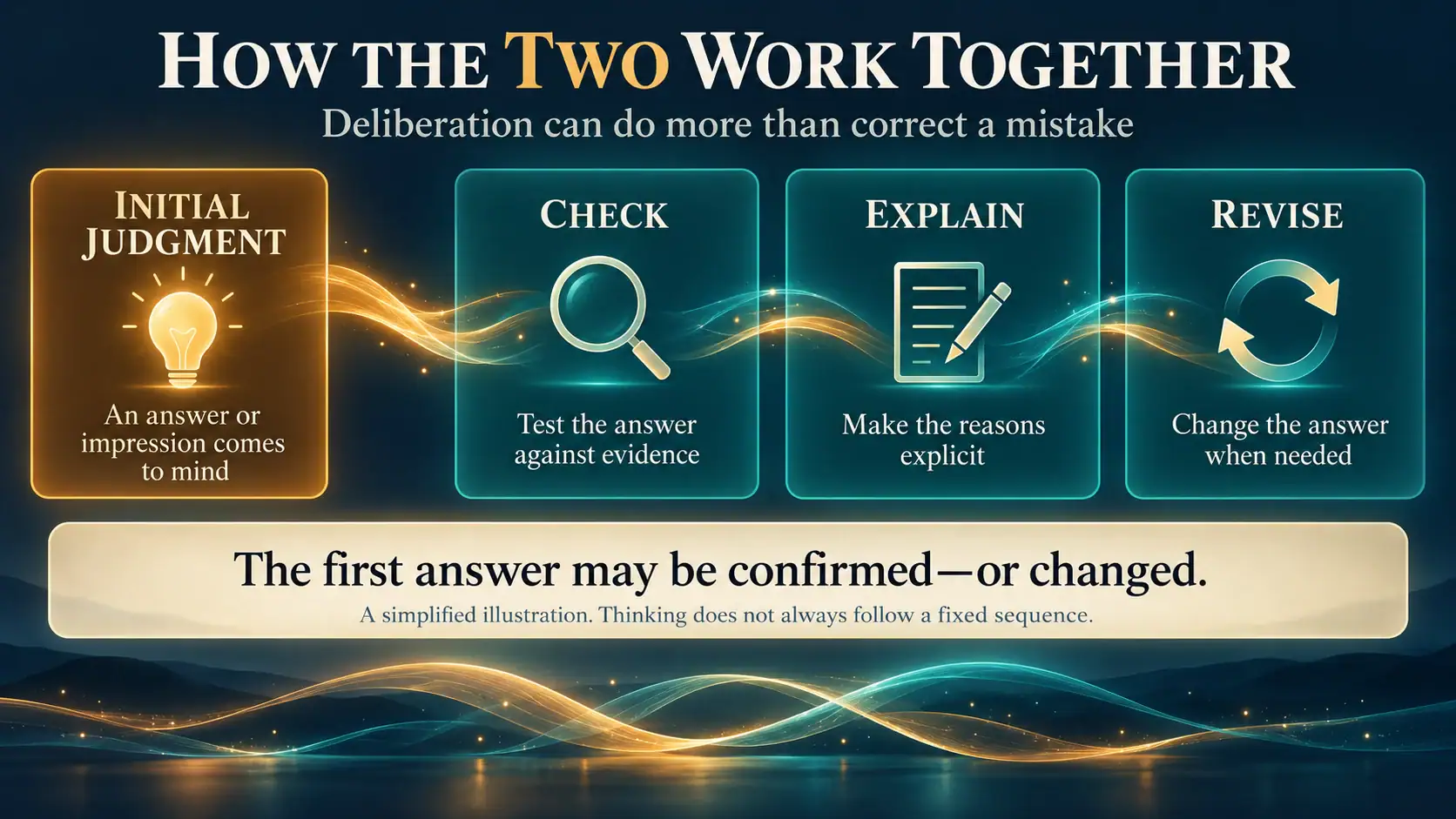
A common explanation says intuition gives an answer and deliberation fixes it. That can happen, but it is too narrow as a universal account. A first answer may already be sound. Deliberation may help explain why it works, make it communicable, or compare it with another possibility.
De Neys’s 2025 discussion of deliberation examines its functions and how to define it more carefully. The practical lesson for this article is modest: do not assume that the only purpose of further thought is to overturn an initial response.
- Check: compare the response with evidence or a calculation.
- Explain: make the reasons explicit enough to inspect or communicate.
- Revise: change the conclusion when the check reveals a problem.
Imagine you estimate that a task will take two days. A review of the work might support that estimate and help you explain it to a colleague. Alternatively, the review may reveal a dependency that changes the estimate. The value lies in what the review establishes, not in whether your first answer survives.
How Intuition and Heuristics Fit the Model
These concepts answer related but different questions. Intuition describes a judgment that appears without an accessible chain of deliberate reasoning. A heuristic is a simplifying strategy. System 1 and System 2 describe broad processing distinctions.
For example, “choose the option I recognize” is a shortcut. Someone might follow recognition immediately, or deliberately adopt that rule because a quick decision is sufficient. Naming the shortcut does not, by itself, establish how consciously it was used.
Keep the distinctions clear with heuristic thinking and intuition vs heuristics. For the way an intuitive judgment functions as an answer or inference, see intuitive reasoning.
Is System 2 Always More Accurate?
No. The value of extra thought depends on what it checks. Calculating the unit price resolves a defined question. Spending longer defending a purchase you already want may leave the underlying assumption untouched.
There is research evidence that evaluating arguments can favor prior beliefs. In two studies of political attitudes, Taber and Lodge (2006) found that participants rated arguments agreeing with their existing attitudes more favorably. These studies concern political reasoning; they do not show that deliberation always causes bias. They illustrate why examining evidence is not automatically impartial.
Fast judgments also differ in quality. Kahneman and Klein (2009) connect skilled intuition to environments containing learnable regularities and opportunities to learn them. Subjective confidence alone cannot establish that those conditions are present. Their analysis helps explain why experience can be useful in one setting without making someone reliable everywhere.
For an everyday decision, examine the relevant experience and the evidence available now. Has this kind of judgment been tested against outcomes? Has the situation changed? Our guide to expert intuition explores those boundaries, while implicit learning explains learning that is not fully accessible as an explicit rule.
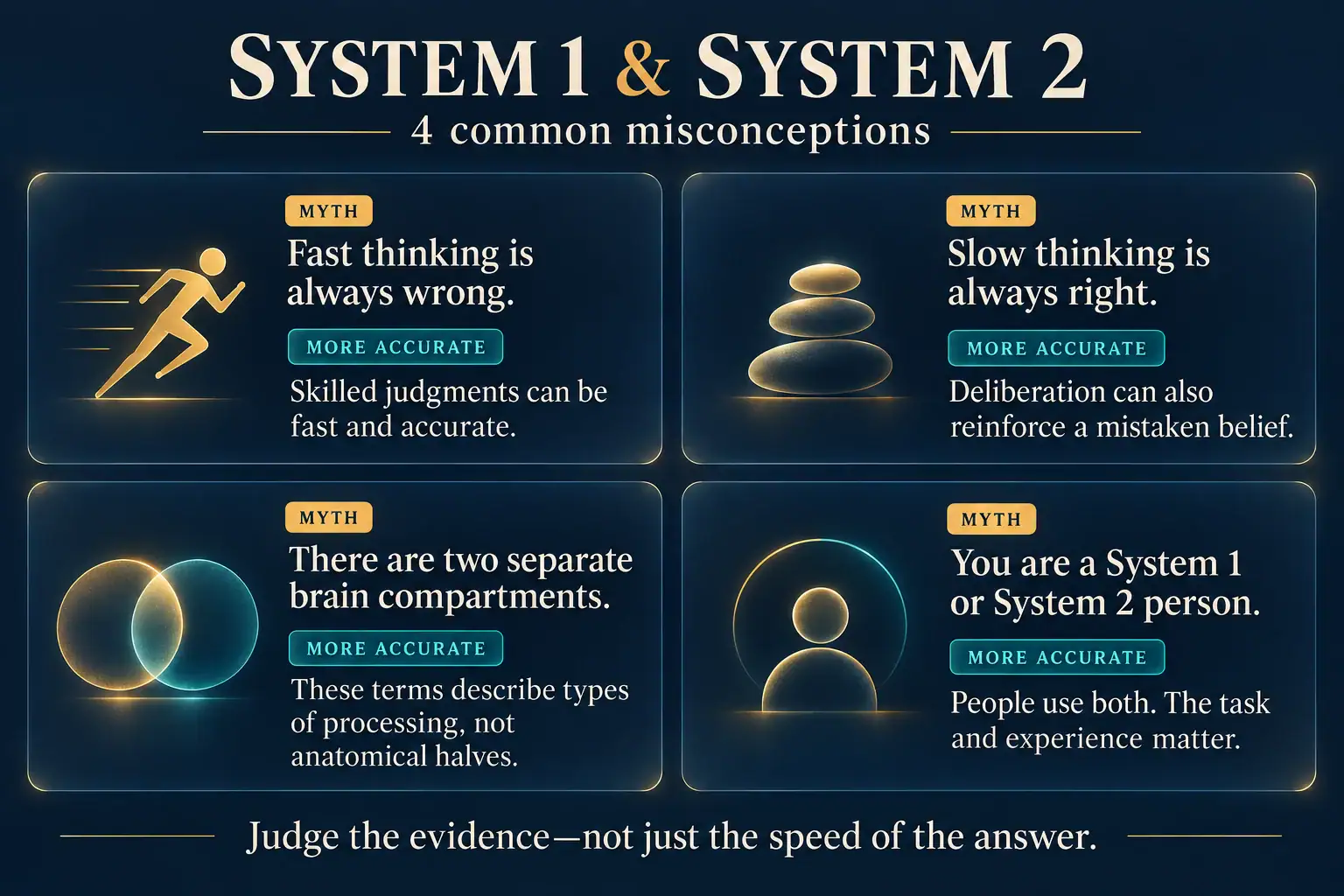
Four Common Misconceptions
- “Fast thinking is always wrong.” A quickly retrieved answer can be correct. Its origin and fit to the situation matter.
- “Slow thinking is always right.” An elaborate argument can still depend on an unsupported premise.
- “There are two separate brain compartments.” The labels are a conceptual distinction, not a diagram of anatomical halves.
- “You are a System 1 or System 2 person.” Use the model to examine tasks and responses rather than assign yourself a fixed identity.
Worked Example: A Project That Looks Ready
The following is a hypothetical scenario, not a research finding or a report of a real project.
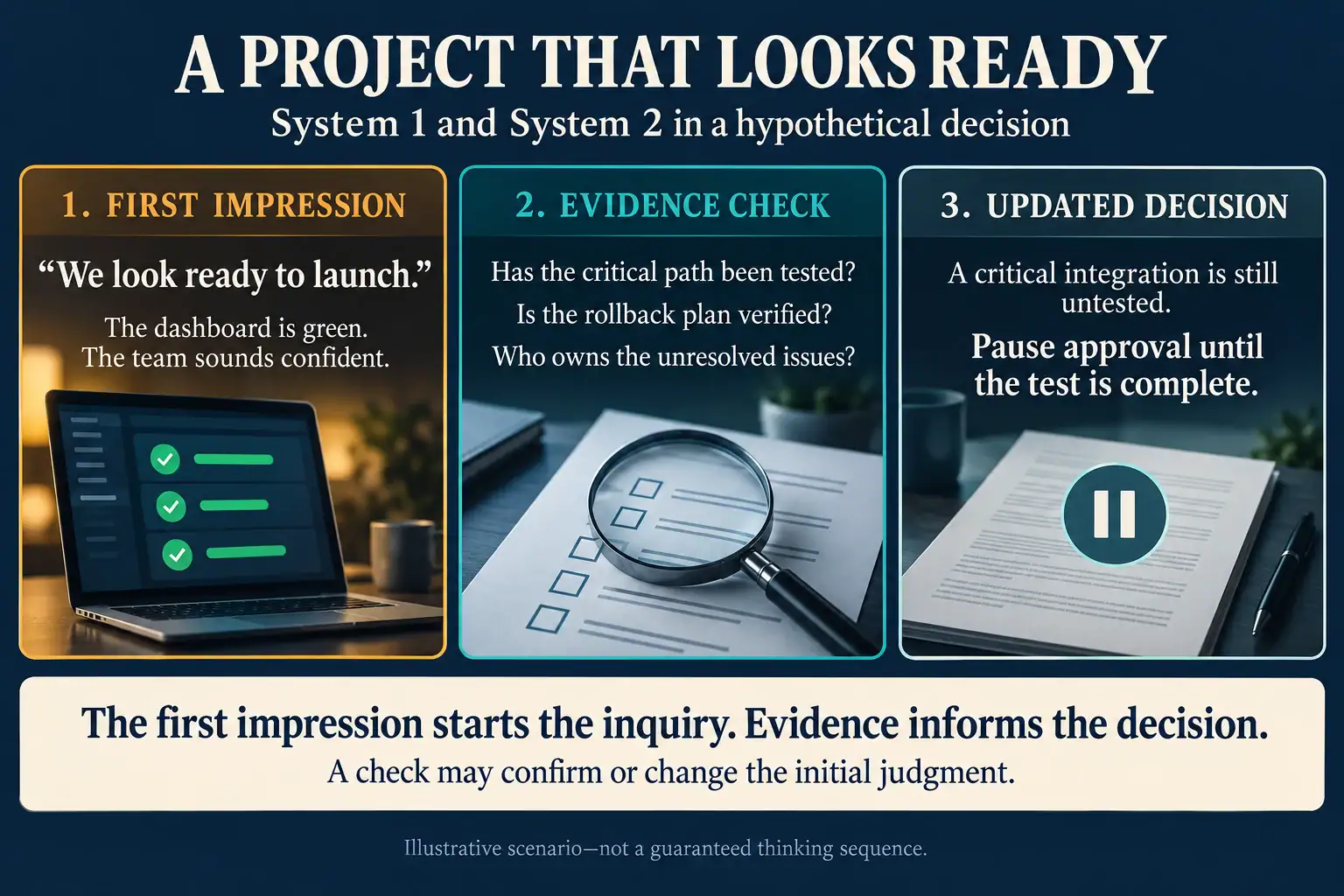
A delivery manager attends a release review. The dashboard is green, the team speaks confidently, and the presentation resembles previous successful launches. The first impression is straightforward: “We look ready.”
That impression is understandable, but the release decision requires more than recognizing a familiar presentation. The manager asks for the evidence behind three specific questions:
- Has the critical end-to-end path been tested?
- Is the rollback plan verified for this release?
- Who owns the unresolved issues, and which ones affect approval?
The review reveals that a critical integration has not been tested. The green status reflects individual workstream reports rather than a complete end-to-end readiness check. The manager pauses approval until the missing test is completed and its result meets the agreed release criteria.
Here, deliberate checking changes the decision because it uncovers relevant information. Simply discussing readiness for longer would not have served the same purpose. The useful move was to connect a specific requirement to evidence.
If the tests had already passed and the remaining criteria were met, the review could instead have supported the initial impression. Both outcomes are compatible with the example. It illustrates one possible interaction rather than a guaranteed thinking sequence.
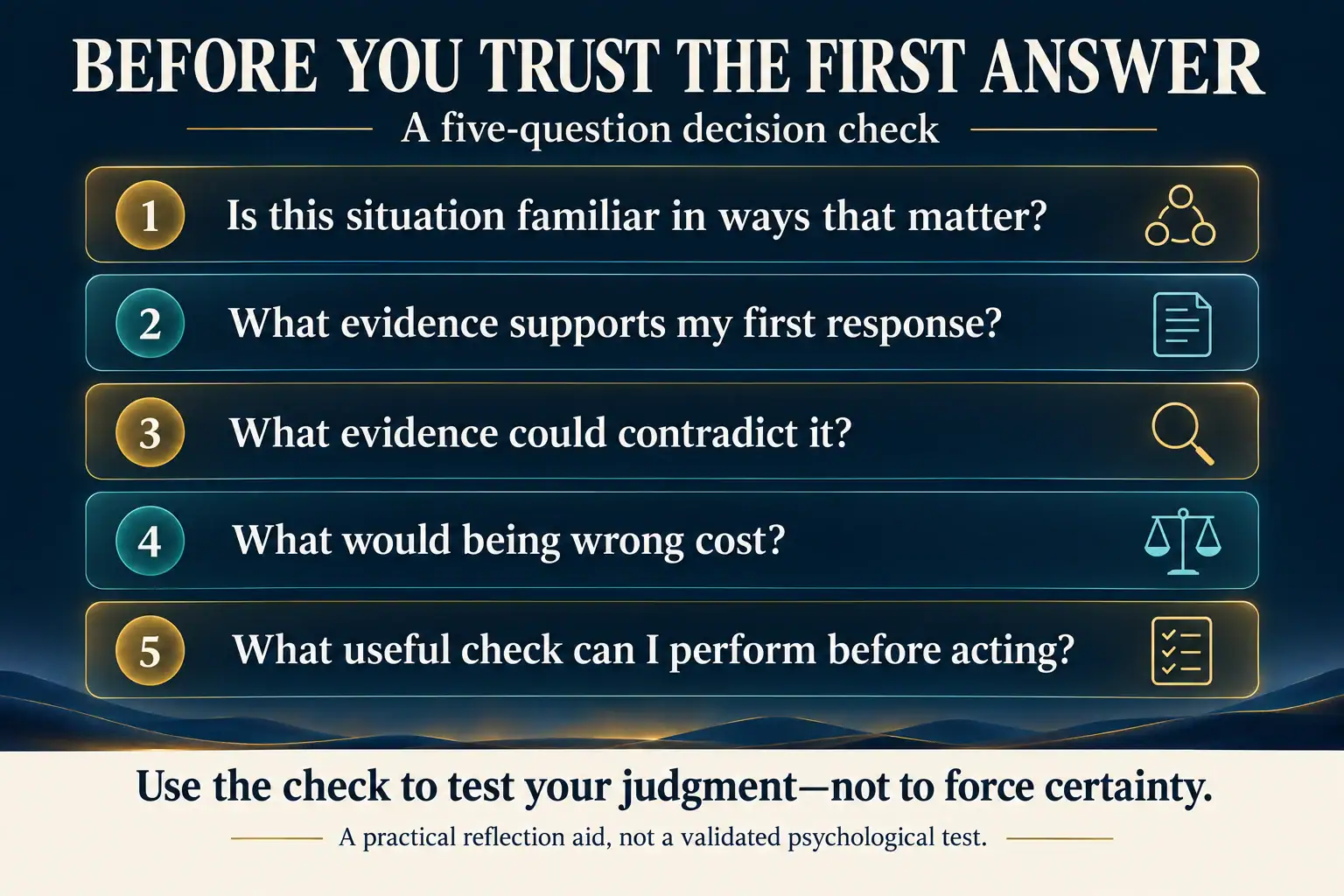
Five Questions Before You Act on a First Response
Use these prompts when a decision is consequential, unfamiliar, or contradicted by evidence. They are an editorial reflection aid, not a validated psychological test or a score of how rational you are.
Is this situation familiar in ways that matter?
Name the relevant similarity. A familiar dashboard is less informative than experience with the same dependency, failure mode, or operating conditions.
What evidence supports my first response?
Identify an observation, result, or comparison. “It feels obvious” describes confidence; it does not supply the missing evidence.
What evidence could contradict it?
Write down one finding that would make you reconsider. In the project example, an untested critical integration is such a finding.
What would being wrong cost?
Consider consequences and reversibility. A routine preference needs less checking than a decision that creates significant commitments for other people.
What useful check can I perform before acting?
Choose a concrete step: inspect a result, calculate a relevant quantity, compare criteria, or clarify an ambiguity with the person involved.
Give the check a stopping point. Decide which evidence would be sufficient, what would remain uncertain, and when the choice must be made. If another round of thought cannot produce relevant information, consider whether a small reversible action or an explicit decision under uncertainty would be more useful.
Related: Cognitive Reflection Test: Questions, Answers, and Limits
Frequently Asked Questions
What is the main difference between System 1 and System 2?
The core contrast is relatively automatic processing versus deliberate processing that requires attention and working memory. Fast and slow describe common tendencies, but they are not a complete definition.
Is System 1 the same as intuition?
They overlap, but the terms have different scope. Intuition usually refers to a judgment or impression, while System 1 is a broader processing label that also covers ordinary automatic responses such as recognizing familiar words.
Is System 2 the same as overthinking?
No. A deliberate calculation or evidence check can have a clear purpose and endpoint. Overthinking commonly describes repeated thought that feels unproductive. More time spent thinking does not necessarily mean a better check has occurred.
Can the same task involve both kinds of thinking?
Yes. Reading can involve immediate word recognition and deliberate interpretation within the same sentence. The labels describe processes, rather than assigning an entire activity to one category.
Can practice change what feels automatic?
Yes. A multiplication answer that once required calculation may become readily retrievable with practice. See the examples above for the research and the limits of this comparison.
Which system should I use for important decisions?
The label alone will not make the decision safer. Specify the criteria, examine relevant evidence, and use appropriate checks. An initial judgment can help you notice an issue; deliberate work can help establish whether that issue changes the choice.
Try this on your next decision: write your first response, one observation that supports it, and one finding that would change it. Then perform the smallest useful check. To explore the judgment that starts this process, continue with the guide to intuitive thinking.
Research Sources
- Evans, J. St. B. T., & Stanovich, K. E. (2013). Dual-Process Theories of Higher Cognition: Advancing the Debate. Perspectives on Psychological Science, 8(3), 223–241.
- De Neys, W. (2025). Defining deliberation for dual-process models of reasoning. Nature Reviews Psychology, 4, 544–552.
- Kahneman, D., & Klein, G. (2009). Conditions for intuitive expertise: a failure to disagree. American Psychologist, 64(6), 515–526.
- Compton, B. J., & Logan, G. D. (1991). The transition from algorithm to retrieval in memory-based theories of automaticity. Memory & Cognition, 19, 151–158.
- Taber, C. S., & Lodge, M. (2006). Motivated Skepticism in the Evaluation of Political Beliefs. American Journal of Political Science, 50(3), 755–769.