An experienced professional can notice that something is wrong before a checklist confirms it. A nurse detects a subtle change in a patient, a mechanic hears an unfamiliar vibration, or a project leader notices that a vague dependency will become a delay. The judgment may arrive quickly, but it is not necessarily a guess. It can be the visible result of years of tacit learning.
Tacit knowledge in decision-making is context-specific know-how built through repeated experience. It helps a person notice meaningful cues, match the present situation to learned patterns, anticipate likely outcomes, and select a plausible response before they can explain every mental step. It is a major foundation of expert intuition—but it is reliable only under the right conditions.

What is tacit knowledge in decision-making?
Tacit knowledge is knowledge expressed through skilled perception and action more easily than through words. You may know how much pressure to apply, which cue matters, when a situation is drifting, or which explanation does not fit—even if you cannot immediately state the complete rule behind that judgment.
Philosopher Michael Polanyi captured the core idea with the observation that people can “know more than we can tell.” His work does not imply that tacit knowledge is supernatural. It means that competent performance contains more relationships, sensations, exceptions, and contextual adjustments than a person can fully convert into a procedure. The University of Chicago Press description of The Tacit Dimension emphasizes this personal and partly inarticulate dimension of knowing.
In a decision, tacit knowledge often appears as:
- cue sensitivity: noticing a small but meaningful deviation;
- pattern recognition: seeing how several weak signals fit together;
- expectation: sensing what should happen next if the situation is normal;
- anomaly detection: recognizing that the current pattern violates that expectation;
- response selection: generating a plausible first action from experience.
This is why a useful explanation of intuition starts with pattern recognition under uncertainty. The feeling is only the surface. Beneath it is a compressed history of situations, actions, outcomes, and corrections. For the wider relationship between fast judgment and deliberate analysis, see intuition in decision-making.
Tacit vs implicit vs explicit knowledge
The terms tacit, implicit, and explicit are often used loosely, and some fields treat tacit and implicit knowledge as synonyms. For practical decision-making, the following distinction is useful: explicit knowledge has already been codified; implicit knowledge has not yet been articulated but may be made explicit; tacit knowledge resists complete codification because skilled performance depends on context and embodied practice.
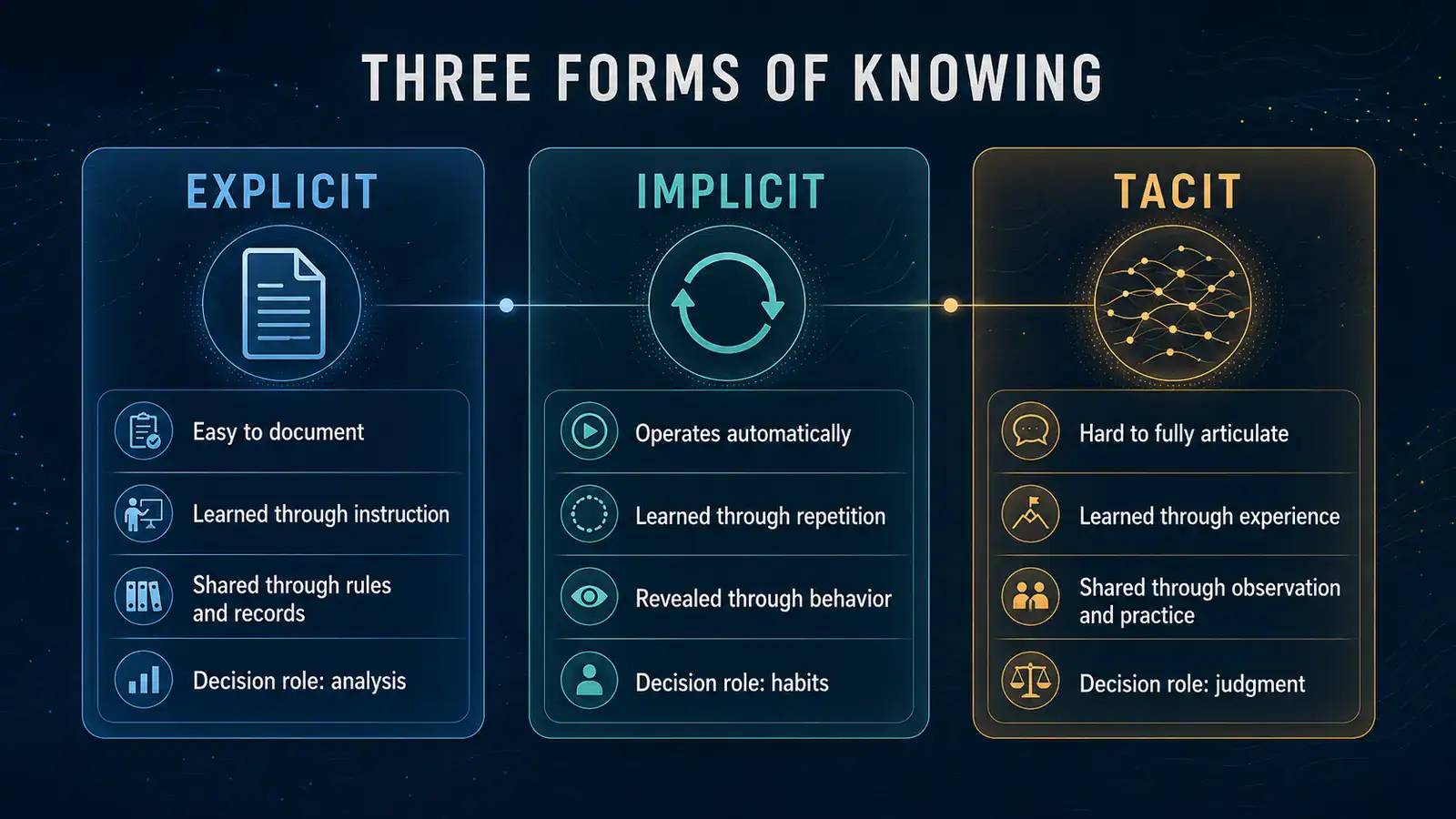
| Knowledge type | What it is | How it transfers | Decision example |
|---|---|---|---|
| Tacit | Context-sensitive know-how that cannot be fully stated as rules | Observation, guided practice, coaching, feedback, and reflection | A mechanic notices that an engine sounds wrong before identifying the component |
| Implicit | Knowledge influencing behavior without current conscious awareness | Prompting, reflection, comparison, and explanation may surface it | A manager realizes they routinely ask one diagnostic question before approving risky work |
| Explicit | Codified facts, models, criteria, and procedures | Documents, instruction, databases, checklists, and formal training | A written escalation threshold defines when approval is mandatory |
Good decisions rarely use only one type. Explicit knowledge provides standards and traceability. Implicit knowledge can be surfaced and tested. Tacit knowledge helps interpret ambiguous context. The aim is not to replace analysis with intuition, but to connect fast recognition with reasons, evidence, and safeguards.
How experience becomes intuition
Experience does not automatically create expertise. Time in a role produces better intuition only when a person encounters meaningful patterns, attempts decisions, sees what happened, and updates their expectations. Without that learning loop, experience can reinforce bad habits as easily as good judgment.
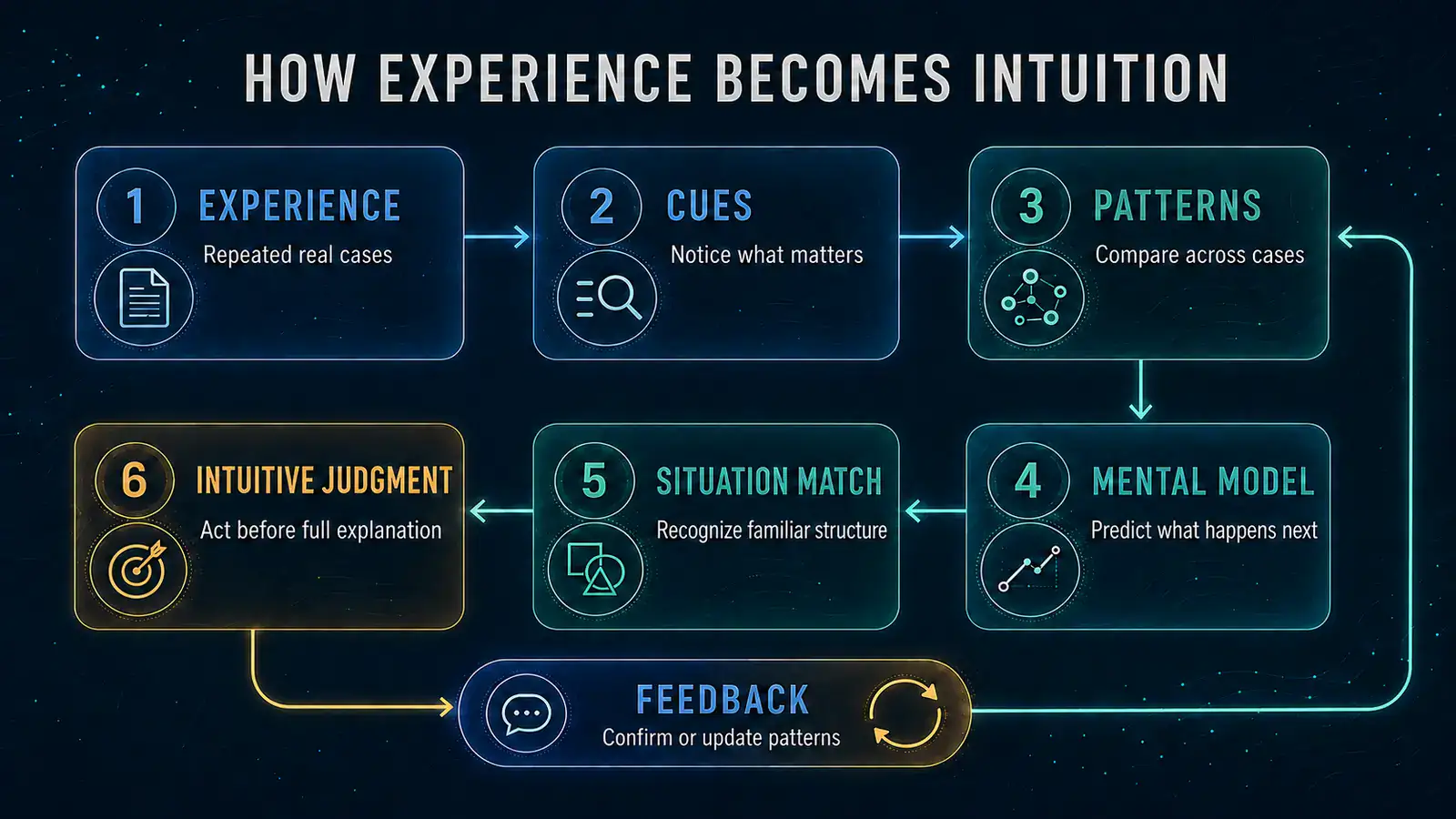
The learning mechanism in six steps
- Repeated exposure: the person encounters many variations of a situation rather than memorizing one ideal case.
- Selective attention: outcomes teach which details are diagnostic and which are background noise.
- Pattern compression: separate cues become a meaningful configuration that can be recognized as a whole.
- Expectation: the pattern suggests what is likely to happen next and what would count as an anomaly.
- Action or mental simulation: the decision-maker tests a plausible response against the situation.
- Feedback and calibration: the outcome strengthens, revises, or rejects the pattern.
Gary Klein’s Recognition-Primed Decision model describes how experienced people can recognize a situation, generate a plausible first option, and mentally evaluate it without comparing a long list of alternatives. For deeper context, see our guides to recognition-primed decision-making and naturalistic decision-making.
The crucial point is that fast judgment is the output of learning. Speed alone is not evidence of expertise. A quick answer can come from a valid pattern, a familiar stereotype, an emotional reaction, or a convenient story. Reliability depends on how the pattern was acquired.
Tacit knowledge and implicit learning are related but distinct: one concerns knowledge that is difficult to articulate, while the other concerns learning patterns without full conscious awareness. Explore implicit learning and its everyday examples to understand the difference.
Tacit knowledge examples in decision-making
Tacit knowledge is easiest to understand through the subtle cues experts use. These cues are not secret facts. They are small deviations whose importance becomes visible only after a person has seen many cases and received useful feedback.
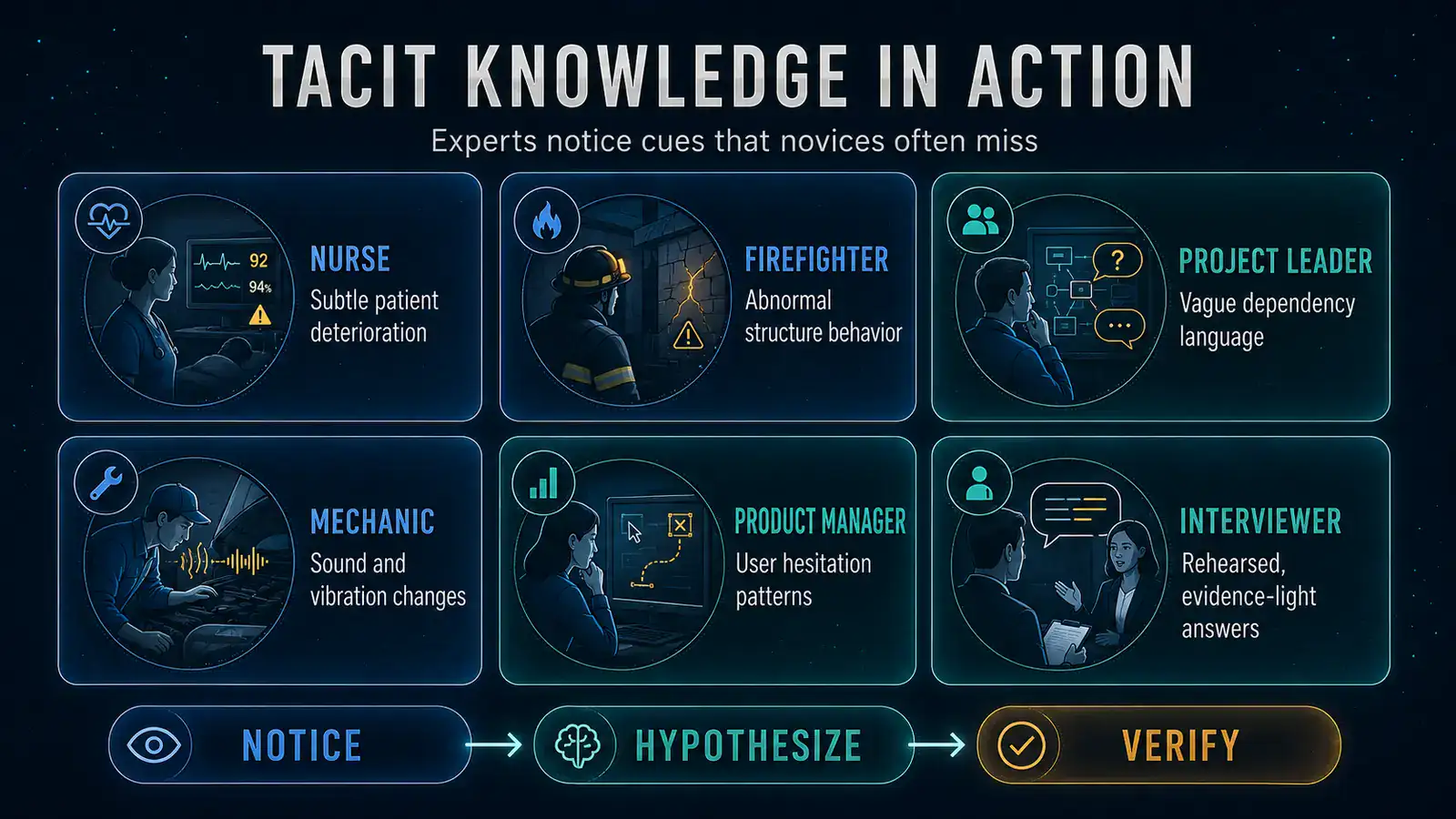
| Role | Subtle cue | Tacit hypothesis | Verification |
|---|---|---|---|
| Nurse | A small change in breathing, responsiveness, or overall presentation | The patient may be deteriorating before one metric becomes decisive | Reassess, measure, document, and escalate under clinical protocol |
| Firefighter | Heat, sound, smoke movement, or structural behavior that violates expectation | The current tactic may be unsafe | Check conditions, communicate, and follow operational safety procedures |
| Project leader | Owners describe a dependency with vague dates and passive language | The dependency is less controlled than the plan suggests | Ask for named ownership, evidence, dates, assumptions, and an escalation trigger |
| Mechanic | A new combination of sound, vibration, and load | A component may be degrading | Inspect, measure, compare, and isolate the source |
| Product manager | Users pause, backtrack, or seek reassurance at the same moment | The interface creates uncertainty even when users complete the task | Review recordings, interview users, and test an alternative |
| Interviewer | A polished answer contains little specific evidence | The response may be rehearsed rather than experience-based | Ask for a concrete example, trade-off, result, and lesson learned |
Research on emerging public-health incidents likewise found that practitioners described tacit knowledge as shaping communication and decision-making under uncertainty, reinforcing the need to pair experience with explicit protocols.
These examples share one disciplined sequence: notice → hypothesize → verify. The tacit signal directs attention; it does not remove the need for evidence, professional standards, or accountability.
When is tacit judgment reliable?
The most important question is not “How confident does this feel?” It is “What learning conditions produced this judgment?” Daniel Kahneman and Gary Klein’s paper Conditions for Intuitive Expertise argues that skilled intuition is most likely to develop when the environment contains learnable regularities and the decision-maker has adequate opportunities to learn them through practice and feedback.
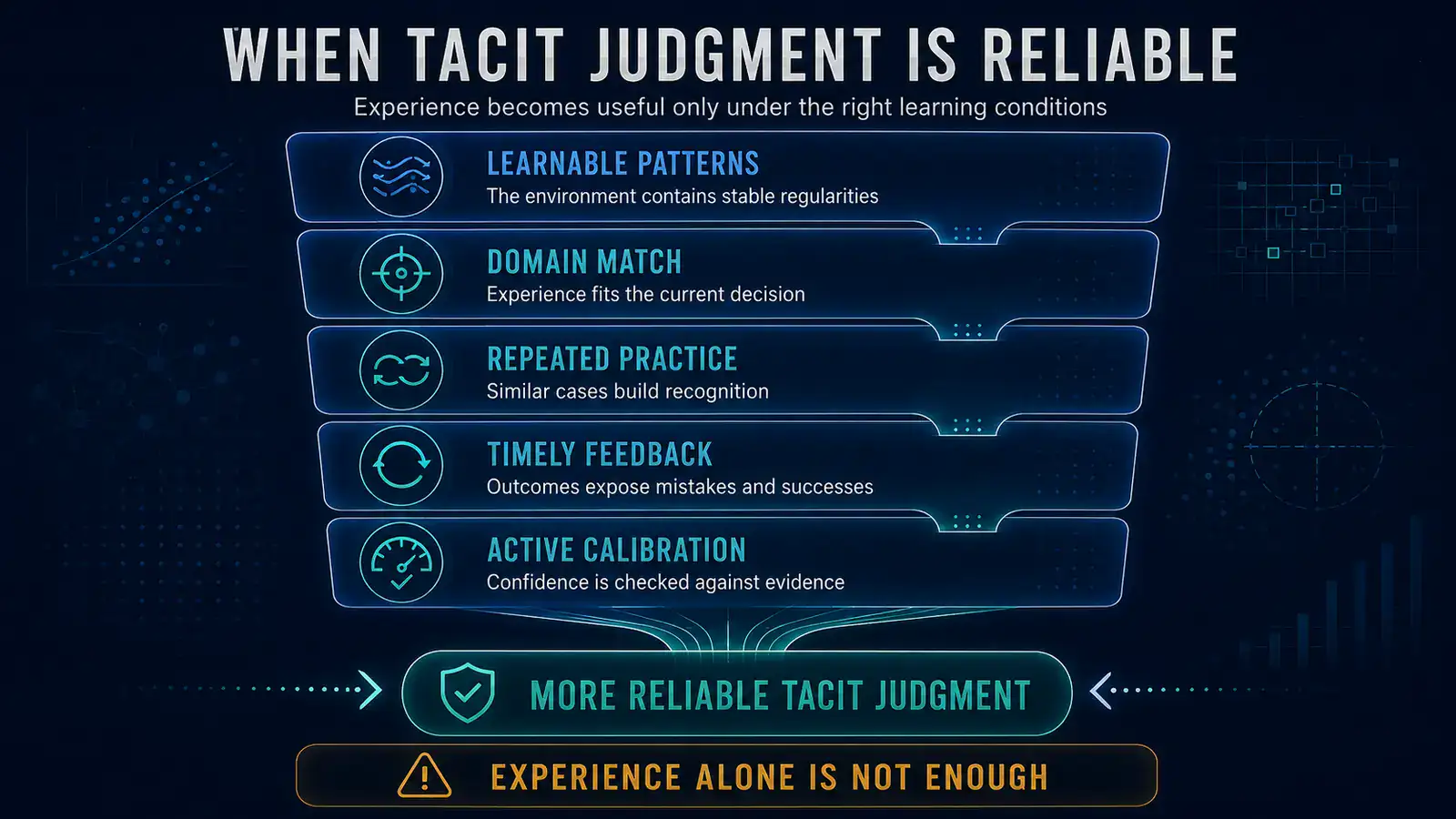
Five conditions for more reliable tacit knowledge
- Learnable patterns. The environment contains recurring relationships between cues, actions, and outcomes. If results are mostly random, experience can create stories but not dependable skill.
- Domain match. The experience is relevant to the current decision. Expertise transfers poorly when the task, population, technology, incentives, or time horizon changes materially.
- Repeated practice. The person has encountered enough varied cases to distinguish a robust pattern from a memorable exception.
- Timely feedback. Outcomes arrive soon enough, clearly enough, and honestly enough to correct the mental model.
- Active calibration. The decision-maker compares predictions with results, examines misses, and updates confidence instead of remembering only successes.
These conditions explain why expert intuition can be impressive in one domain and unreliable in another. They also clarify the difference between trained pattern recognition and a shortcut. Our guide to intuition versus heuristics explores that boundary in more detail.
Confidence is not the same as calibration
A coherent story can feel true even when the environment is unpredictable. Calibration requires a record: What did you expect? What happened? Which cue mattered? Where were you wrong? An expert who cannot identify misses, boundary conditions, or reasons to slow down may be defending an identity rather than demonstrating reliable tacit knowledge.
When tacit knowledge misleads
Tacit judgment fails when a familiar feeling is produced by the wrong pattern, the wrong domain, or the wrong learning history. The failure is dangerous precisely because the answer may still feel fluent and convincing.
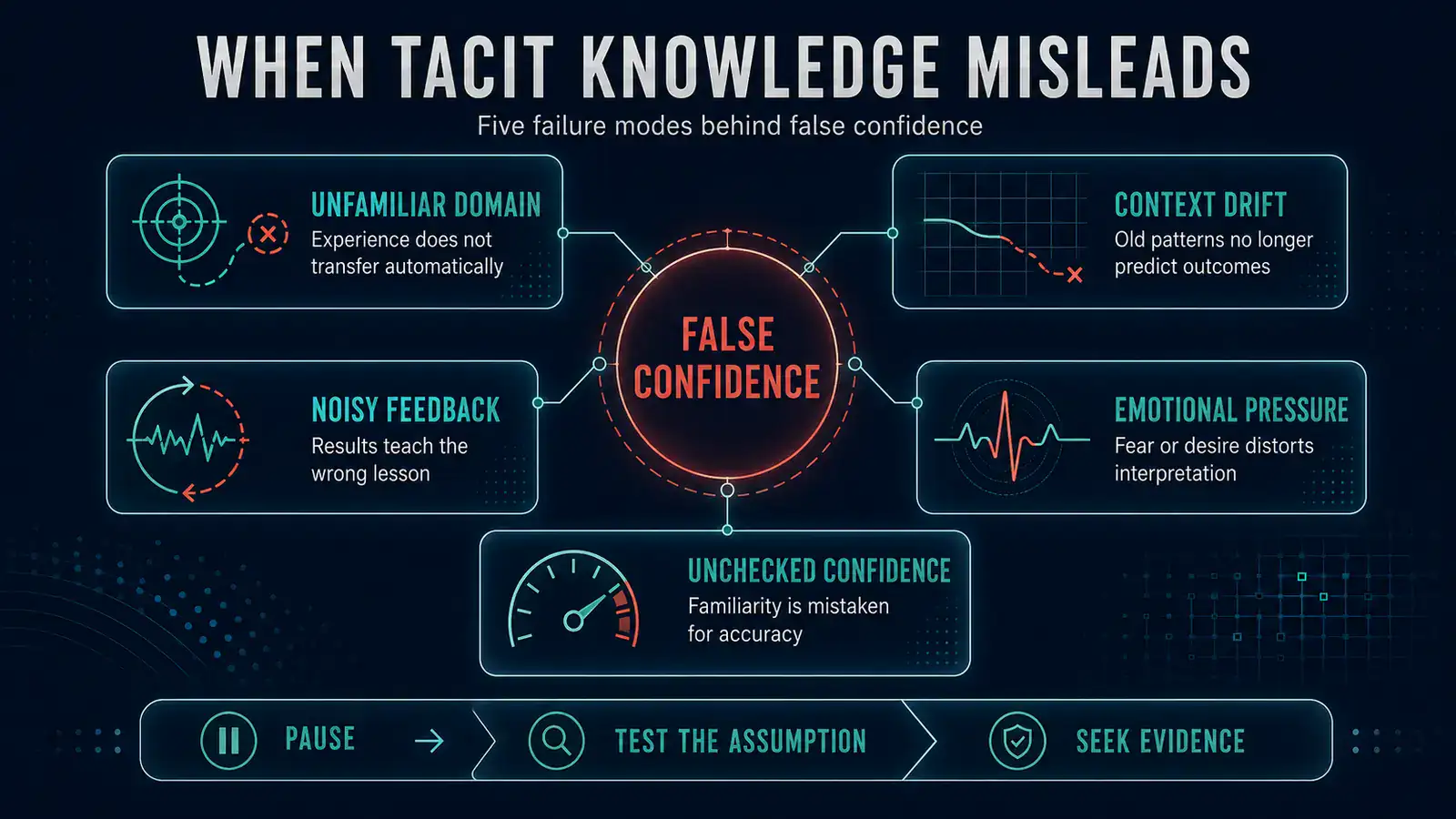
Five common failure modes
- Unfamiliar domain: experience from one setting is applied to another where the causal structure differs.
- Context drift: technology, incentives, people, constraints, or risks changed while the old pattern remained psychologically familiar.
- Noisy feedback: luck is mistaken for skill, delayed outcomes hide mistakes, or the organization rewards confidence instead of accuracy.
- Emotional pressure: fear, urgency, status, attachment, or wishful thinking influences which cues receive attention.
- Unchecked confidence: fluency and familiarity are treated as proof instead of prompts for verification.
When one of these conditions is present, use a simple response: pause, test the assumption, and seek evidence. Name the pattern you think you recognize. Ask what else could produce the same cues. Look for information that would disconfirm your first interpretation. If the situation is novel, irreversible, or high stakes, increase analysis and independent review.
How to transfer tacit knowledge
Tacit knowledge cannot be transferred by documentation alone because the learner must acquire attention, timing, context, and judgment—not just information. Yet it is not trapped permanently inside the expert. It can be developed through shared work that combines demonstration, explanation, practice, feedback, and reflection.
Ikujiro Nonaka’s theory of organizational knowledge creation describes continuing interaction between tacit and explicit knowledge. More recent research on tacit knowledge transfer in complex practice also emphasizes that the form of externalization should fit the learner’s maturity and context.
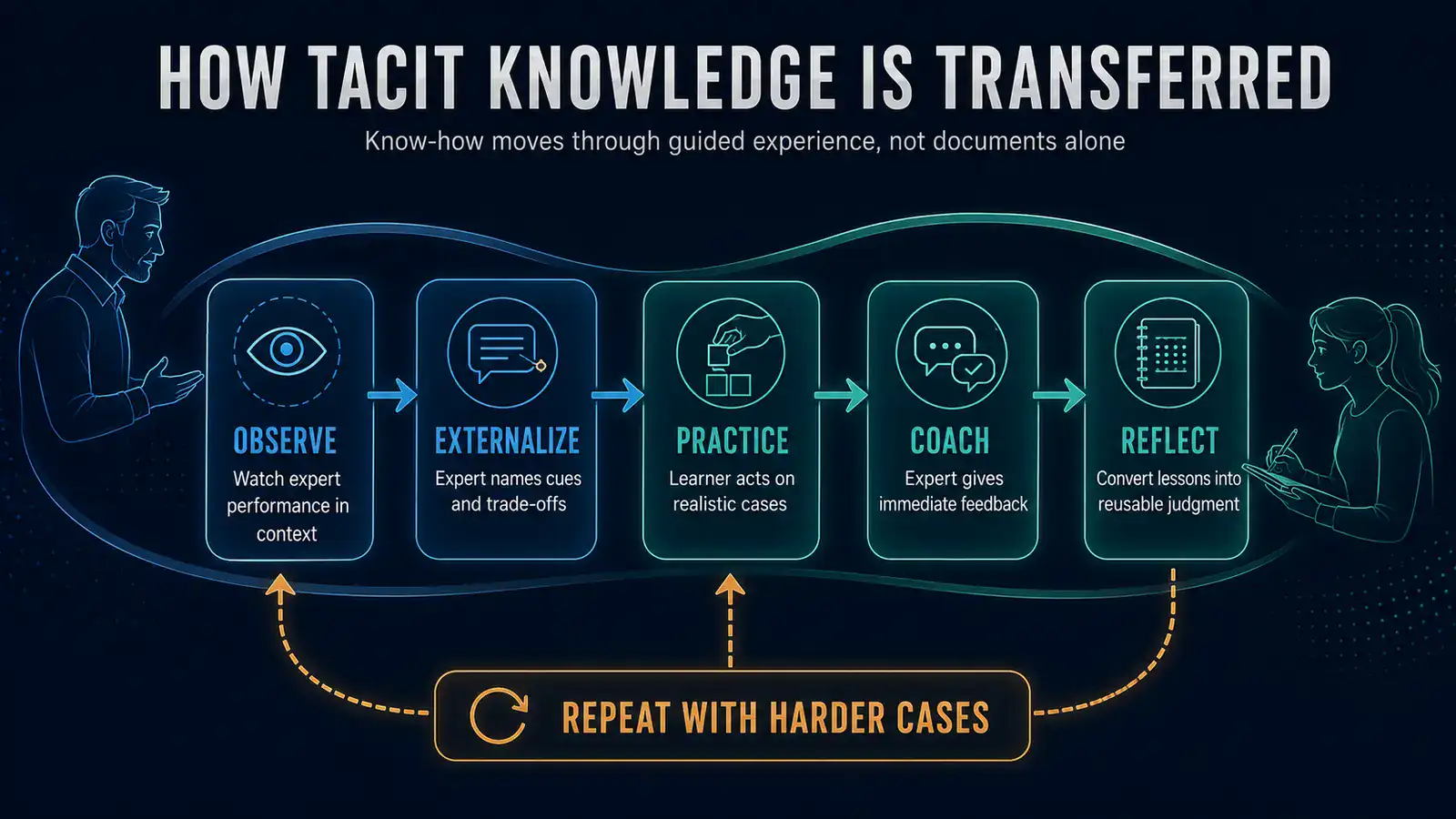
A five-stage transfer process
- Observe. Let the learner watch expert performance in realistic context, including preparation, information gathering, and adaptation—not only the final action.
- Externalize. Ask the expert to name cues, expectations, trade-offs, anomalies, and reasons for rejecting alternatives. “What did you notice?” is usually more useful than “What is the rule?”
- Practice. Give the learner realistic cases where they must notice, predict, decide, and explain. Passive exposure creates recognition without testing whether it can guide action.
- Coach. Provide specific, timely feedback about cue selection, interpretation, decision quality, and outcome. Correct the model, not just the answer.
- Reflect. Compare expectation with reality and capture reusable lessons, exceptions, and boundary conditions. Then repeat with harder and more varied cases.
Organizational practices that preserve expert know-how
- Shadowing with narration: the learner observes while the expert explains changes in attention and expectation.
- Cognitive interviews: reconstruct a difficult decision around cues, uncertainty, alternatives, and turning points.
- Case-based simulation: pause scenarios before the outcome and require a prediction.
- After-action reviews: compare what was expected, what occurred, why it differed, and what should change.
- Paired decisions: expert and learner make independent judgments, then compare reasoning before the outcome is known.
- Case libraries: store not only the solution but also early signals, context, rejected options, exceptions, and failure boundaries.
- Succession overlap: transfer responsibility gradually while the expert can still observe and correct decisions.
The goal is not to turn every judgment into a rigid rule. It is to make expert attention more visible, give learners meaningful practice, and preserve the explicit parts that can support future judgment. These methods also strengthen the broader skills behind better intuitive thinking.
Five questions before you trust tacit judgment
Before acting on an experienced hunch, run a short calibration check. The questions do not prove that an intuition is correct. They reveal whether the judgment deserves weight and what must be verified.
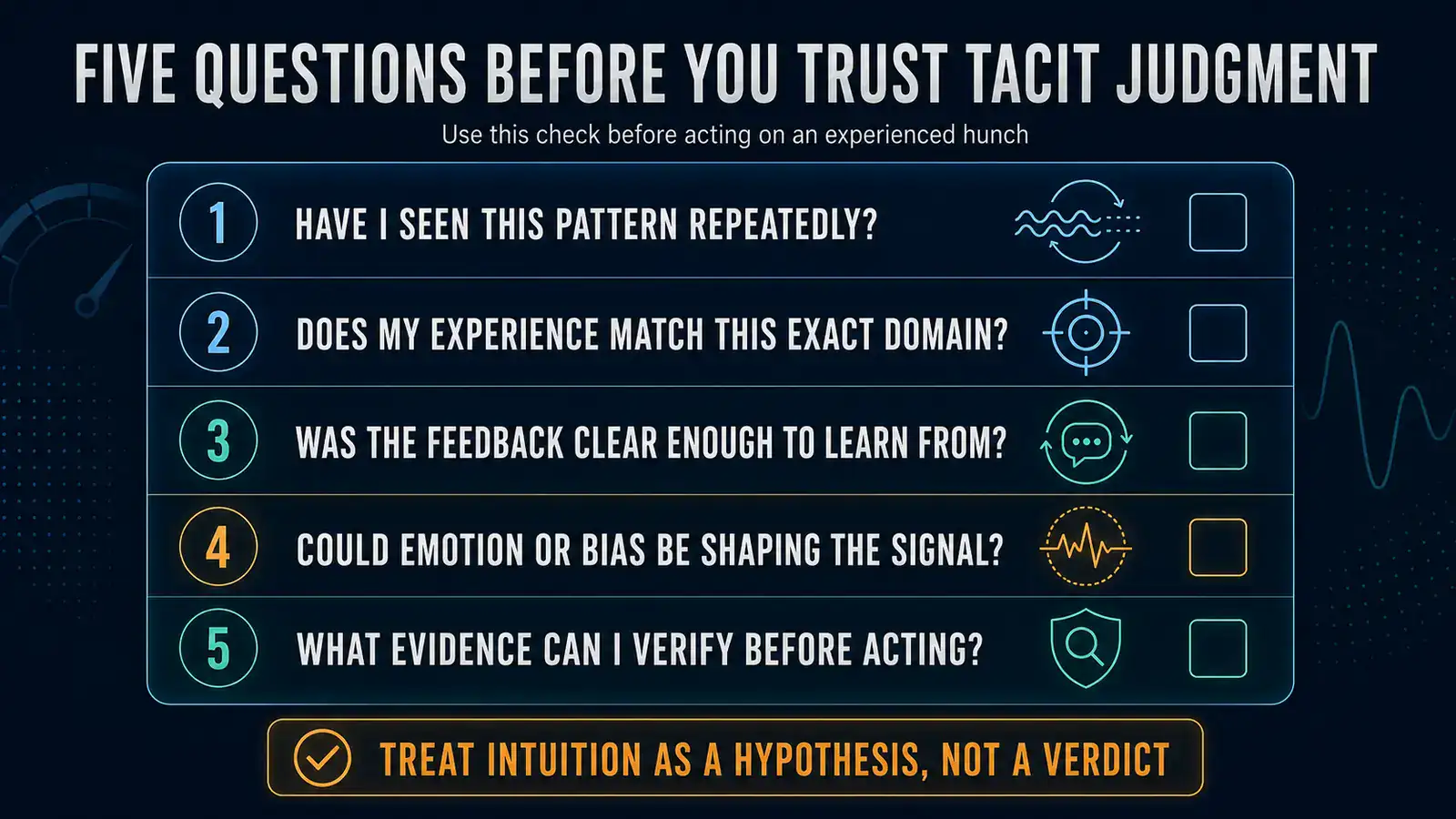
- Have I seen this pattern repeatedly? One memorable case is an anecdote, not a reliable pattern library.
- Does my experience match this exact domain? Check the task, context, population, technology, incentives, and time horizon.
- Was the feedback clear enough to learn from? Ask whether previous outcomes genuinely revealed decision quality or merely reflected luck and delay.
- Could emotion or bias be shaping the signal? Notice urgency, fear, attraction, status pressure, and the desire for one answer to be true.
- What evidence can I verify before acting? Identify the fastest proportionate check, especially for consequential or irreversible decisions.
If one or more answers are unclear, slow down. Separate the observation from the interpretation: “I noticed X; I think it may mean Y; I will check Z.” This preserves the speed and sensitivity of intuitive processing while adding the discipline of evidence.
How to combine tacit and explicit knowledge in a decision
The strongest decision process does not force a choice between intuition and analysis. It assigns each a job:
- Record the known facts. Establish constraints, standards, base rates, and decision criteria.
- Ask what the tacit signal is noticing. Name the cue, anomaly, pattern, or expectation violation.
- Convert the feeling into a hypothesis. State what you think is happening and what consequence you anticipate.
- Test the hypothesis. Seek confirming and disconfirming evidence, compare alternatives, and involve independent expertise when appropriate.
- Decide with boundaries. Define the action, review point, stop condition, and evidence that would require a change.
- Close the learning loop. Compare the prediction with the outcome so the next intuition is better calibrated.
This approach turns tacit knowledge into an input that can be examined without pretending it can be fully reduced to a checklist. It also complements explicit mental models in decision-making: models organize what to consider, while tacit expertise helps detect how the current situation differs from the model’s normal case.
Frequently asked questions
What is tacit knowledge in decision-making?
Tacit knowledge in decision-making is experience-based know-how that helps a person recognize cues, patterns, anomalies, and plausible responses without consciously stating every rule. It is learned through situated practice and feedback and is often expressed as expert intuition.
How is tacit knowledge different from intuition?
Tacit knowledge is the underlying learned know-how. Intuition is the rapid judgment, expectation, or felt signal that may emerge from it. Intuition can also come from emotion, bias, or superficial familiarity, so not every intuitive feeling reflects valid tacit knowledge.
What are examples of tacit knowledge?
Examples include a nurse noticing subtle deterioration, a firefighter recognizing abnormal structural behavior, a mechanic identifying an unusual sound pattern, a project leader detecting weak ownership, or a product manager noticing repeated user hesitation. In each case, the expert perceives a meaningful configuration that a novice may overlook.
Is tacit knowledge always reliable?
No. It is more reliable when the environment contains stable patterns, experience matches the current domain, practice is repeated, feedback is clear, and the person actively calibrates predictions against outcomes. It becomes less reliable in novel, changing, emotional, or feedback-poor situations.
Can tacit knowledge be transferred?
It can be developed in another person, although it cannot be copied like a document. Effective transfer combines observation, expert narration, realistic practice, timely coaching, reflection, and progressively harder cases. Documentation supports this process but cannot replace shared experience.
How can organizations capture tacit knowledge?
Organizations should capture cues, expectations, exceptions, trade-offs, rejected options, and boundary conditions—not only final procedures. Shadowing, cognitive interviews, simulations, paired decisions, after-action reviews, case libraries, and succession overlap make expert judgment visible and teachable.
Should you trust a gut feeling in an important decision?
Treat it as a signal worth investigating, not as automatic proof. Ask whether the pattern is repeated, domain-relevant, learned through clear feedback, free from obvious emotional distortion, and verifiable. The higher the stakes and irreversibility, the stronger the evidence and independent review should be.
Research sources
- Polanyi, M. The Tacit Dimension. University of Chicago Press.
- Nonaka, I. (1994). A Dynamic Theory of Organizational Knowledge Creation. Organization Science, 5(1), 14–37.
- Kahneman, D., & Klein, G. (2009). Conditions for Intuitive Expertise: A Failure to Disagree. American Psychologist, 64(6), 515–526.
- Klein, G. Recognition-Primed Decision Model.
- Yasuoka, M. (2021). How To Transfer Tacit Knowledge for Living Lab Practice. Proceedings of HICSS 2021.
- Sanford, S., et al. (2020). The role of tacit knowledge in communication and decision-making during emerging public health incidents.
Bottom line: Tacit knowledge is neither magic nor a substitute for analysis. It is compressed, experience-based sensitivity to meaningful patterns. Use it to notice what deserves attention, convert the signal into a hypothesis, verify it proportionately, and learn from the outcome. That is how experience becomes intuition—and how intuition becomes better judgment.