To enhance intuition, practice in familiar situations, write down your first impression, check the evidence, and compare your prediction with what actually happens. The goal is to learn when a gut feeling deserves attention and when it needs correction.
This practical workbook gives you intuition exercises, a journal example, a self-check, and a seven-day training plan. Start with small decisions that produce observable results. A stronger feeling is not necessarily a more accurate judgment.

For the broader foundations, see our guide to developing intuition. This page focuses on what to practice, what to record, and how to review your results.
What Can Intuition Training Actually Improve?
Intuition is a judgment or impression that arrives without a consciously worked-out explanation. Some intuitive judgments draw on learned patterns; others reflect shortcuts, expectations, preferences, or bias. Speed alone does not tell you which kind you are experiencing.
In their research paper Conditions for Intuitive Expertise, psychologists Daniel Kahneman and Gary Klein emphasize the importance of an environment with learnable patterns and sufficient opportunity to learn them. Repeated experience and useful feedback matter more than the subjective certainty of a hunch.
For example, someone who regularly coordinates similar projects may recognize an early warning in missing inputs. That experience does not automatically make their intuition reliable in investing, medicine, or another unfamiliar field. Intuitive skill is often specific to a task.
Quiet attention, journaling, and body awareness can support reflection. They should not be presented as proof that you can predict events accurately. For background on the underlying processes, read the neuroscience of intuition.
Core Principles of Intuition Training
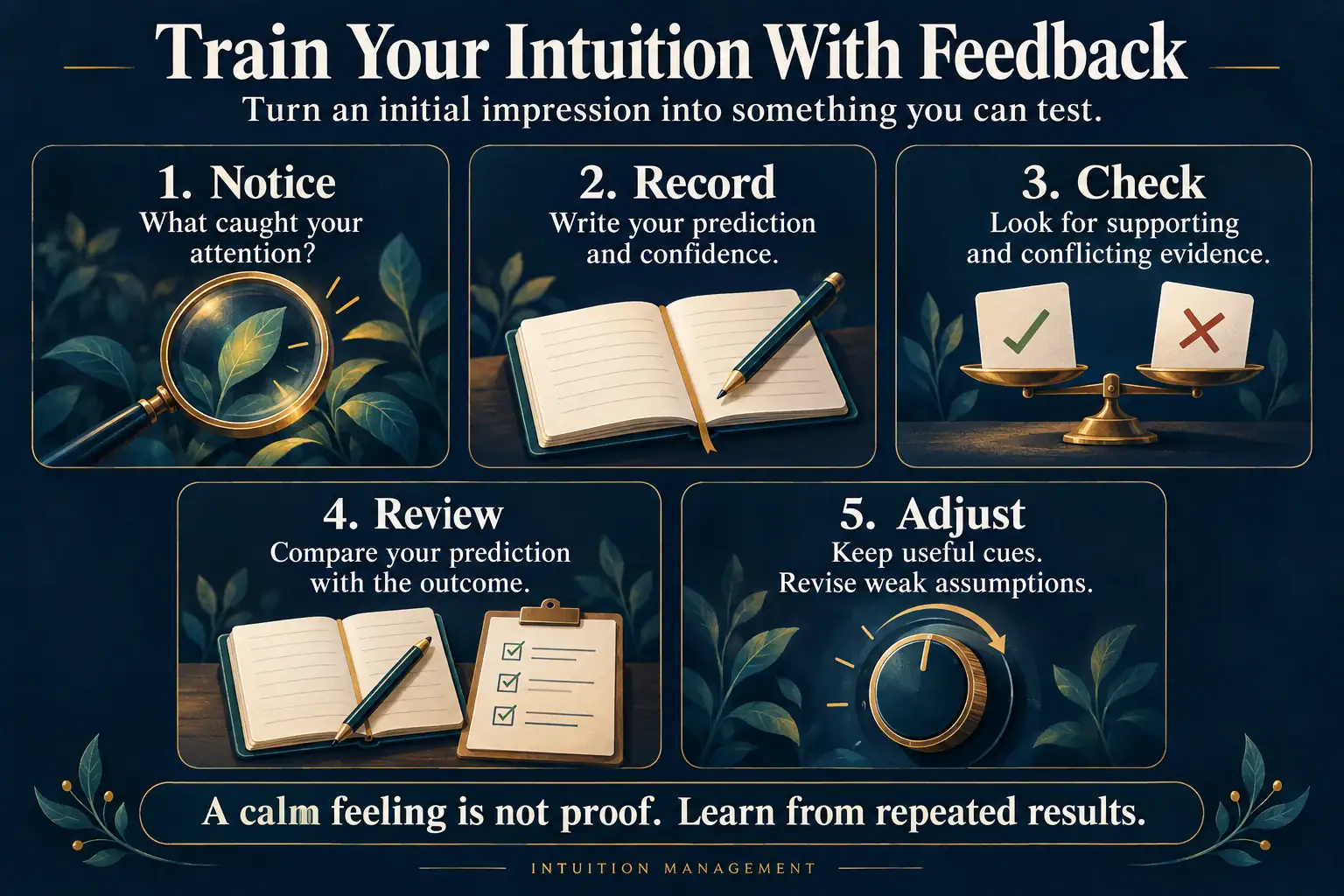
- Choose a familiar setting: practice where you have relevant experience and can identify recurring cues.
- Make the impression testable: write a specific prediction before you know the outcome.
- Check alternatives: look for evidence that could make your first interpretation wrong.
- Close the feedback loop: review successes, errors, and unresolved cases.
- Match the method to the stakes: use analysis and appropriate expertise when consequences are significant.
Are your practice habits ready for feedback?
Choose the answer that describes your current habits. This reflection tool is not a validated test of intuitive ability.
1. Do you record predictions before knowing the outcome?
2. Do you check evidence that could contradict your impression?
3. Do you review misses as well as correct predictions?
4. Do you practice in familiar situations with observable outcomes?
5. Do you record confidence and a date to check the result?
Practical Exercises to Enhance Intuition
1. Pause and Separate Observation From Interpretation
Take two quiet minutes before a small decision. Write three separate lines: what you observed, what you felt, and what you think it means. For example: “Two updates are missing” is an observation; “I feel uneasy” is a feeling; “Friday’s deadline may slip” is an interpretation.
This pause gives you a clearer record of your impression. It does not require you to delay necessary action or suppress reasoning. Analyze the impression after recording it, while you can still distinguish the original cue from the explanation you added.
2. Track Intuitive Signals in Writing
Choose one prediction with a clear outcome and review date. Record your impression before the result is known, alongside your confidence and the cues behind it. A useful entry says “The update will miss Friday’s deadline,” rather than “Something feels wrong.”
Add evidence against the prediction. If you later change your mind, keep the original entry and record the revision separately. This reduces the temptation to remember a vague impression as more precise than it was.
Intuition Journal: A Worked Example
The following example is fictional. It illustrates how to record a workplace impression; it is not evidence that this method guarantees better forecasts.
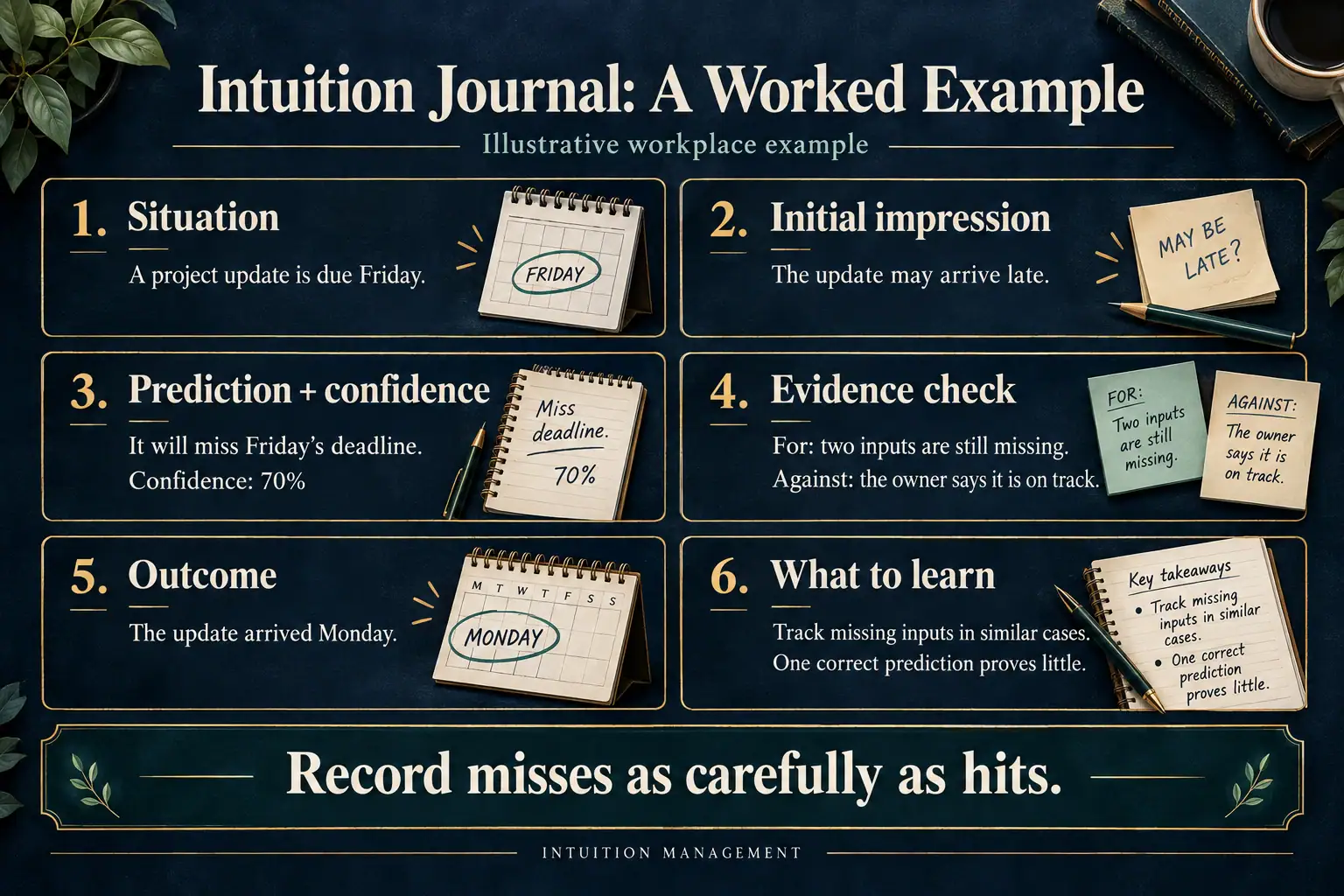
- Situation: a project update is due Friday.
- Initial impression: the update may arrive late.
- Prediction: it will miss Friday’s deadline; confidence is 70%.
- Evidence: two inputs are missing, but the owner says delivery is on track.
- Outcome: the update arrives Monday.
- Lesson: track missing inputs in future comparable cases. One correct prediction proves little.
Seventy percent confidence means you would expect roughly seven out of ten comparable predictions at that confidence level to be correct over many observations. One result cannot establish whether your confidence is well calibrated. Record what you did after the prediction, too: an intervention may change the outcome.
3. Practice With Low-Stakes, Observable Outcomes
Choose recurring situations such as estimating whether a familiar task will fit into a 30-minute work block, or whether a routine request will need clarification. Write the expected result and check it afterward. Use comparable tasks so that feedback can reveal a useful pattern.
Avoid treating random guesses as a general intuition test. Predicting an arbitrary number or choosing an unfamiliar route without comparable feedback tells you little about whether your judgment is improving.
4. Notice Body Signals Without Treating Them as Answers
Before a decision, briefly notice your jaw, shoulders, chest, or stomach. Write what you feel without deciding that tension means “no” or ease means “yes.” Ask what else might explain the sensation, then examine the decision itself.
Body awareness can help you describe your emotional state. It does not independently verify an external fact, another person’s intentions, or the safety of an option. A familiar but unhelpful choice may feel comfortable; a useful new experience may feel uncomfortable.
5. Use Freewriting or a Quiet Walk to Generate Possibilities
Set a five-minute timer and write possible explanations for a concern without editing. Alternatively, take a short walk without incoming messages and return to your question afterward. Treat any insight as a possibility to investigate.
When you review your notes, select one idea that can be checked. Freewriting, visualization, and dream recall may provide material for personal reflection, but this guide does not treat them as established methods for improving prediction accuracy.
6. Review the Result Before Moving On
At the review date, mark the prediction correct, incorrect, or unresolved using the criteria you wrote in advance. Note which cues were informative, what you overlooked, and whether your action affected the result. Keep unresolved cases visible until a meaningful outcome is available.
Finish with one modest change to your next attempt: seek an earlier update, lower confidence when a cue is missing, or check an alternative explanation. Repeating comparable cases creates more useful feedback than collecting unrelated hunches.
Align Intuition With Your Values
Values help you decide what matters. Predictions help you estimate what may happen. Keep those questions separate: “I value flexible hours” expresses a preference; “This role will offer flexible hours” requires evidence.
Name your three most relevant values, then compare each option against them. If you imagine accepting a job and feel relief, ask what the relief refers to: the actual role, leaving your current role, or ending the uncertainty. Verify working hours and expectations directly rather than inferring them from that feeling.
A body-based yes/no check can start reflection about preferences. It should not settle factual questions. You can respect an internal response while continuing to investigate what the choice involves.
For more ways to practice, explore these intuition games. Choose an exercise that lets you record your first impression, check the outcome, and learn from both accurate and mistaken judgments.
A Simple Seven-Day Intuition Training Plan
Use this week to establish a repeatable routine. Most activities can fit into five to ten minutes, although outcomes may take longer to arrive. Seven days does not demonstrate mastery or guarantee measurable improvement.
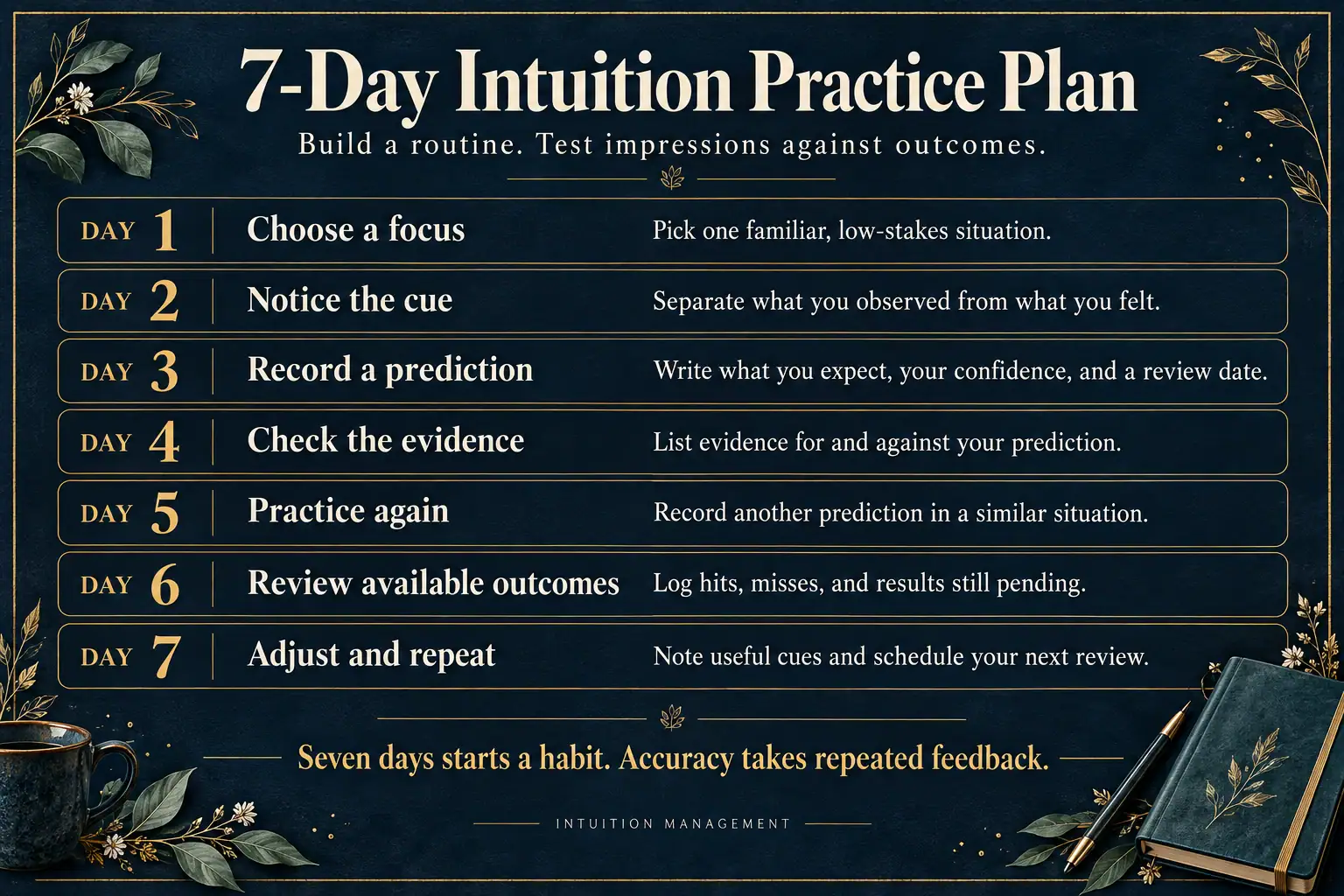
Day 1: Choose a focus
Pick one familiar, low-stakes situation. Choose a recurring task where you have relevant experience and can observe the result.
Day 2: Notice the cue
Separate what you observed from what you felt. Write the observable cue separately from your emotional response and explanation.
Day 3: Record a prediction
Write what you expect, your confidence, and a review date. Define what would count as a correct result before it happens.
Day 4: Check the evidence
List evidence for and against your prediction. Include at least one plausible alternative explanation.
Day 5: Practice again
Record another prediction in a similar situation. Keep the new entry separate so you can compare both later.
Day 6: Review available outcomes
Log hits, misses, and results still pending. Do not label a pending result a success or failure just to finish the week.
Day 7: Adjust and repeat
Note useful cues and schedule your next review. Repeat the cycle in the same setting; revise one habit based on what you learned.
Train your intuition for 7 days
Check each completed activity. Progress measures practice completion, not intuitive accuracy. This tracker resets when the page is reloaded.
For more practice ideas after this week, explore 30 days of intuition exercises. Continue applying the same evidence checks and outcome reviews to any exercise you choose.
How to Tell Whether Your Intuition Is Improving
Feeling more decisive is not the same as becoming more accurate. Review the quality of your records and the results of comparable predictions over time.
- Specificity: are your predictions clear enough to evaluate?
- Accuracy: how often were completed predictions correct, and how many observations does that represent?
- Confidence: are your highly confident judgments more reliable than your tentative ones?
- Baseline: does your judgment add anything beyond a simple rule, such as the usual completion rate?
- Learning: are repeated errors changing how you interpret the next situation?
Small samples are noisy. Report the number of observations, keep pending outcomes separate, and avoid claiming general improvement from a few successful guesses. Better practice may sometimes mean becoming less confident in situations where the evidence is weak.
Common Intuition Training Mistakes
- Treating calmness, urgency, or intensity as a test of truth.
- Remembering accurate impressions while ignoring misses.
- Rewriting a prediction after learning the outcome.
- Practicing across unrelated situations and assuming the skill transfers.
- Confusing personal alignment with evidence about the outside world.
- Using a hunch alone for a consequential decision that requires verification.
Frequently Asked Questions
Can intuition be trained?
Some intuitive judgments can improve through relevant experience and useful feedback in environments with learnable patterns. There is no single exercise that makes every kind of gut feeling reliable.
What is a practical way to start enhancing intuition?
Choose one familiar, low-stakes situation. Record a specific prediction, your confidence, supporting and conflicting evidence, and a date to check the result. Review what happened before repeating the exercise.
How do I know whether my intuition is accurate?
Compare predictions written in advance with observable outcomes across similar situations. Neither a calm feeling nor strong confidence proves accuracy.
How can I distinguish intuition from fear?
You cannot reliably distinguish them by emotional tone alone. Identify the observable cues, consider alternative explanations, check your relevant experience, and look for independent evidence.
Does meditation improve intuition?
Quiet attention may help you notice thoughts and feelings. That is different from demonstrating better prediction accuracy. If you use meditation, pair it with written predictions and outcome reviews.
How long does intuition training take?
There is no universal timeline. It depends on the task, prior experience, the regularity of the environment, and how quickly useful feedback becomes available. A seven-day plan establishes a routine rather than proving expertise.
Do intuition exercises work across every area of life?
Do not assume that they do. Skill learned in one setting may not transfer to another. Treat an unfamiliar situation as a reason to gather more evidence and reduce confidence.
Should I trust my gut when choosing a job?
Use the feeling to identify questions worth asking. Compare the role with your values and verify practical details such as responsibilities, manager expectations, working hours, and compensation before deciding.
Make Your Next Impression Testable
Choose one small situation today. Write what you notice, what you expect, and what would change your mind. Set a review date. Your most useful training material is the comparison between what you expected and what actually happened.
The aim is thoughtful judgment: knowing when an impression is supported, when it needs checking, and when you do not yet have enough experience to rely on it.
Research Reference
Kahneman, D., & Klein, G. (2009). Conditions for intuitive expertise: A failure to disagree. American Psychologist, 64(6), 515–526. The practical workbook above is an editorial application of feedback principles, not a validated training program from the paper.
Leave a Reply
You must be logged in to post a comment.