The hidden bottleneck between knowing and doing—and how to restore access to action. Why do I freeze when I need to act?

Why do I freeze when I need to act?
You may freeze because action depends on more than motivation. It requires enough cognitive capacity, emotional safety, prediction confidence, perceived reward, energy, motor initiation, and tolerance for uncertainty to align at the same time. When those conditions fall below the threshold required by the task, you can know exactly what to do and still feel unable to begin.
- Not necessarily laziness
Difficulty starting can reflect reduced access to action. - Not only motivation
Wanting the outcome does not guarantee movement. - Not just procrastination
Delay is the behavior; the mechanism may be deeper. - Often a systems problem
Several enabling conditions may be misaligned at once.
In this article
You open the document.
The cursor blinks.
You know what needs to be written. You may already have rehearsed the first sentence in your mind. The task matters. The deadline is real. Part of you genuinely wants to begin.
But nothing happens.
You move your hand toward the keyboard, hesitate, check something else, return to the document, and discover that the task now feels harder than it did a few minutes earlier.
The same pattern can appear before sending an email, making a phone call, opening a bill, starting a conversation, choosing between two options, cleaning a room, or completing a task that should take less than five minutes.
From the outside, it can look like procrastination.
From the inside, it often feels more like a barrier between intention and movement.
The hidden mystery behind freezing
The usual explanations are familiar: you are not motivated enough, you need more discipline, you are overthinking, you are afraid of failure, you have developed a bad habit, or you simply need to force yourself to begin.
Sometimes these explanations contain part of the truth. But they rarely explain the full mechanism.
They describe what the situation looks like. They do not explain why a person can possess knowledge, ability, desire, and opportunity while still being unable to translate intention into action.
The central problem is not always a lack of intention. Sometimes the problem is that action is temporarily inaccessible.
This distinction matters because inaccessible action is easily misread as unwillingness.
When you cannot begin, you may conclude that you do not care enough. When you avoid a task, you may decide that you are lazy. When the pattern repeats, you may turn a temporary systems problem into a permanent judgment about your character.
But knowing what to do and being able to do it are not the same cognitive event.
The hidden gap between knowing and doing
Self-help advice often assumes a simple sequence:
Know what to do → Decide to do it → Do it
Real action is more complicated.
Between intention and behavior, the brain must coordinate attention, working memory, cognitive flexibility, emotional regulation, effort, uncertainty, energy, and behavioral initiation. A task can be logically simple while still demanding coordination across several executive functions.
This is why people search for answers to questions such as “Why can’t I make myself do anything?”, “Why do I know what to do but can’t do it?”, “Why can’t I start tasks?”, and “Why do simple tasks feel impossible?” These are different ways of describing the same deeper gap: intention exists, but action access has weakened.
The problem is not necessarily the objective size of the action. The problem is whether the conditions required to make that action available are currently aligned.
You may know exactly what to do while lacking the cognitive capacity to organize the next step. You may have enough energy but low confidence that your effort will work. You may understand the task but experience it as emotionally unsafe. You may want the result while feeling unable to tolerate the uncertainty involved in beginning.
Each of these conditions can weaken access to action without removing your underlying intention.
Why motivation is an incomplete explanation
Motivation matters, but it does not operate as a direct command that automatically produces movement.
People can be highly motivated and still freeze.
A student may desperately want to submit an assignment and still be unable to open the file. A professional may care deeply about a project and repeatedly avoid its most important task. A person may understand the consequences of delaying a difficult conversation and still postpone it for weeks.
In each case, the desire for the outcome is real.
What is missing is not necessarily motivation. What may be missing is sufficient access to the coordinated state from which action can emerge.
Motivation can increase the importance of acting. It cannot, by itself, guarantee that action becomes available.
This helps explain a frustrating paradox: the more important a task becomes, the harder it can sometimes feel to begin.
Importance can increase pressure. Pressure can increase perceived threat. Threat can consume cognitive capacity, reduce self-efficacy and prediction confidence, and narrow the range of actions that feel available. The task matters more, yet the system becomes less able to engage with it.
Why calling it laziness makes the freeze worse
When action fails, people often replace explanation with judgment.
They tell themselves that they should be able to do this, that there is no reason for it to be difficult, that other people manage it, that they are wasting time, or that something is fundamentally wrong with them.
These judgments add pressure without restoring any of the conditions needed for action.
Self-criticism can increase stress. Increased stress can reduce working capacity. Reduced capacity can make the next attempt harder. The harder the task feels, the more evidence the person believes they have that they are incapable or undisciplined.
The explanation becomes part of the mechanism.
| Common explanation | What it describes | Action Access interpretation |
|---|---|---|
| Laziness | A moral judgment about effort | One or more enabling conditions may be below the action threshold. |
| Low motivation | Weak desire for an outcome | Desire may be present while capacity, safety, confidence, or initiation is low. |
| Procrastination | Observable delay | Delay may be a response to inaccessible action, uncertainty, or threat. |
| Poor discipline | Failure to act consistently | The system may repeatedly enter the same constraining conditions. |
| Executive dysfunction | Difficulty initiating, sequencing, or sustaining action | A possible manifestation that deserves context and, when persistent, professional evaluation. |
The Action Access Model™
The Action Access Model™ proposes that action is not produced by a single internal force such as motivation, confidence, discipline, or willpower.
Action becomes available when several enabling conditions align strongly enough for the system to cross an internal threshold.
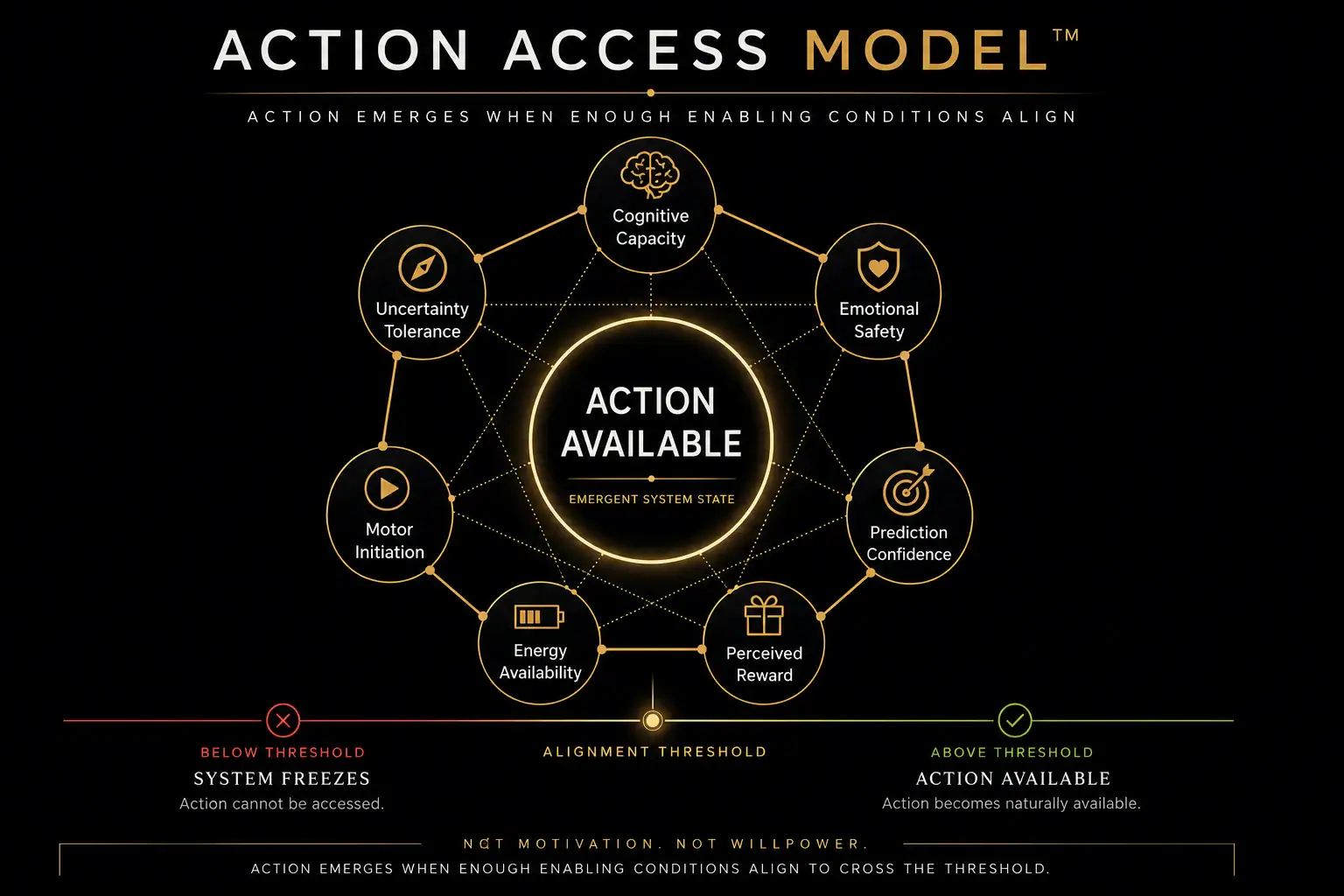
The model includes seven interacting conditions:
- Cognitive Capacity
- Emotional Safety
- Prediction Confidence
- Perceived Reward
- Energy Availability
- Motor Initiation
- Uncertainty Tolerance
These conditions do not operate independently. They influence one another, strengthen or weaken one another, and together determine whether action feels accessible.
Action is an emergent system state. It appears when enough enabling conditions become sufficiently aligned.
1. Cognitive Capacity
Cognitive capacity is the amount of usable mental resource available for engaging with a task.
It includes the ability to hold information in working memory, sequence steps, compare options, resist distraction, remember what matters, and maintain attentional control long enough to make progress.
A task may look simple from the outside while still requiring more working capacity than is currently available.
This is why opening an email, choosing a file name, deciding how to phrase a message, or determining where to begin can feel strangely difficult during periods of cognitive overload or mental exhaustion.
2. Emotional Safety
Before action begins, the brain does not only evaluate what must be done. It also evaluates what the action may expose you to.
A task can carry the possibility of criticism, embarrassment, rejection, conflict, failure, responsibility, or irreversible consequences.
Even when the physical environment is safe, the action itself may feel psychologically dangerous.
When perceived threat rises, the system may prioritize protection over movement.
3. Prediction Confidence
Prediction confidence is the brain’s estimate that a particular action will produce a useful or manageable result.
You are more likely to begin when you can imagine a plausible path from effort to outcome.
You are less likely to begin when the task feels ambiguous, when previous attempts failed, or when you do not know whether your effort will matter.
When prediction confidence is low, delay can feel safer than investment.
4. Perceived Reward
Action requires a reason for the system to spend effort.
Perceived reward does not mean pleasure alone. It includes meaning, relief, progress, safety, belonging, competence, completion, and the avoidance of future costs.
A task can be objectively important while feeling internally unrewarding, especially when the payoff is distant, invisible, uncertain, or disconnected from the immediate effort.
5. Energy Availability
Action also depends on the availability of physical and mental energy.
Low energy can result from insufficient rest, sustained stress, emotional strain, decision fatigue, prolonged concentration, or constant context switching.
You may care deeply about a task while lacking the resources required to initiate and sustain it.
6. Motor Initiation
Intention must eventually become movement.
You must place your hands on the keyboard, open the application, stand up, speak the first sentence, or perform the first physical step.
Motor initiation is the point at which thought crosses into behavior.
7. Uncertainty Tolerance
Most meaningful actions begin before certainty is complete.
You rarely know the perfect first sentence, the exact outcome, the full sequence, or whether the decision will prove correct.
When uncertainty tolerance is low, the brain may keep searching for more information, more reassurance, more preparation, or a stronger feeling of certainty.
This pattern often overlaps with overthinking, difficulty prioritizing, and second-guessing.
The alignment threshold
The model does not assume that every condition must be perfect. People regularly act while tired, uncertain, anxious, distracted, or doubtful.
The system only needs enough alignment to cross the threshold required for a particular action.
- A familiar action may require little prediction confidence.
- A high-risk decision may require much more emotional safety.
- A physically demanding task may depend heavily on energy availability.
- An ambiguous creative task may demand greater uncertainty tolerance.
- A complex project may require significantly more cognitive capacity.
This explains why an action can feel impossible at one moment and surprisingly easy later.
The task may not have changed.
The system state did.
Why small tasks can feel impossible
One of the most confusing aspects of action paralysis is that the size of the task often has little relationship to how difficult it feels.
You may spend three hours preparing for a five-minute email. You may avoid opening a document for days even though the first sentence takes less than a minute to write. You may walk past an unpaid bill repeatedly while knowing it could be handled almost immediately.
If action depended only on objective task size, these situations would make little sense.
The Action Access Model™ suggests a different explanation: a task feels difficult when it requires more internal coordination than your system can currently provide.
The brain does not experience the size of a task. It experiences the conditions required to perform it.
A short email may carry social risk. A simple decision may close off other options. A routine action may remind you of previous failures. A two-minute task may arrive after a day in which your capacity has already been spent.
This is why readers who identify with task paralysis often also recognize the patterns described in Why Do Small Tasks Feel So Hard?, Why Do I Feel Stuck Even Though I’m Trying?, and Why Do I Feel Busy but Get Nothing Done?.
Why pressure can reduce action access
Many people assume that increasing pressure naturally increases action.
Sometimes it does. But beyond a certain point, additional pressure begins consuming the very resources needed to act.
- Pressure increases stress.
- Stress narrows attention.
- Attention becomes occupied by threat instead of execution.
- Cognitive capacity falls.
- Prediction confidence weakens.
- Action becomes less accessible.
This is why telling yourself that a task is urgent can sometimes make beginning even harder. The dynamic is related to the false urgency described in Why Does Everything Feel Urgent?.
Why “just start” often does not work
Advice such as “Just do it” or “Take the first step” can be helpful when action is already accessible.
When the underlying conditions are misaligned, however, that advice addresses the symptom rather than the mechanism.
If emotional safety is low, simply demanding action does not create safety. If prediction confidence has collapsed, commanding yourself to begin does not restore confidence. If cognitive capacity has been exhausted, more pressure usually consumes what little capacity remains.
Trying harder cannot reliably compensate for conditions that make action inaccessible.
The Freeze Loop™
Systems often reinforce themselves.
A small reduction in action access can lead to delay. Delay can produce guilt and self-criticism. Guilt increases stress. Stress consumes cognitive resources. Reduced capacity weakens prediction confidence. Lower confidence increases avoidance. Avoidance further reduces action access.
Eventually the difficulty is no longer caused by the original task alone. The system itself begins maintaining the problem.

Stage 1: Reduced Action Access
The loop begins when one or more enabling conditions fall below what the task requires. You may be tired, cognitively overloaded, uncertain, emotionally threatened, unconvinced that the effort will work, or unable to cross from intention into movement.
Stage 2: Delay or Avoidance
When action is inaccessible, the system looks for an alternative. You check another tab, reorganize your notes, answer an easier message, seek more information, or wait for a better internal state.
Stage 3: Guilt and Self-Criticism
Once the task remains unfinished, the mind begins explaining the delay. Without a systems model, the explanation often becomes personal: lazy, unreliable, weak, incapable, or wasting potential.
Stage 4: Stress and Anxiety
Guilt changes the task. The email is no longer only an email. It is evidence of delay. The unfinished document becomes proof that you are falling behind. The task accumulates emotional weight.
Stage 5: Reduced Cognitive Capacity
Stress consumes mental resources. Attention becomes divided between the task and the internal commentary surrounding it. Working memory holds the task, the deadline, the consequences, the self-judgment, and possible failure at the same time.
Stage 6: Lower Prediction Confidence
Repeated failed attempts teach the brain that approaching this task leads to discomfort, confusion, delay, or retreat. The person may still be capable of the task, but the system’s expectation has changed.
Stage 7: Stronger Avoidance
Lower confidence makes avoidance more likely during the next attempt. The brain has learned that disengagement reduces immediate discomfort and that engagement may fail.
What begins as hesitation can gradually become a self-reinforcing feedback loop.
Why the Freeze Loop can feel like a personality trait
Once the loop repeats often enough, people stop describing it as something that happens and begin describing it as who they are.
“I am a procrastinator.” “I never finish anything.” “I cannot be trusted with important tasks.” “I always ruin opportunities.”
This shift from state to identity is dangerous because identity statements make dynamic systems feel permanent.
A loop is a pattern of interaction. It is not a fixed essence.
The fact that the system repeatedly enters a freeze state does not prove that the person lacks discipline or ability. It proves that the current conditions repeatedly produce the same result.
Change the conditions, and the pattern can change.
Why rest alone may not restore action
Rest can be essential. But it does not always restore action access by itself.
You can regain energy while the task still feels emotionally unsafe. You can sleep well while prediction confidence remains low. You can take time off while uncertainty continues to expand. You can feel physically better while the accumulated guilt attached to the task remains untouched.
Energy is one condition in the model. It is not the whole model. This is why some people still struggle after rest, a pattern explored in Why Am I Mentally Exhausted All the Time? and Why Your Brain Feels Tired Even After Rest.
Why more planning can increase the freeze
Planning can reduce uncertainty. But it can also become a substitute for movement.
When the brain does not trust its ability to act, it may try to create certainty through increasingly detailed preparation. You build another list, redesign the workflow, research another method, compare more options, or wait until the whole path feels clear.
Useful planning reduces the distance to action.
Defensive planning increases the distance while making the delay look responsible.
Why the first successful action matters
The Freeze Loop™ strengthens through evidence. Each failed attempt becomes evidence that the task is difficult and the system cannot handle it.
Recovery also strengthens through evidence.
A successful action, even a small one, can update the system’s prediction. The brain learns that movement is possible, that the task can produce progress, and that engaging does not necessarily lead to collapse.
The right first action is not merely a productivity tactic. It is a prediction update.
The Action Access Recovery Loop™
The Action Access Recovery Loop™ reverses the logic of the Freeze Loop™.
Instead of adding pressure to an already constrained system, it gradually restores the conditions that make action possible.
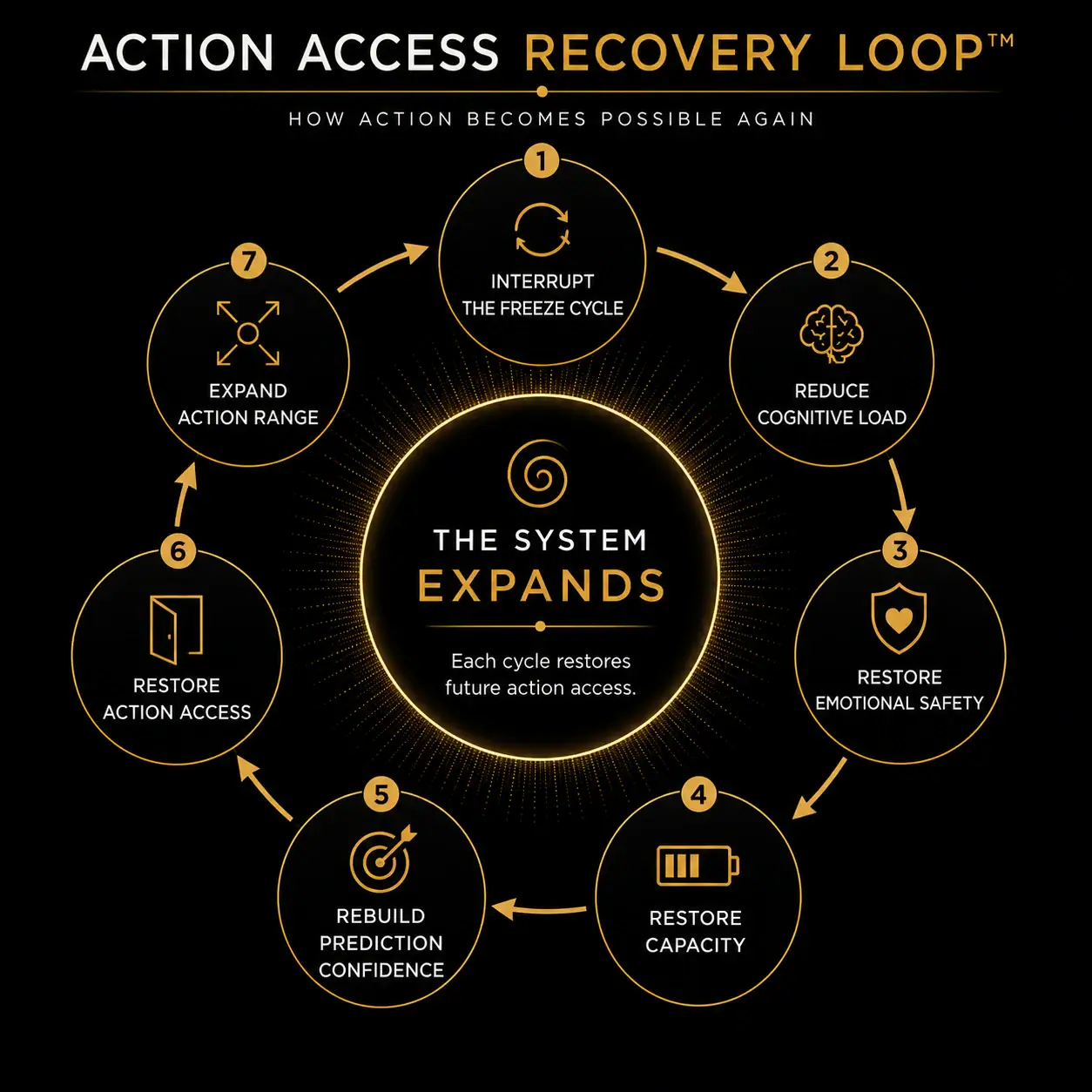
1. Interrupt the Freeze Cycle
Stop reinforcing the sequence of avoidance, guilt, pressure, and further withdrawal. Replace “I am refusing to act” with “My system is having difficulty accessing action.” This does not remove responsibility; it creates diagnostic clarity.
2. Reduce Cognitive Load
Reduce the number of open decisions. Externalize steps. Define one visible next action. Close unrelated tabs. Move information out of working memory and into a stable place.
3. Restore Emotional Safety
Ask what the action appears to threaten: criticism, conflict, failure, exposure, commitment, disappointment, or loss of alternatives. Then reduce the perceived stakes where possible.
4. Restore Capacity
Rest, food, hydration, movement, reduced stimulation, fewer transitions, and protected attention can matter. Capacity restoration should create a bridge back to action rather than an indefinite waiting period.
5. Rebuild Prediction Confidence
Choose an action small enough to complete and meaningful enough to update the system. Instead of “finish the report,” open the correct file and write the heading for the next section.
6. Restore Action Access
Once a small action succeeds, continue with the next adjacent action rather than immediately demanding the entire imagined workload.
7. Expand the Action Range
Repeated successful actions increase the range of tasks the system can approach. Uncertainty becomes more tolerable, confidence rises, and the transition from intention to movement becomes easier.
A practical Action Access check
When you notice yourself freezing, do not begin with “What is wrong with me?” Ask:
- Cognitive Capacity: Can I currently hold and sequence what this task requires?
- Emotional Safety: What does beginning seem to expose me to?
- Prediction Confidence: Do I believe this effort is likely to lead somewhere useful?
- Perceived Reward: Is the value of acting visible enough right now?
- Energy Availability: Do I have sufficient resources for this action?
- Motor Initiation: What exact physical movement begins the task?
- Uncertainty Tolerance: What do I believe I must know before I am allowed to start?
You do not need perfect answers. You are looking for the strongest constraint.
The next action should target that constraint rather than applying generic pressure to the entire system.
Examples of restoring action access
When you cannot send an email
The visible task is “send the email.” The real constraints may include uncertainty about tone, fear of judgment, too many possible formulations, and low confidence that the message will be received well.
A better first action may be to write three factual points the email must communicate.
When you cannot start a report
The visible task is “write the report.” The real constraint may be that “report” represents dozens of undefined actions.
A better first action may be to create the section headings and place existing evidence under each heading.
When you cannot make a decision
The visible task is “choose.” The real constraints may be loss aversion, incomplete information, pressure to be certain, and fear of future regret.
A better first action may be to identify which part of the decision is reversible and which part is not. This connects with the decision frameworks in Signal vs Noise and How to Choose Between Two Options.
When you cannot begin a conversation
The visible task is “talk about the problem.” The real constraint may be emotional safety.
A better first action may be to write one non-accusatory opening sentence that names the issue without demanding an immediate resolution.
What this model does not mean
The Action Access Model™ is not a diagnosis.
Difficulty initiating action can have many causes, and persistent or severe difficulties may deserve professional evaluation. The model is a way to understand interacting conditions, not a substitute for individualized medical or psychological care.
It also does not mean that responsibility disappears.
Understanding a mechanism is not the same as denying consequences. It means choosing interventions that are more likely to work.
A new way to understand discipline
Discipline is often described as the power to act regardless of internal state.
That definition can be useful, but it is incomplete.
Sustainable discipline also includes the ability to maintain, restore, and design the conditions that make repeated action possible.
A disciplined person does not only force movement. They reduce unnecessary uncertainty, protect capacity, make feedback visible, choose appropriate thresholds, and create systems that preserve access.
This is close to the logic developed in the Adaptive Action System: the most useful next step is not always the largest or most impressive step. It is the step the current system can actually access and learn from.
Knowledge Objects introduced
- Action Access Model™: explains the seven enabling conditions that make action available.
- Freeze Loop™: explains how delay, guilt, stress, lower capacity, and lower confidence reinforce one another.
- Action Access Recovery Loop™: explains how the system can restore access and gradually expand its action range.
Key takeaways
- Knowing what to do is not the same as having access to action.
- Action depends on multiple interacting conditions, not motivation alone.
- Small tasks can feel impossible when they require more coordination than the system can currently provide.
- Repeated delay can become a self-reinforcing Freeze Loop™.
- Recovery works best by restoring missing conditions rather than adding pressure.
- A small successful action can rebuild prediction confidence and widen future access.
Conclusion: action is not missing—it is waiting for access
The distance between knowing and doing is not empty.
It is filled with conditions.
When enough of those conditions align, action can feel almost effortless. When they do not, even a small movement can feel impossibly far away.
This is why motivation alone is not enough. It is why pressure can backfire. It is why repeated delay can become a loop. And it is why a carefully chosen successful action can begin changing the entire system.
Most people do not struggle because they lack all desire to move. They struggle because they mistake inaccessible action for unwillingness.
The goal is not to excuse inaction. The goal is to understand what makes action possible.
When you stop asking, “Why am I like this?” and begin asking, “Which condition is preventing access?” the problem becomes more specific.
Specific problems can be worked with.
Reduce the strongest constraint. Create one successful prediction. Let the system experience movement. Then expand the range of action gradually.
You may not need more force.
You may need a better path from intention to access.
Continue learning
- Why Do Small Tasks Feel So Hard? — Understand why task size and task difficulty are not the same.
- Why Do I Feel Stuck Even Though I’m Trying? — Explore why effort can exist without visible movement.
- Cognitive Overload Recovery — Restore usable mental capacity after sustained overload.
- Decision Fatigue Symptoms — Recognize how repeated decisions weaken clarity and initiation.
- Why Can’t I Focus on Anything? — Understand fragmented attention and reduced cognitive control.
- Why Can’t I Prioritize Anything? — See why prioritization fails when too many signals compete.
- Why Do I Overthink Everything? — Learn how analysis can become a substitute for action.
- Why Does Everything Feel Urgent? — Separate real priority from nervous-system urgency.
- Why Can’t I Trust Myself Anymore? — Rebuild confidence in your own decisions and signals.
- Internal Model of Reality — Understand how predictions shape perception and action.
- Signal vs Noise — Identify what deserves attention under uncertainty.
- Adaptive Action System — Choose the next action the current system can actually access.
Frequently asked questions
Why do I know what to do but still cannot do it?
Knowing provides information, but action also depends on cognitive capacity, emotional safety, prediction confidence, perceived reward, energy, motor initiation, and tolerance for uncertainty. You can understand the task while one or more of these conditions remain below the threshold required to begin.
Why can’t I make myself do anything?
When many tasks feel inaccessible at once, the issue may involve depleted capacity, sustained stress, low reward, uncertainty, reduced confidence, or difficulty initiating behavior. The useful question is which condition is constraining action most strongly.
Why can’t I start tasks even when they are important?
Importance can increase pressure and perceived consequences. If pressure rises faster than capacity, confidence, or emotional safety, the task can become harder to start precisely because it matters.
Is freezing the same as procrastination?
Not exactly. Procrastination describes a pattern of delay. Freezing describes the experience of action becoming difficult to access. A freeze state can produce procrastination, but the label alone does not explain the underlying mechanism.
Can anxiety make simple tasks feel impossible?
Yes. Anxiety can increase perceived threat, consume working capacity, narrow attention, and reduce prediction confidence. The objective task may remain small while the internal coordination required to perform it becomes much larger.
Is this executive dysfunction?
Difficulty initiating, sequencing, or sustaining action can overlap with what people describe as executive dysfunction. However, the Action Access Model™ is not a diagnosis. Persistent impairment should be discussed with an appropriately qualified professional.
Why do deadlines sometimes make me freeze more?
Deadlines increase urgency and perceived consequences. Moderate pressure may sharpen attention, but excessive pressure can increase threat, reduce cognitive capacity, and raise the action threshold.
Why does rest not always fix the problem?
Rest can restore energy, but energy is only one enabling condition. Emotional threat, uncertainty, low prediction confidence, cognitive complexity, or accumulated guilt may remain after physical rest.
Why do I avoid emails and messages?
Emails can combine uncertainty, social evaluation, unclear expectations, and the possibility of conflict. The visible action is small, but its emotional and cognitive demands may be high.
Why do I freeze before making a decision?
Decisions can reduce options, create responsibility, and expose you to regret. When uncertainty tolerance or prediction confidence is low, continuing to analyze can feel safer than choosing.
How do I stop the Freeze Loop™?
Interrupt self-criticism, identify the strongest missing condition, reduce cognitive load, restore emotional safety or capacity, and choose one action small enough to complete but meaningful enough to rebuild prediction confidence.
What is the best first step when I feel frozen?
The best first step is the one that addresses the strongest constraint. Sometimes that means clarifying the task. Sometimes it means reducing exposure, resting briefly, writing a private draft, or performing the first physical movement associated with the task.
Can burnout reduce action access?
Yes. Burnout can reduce energy, attention, reward sensitivity, emotional tolerance, and confidence that effort will lead to a meaningful result. These changes can make even familiar tasks difficult to initiate.
Why do I feel capable one day and stuck the next?
Action access changes with system state. Sleep, stress, uncertainty, recent success or failure, emotional safety, and cognitive load can all shift the threshold from one day to another.
Does this mean I should wait until I feel ready?
No. The goal is not perfect readiness. It is enough alignment to make one useful action available. Recovery often begins before you feel fully confident or comfortable.
Editorial note: This canonical manuscript is designed as the source of truth for the final Gutenberg article, WordPress import file, SEO metadata, schema, internal-link architecture, and derivative assets.
Leave a Reply
You must be logged in to post a comment.