Intuition development
Intuition becomes more reliable when you stop treating every feeling as truth and start training attention, pattern recognition, prediction, feedback, and reflection.

Direct answer: To develop intuition, learn to notice subtle signals without immediately interpreting them, turn hunches into specific predictions, test those predictions in low-risk situations, compare outcomes with expectations, and update what you believe. The goal is not stronger certainty. The goal is better calibration.
Most advice about intuition begins in the wrong place. It tells you to trust your gut, listen inward, or stop overthinking. Those suggestions can be helpful, but they leave out the central problem: a feeling can come from experience, anxiety, wishful thinking, social conditioning, fatigue, bias, or a real pattern that your conscious mind has not yet explained.
Developing intuition therefore does not mean believing your first reaction more strongly. It means improving the system that produces that reaction. You strengthen the quality of the signals you notice, the patterns you learn, the predictions you make, and the feedback you accept from reality.
A useful working definition is:
Intuition is a rapid, often pre-verbal prediction produced from experience, context, memory, bodily information, and pattern recognition before deliberate reasoning reconstructs every step.
This guide explains how to develop intuition without romanticizing it. You will learn how intuition forms, how to separate it from anxiety and bias, how to train it through daily practice, how to use intuition with analytical thinking, and how to measure whether it is actually becoming more accurate.
What intuition really is
Intuition is often described as a gut feeling, inner knowing, hunch, instinct, or sixth sense. These phrases describe how intuition feels, but not how it works.
In practical terms, intuition is rapid sense-making. Your mind detects a configuration of cues, compares it with learned patterns, and generates a prediction before you can consciously describe the complete chain of reasoning. The result may appear as a feeling that something fits, a quiet warning, an unexpected preference, a sudden solution, or a sense that an apparently normal situation contains a mismatch.
This does not mean every immediate feeling is intuition. It means some conclusions become conscious faster than the reasoning behind them.
Intuition may draw on:
- previous experiences and their outcomes;
- subtle changes in tone, timing, posture, sequence, or context;
- regularities you have encountered many times;
- memories that are not currently in focal awareness;
- emotional and bodily information;
- expectations about what normally happens next;
- values, goals, and learned assumptions.
That final point matters. Intuition is not produced by a perfectly neutral observer. It is generated by your current understanding of reality. If that understanding is accurate and relevant to the situation, the prediction may be useful. If it is incomplete, outdated, or distorted, the intuition can feel convincing and still be wrong.
For a deeper conceptual foundation, read What Intuition Really Is: Pattern Recognition Under Uncertainty and Internal Model of Reality.
Can intuition be developed?
Yes, intuition can be developed—but not as a universal power that becomes equally accurate in every area of life.
Intuition improves most reliably inside a domain where three conditions exist:
- Meaningful patterns repeat. The environment contains regularities that can be learned.
- You receive feedback. You eventually learn whether your prediction matched reality.
- You reflect honestly. You update your understanding instead of remembering only the times you were right.
Primary evidence: in chess, stronger experts can extract useful information within seconds, but additional deliberation can still improve tactical decisions. See Chassy et al. (2023) and Moxley et al. (2012).
This explains why a person can have excellent intuition in one domain and poor intuition in another. An experienced nurse may recognize a patient’s deterioration before a novice sees it. A project manager may sense that a “green” status report hides delivery risk. A musician may immediately hear that an arrangement is unbalanced. None of those abilities automatically produces accurate intuition about investing, relationships, health, or unfamiliar technologies.
Intuition becomes trustworthy where relevant experience meets timely feedback and honest correction.
You can therefore improve intuition by training the processes beneath it:
- attention, so you notice useful information;
- interoception, so you can detect bodily states without confusing sensation with interpretation;
- emotional literacy, so fear, desire, shame, and excitement become identifiable data rather than hidden drivers;
- pattern recognition, so repeated relationships become visible;
- prediction, so vague feelings become testable;
- reflection, so outcomes update future judgment;
- analytical verification, so high-stakes conclusions are checked.
The aim is not to eliminate uncertainty. It is to become more skillful at acting before complete certainty is available.
How intuition forms: from reality to inner knowing
You are surrounded by more information than conscious attention can process. Your mind must select. It notices some cues, ignores others, assigns meaning, compares the present with previous experience, and anticipates what is likely to happen next.
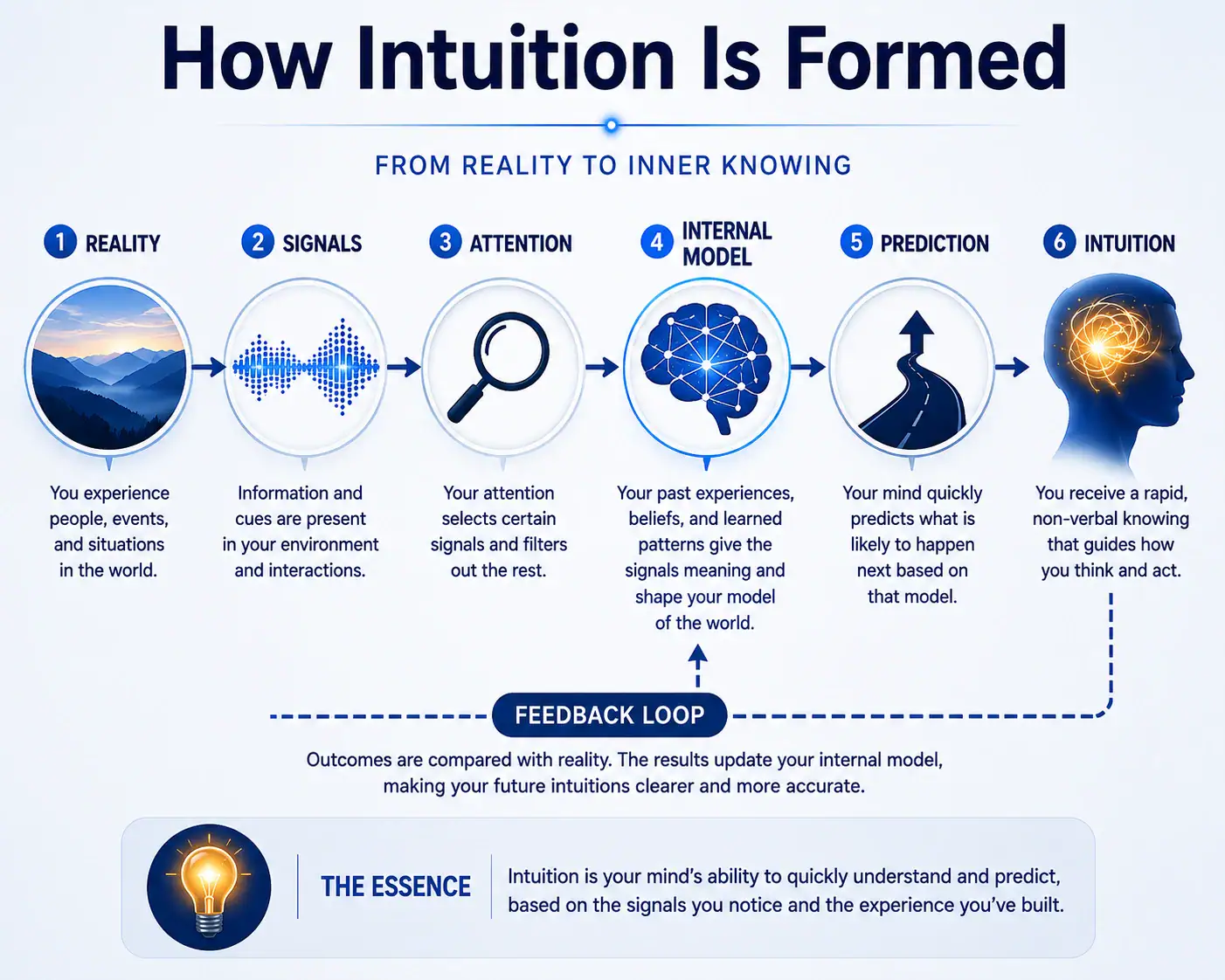
1. Reality produces signals
People, events, environments, systems, and conversations produce observable information. A deadline moves. A person’s pace changes. A familiar process produces an unfamiliar result. Your body becomes tense during one option and more settled during another. These are not conclusions. They are signals.
2. Attention selects a fraction of those signals
Attention acts as a gate. It amplifies some information and filters out the rest. Expertise changes what becomes noticeable: a novice and an expert can look at the same situation while seeing different patterns because their attention has learned to prioritize different cues.
Attention is also vulnerable to noise. Fatigue, constant notifications, emotional activation, social pressure, and cognitive overload can make irrelevant information feel important while meaningful signals disappear. The Signal vs Noise framework explains why information quality matters more than information volume.
3. The internal model interprets the signal
A signal has no useful meaning in isolation. Your mind interprets it through memories, beliefs, expectations, values, goals, language, and context. A delayed response may mean rejection, careful thought, competing priorities, or a technical problem. The same event can generate different intuitions because different internal models interpret it differently.
4. The mind generates a prediction
Your model anticipates what is likely to happen next. The prediction may be highly specific—“this dependency will delay the launch”—or initially vague—“something about this plan does not fit.” When the prediction reaches awareness before the reasoning is fully verbalized, it feels intuitive.
5. Action creates feedback
A prediction becomes valuable only when reality can confirm, refine, or challenge it. You ask a question, wait, investigate, test a small action, or observe what happens. The outcome then updates—or fails to update—your model.
What bodily signals can and cannot tell you
Interoception is the ability to sense and interpret internal bodily states such as heartbeat, breathing, temperature, tension, hunger, fatigue, or activation. Bodily changes can carry useful information because emotion and decision-making are not separate from the body. But bodily sensation is not proof.
A tight chest may accompany a real mismatch, fear of conflict, excitement, lack of sleep, caffeine, or a learned association from an earlier experience. The accurate observation is “my chest tightened.” The interpretation “this opportunity is dangerous” is a hypothesis.
That distinction protects intuition from becoming self-confirming:
Primary studies illustrate why body awareness must be calibrated rather than blindly trusted: Bechara et al. (1997), Dunn et al. (2010) and Sugawara et al. (2020) found relationships among anticipatory bodily responses, interoceptive ability, and decision processes, while also showing that bodily information can help or hinder depending on the signal and context.
Notice the sensation precisely. Hold the explanation lightly. Test what the signal might mean.
The four levels of intuition development
Intuition does not mature in a single leap. It usually develops through increasingly integrated capacities. These are not rigid stages, and people often move between them depending on context.
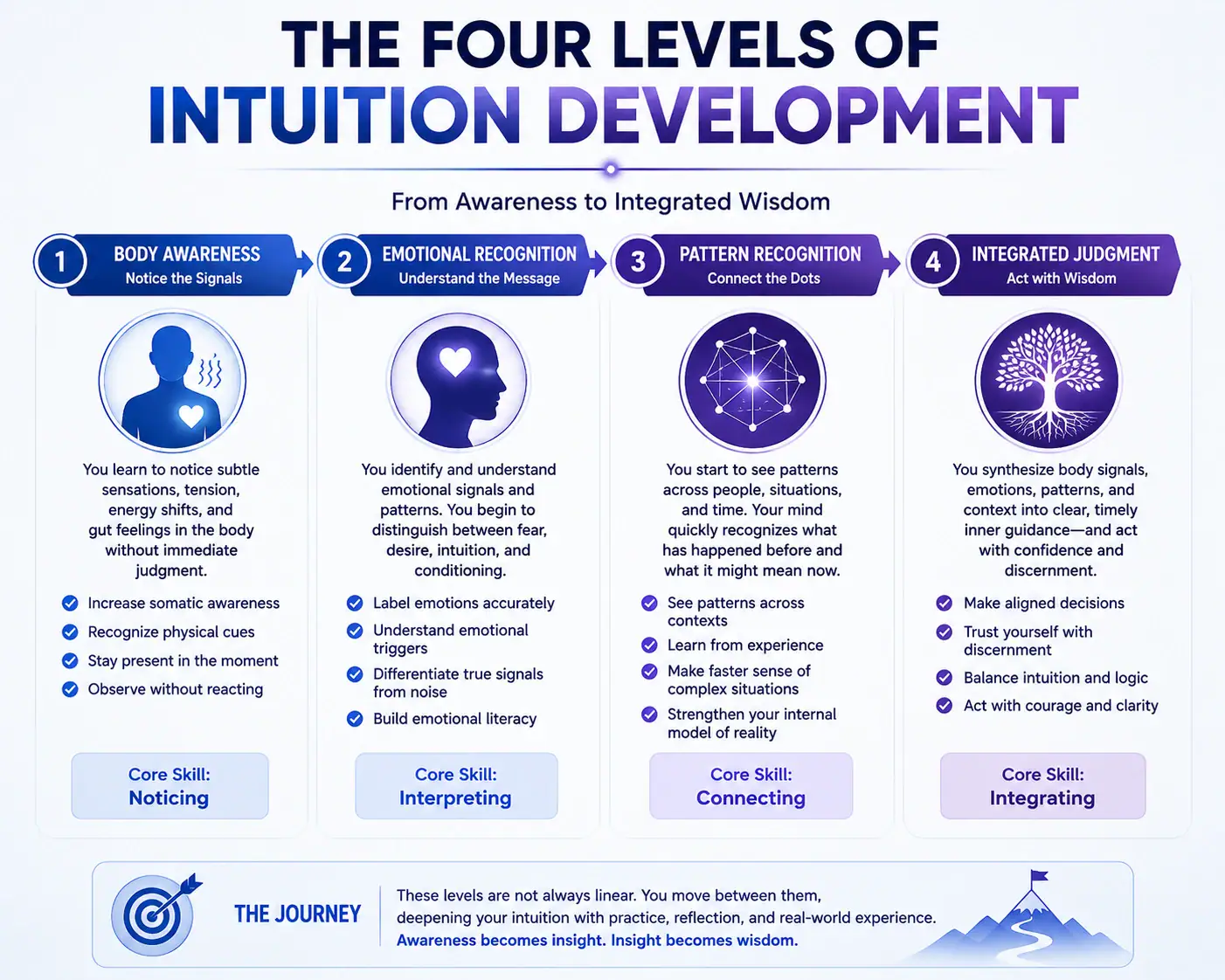
Level 1: Body awareness
You learn to notice subtle sensations, activation, ease, heaviness, warmth, contraction, energy shifts, and changes in breathing without reacting immediately. The core skill is noticing.
Level 2: Emotional recognition
You become better at identifying whether the signal is connected to fear, desire, anger, shame, hope, attraction, grief, relief, or social pressure. The core skill is interpreting without collapsing emotion and truth into the same thing.
Level 3: Pattern recognition
You begin to see recurring relationships across people, situations, sequences, timing, and outcomes. The core skill is connecting the present with relevant experience while remaining alert to meaningful differences.
Level 4: Integrated judgment
You combine bodily signals, emotion, learned patterns, context, evidence, values, and deliberate reasoning. You can use intuition to generate a direction and analysis to test the direction. The core skill is integrating.
The fourth level is the real goal. It is not blind self-trust. It is judgment that can remain responsive to both inner information and external reality.
The Intuition Development Loop™
Intuition improves through a repeatable learning cycle rather than through belief alone.
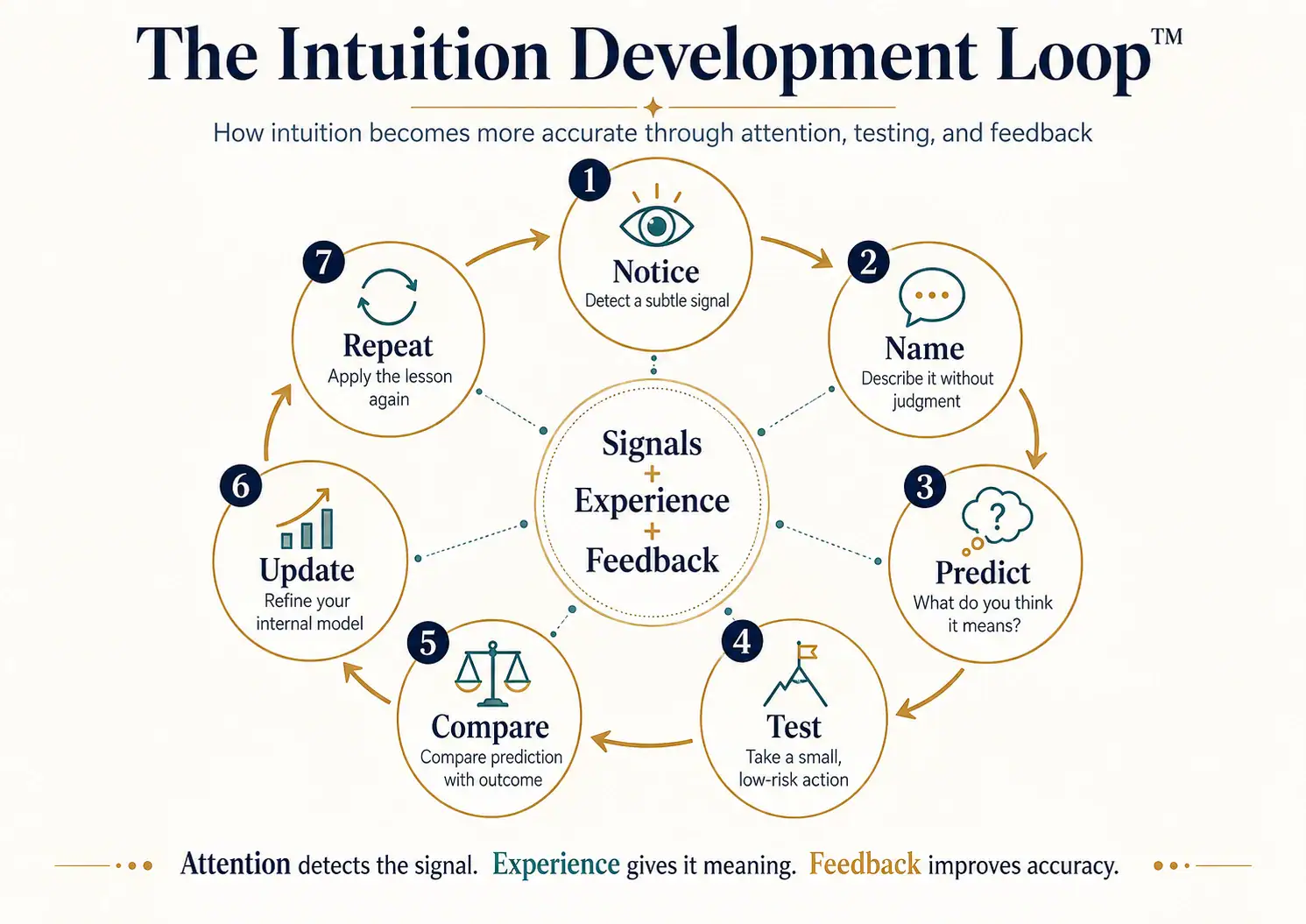
Notice
Detect a subtle internal or external signal before it disappears beneath explanation, urgency, or social pressure.
Name
Describe what you observed without immediately deciding what it means. “The room became quieter after the timeline was mentioned” is cleaner than “everyone knows the plan will fail.”
Predict
State what you think the signal means in a form that could be confirmed or corrected. A prediction is more useful than a vague feeling because reality can answer it.
Test
Choose a proportionate, low-risk action: ask one question, check one assumption, delay a commitment, compare one data point, or run a small experiment.
Compare
Compare the original prediction with what actually happened. Do not rewrite the prediction after seeing the outcome.
Update
Refine the internal model. Identify which signal mattered, which assumption failed, and what you would notice sooner next time.
Repeat
Apply the improved understanding to future situations. Repetition turns isolated experience into organized judgment.
For a more detailed calibration system, see Intuition Calibration: How to Measure and Improve Your Gut Accuracy.
How to develop intuition step by step
The following practices develop different parts of the intuition system. They work best together.
1. Reduce noise before searching for a signal
A mind under constant demand does not necessarily lose intuition; it loses access to subtle information. When attention is saturated, the loudest input often wins, not the most relevant one.
Before making an important judgment:
- pause notifications and incoming messages;
- write down unrelated tasks that are occupying working memory;
- take several slower breaths without trying to force calm;
- name the decision in one sentence;
- separate what is known, assumed, and still unknown.
This is not a ritual for becoming perfectly calm. It creates enough cognitive space to distinguish the decision from everything competing with it. When mental load is the primary obstacle, Cognitive Overload Recovery can help restore access to attention.
2. Train neutral body awareness
Spend three to five minutes noticing sensation without converting every sensation into a message. Scan the jaw, throat, chest, abdomen, shoulders, hands, and breathing. Use descriptive language:
- tight or open;
- warm or cool;
- heavy or light;
- activated or settled;
- moving or still;
- localized or diffuse.
The aim is to improve signal resolution. “I feel bad” contains little information. “My breathing became shallow when I imagined accepting the deadline” is more precise.
3. Separate observation from interpretation
Intuition becomes unreliable when observation and story merge instantly. Use a two-column note:
| Observed signal | Possible interpretation |
|---|---|
| The supplier answered quickly but avoided one technical question. | They may not have validated the requirement. |
| My body tensed when I imagined saying yes. | The commitment may conflict with capacity—or I may fear disappointing someone. |
| The team became quiet after the delivery date was announced. | There may be hidden disagreement, confusion, or perceived risk. |
Generate at least two plausible interpretations. This prevents the first story from disguising itself as certainty.
4. Make small, testable predictions
Vague intuition cannot be calibrated. Replace “I have a bad feeling” with a prediction:
- “I expect the client to request a scope change after reviewing the prototype.”
- “I think this conversation will reveal a concern that has not been stated directly.”
- “I predict this task will take longer because one dependency is not understood.”
- “I expect my resistance to decrease after I clarify the first action.”
Then add a confidence estimate—perhaps 55%, 70%, or 85%. The number does not need to be mathematically perfect. It forces you to distinguish possibility from certainty and gives you something to compare over time.
5. Practise in low-stakes situations
Do not begin by testing intuition on irreversible, emotionally loaded decisions. Train where feedback is available and the cost of error is small.
Examples include:
- which task will encounter an unexpected dependency;
- which meeting needs extra preparation;
- which route or schedule will feel less rushed;
- which conversation should happen today rather than next week;
- which draft direction will be easier to develop;
- whether a minor request will expand in scope.
Low-stakes practice provides more learning cycles and less emotional distortion.
6. Keep an intuition journal
A useful journal records the prediction before the outcome. Include:
- date and context;
- the first signal you noticed;
- the interpretation you considered;
- alternative explanations;
- your prediction;
- confidence level;
- the action you took;
- the actual outcome;
- what the outcome taught you.
Review entries weekly rather than obsessively after every small decision. The purpose is pattern discovery, not self-surveillance.
7. Study misses as carefully as hits
People naturally remember striking successes: the moment they “knew” someone would call, sensed a risk, or chose the right direction. Misses are easier to forget, reinterpret, or blame on changing circumstances.
Ask:
- Was the signal real but the interpretation wrong?
- Did I notice only evidence that supported my expectation?
- Did strong emotion amplify one possibility?
- Was I applying an old pattern to a changed environment?
- Was the prediction too vague to evaluate?
- Did the outcome change because my action changed the situation?
Being wrong is not evidence that intuition cannot be developed. It is the feedback through which development occurs.
8. Build domain-specific experience deliberately
General self-awareness helps, but reliable intuition depends heavily on relevant experience. To develop intuition in a particular domain:
- study representative cases, not only dramatic examples;
- compare similar situations with different outcomes;
- learn which cues experts treat as diagnostic;
- seek feedback faster where possible;
- review decisions while the original reasoning is still available;
- notice exceptions that challenge simple rules.
Experts do not merely accumulate more facts. They organize experience into relationships, patterns, exceptions, and likely consequences.
9. Combine intuition with evidence
Intuition and data should not compete for status. Use them in sequence:
- Let intuition identify a possibility, mismatch, risk, or direction.
- Translate it into a hypothesis.
- Identify the evidence that would support or weaken that hypothesis.
- Choose an action proportional to uncertainty and risk.
- Update after the outcome.
This approach preserves speed without sacrificing correction. It is especially important when the decision affects health, safety, finances, legal obligations, or other people.
Intuition vs anxiety vs impulse vs bias
The hardest part of developing intuition is not hearing a signal. It is identifying what kind of signal you are hearing.

| Signal | Common pattern | Useful response |
|---|---|---|
| Intuition | Specific and contextual; often points toward one prediction or mismatch. | Name the signal, consider alternatives, and test it proportionately. |
| Anxiety | Threat-focused and repetitive; multiplies possible dangers and seeks certainty. | Regulate first, separate facts from feared outcomes, and avoid treating urgency as evidence. |
| Impulse | Pushes toward immediate action, relief, escape, reward, or discharge of emotion. | Pause, create delay, and choose the smallest reversible action. |
| Bias | Fits new information into an existing assumption and resists disconfirming evidence. | Ask what would prove the current interpretation incomplete or wrong. |
These are tendencies, not diagnostic laws. Intuition is not always quiet. Anxiety is not always loud. A real danger can create urgent fear, and a biased conclusion can feel calm. Focus on the structure of the prediction and its relationship to evidence, not only on emotional tone.
Use the four-question signal check
- Specificity: What exactly am I predicting?
- Source: Which observable signals or experiences produced it?
- Alternatives: What else could explain those signals?
- Test: What small action could give me better information?
For further practice, read Intuition or Anxiety?, Intuition vs Anxiety, and Intuition vs Bias.
Intuition and thinking are partners
One of the most persistent mistakes in intuition training is turning it into a contest between gut feeling and logic. Human judgment is usually stronger when rapid pattern recognition and deliberate evaluation cooperate.
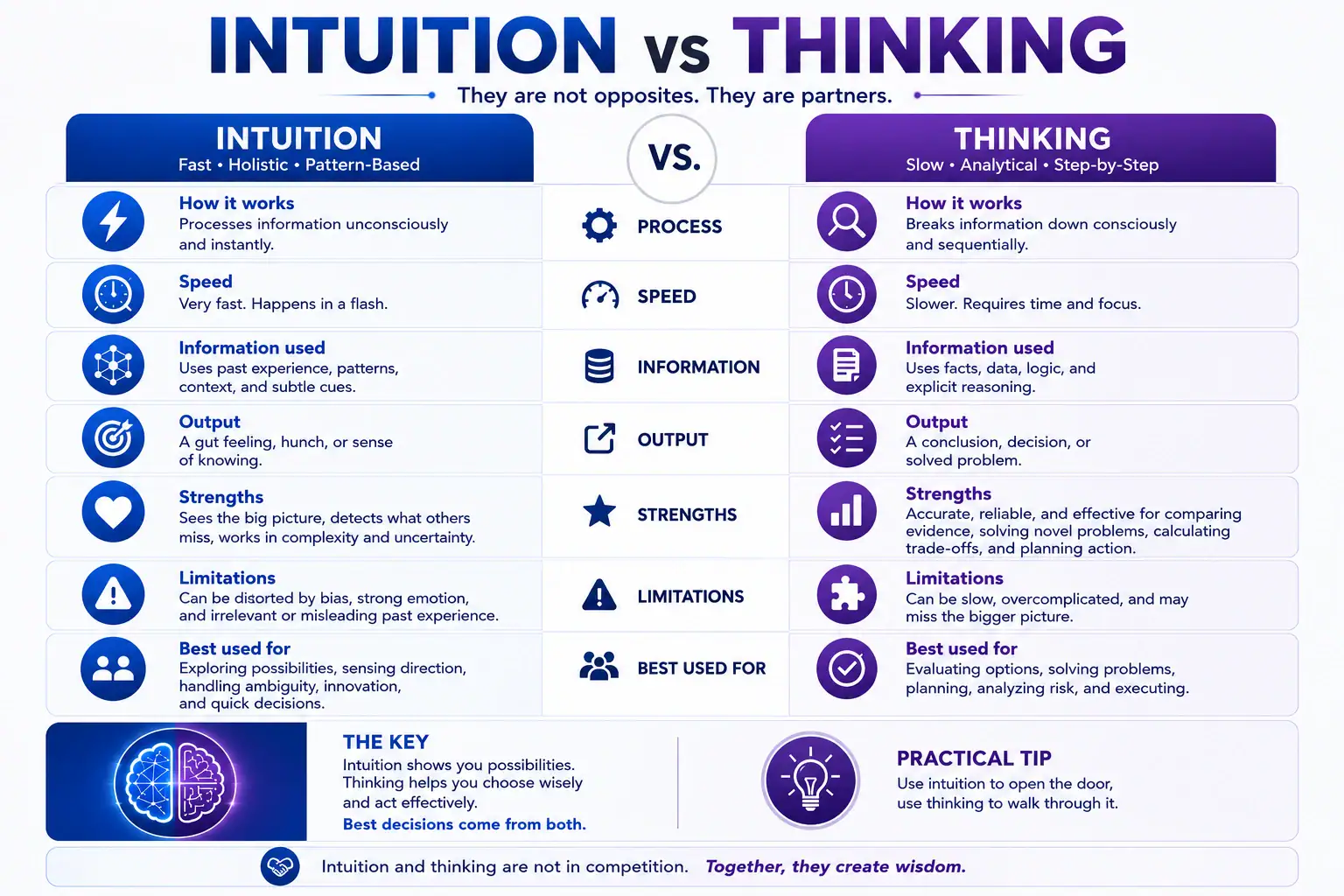
Intuition is useful for:
- recognizing familiar patterns quickly;
- detecting subtle mismatches;
- generating promising hypotheses;
- sensing direction under incomplete information;
- working with complex patterns that are difficult to verbalize immediately.
Deliberate thinking is useful for:
- comparing explicit evidence;
- checking assumptions;
- calculating probabilities, costs, and trade-offs;
- solving unfamiliar problems;
- planning execution;
- documenting and communicating why a decision is justified.
The best sequence depends on the situation. In familiar, time-sensitive conditions, intuition may produce the first useful direction. In novel, high-stakes, or highly measurable conditions, analysis should carry more weight. In many complex decisions, the strongest process is iterative:
Intuition proposes. Analysis tests. Action generates feedback. Learning improves both.
Read Intuition vs Logic for a deeper comparison.
A 10-minute daily intuition practice
Consistency matters more than intensity. This routine trains signal awareness, prediction, and reflection without requiring a large time commitment.
Minutes 1–2: Reduce noise
Put the phone aside, slow the pace of breathing, and write down any unrelated task that is occupying attention.
Minutes 3–4: Scan internal and external signals
Notice one bodily sensation and one environmental cue. Describe both without interpretation.
Minutes 5–6: Choose one real question
Use a low-stakes question with feedback likely to arrive: “Which task contains hidden complexity?” or “What concern may appear in today’s meeting?”
Minutes 7–8: Make a prediction
Write one specific prediction, one alternative explanation, and a confidence estimate.
Minutes 9–10: Review an earlier prediction
Compare one previous expectation with reality. Record what the outcome changed in your understanding.
You can also use The Personal Signal Decoder to identify recurring signal patterns and the Signal vs Noise Simulator to practise judgment under uncertainty.
A 30-day plan to strengthen intuition
This plan emphasizes progressive skill-building. Do not measure success by how mystical or certain you feel. Measure whether your observations become more precise and your predictions become easier to test.
Week 1: Signal awareness
- Complete one three-minute body scan each day.
- Record one external cue without interpreting it.
- Practise separating sensation from story.
- Notice when urgency narrows attention.
Outcome: clearer observation.
Week 2: Prediction practice
- Make one low-stakes prediction each day.
- Add a confidence estimate.
- Write at least one alternative explanation.
- Choose a small action that can generate feedback.
Outcome: intuition becomes testable.
Week 3: Calibration and bias detection
- Review the first two weeks of entries.
- Identify where confidence exceeded accuracy.
- Look for repeated emotional or situational distortions.
- Study misses without rewriting the original prediction.
Outcome: better self-correction.
Week 4: Integrated decisions
- Use intuition to generate a hypothesis.
- Use evidence to test it.
- Choose proportional action.
- Complete a short reflection after the outcome.
Outcome: intuition and analysis work together.
At the end of 30 days, review the entire set. Look for domains where intuition improved, conditions where it became distorted, and signals that proved consistently useful. A personal pattern is more valuable than a generic rule.
How to measure whether your intuition is improving
Improvement is not simply “being right more often.” A good decision can produce a bad outcome, and a poor decision can get lucky. Measure the quality of the process as well as the result.
Signs of real development
- Your predictions become more specific. “Something is wrong” becomes “this dependency is likely to delay testing.”
- Your confidence becomes better calibrated. You are less likely to treat a 60% possibility as certainty.
- You notice signals earlier. You detect changes before they become crises.
- You generate alternatives. The first interpretation no longer owns the entire decision.
- You recover from misses faster. Being wrong becomes information rather than a threat to identity.
- You distinguish domains. You know where experience supports intuition and where it does not.
- You can identify the signal. You can explain which cues shaped the judgment, even if the original conclusion felt immediate.
- You use proportionate action. The strength of a feeling no longer determines the size of the response.
A simple calibration score
For each prediction, record:
- clarity: Was the prediction specific enough to evaluate?
- confidence: How likely did you think it was?
- outcome: What actually happened?
- signal quality: Which cues were genuinely relevant?
- learning: What should change in the model?
Review groups of decisions, not isolated events. Twenty modest predictions reveal more about calibration than one dramatic success.
When not to trust intuition alone
Intuition deserves less weight when the environment does not support reliable learning or when the cost of error is high.
- you are operating outside your experience;
- the environment changes too quickly for old patterns to remain valid;
- feedback is rare, delayed, hidden, or ambiguous;
- you are intensely afraid, angry, attracted, ashamed, exhausted, or euphoric;
- you have a strong personal incentive to prefer one conclusion;
- the decision concerns medical care, legal obligations, major finances, safety, or irreversible consequences;
- a feeling encourages you to ignore clear contradictory evidence;
- the prediction cannot be made specific enough to test.
In high-stakes situations, intuition can still be useful as an alert: it may tell you where to investigate, what question to ask, or which assumption requires verification. It should not automatically become the final verdict.
How developed intuition works in real life
Example 1: A project risk that looks “green”
Signal: A delivery manager notices that every status report is positive, yet technical questions receive increasingly vague answers.
Prediction: The team is reporting activity rather than validated progress, and integration risk will appear late.
Test: Ask for one end-to-end demonstration and evidence for the highest-risk dependency.
Outcome: The demo exposes an unresolved interface problem.
Update: Future intuition becomes more sensitive to the mismatch between confident language and missing verification.
Example 2: A conversation that leaves unexplained tension
Signal: A person agrees verbally, but their pace slows and they stop asking questions after one topic appears.
Prediction: Agreement may be compliance rather than commitment.
Test: Ask, “What part of this feels least workable?” rather than assuming resistance.
Outcome: A constraint emerges that the person did not feel safe naming directly.
Update: The useful pattern is not “silence means disagreement.” It is “a change in engagement after a specific topic may signal an unspoken constraint.”
Example 3: Creative direction
Signal: An initial concept is technically competent but repeatedly feels lifeless during revision.
Prediction: The concept solves the brief but lacks a clear emotional center.
Test: Produce two small alternatives built around different emotional promises.
Outcome: One alternative immediately creates stronger coherence across copy, visuals, and structure.
Update: The artist learns which early sensations indicate ordinary difficulty and which indicate a weak underlying concept.
Example 4: A personal boundary
Signal: A request seems reasonable, yet the body becomes heavy when imagining agreement.
Prediction: The request may conflict with capacity rather than values.
Test: Delay the answer, review current obligations, and consider a smaller commitment.
Outcome: The calendar confirms that saying yes would create hidden overload.
Update: The signal becomes associated with capacity pressure, not with a universal instruction to refuse.
Example 5: Hiring or collaboration
Signal: A candidate gives polished answers but avoids concrete examples of mistakes and learning.
Prediction: The presentation may be stronger than reflective capacity.
Test: Ask for a detailed failure, the original assumption, and what changed afterward.
Outcome: The answer remains abstract, while another candidate demonstrates precise learning.
Update: Intuition becomes anchored to observable behavior rather than “energy” alone.
The Intuition in Action™ Loop
Training only matters when it changes how you act. The final loop connects awareness with decision, reflection, and learning.
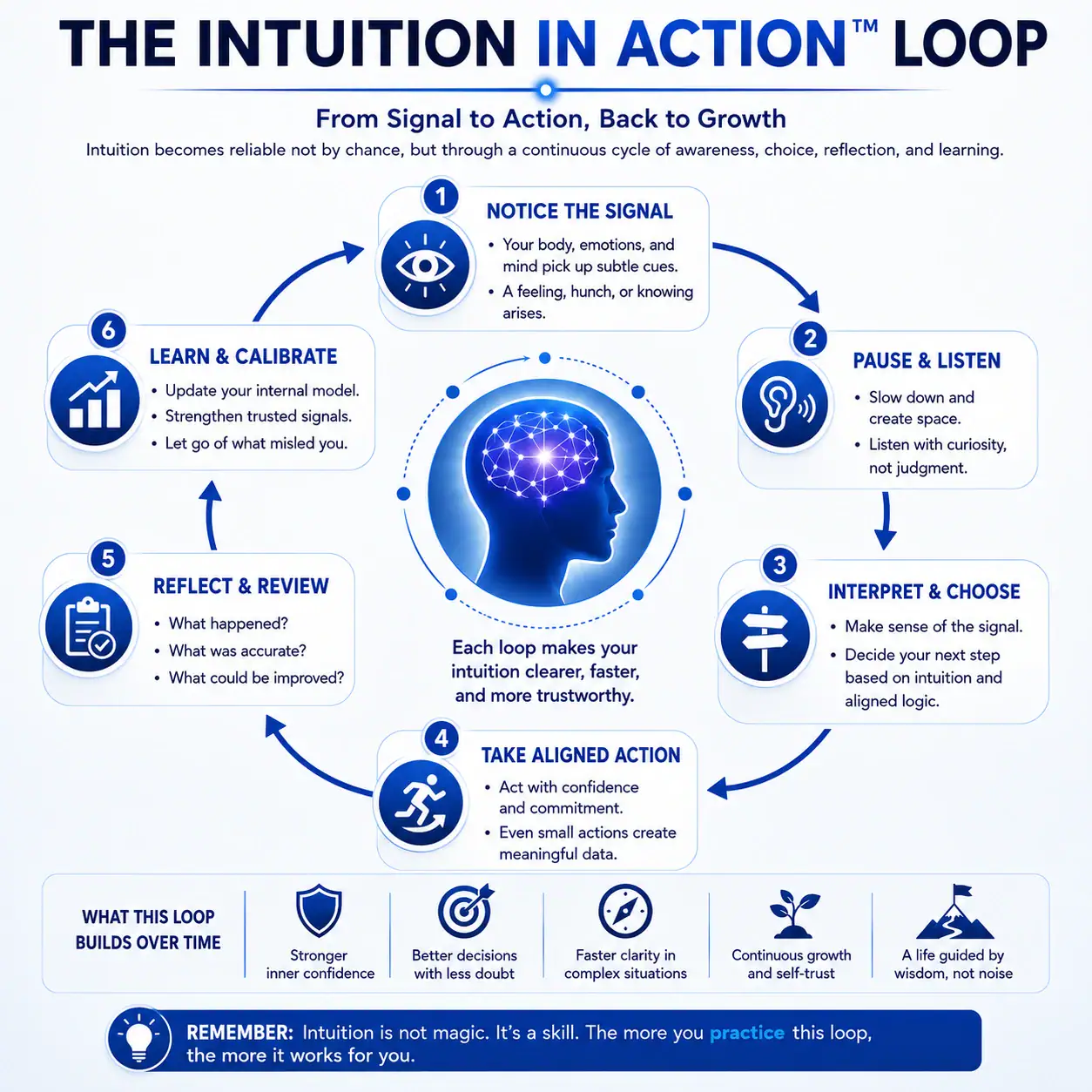
The loop is simple:
- Notice the signal. Something changes internally or externally.
- Pause and listen. Create space before reaction becomes action.
- Interpret and choose. Make sense of the signal alongside context and logic.
- Take aligned action. Act proportionately and deliberately.
- Reflect and review. Compare the prediction with what occurred.
- Learn and calibrate. Update the model and carry the lesson forward.
Each cycle can build stronger inner confidence, better decisions with less unnecessary doubt, faster clarity in complex situations, and a more realistic form of self-trust. The confidence is earned because it is connected to learning—not because every feeling is treated as correct.
Frequently asked questions about developing intuition
Can intuition really be developed?
Yes. You can improve the capacities that support intuition: attention, body awareness, emotional recognition, pattern learning, prediction, feedback, and reflection. Improvement is usually domain-specific rather than universal.
How long does it take to develop intuition?
There is no universal timeline. You may notice better signal awareness within weeks, but reliable domain intuition grows through repeated exposure and meaningful feedback. Complex expertise can take years because the patterns themselves take time to encounter.
What is the fastest way to improve intuition?
Turn vague feelings into specific low-stakes predictions and record the outcome. This creates a faster learning loop than simply journaling feelings without testing them.
Can intuition be trained without meditation?
Yes. Meditation can help some people notice internal states, but it is not required. Prediction journals, deliberate observation, case review, feedback, and low-risk experiments also train intuition.
Does meditation improve intuition?
Meditative and mind–body practices may improve awareness of bodily and emotional states for some people, but awareness alone does not guarantee accurate interpretation. A primary intervention study by Sugawara et al. (2020) found changes in interoceptive accuracy and decision-related measures after interoceptive training. Feedback and calibration remain necessary.
How do I know whether a feeling is intuition or anxiety?
Do not rely only on whether it feels calm or urgent. Ask what the feeling predicts, which signals support it, what alternatives exist, and what small test could provide information. Anxiety often multiplies threats and seeks certainty; intuition is more useful when it can be translated into a contextual prediction.
Is intuition the same as a gut feeling?
A gut feeling is one way intuition may appear, but not every gut feeling is intuitive judgment. Bodily sensations can reflect stress, excitement, fatigue, memory, or other physiological states.
Can intuition be wrong?
Yes. Intuition can be distorted by bias, strong emotion, irrelevant experience, incomplete information, outdated patterns, and environments that do not provide reliable feedback.
Why is expert intuition often better?
Experts have encountered more relevant patterns and usually organize them into richer models. They can notice diagnostic cues quickly. Expert intuition still requires verification when the environment changes or the case is unusual.
Can overthinking weaken intuition?
Excessive analysis can bury an early signal under competing explanations, especially when no new information is being added. But careful thinking can also protect you from false intuition. The aim is not less thought in every situation; it is thought that tests rather than smothers the signal.
Should I trust my first impression?
Treat it as data, not a verdict. First impressions can contain rapid pattern recognition, but they can also contain stereotypes, mood, projection, and missing context. Make the impression specific and test it.
How can I measure intuitive accuracy?
Record predictions before outcomes, add confidence estimates, and review groups of decisions. Track specificity, calibration, signal quality, and learning—not only whether the final outcome was positive.
Can intuition predict the future?
Intuition can anticipate likely outcomes by recognizing patterns and context. That is prediction in the ordinary cognitive sense, not guaranteed foresight. It becomes less reliable as the environment becomes more random, unfamiliar, or rapidly changing.
What should I do when intuition and evidence disagree?
Investigate the disagreement. The intuition may be detecting a missing variable, or it may be distorted. Identify the exact prediction, review the evidence, seek disconfirming information, and choose action proportional to the stakes.
Can intuition and logic work together?
Yes. Intuition can generate a hypothesis or direction, while deliberate reasoning can compare evidence, calculate trade-offs, and plan execution. Strong judgment often uses both.
Why do I keep second-guessing intuitive decisions?
Second-guessing often appears when the original signal was vague, the stakes feel high, feedback is unavailable, or self-trust has become tied to never being wrong. Make the prediction explicit and define what evidence would justify revising it. See Why Do I Second-Guess Myself?.
Final thought: develop accuracy, not mystique
Learning how to develop intuition is not a journey toward absolute certainty. It is a practice of becoming more precise about what you notice, more honest about what you do not know, more disciplined in how you test a feeling, and more willing to learn when reality disagrees.
Your intuition becomes more useful when you:
- reduce noise;
- notice signals early;
- separate observation from interpretation;
- make specific predictions;
- test them proportionately;
- compare them with outcomes;
- update the model;
- combine inner information with evidence.
The goal is not to trust every feeling. The goal is to build a mind that learns from reality quickly enough to recognize what matters before every reason can be put into words.
Continue your intuition practice
Move from reading to structured practice with The Intuition Path, explore your next steps through Your Intuition Journey, or practise decision-making with the Signal vs Noise Simulator.
Research basis
The practical model in this article is a synthesis. The studies below are linked primary research that supports specific components—rapid pattern recognition, interoception, expert judgment, feedback, and calibration—rather than proof that intuition is universally accurate.
- Bechara, A., Damasio, H., Tranel, D., & Damasio, A. R. (1997). Deciding advantageously before knowing the advantageous strategy. Science, 275, 1293–1295. Found anticipatory nonconscious response patterns before participants could explicitly explain the advantageous strategy.
- Dunn, B. D., et al. (2010). Listening to your heart: How interoception shapes emotion experience and intuitive decision making. Psychological Science, 21, 1835–1844. Showed that stronger access to bodily signals could help or hinder intuitive decisions depending on whether those signals pointed toward advantageous choices.
- Moxley, J. H., Ericsson, K. A., Charness, N., & Krampe, R. T. (2012). The role of intuition and deliberative thinking in experts’ superior tactical decision-making. Cognition, 124, 72–78. Examined how rapid expert judgment and additional deliberation contribute to tactical chess performance.
- Zander, T., et al. (2016). Intuitive decision making as a gradual process: Investigating semantic intuition-based and priming-based decisions with fMRI. Brain and Behavior, 6, e00420. Investigated the gradual emergence of intuitive coherence and its neural correlates.
- Sugawara, A., Terasawa, Y., Katsunuma, R., & Sekiguchi, A. (2020). Effects of interoceptive training on decision making, anxiety, and somatic symptoms. BioPsychoSocial Medicine, 14, 7. Tested whether interoceptive training changed interoceptive accuracy and decision-related outcomes.
- Chassy, P., Lahaye, R., Didierjean, A., & Gobet, F. (2023). Intuition in chess: A study with world-class players. Psychological Research, 87, 2380–2389. Measured intuitive position evaluation under a five-second limit across chess expertise levels.
- van’t Wout, M., Faught, S., & Menino, D. (2013). Does interoceptive awareness affect the ability to regulate unfair treatment by others? Frontiers in Psychology, 4, 880. Examined interoceptive awareness in social decision-making and emotion regulation.
- Pollatos, O., et al. (2023). Interoceptive accuracy is associated with benefits in decision making in children. Frontiers in Psychology, 14. Studied associations between interoceptive accuracy and decision performance in younger participants.
Editorial note: This article is educational and does not replace medical, psychological, legal, or financial advice. High-stakes decisions should be checked with appropriate evidence and qualified professionals.