Learn how to tell the difference between a gut feeling that guides you — and anxiety that quietly controls you.

Why Intuition and Anxiety Feel the Same — But Lead You in Opposite Directions
You feel something in your body — a pull, a tightening, a sudden drop in your stomach. And the question appears almost instantly:
Is this intuition… or is this anxiety?
This confusion is not случайна. Both intuition and anxiety speak through the same channel — your nervous system. The difference is not in where they appear, but in how they move.
One creates clarity. The other creates noise. Learning to tell them apart changes everything — how you decide, how you act, and how much you trust yourself.
This is not about “feeling better.” It’s about reading your internal signals accurately.
What Anxiety Actually Is (And Why It Feels So Convincing)
Anxiety is not just a thought. It’s a full-body prediction system designed to keep you safe — even when there is no real threat.
When activated, your brain shifts into survival mode. The body follows immediately:
- Heart rate increases
- Breathing becomes shallow
- Muscles tighten
- Attention narrows toward potential danger
- Thoughts accelerate into worst-case scenarios
The problem is not that anxiety exists. The problem is that it feels like truth.
It doesn’t say, “This is fear.” It says, “This is important. Don’t ignore this.”
How Anxiety Imitates Intuition
Anxiety rarely presents itself openly. It borrows the voice of intuition and uses it to justify avoidance.
It sounds like guidance, but it behaves differently:
- It repeats. Intuition appears once. Anxiety loops.
- It escalates. Intuition stays simple. Anxiety builds scenarios.
- It pressures. Intuition allows space. Anxiety demands action now.
- It destabilizes identity. Intuition points. Anxiety attacks.
This is the critical distinction:
Intuition informs. Anxiety insists.
Intuition vs Anxiety — The Real Difference
| Intuition | Anxiety |
|---|---|
| Quiet, clear, grounded | Loud, urgent, scattered |
| Appears once | Repeats and escalates |
| Neutral tone | Emotional and dramatic |
| Feels stable over time | Changes with stress |
| Leads to clarity | Leads to hesitation or avoidance |
How to Tell the Difference in Real Time
You don’t need hours to figure it out. You need a shift in attention.
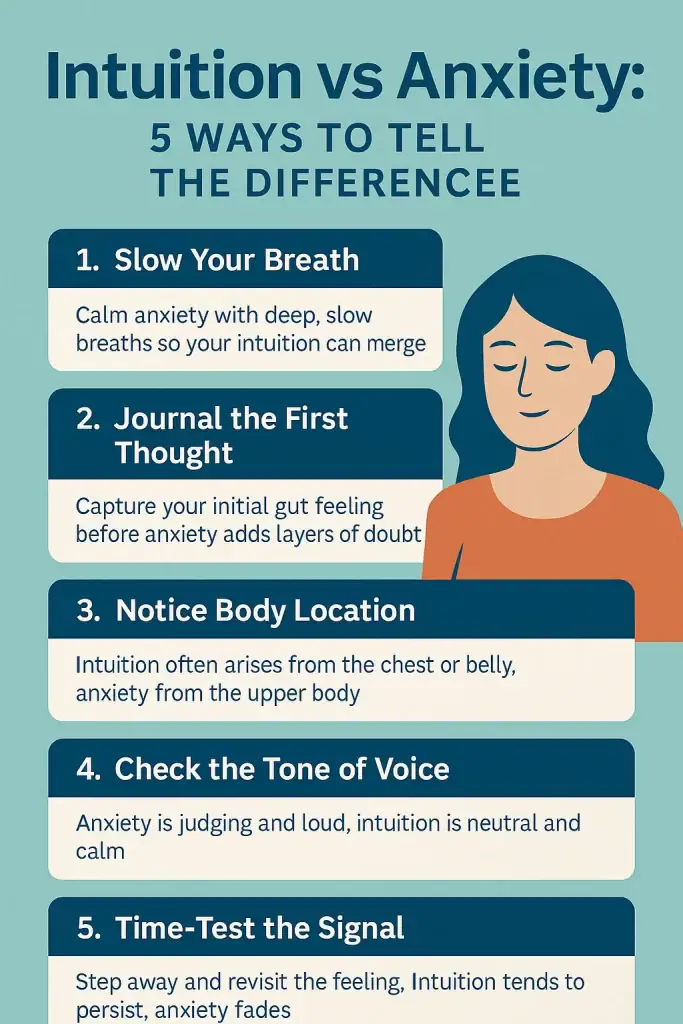
1. Slow the body first
If the body is activated, perception is distorted. One slow exhale is often enough to reduce noise.
2. Capture the first signal
What came first — before the mental story started? That first signal is usually closer to intuition.
3. Observe the pattern
If it repeats, grows, and multiplies — it’s anxiety. If it stays simple — it’s likely intuition.
4. Check time stability
Come back later. Intuition remains. Anxiety shifts.
5. Test with a small action
You don’t need to commit fully. Take one small step. Intuition strengthens with action. Anxiety often weakens.
Where Most People Get It Wrong
The mistake is not confusion. The mistake is overcorrection.
- Some people ignore intuition because it “feels emotional”
- Others follow anxiety because it “feels strong”
Both lead to the same outcome:
loss of internal accuracy
What Changes When You Get This Right
When you begin to separate intuition from anxiety, something subtle shifts:
- Decisions become faster — but not rushed
- Overthinking decreases without forcing it
- Confidence becomes quieter, but more stable
- You stop needing constant external validation
You don’t become fearless.
You become accurate.
Final Thought
Anxiety shouts because it wants control. Intuition whispers because it doesn’t need it.
The more you learn to hear the difference, the less you hesitate — and the more your decisions start to feel like they come from the same place every time.
Next time something speaks inside you — don’t just ask what it says. Ask how it feels.