Why can’t I start tasks, even when I know what needs to be done?
You may even want to do it.
Yet somehow, you do not start.
The task stays open. The day passes. The pressure grows. And what should have taken ten minutes becomes something you carry for days, weeks, or even months.
If you have ever thought, “I know what I need to do but I can’t start,” the problem may not be laziness. It may be task paralysis, decision fatigue, cognitive overload, emotional friction, or uncertainty blocking the transition from intention to action.
This is closely related to why decisions feel hard when your system is overloaded. The issue is not always that you do not care. Sometimes your brain is carrying too much noise to create a clean next move.
Why Can’t I Start Tasks Even When I Want To?
Most people treat starting as a motivation problem.
So when they cannot begin, they assume they need more discipline, more pressure, more accountability, or a better productivity system.
Sometimes those things help.
But often they miss the deeper issue.
Starting is not one simple skill. It depends on several internal systems working together: attention, decision-making, emotional regulation, energy availability, task clarity, uncertainty tolerance, and perceived risk.
When one of those systems is overloaded, starting can feel strangely difficult even when the task itself is simple.
Psychologists increasingly describe procrastination as more than poor time management. The American Psychological Association’s Speaking of Psychology episode on procrastination discusses how procrastination can involve emotion regulation rather than simple laziness.
Related Symptoms: When Starting Feels Hard
This article may be relevant if you recognize thoughts like:
- “I know what I should do, but I can’t make myself start.”
- “Why can’t I start tasks?”
- “I feel stuck and can’t start anything.”
- “Simple tasks feel overwhelming.”
- “I keep avoiding something even though it matters.”
- “I spend more time thinking about the task than doing it.”
- “I need to start, but my brain refuses.”
- “I feel frozen before action.”
These experiences often get labeled as procrastination. But procrastination is usually the visible behavior. The hidden cause may be much more specific.
Seven Hidden Reasons You Know What to Do but Can’t Start
1. Cognitive Overload
Cognitive overload happens when your mind is already processing too many inputs.
The task itself may not be hard. But your mental space is crowded with open loops, decisions, notifications, worries, plans, and unfinished commitments.
When your brain is overloaded, even a small task can feel like one more demand on an already full system. You may sit down to begin and immediately think of everything else you have not done.
This is not a character flaw. It is a capacity problem.
2. Decision Fatigue
Every task requires decisions.
Where should I begin? What order should I follow? How much effort is enough? What if I choose the wrong direction?
If your decision capacity is already depleted, the task can feel harder before you even touch it. This is why people often delay action while believing they are “just thinking about it.”
For a deeper practical framework, see Why Decisions Feel Hard.
3. Uncertainty
Many people are not avoiding action.
They are avoiding uncertainty.
If the outcome is unclear, the next step is vague, or the task contains too many possible directions, your brain may keep searching for certainty before allowing movement.
The problem is that certainty often arrives after action, not before it.
This is also where people can confuse useful inner signals with fear-based noise. If you are unsure whether a feeling is warning you or simply protecting you from uncertainty, read Intuition or Anxiety?.
4. Emotional Friction
Some tasks are not difficult because of what they require physically.
They are difficult because of what they activate emotionally.
A short email may carry fear of judgment. A simple phone call may carry conflict. A creative project may carry fear of failure. A financial task may carry shame, avoidance, or anxiety.
When a task contains emotional weight, avoidance can feel protective. The brain is not only avoiding work. It is trying to avoid discomfort.
5. Perfection Pressure
Perfectionism often disguises itself as responsibility.
You tell yourself the task matters, so you need to do it properly. You wait for the right moment, the right energy, the right plan, or the right level of confidence.
But the higher the standard for beginning, the harder beginning becomes.
Sometimes the solution is not to improve the plan. It is to lower the entry point.
6. Low Capacity
When your energy is low, the same task feels larger. A task that would take ten minutes on a clear day can feel impossible when you are depleted. This is why starting problems often increase during burnout, stress, poor sleep, or decision fatigue.
7. Too Many Open Loops
An open loop is anything unfinished that keeps occupying attention. When too many loops stay active, your brain has less available capacity for the next action. You are not starting from zero. You are starting while already mentally loaded.
Your Nervous System Decides Before Motivation Appears
Modern productivity culture teaches people to wait for motivation. But motivation is often downstream from nervous system state. When the body detects overload or instability, it shifts into protective patterns: avoidance, freezing, hyperanalysis, mental fog, task switching, doomscrolling, low initiation energy.
This is why people frequently confuse nervous system overload with laziness. But truly lazy people usually do not spend hours feeling guilty for not starting. Overloaded people do. The difference matters: lazy people rarely care this much about what they’re avoiding.
Signs this is overload rather than laziness include constant mental activity, difficulty relaxing, guilt while resting, emotional numbness, physical tension, brain fog, and starting many things without finishing them.
Is This Resistance a Signal, or Just Noise?
Not all resistance to starting means the same thing. Sometimes you’re not avoiding the task — you’re reacting to something about it: an unclear outcome, a hidden risk, a misalignment with your actual priorities, a doubt your mind hasn’t articulated yet. Forcing action doesn’t work here, because you’re trying to override a system that hasn’t resolved what it’s detecting.
But sometimes resistance really is just fatigue, habit, low energy, or lack of structure — and in those cases, starting usually reduces the friction rather than fighting it.
The simplest way to tell the difference: signal tends to persist, noise often fades once you begin. Before forcing action, ask what exactly feels difficult — the task itself, or something about the outcome — and whether the resistance stays if you step away and come back later.
Example: When Procrastination Is Really Visibility Pressure
Imagine someone delaying a presentation for two weeks.
They keep telling themselves they are procrastinating. They open the file, close it, check messages, reorganize notes, and promise to start later. At first, it looks like a motivation problem.
But after investigating the resistance, the real pattern becomes clearer: they are not avoiding the work. They are avoiding being seen. The presentation is connected to judgment, visibility, and the possibility of doing badly in front of others.
The solution changes immediately. More discipline is not the best first step. A smaller, safer entry point is better: open the presentation, write one rough slide, do not polish it, do not rehearse yet — just create movement.
The task did not become easy. But the doorway became smaller. And sometimes that is enough to begin.
Quick Self-Check: What Is Blocking Your Start?
Start Resistance Self-Check
Check what feels true right now:
- □ My mind feels full before I begin.
- □ I am unsure what the first step should be.
- □ I keep thinking about different ways to approach the task.
- □ The task feels emotionally uncomfortable.
- □ I feel too tired or depleted to begin.
- □ I want to do it properly, so starting badly feels wrong.
- □ The task feels bigger in my head than it probably is.
- □ I keep waiting for motivation, clarity, or the right moment.
If you checked three or more: your challenge may not be laziness. It may be resistance created by overload, uncertainty, emotional friction, low energy, or perfection pressure.
Next question: What would make the start smaller?
A Better Question Than “How Do I Force Myself?”
Most people ask:
How do I make myself start?
That question often leads to pressure.
A more useful question is:
What is preventing the start from happening naturally?
This question changes the problem.
Instead of attacking yourself, you investigate the system. You look for the point where movement is being blocked.
Is the task unclear? Is the next step too large? Are there too many choices? Is your energy low? Is the emotional cost higher than you admitted? Is perfection pressure making the entry point too heavy?
Once you identify the real source of resistance, the solution becomes more specific.
The 60-Second Start Test
Try this before building a bigger plan.
- Choose one task you have been avoiding.
- Define the smallest possible visible action.
- Set a timer for 60 seconds.
- Work only until the timer ends.
- Stop and notice what changed.
The goal is not to finish.
The goal is to create evidence that movement is possible.
Many people discover that resistance changes after movement begins. Not always. But often enough to matter.
Why Small Starts Work
Small starts work because they reduce the psychological size of the task.
Your brain may resist “finish the project.”
But it may tolerate “open the document.”
It may resist “clean the house.”
But it may tolerate “put away three items.”
It may resist “fix my finances.”
But it may tolerate “open the bank account page.”
The start does not need to be impressive. It needs to be possible.
When You Can’t Start, Reduce the Doorway
Many people try to increase force.
They push harder. Shame themselves. Create stricter rules. Add pressure. Promise dramatic change.
But if resistance is already high, pressure can make the task feel even heavier.
A better move is to reduce the doorway.
Make the first step so small that it almost feels too easy.
That is not weakness. It is strategy.
Want the Complete Workbook?
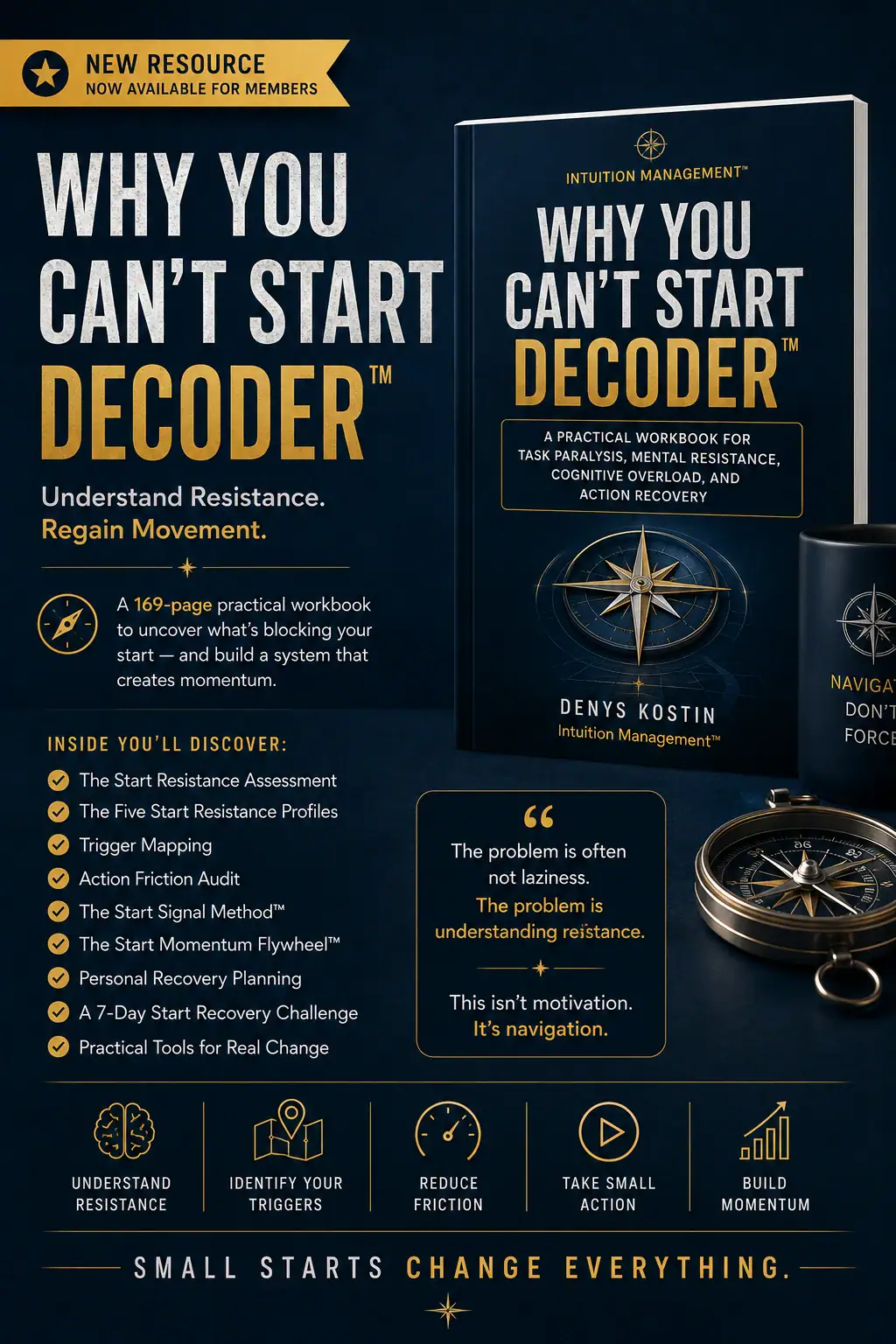
The complete Why You Can’t Start Decoder™ is a 169-page practical workbook designed to help you identify what is actually preventing action and build a personal system for movement.
Inside, you will find:
- The Start Resistance Assessment
- The Five Start Resistance Profiles
- Trigger Mapping
- Action Friction Audit
- The Start Resistance Cycle™
- The Start Signal Method™
- The Start Momentum Flywheel™
- Personal Recovery Planning
- A 7-Day Start Recovery Challenge
- Practical tools for rebuilding momentum
Access the workbook here: Why You Can’t Start Decoder™ on Patreon
All paid members receive access to the full resource library.
This isn’t motivation.
It’s navigation.
Related: Why Do I Freeze When I Need to Act?
Continue Your Intuition Management Journey
If this article describes your experience, the next step is not to judge yourself more harshly. The next step is to understand your signal more clearly.
- Why Decisions Feel Hard — understand decision fatigue and cognitive overload.
- Intuition or Anxiety? — learn whether a feeling is useful information or protective noise.
- The Personal Signal Decoder — explore how personal signals shape decisions.
- Your Intuition Journey — start from the central hub for decision clarity under uncertainty.
FAQ: Why You Can’t Start Tasks
Why can’t I start even when I want to?
You may be dealing with cognitive overload, decision fatigue, uncertainty, emotional friction, low energy, or perfection pressure. Wanting to act does not always mean your system has enough clarity and capacity to begin.
Is this procrastination or decision fatigue?
It may look like procrastination from the outside, but decision fatigue can be one of the hidden causes. If the task requires too many choices, your brain may delay action because decision capacity is already depleted.
What causes task paralysis?
Task paralysis often appears when a task feels too unclear, too large, too emotionally charged, too visible, or too risky. It can also appear when your nervous system is overloaded or your energy is low.
Can anxiety make it hard to start tasks?
Yes. Anxiety can make starting feel risky, especially when the task involves uncertainty, judgment, conflict, or possible mistakes. In that case, the resistance is not only about effort. It is also about perceived safety.
Why do simple tasks feel overwhelming?
Simple tasks can feel overwhelming when your mental load is already high. The task may be small, but the system trying to process it may be overloaded, tired, uncertain, or emotionally activated.
How do I start when I feel stuck?
Make the start smaller. Choose one visible action that can be completed in 60 seconds or less. The goal is not to finish the task. The goal is to create movement and gather evidence that starting is possible.