Intuitive leadership is the use of experience-based judgment to recognize patterns, notice emerging problems, and choose a direction before every detail is available. Used responsibly, it combines those first impressions with evidence, team input, and feedback. An intuitive judgment can be useful without being automatically correct.
A project dashboard says everything is on track, but your team’s answers become vague. A customer praises the service while quietly reducing engagement. You notice a mismatch before you can fully explain it. The leadership task is to turn that impression into a question you can investigate.

For managers, executives, and business owners, the practical question is: when should you act on your gut, and when should you slow down and check it? This guide explains the meaning, benefits, limitations, workplace examples, and a repeatable process for using intuition in leadership decisions.
In this guide
- What is intuitive leadership?
- Intuition vs. analytical decision-making
- When to trust your judgment
- Benefits and risks
- Intuitive leadership examples at work
- A five-step decision process
- How to develop leadership intuition
- Leading under pressure
- Making it work across a team
- Five questions before acting
- Frequently asked questions
What Is Intuitive Leadership?
Intuitive leadership describes how a leader uses an initial sense of what matters to guide attention and action. That impression may arrive as a concern, an opportunity, or a possible explanation before the leader can articulate every step behind it. It becomes responsible leadership when the leader checks the impression and remains willing to revise it.
It is a way of making judgments within leadership, rather than a substitute for strategy, management skills, or accountability. A collaborative, transformational, or results-focused leader can use both intuition and deliberate analysis.
Characteristics of an effective intuitive leader
- Observant: notices concrete changes in behavior, workflow, customer responses, or operating conditions.
- Specific: translates “something feels wrong” into a question about a particular risk or opportunity.
- Self-aware: recognizes that fatigue, preference, pressure, and emotion may influence an impression.
- Open to challenge: invites colleagues to offer a competing explanation.
- Accountable: explains the decision, names the uncertainty, and checks what happened afterward.
Intuitive Leadership vs. Analytical Decision-Making
Intuition and analysis can contribute to the same decision. Intuition can suggest where to look; analysis can test whether the concern holds up. Neither should receive automatic authority just because it feels convincing or appears in a spreadsheet.
| Approach | Useful contribution | Main check |
|---|---|---|
| Intuition | Identifies a possible pattern or mismatch. | Does relevant experience support this impression? |
| Analysis | Compares evidence, options, and consequences. | Are the data and assumptions appropriate? |
| Combined approach | Uses a hunch to focus investigation and evidence to shape action. | What would change the decision? |
In everyday speech, “gut instinct” often means intuition. More precisely, learned intuition is different from an innate instinct, a practiced habit, or a sudden insight. For those distinctions, see intuition vs. instinct vs. insight.
When Should Leaders Trust Their Intuition?
Kahneman and Klein’s research on intuitive expertise identifies two central conditions: an environment with learnable regularities and an opportunity to learn those regularities through experience and feedback. How confident a judgment feels is not a reliable measure of its accuracy.
For example, familiarity with one team’s delivery patterns may inform a concern about that team. It does not automatically qualify you to predict an unfamiliar market. Expertise has boundaries, and changed conditions can make old patterns less useful.
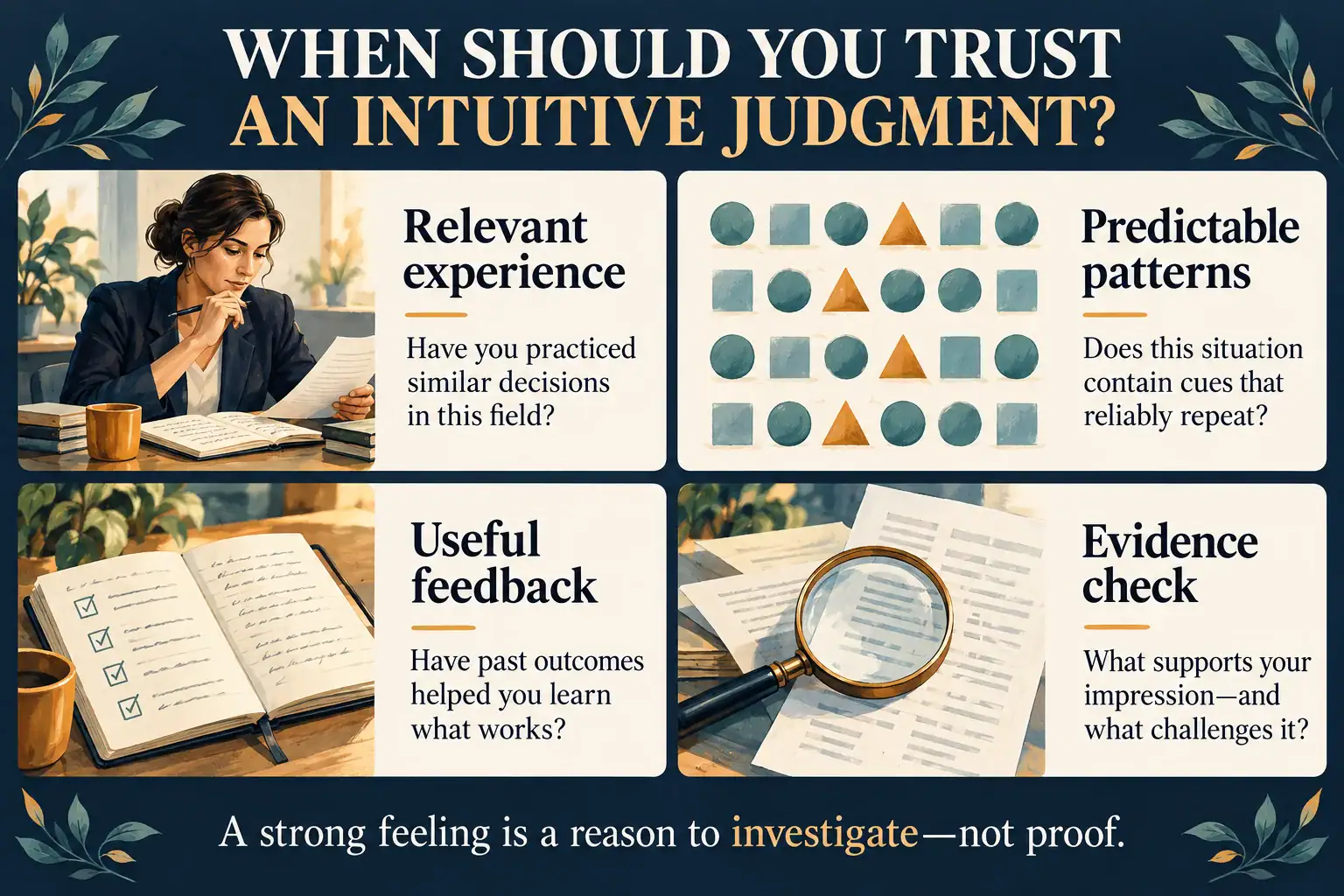
- Relevant experience: have you made similar decisions in this particular setting?
- Predictable patterns: are there recurring cues, or is the situation substantially new?
- Useful feedback: did you learn what happened after previous decisions, including mistakes?
- Evidence check: what observation supports the impression, and what might contradict it?
Calmness is not proof of accuracy, and urgency does not prove a judgment is wrong. Evaluate the basis of the judgment rather than trying to identify “true intuition” by its emotional tone. Explore intuition vs. bias for a closer look at that problem.
Benefits and Risks of Intuitive Leadership
The potential value is practical: noticing a question worth asking before it appears in a formal report. Benefits depend on what the leader does with the impression; intuition alone does not guarantee better performance.
- Earlier investigation: a mismatch in a customer conversation prompts a follow-up before the account review.
- Focused attention: an experienced manager identifies which dependency needs checking first.
- More useful team conversations: a leader asks about an observed change instead of assuming silence means agreement.
- New ideas to test: a product hunch becomes a small experiment with a defined success measure.
The corresponding risks are overconfidence, confirmation bias, misplaced trust in past success, and decisions that nobody can challenge. A leader who says “I just know” can unintentionally turn a personal impression into an organizational rule.
Avoid judging the decision process by a single outcome. A lucky result can follow weak reasoning, and a carefully considered decision can still turn out badly. Review the information available at the time as well as the eventual result.
Intuitive Leadership Examples at Work
The following examples are illustrative scenarios, not documented company case studies. They show how to move from an impression to a checkable decision.
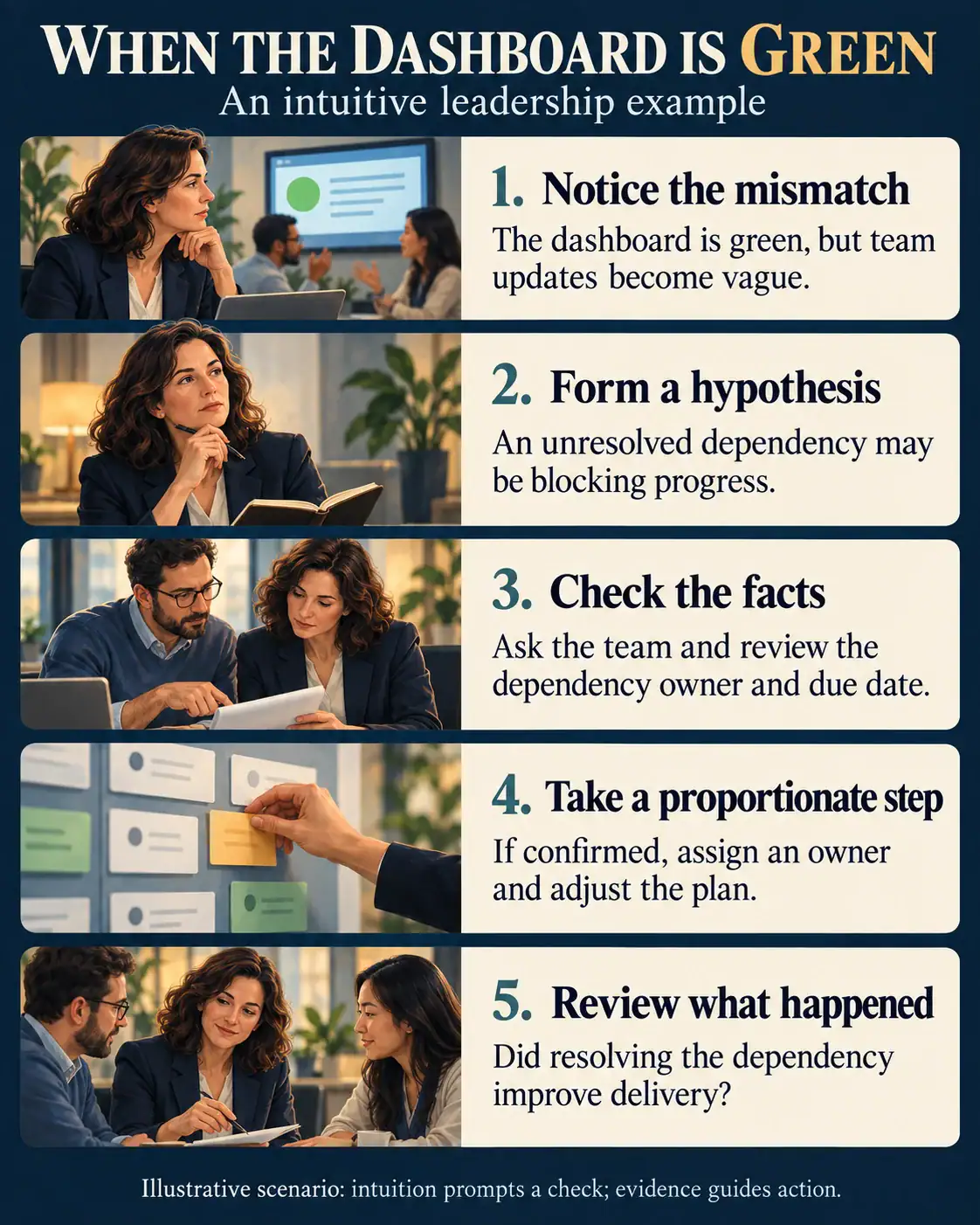
Example 1: A green project dashboard hides a dependency
A delivery leader sees an on-track status, but two team members give increasingly vague answers about a handoff. The leader suspects an unresolved dependency. Instead of accusing the team of hiding a delay, the leader asks who owns the handoff, what remains incomplete, and when the receiving team can accept it.
If the review confirms that ownership is missing, the leader assigns an owner, checks the impact on the schedule, and adjusts the plan. If the dependency is already resolved, the leader drops that hypothesis and asks what else could explain the vague updates. Either result is useful: the initial impression has been tested.
Example 2: A customer sounds satisfied but disengages
An account manager notices that a customer’s replies are shorter and previously active stakeholders miss meetings. The impression is that the relationship may be weakening. A useful next step is to ask about changing priorities and review engagement alongside service issues. Budget timing, staff changes, and satisfaction concerns are different explanations requiring different responses.
Example 3: A candidate feels like a strong fit
A hiring manager immediately likes a candidate. That feeling should not replace a consistent assessment of job-related skills. The U.S. Office of Personnel Management’s structured interview guidance uses predetermined questions and common rating standards across candidates. Use that structure to evaluate the evidence rather than treating personal rapport as proof of competence.
A Five-Step Intuitive Leadership Decision Process
Use this practical process when a hunch deserves attention but the appropriate response is not yet clear. It is a working checklist, not a validated diagnostic test.
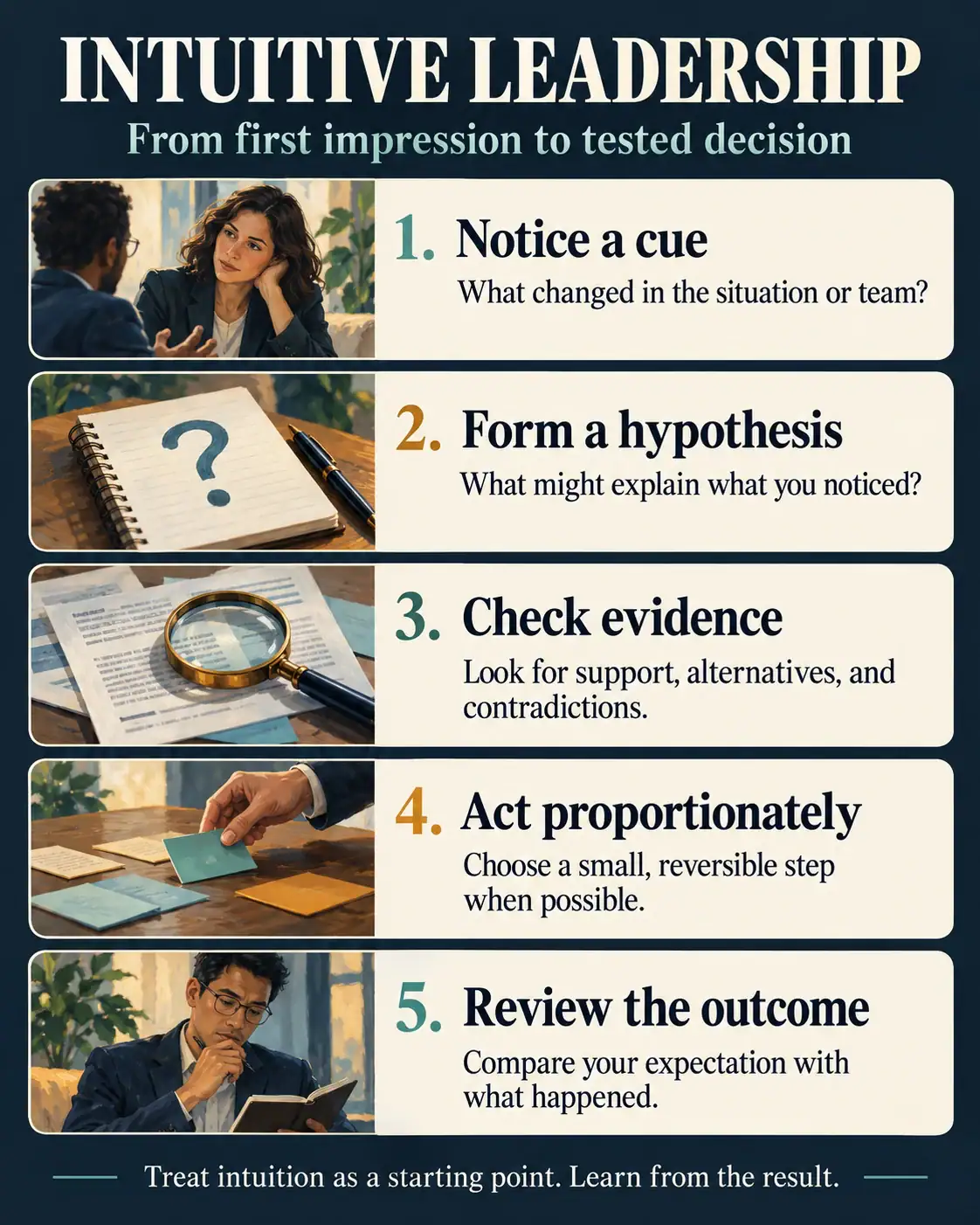
- Notice a cue. State what you observed: “The last two handoff updates did not include an owner.” Separate that observation from your interpretation.
- Form a hypothesis. Write a possible explanation: “Ownership may be unclear.” Add at least one alternative, such as an incomplete status template.
- Check evidence. Ask the relevant people, inspect the work, and look for contradictions. Decide what finding would change your mind.
- Act proportionately. Choose a small, reversible step when possible. Larger consequences require stronger justification, appropriate review, and clear accountability.
- Review the outcome. Compare the result with your prediction at an agreed time. Record what you learned and whether the original cue was useful.
A useful decision statement is: “I noticed X. My current explanation is Y. We will check Z, take this step if confirmed, and review the result on this date.” It lets you communicate a hunch without presenting it as a fact.
How to Develop Intuitive Leadership
Choose a narrow area of practice: delivery risks, customer conversations, or recurring operational problems. Record your impressions before you know the result, compare them with outcomes, and look for repeatable lessons. Counting both useful and misleading impressions is more informative than remembering only your successes.
Keep a short decision journal
- Observation: what exactly happened?
- Initial impression: what do I think it means?
- Alternative: what other explanation fits?
- Prediction: what observable result do I expect, and by when?
- Action and review: what did I do, what happened, and what should I change?
Keep entries brief enough to use during a working week. For a deeper practice plan, continue with how to develop intuition in leadership.
Use scenario rehearsal to expose assumptions
Imagine choosing each option and ask what must go right, what could fail, and which stakeholder could be affected. Notice your emotional response, then translate it into a question. Feeling comfortable with an imagined outcome does not validate the forecast.
Ask better questions in team meetings
- What changed since our last review?
- Which assumption is least supported?
- What are we treating as agreed when it is still unresolved?
- What evidence would lead us to choose a different option?
Ask for individual observations before stating your own view. Then compare explanations. This gives colleagues room to contribute information without simply agreeing with the person leading the meeting.
Can intuition reduce decision fatigue?
For recurring work, use agreed decision rules, delegation, and clear escalation thresholds to reduce repeated deliberation. Intuition may help you notice exceptions, but it should not become an expectation that leaders must personally sense every problem. A persistent overload problem deserves changes to workload and decision ownership, rather than another demand to “trust yourself.”
Intuitive Leadership Under Crisis and Pressure
Under pressure, separate the need to act quickly from the question of whether the situation is familiar. If trained responders recognize a known incident, established procedures can support timely action. If the event is unfamiliar, a compelling resemblance to a past crisis may be misleading.
Within the time available, ask: What do we know? What are we assuming? What must happen now? When will we reassess? Use incident procedures and escalation routes where applicable. Assign a person to monitor whether the working explanation still fits new information.
For example, during a service outage, a resemblance to a previous failure can guide which logs to inspect. It should not justify a risky production change without checking the current evidence and the relevant response procedure. Speed and verification need to be designed together.
Integrating Intuition into Organizations
Intuition isn’t only individual. It can exist at the system level when teams learn to notice early signals together — normalizing intuitive language, creating space for reflection before decisions, and rewarding insight rather than just output.
For the full approach to building this at the team and culture level, see The Intuitive Leader: How to Build a Culture That Trusts Inner Wisdom.
Five Questions Before Acting on Intuition
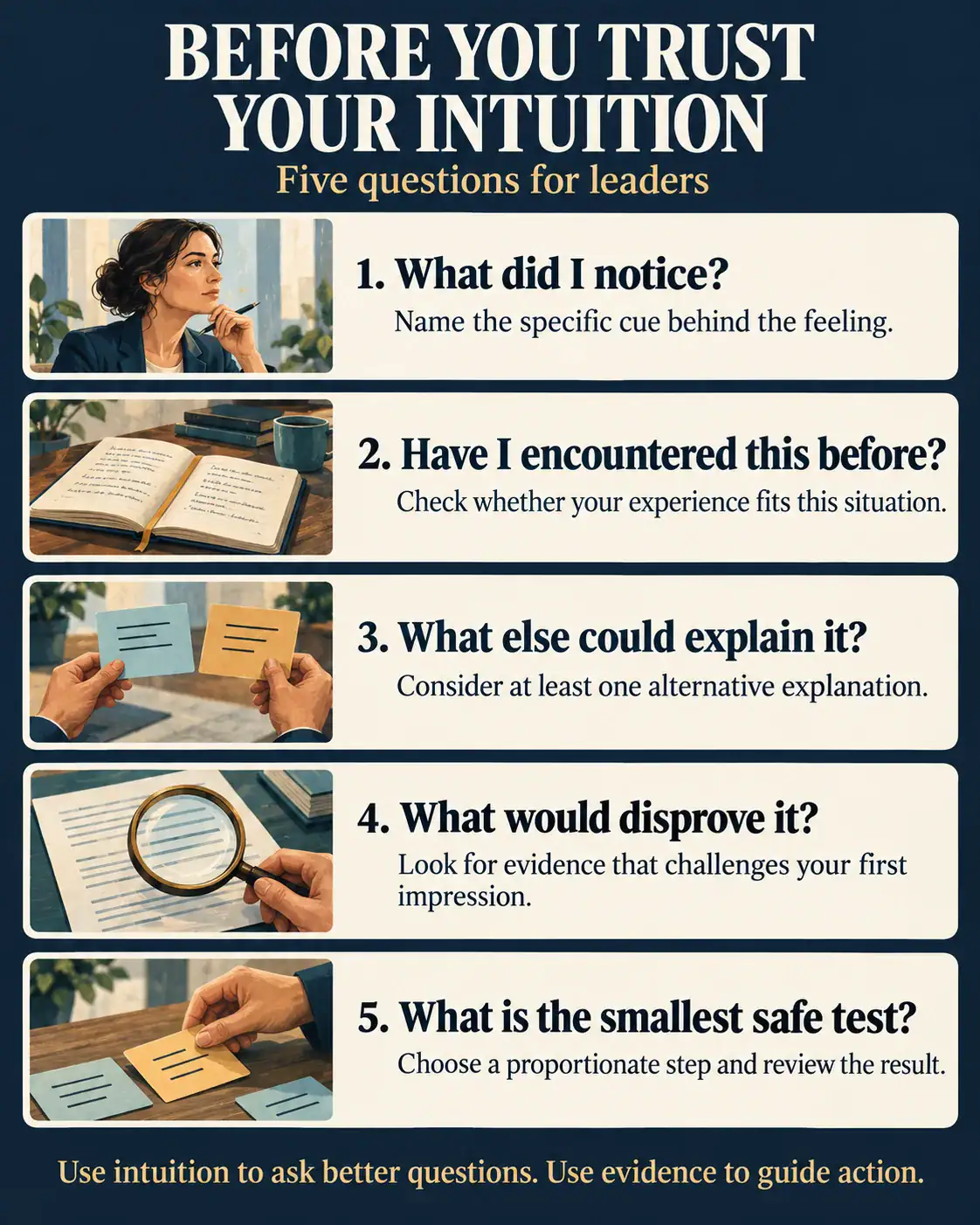
- What did I notice? Name the specific cue behind the feeling.
- Have I encountered this before? Check whether your experience fits this situation.
- What else could explain it? Consider at least one alternative explanation.
- What would disprove it? Look for evidence that challenges your first impression.
- What is the smallest safe test? Choose a proportionate step and review the result.
Frequently Asked Questions About Intuitive Leadership
What is an intuitive leader?
An intuitive leader uses initial impressions to notice possible patterns and guide attention. Effective practice includes checking evidence, inviting other perspectives, and revising a judgment when new information warrants it.
What is an example of intuitive leadership?
A manager notices that team updates have become vague despite a green project status. The manager investigates an unresolved dependency and adjusts the plan only if the evidence supports that explanation.
Is intuitive leadership better than analytical leadership?
There is no universally better approach. Intuition can raise a useful hypothesis; analysis can compare evidence and consequences. The balance should reflect the decision, the available time, and the consequences of being wrong.
Can intuitive leadership be learned?
You can practice observing cues, recording predictions, seeking feedback, and reviewing outcomes. Work within a defined area and track errors as carefully as successes. More confidence alone is not evidence of improvement.
How is intuition different from emotional intelligence?
Emotional intelligence concerns understanding and managing emotions. Intuition concerns a judgment that emerges without fully conscious step-by-step reasoning. They can interact, but sensitivity to emotion does not make every interpretation of another person accurate.
When should leaders avoid relying on gut feelings alone?
When the setting is unfamiliar, feedback is weak, assumptions have changed, or the consequences are difficult to reverse. Hiring, major commitments, and safety-sensitive decisions need appropriate evidence and review rather than an unexamined impression.
How can I explain an intuitive decision to stakeholders?
Describe the cue, your working explanation, the alternatives you considered, the evidence you checked, and the next review point. Be clear about what remains uncertain and who is accountable for the action.
Put Intuitive Leadership into Practice
Choose one current decision. Write the cue you noticed, your first explanation, one alternative, and the evidence that would change your mind. Then select a proportionate next step and a review date.
The goal is better judgment under uncertainty. Use intuition to ask better questions, evidence to guide action, and feedback to improve the next decision.
For broader exercises beyond the workplace, use this practical guide to developing intuition.