Intuition and health meet in the body’s quiet signals. Have you ever felt that something was “off” in your body before you could clearly explain why?
A quiet pressure in your chest. A heaviness in your stomach. A subtle sense that something needed attention.

This article does not suggest that intuition can diagnose illness. Medical testing, clinical judgment, and professional care matter. Health intuition is best understood as an early attention signal: a reason to observe, track, and seek appropriate help when needed.
These moments point to something deeply human: the connection between intuition and health. Not intuition as guesswork, but as pattern recognition happening below conscious awareness.
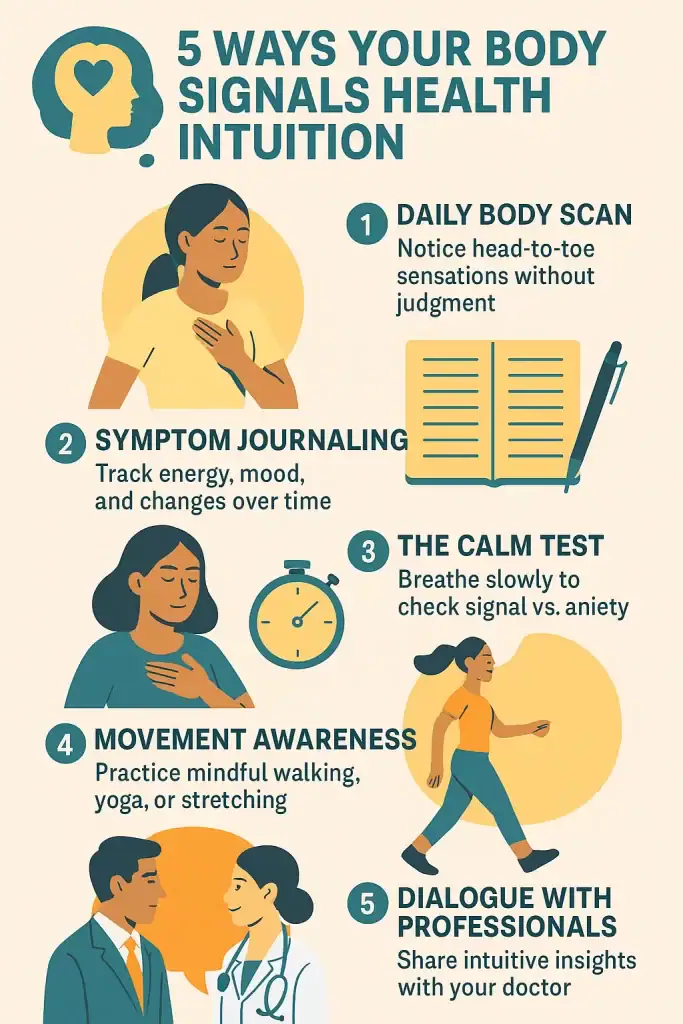
Modern medicine is built on data — and rightly so. But your body is not waiting for lab results to notice change. It is constantly sensing, scanning, and signaling.
Learning to notice those signals does not replace medical care. It makes you a more accurate participant in it.
This is where health intuition lives: not instead of science, but as a prompt for clearer attention, better tracking, and wiser follow-up.
What Health Intuition Actually Is
Health intuition is not mystical. It is the brain’s ability to integrate subtle internal signals, often before they become easy to explain.
This process is closely related to interoception: your brain’s capacity to read the internal state of your body.
Every moment, your system tracks changes in heart rhythm, breathing, muscle tension, digestion, energy, and stress response.
You do not consciously process most of this. But your nervous system does.
What you experience as a “gut feeling” is often a compressed output of thousands of micro-signals your mind has not verbalized yet.
For a broader explanation of this mechanism, read Somatic Intelligence in Leadership.
Why the Body Notices Before the Mind
The body does not wait for conclusions. It reacts to change immediately.
Before something becomes obvious to conscious thought, there may be shifts in energy, sleep, tension, appetite, stress response, or emotional tone.
Your conscious mind looks for clear evidence. Your body works with early signals.
This is why people sometimes feel that something deserves attention before they can explain it clearly. The important point is not to jump to conclusions. The important point is to listen, track, and verify.
When Health Intuition Is Useful
Useful health intuition tends to have a specific quality.
- Quiet — not dramatic.
- Consistent — not changing every hour.
- Specific — “something feels off here,” not everywhere.
- Calm but persistent — asking for attention, not panic.
It does not push fear. It signals attention.
In practical terms, this may lead you to rest earlier, track a symptom, notice a pattern, ask better questions, or seek professional support when something persists.
When It Is Not Intuition — But Noise
Not every body signal is reliable.
The same system that detects meaningful changes can also amplify stress, fear, fatigue, or habit patterns.
This is where many people confuse intuition with anxiety.
Fear-based signals tend to be loud and urgent. They become catastrophic, rapidly shifting, and tied to “what if” thinking.
Intuitive signals tend to be simple and stable. They are observational rather than dramatic.
A useful distinction: intuition points, fear narrates.
For a deeper comparison, see Gut Feeling or Anxiety?
The Signal vs Noise Problem in Health
Health intuition is not about feeling everything. It is about learning which signals matter.
This is a calibration problem.
Without calibration, you may ignore real signals or overreact to harmless ones.
With calibration, you notice patterns, detect deviation from your baseline, and respond proportionally.
This is why tracking matters. A signal becomes more useful when you can compare it with sleep, stress, food, medication changes, activity, and outcome.
How to Train Health Intuition
Health intuition improves the same way any pattern-recognition skill improves: through exposure and feedback.
1. Build a Baseline
You cannot detect “off” if you do not know what “normal” feels like.
Track your energy, sleep, stress, and recurring body sensations for one or two weeks. Patterns start to emerge quickly.
2. Reduce Noise Before Interpreting
Before interpreting a signal, take five slow breaths, relax the body, and let urgency drop.
If the signal becomes clearer and calmer, it may deserve attention. If it becomes louder or more chaotic, it is more likely anxiety or stress activation.
3. Track Signals Against Outcomes
Write down what you felt, where you felt it, what was happening in your life, and what happened later.
This is how intuition becomes calibrated, not guessed.
4. Contextualize Before Reacting
Always check context: sleep quality, caffeine intake, stress level, recent medication changes, food, hydration, and exercise.
Many body signals are context-driven, not illness-driven.
5. Use Intuition as a Trigger — Not a Conclusion
The role of intuition is not to diagnose.
Its role is to say: “Look here.”
Then you observe, document, and verify with appropriate medical support when needed.
The Right Relationship: Intuition and Health
The strongest position is not choosing between intuition and data.
It is sequencing them correctly:
- Intuition detects.
- Attention focuses.
- Tracking clarifies.
- Medical data verifies.
Ignoring intuition can delay awareness. Ignoring data can create risk.
Together, they support early awareness with grounded action.
A Simple 7-Day Calibration Reset for Intuition and Health
Use this short reset to become more precise without becoming anxious.
- Track baseline energy, mood, and body sensations.
- Do a daily body scan.
- Log one signal per day.
- Note context such as sleep, stress, food, caffeine, and hydration.
- Compare feeling vs outcome.
- Look for patterns.
- Adjust what you trust.
After one week, your perception usually becomes more specific. You begin to notice the difference between stress noise, baseline variation, and signals that deserve follow-up.
When to Seek Medical Advice
Health intuition should make you more attentive, not more isolated. If a signal is persistent, unusual, worsening, or concerning, it is wise to seek professional medical advice.
Do not use intuition to override medical care, delay evaluation, or self-diagnose serious conditions. Use it to notice early, describe clearly, and ask better questions.
A simple sentence can help: “I have noticed this pattern for several days, and I would like to understand whether it needs attention.”
Conclusion: Listening Without Overreacting
Your body is not silent. It is continuous feedback.
The question is not whether signals exist. The question is whether you can distinguish signal from noise.
Health intuition is not about replacing medicine. It is about becoming more accurate in where you direct attention, when you act, and how early you notice change.
When trained, it becomes something simple but powerful: early awareness without unnecessary fear.
Continue with What Intuition Feels Like, The Intuition Path, and Intuition Calibration.
Frequently Asked Questions about Intuition and Health
Can your body sense something before your mind understands it?
Yes, sometimes. Through interoception, the nervous system can detect subtle internal changes before you consciously understand them. But this does not mean intuition can diagnose illness.
Is health intuition reliable?
It can be useful as an attention signal, especially when it is calm, consistent, and specific. It becomes more reliable when paired with tracking, context, and medical verification.
How do I know if it is anxiety or intuition?
Intuition usually feels quieter and more stable. Anxiety often feels urgent, repetitive, and catastrophic.
Should I see a doctor if I feel something is wrong?
If a body signal is persistent, unusual, worsening, or concerning, it is wise to seek professional medical advice. Intuition should guide attention, not replace care.