You hear a sentence and immediately feel that something is unusual. You may be unable to name the grammatical rule, yet one wording sounds more natural than another. That gap between what you can do and what you can explain is a useful starting point for understanding implicit learning.
Implicit learning is the acquisition of patterns or regularities without full conscious awareness of the knowledge acquired. It can influence expectations and performance before a person can describe the underlying rule. However, difficulty explaining a judgment does not, by itself, prove that learning was unconscious.
This guide explains the meaning, examples, research methods, and practical limits of implicit learning—and how it can contribute to intuition.

What is implicit learning?
The important distinction is between learning something and knowing what you have learned. A person may become more sensitive to a sequence or relationship while having little accessible knowledge of its structure. “Implicit” describes that relationship to awareness; it does not mean mystical knowledge or learning without experience.
For example, you might concentrate on pressing the correct key when a symbol appears. If the symbols follow a recurring sequence, your responses may begin to anticipate it even though discovering a sequence was never your stated goal. Establishing whether that improvement reflects implicit learning requires additional testing.
Implicit learning overlaps with research on statistical learning, which investigates sensitivity to regularities such as which events tend to follow others. The terms are related, but statistical learning is not automatically unconscious. A review by Batterink, Paller, and Reber examines their relationship and underlying mechanisms. Read the research overview.
Implicit does not mean effortless
You can intentionally practice a task while remaining unaware of some patterns you acquire. Attention, repetition, task demands, and prior knowledge can still matter. The useful question is not “Was I trying?” but “What knowledge influenced my performance, and how aware was I of it?”
Implicit vs explicit learning
Explicit learning involves consciously learning facts, rules, or strategies. Implicit learning involves acquiring regularities without full awareness of the resulting knowledge. A language learner can study a rule explicitly while also becoming sensitive to common expressions through use.
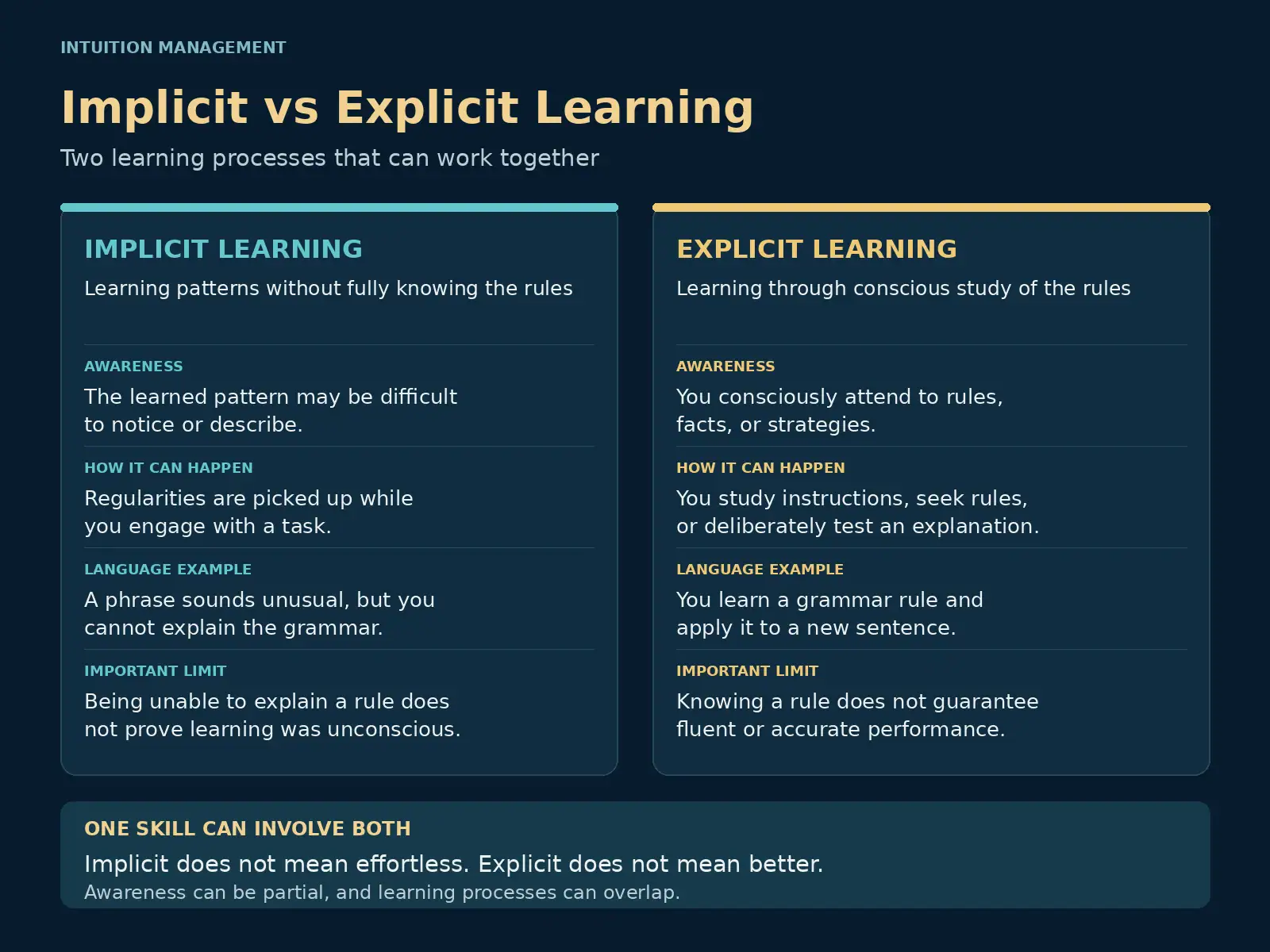
| Aspect | Implicit learning | Explicit learning |
|---|---|---|
| Awareness | Limited awareness of the acquired regularity. | Conscious attention to knowledge or a strategy. |
| Typical approach | Encounter patterns while engaging with a task. | Study, seek explanations, or deliberately test rules. |
| Possible expression | Performance changes before the rule can be fully reported. | The learner can describe at least part of what they are applying. |
| Language illustration | A phrase feels unusual without a clear grammatical explanation. | A learned grammar rule guides a correction. |
| Limitation | Unreported knowledge is not necessarily unconscious. | Stating a rule does not guarantee skilled performance. |
Neither process is universally superior. For a new procedure, clear instructions may be indispensable. With practice, aspects of performance may become easier to execute. But automatic performance alone does not tell you whether the original learning was implicit or explicit.
Five examples of implicit learning
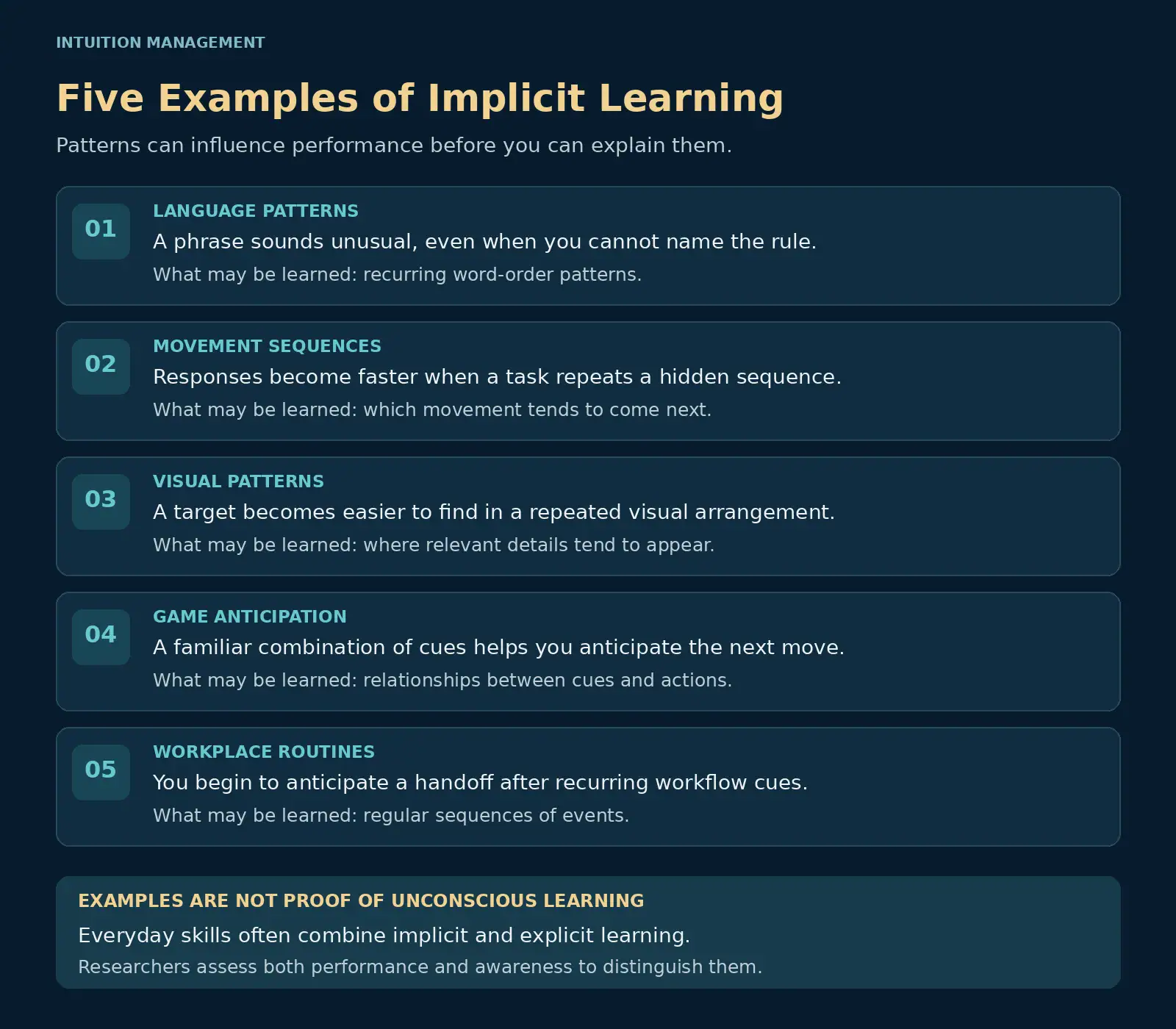
The examples below combine laboratory task types with everyday illustrations. Everyday skills commonly involve a mixture of learning processes.
1. Language patterns
A familiar word order may sound natural even when you cannot explain the relevant grammar. This illustrates how performance can exceed verbal explanation. Natural language learning also involves instruction, meaning, social interaction, and conscious noticing; it should not be reduced to an entirely unconscious process.
2. Movement sequences
In sequence-learning tasks, participants respond to a series of signals. Researchers compare performance when the sequence follows a pattern and when it changes. Faster responses to predictable sequences can indicate learning, while separate measures investigate awareness. Work by Esser and colleagues also examines how explicit knowledge can emerge during sequence learning. See the study.
3. Visual patterns
People may find a target faster when a visual arrangement repeats. This effect, called contextual cueing, is often discussed in implicit-learning research. However, its unconscious interpretation is disputed: a reanalysis of 20 studies questioned whether the evidence established an advantage beyond explicit recognition. Learning a layout and learning it unconsciously are different claims. Read the reanalysis.
4. Game anticipation
A player may anticipate a move from a familiar combination of cues before explaining the judgment. Remembered strategies, deliberate analysis, and learned expectations may all contribute. A useful follow-up is whether the prediction remains accurate against unfamiliar opponents.
5. Workplace routines
A colleague begins to anticipate a delayed handoff after repeatedly encountering a particular combination of workflow signals. Their expectation may partly reflect learned regularities they cannot yet describe. The worked example below shows how to investigate that expectation.
How researchers study implicit learning
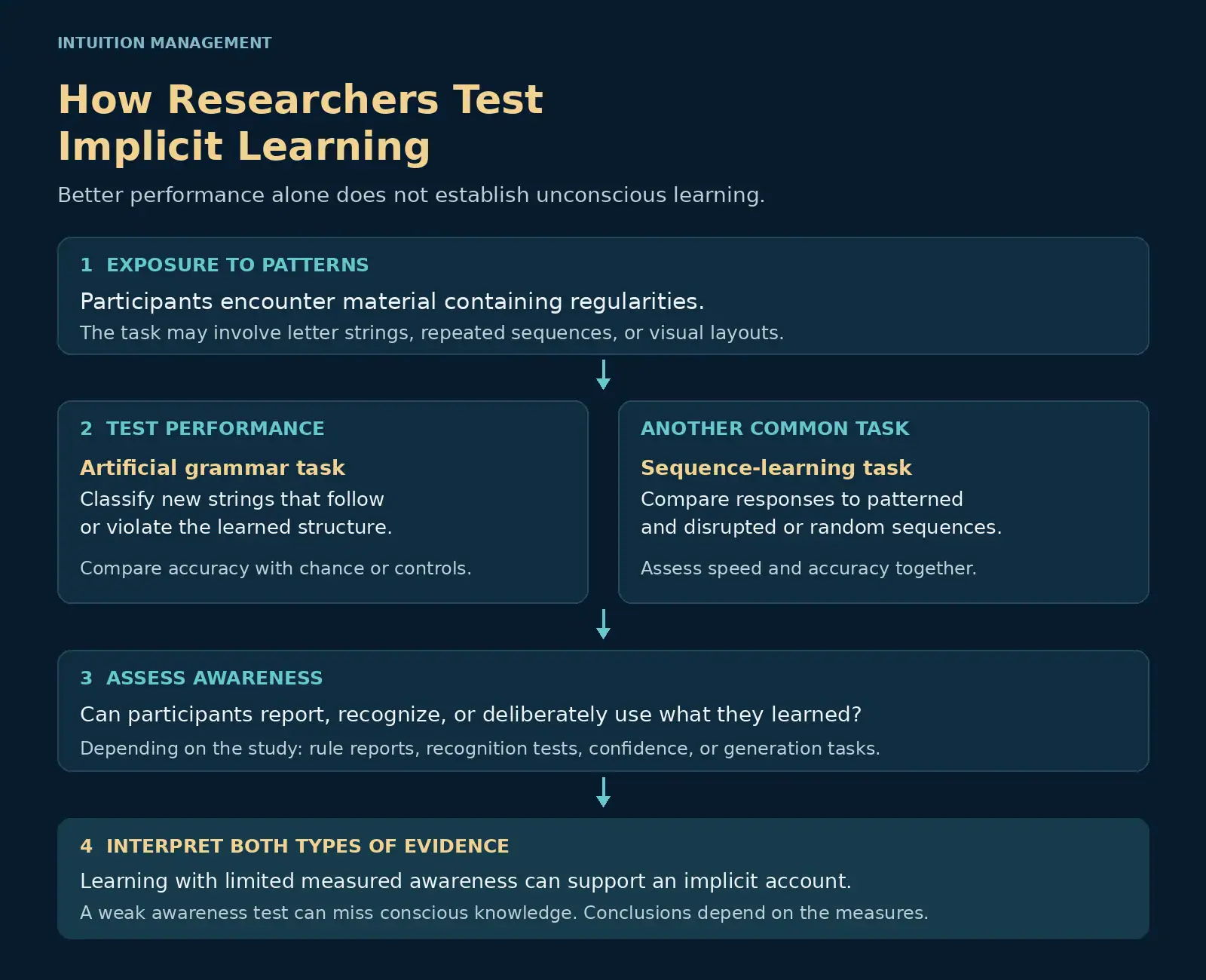
Researchers must answer two questions: Did learning occur? And what did the participant consciously know? These questions require different evidence.
Artificial grammar learning
Participants encounter strings constructed according to a rule system. Later, they classify unfamiliar strings that follow or violate that system. Above-chance classification can show learning, but it does not establish exactly what was acquired. Participants might use fragments, familiarity, partially explicit rules, or a combination. Artificial grammar research has examined these competing explanations. See research on structural selection.
Sequence learning and awareness checks
Sequence tasks examine changes in response speed and accuracy. Awareness assessments may ask people to report a rule, recognize a sequence, generate expected responses, or rate their confidence. The relevant tests depend on the study and must be sensitive enough to detect partial knowledge.
A weak awareness test can miss conscious knowledge. Conversely, asking someone to search for a rule can change what they notice. Good interpretation therefore considers the tasks, measurement sensitivity, timing, and alternative explanations—not just a participant saying, “I was guessing.”
How implicit learning contributes to intuition
Implicit learning can help build expectations that later contribute to fast judgments. A recurring situation may feel familiar, or a deviation may attract attention, before the person reconstructs the reason. That is a possible link between learning history and intuitive processing.

Patterson and colleagues investigated this connection using sequences of objects in a simulated environment. They reported learning that supported intuitive decisions within their experimental task. Transfer depended on presentation conditions: it was not equally successful in both directions. This supports studying implicit learning as a contributor to intuition, without establishing universal transfer to everyday decisions. Read the experiment’s abstract.
A worked example: anticipating a delayed handoff
Illustrative scenario: a delivery lead has repeatedly seen a similar combination before a missed handoff: an unnamed owner, an unconfirmed prerequisite, and a date described as “probably Friday.” This time, the lead senses a risk before consciously listing those cues.
| Step | What the lead does |
|---|---|
| Notice | Records the three observable cues without labeling the team unreliable. |
| Predict | Writes: “The handoff may miss Friday if the prerequisite remains unresolved.” |
| Verify | Asks for a named owner, evidence that the prerequisite is complete, and the basis for Friday’s date. |
| Act | Finds that the prerequisite is genuinely blocked and helps assign an owner and a recovery action. |
| Review | Records that the handoff eventually occurred on Monday, along with the blocker and the intervention. |
The outcome is consistent with the concern, but one example cannot establish reliable skill or unconscious learning. The intervention also changed the situation, so the lead should record it rather than treat the outcome as an untouched test. Across future cases, track both delays and on-time handoffs to see whether these cues are useful.
If the prerequisite had already been completed and only the report was stale, the same check would have challenged the hunch. The practical benefit is better-directed investigation, not automatic trust in the feeling.
For the broader conditions that make experience dependable, see expert intuition. For how experienced people recognize situations and evaluate a plausible response, see recognition-primed decision-making. Neither concept is synonymous with implicit learning.
Implicit learning, implicit memory, and tacit knowledge
These terms describe related aspects of experience rather than four mutually exclusive compartments. The following distinctions are practical; usage varies across disciplines.

| Concept | Main question | Meaning |
|---|---|---|
| Implicit learning | How was the pattern acquired? | Regularities are learned without full awareness of the acquired knowledge. |
| Explicit learning | How was knowledge acquired? | Facts, rules, or strategies are consciously learned. |
| Implicit memory | How does earlier experience affect performance? | Its effects appear without requiring conscious recollection of the earlier event. |
| Tacit knowledge | How easily can know-how be explained? | Knowledge is expressed through competent action more readily than a complete verbal account. |
For example, earlier exposure may make a word easier to complete without deliberately recalling the encounter—a common illustration of implicit memory. That differs from acquiring a recurring relationship across many events. Schacter discusses priming and implicit memory in his research perspective on memory.
Tacit know-how may develop through a mixture of instruction, practice, and implicit learning. A craftsperson can consciously learn safety rules while gradually acquiring fine control that is harder to describe. Our guide to tacit knowledge in decision-making develops the knowledge and transfer side of this distinction.
Implicit learning vs incidental learning
Incidental learning concerns intention: learning something when that was not the main goal. Implicit learning concerns awareness of the resulting knowledge. You can unintentionally learn a fact and then consciously recall it, so incidental learning need not be implicit.
When learned patterns become misleading
Learning a relationship does not make it dependable. The following practical limitations apply to learned judgments whether acquisition was implicit, explicit, or mixed.

- Misleading correlations: events can recur together without a stable relationship. Check whether the association holds in new cases.
- Unrepresentative experience: your examples may omit failures, unusual situations, or less memorable outcomes. Ask what is missing.
- Changing conditions: a new process, technology, or incentive can undermine a once-useful expectation. Check whether the same cues still predict the same result.
- Limited transfer: familiarity with one task does not establish skill in another. Test the pattern in the setting where you intend to use it.
In the workplace example, an incomplete update might historically have preceded delays. After a reporting-system change, the same appearance might simply reflect slower synchronization. The cue looks familiar, but its meaning has changed. Checking the underlying work is more informative than defending the initial feeling.
How to support useful pattern learning
You cannot reliably command a particular lesson to remain unconscious. You can, however, design practice that makes useful regularities easier to encounter and performance easier to evaluate. Use the following suggestions to structure practice and assess progress.
- Choose a specific task. “Anticipate delayed handoffs in this workflow” is more testable than “become more intuitive.”
- Use varied, relevant examples. Include ordinary cases, exceptions, and near misses so one memorable story does not stand in for the whole task.
- Make predictions before outcomes are visible. Write down what you expect and why. This adds deliberate checking; the goal is useful learning, not keeping everything implicit.
- Compare predictions with outcomes. Record misses as well as hits and distinguish a good judgment from a lucky result.
- Test on unfamiliar cases. Repeating a practiced example can demonstrate familiarity without showing transfer.
- Combine experience with explanation. Use instructions, coaching, and explicit checks when they help. There is no need to choose only one learning process.
For a broader practice routine, continue with how to train your intuition. Keep the task and feedback concrete enough that improvement can be observed.
Try a short pattern-recognition activity
This original activity illustrates sensitivity to regularities. It is not a diagnostic test of implicit learning, and a few answers cannot measure your intuition.
First, look at these examples:
ABBA ACCA ADDA AEEA
Now decide which of these new strings follow the same pattern. Record your answers before revealing the explanation:
AFFA ABCA AGGA AHHB
Also note whether your answer came from a rule you could state, a sense of familiarity, or uncertainty.
Show the answer and explanation
AFFA and AGGA fit the intended pattern: the first and last letters are A, and the two middle letters match. ABCA has different middle letters; AHHB ends with B.
You may have consciously noticed the rule immediately. You may have used similarity to the examples. Either can produce correct answers. This small activity cannot separate those explanations or establish unconscious learning. Its purpose is to make the difference between performance and an explanation of performance easier to discuss.
Frequently asked questions
What is a simple example of implicit learning?
Becoming faster at responding to a hidden repeating sequence without full awareness of its structure is a common research example. Researchers still need awareness checks to determine what the participant consciously knows.
Is implicit learning the same as intuition?
No. Implicit learning describes acquisition of knowledge; intuition describes a form of judgment or experience. Implicitly learned patterns can contribute to intuition alongside other influences.
Does implicit learning require no attention?
No. A person may pay close attention to a task while remaining unaware of some regularities acquired during it. Attention and awareness of a rule are different questions.
Can implicit knowledge become explicit?
People may later notice or articulate aspects of a pattern that previously influenced performance without a clear explanation. That does not mean every element becomes verbalizable or that all learning follows the same progression.
Is implicit learning better than explicit learning?
There is no universal winner. The useful combination depends on the task, instruction, experience, and what successful performance requires. Neither unconscious acquisition nor conscious understanding guarantees accuracy.
Can a quick online activity measure implicit learning?
A short demonstration can introduce the idea, but establishing implicit learning requires suitable comparison conditions and sensitive awareness measures. A score alone cannot show how the answers were produced.
Use familiarity as a starting point for investigation. Ask what pattern you may have learned, whether it applies here, and what evidence would change your mind.
Research references
- Batterink, L. J., Paller, K. A., & Reber, P. J. (2019). Understanding the Neural Bases of Implicit and Statistical Learning. Topics in Cognitive Science.
- Van den Bos, E., & Poletiek, F. H. (2010; online 2009). Structural selection in implicit learning of artificial grammars. Psychological Research.
- Esser, S., Lustig, C., & Haider, H. (2022; online 2021). What triggers explicit awareness in implicit sequence learning? Implications from theories of consciousness. Psychological Research.
- Meyen, S., Vadillo, M. A., von Luxburg, U., & Franz, V. H. (2024; online 2023). No evidence for contextual cueing beyond explicit recognition. Psychonomic Bulletin & Review.
- Patterson, R. E., and colleagues (2013). Training intuitive decision making in a simulated real-world environment. Human Factors.
- Schacter, D. L. (2019; online 2018). Implicit Memory, Constructive Memory, and Imagining the Future: A Career Perspective. Perspectives on Psychological Science.