Intuitive thinking skills are seven abilities that improve fast judgment: pattern recognition, cue discrimination, context integration, uncertainty tolerance, metacognitive awareness, calibration, and intuition–analysis switching. Strong intuition is therefore not simply a matter of “trusting your gut.” It depends on what you have learned, whether the environment contains learnable patterns, whether you receive valid feedback, and how well you separate confidence from accuracy.
This guide breaks intuitive thinking into seven trainable skills and shows how they work together. The goal is not to make every decision intuitive. It is to make your fast judgments more discriminating, calibrated, and useful—and to recognize when intuition has reached its limits.
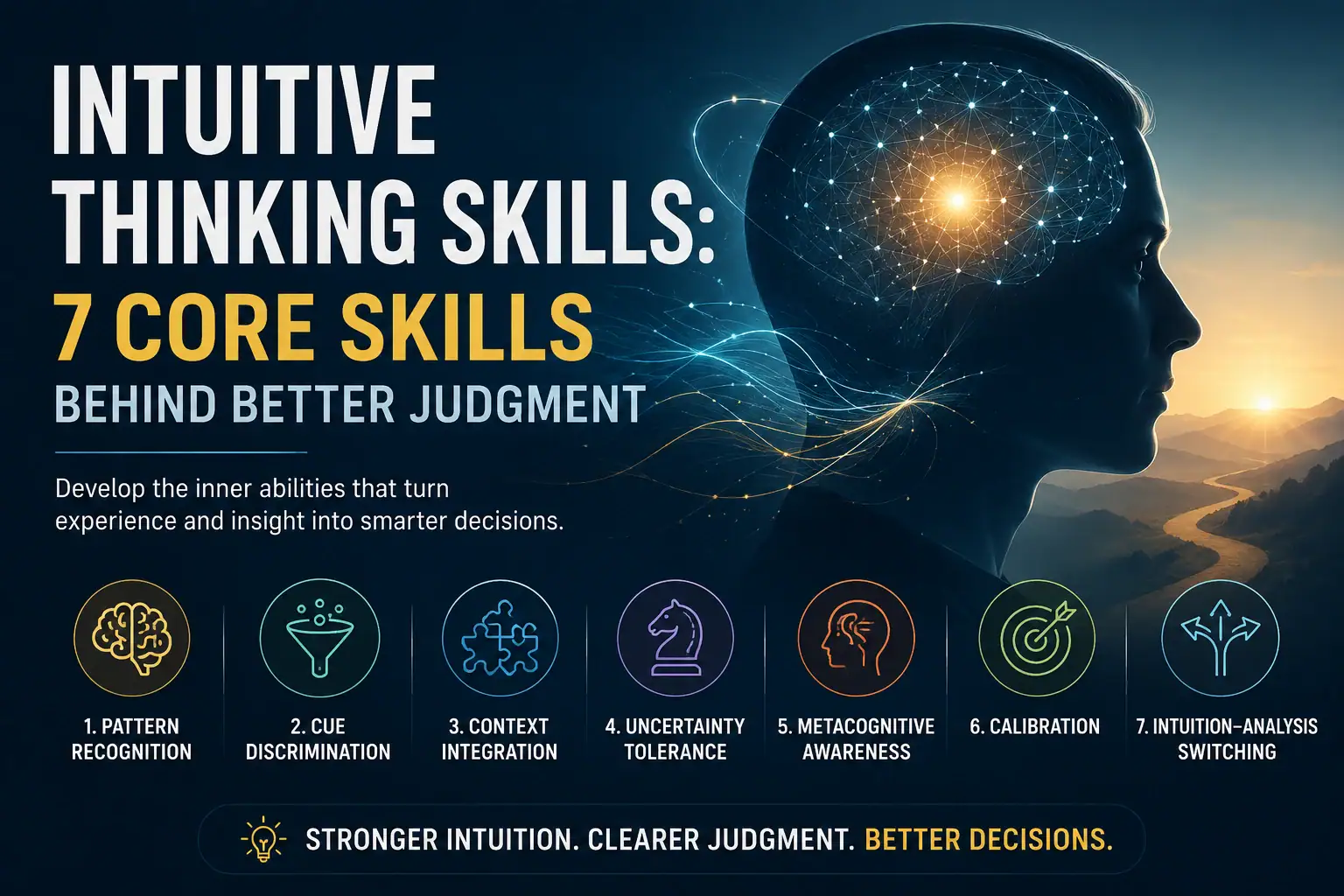
What Are Intuitive Thinking Skills?
Intuitive thinking is a fast form of judgment in which relevant information can influence a decision before every step of the reasoning is consciously articulated. Intuitive thinking skills are the capacities that make this process more useful: noticing diagnostic patterns, filtering noise, combining context, monitoring uncertainty, and learning from feedback.
That distinction matters. A person can prefer intuitive thinking without being particularly accurate, just as an analytical person can still develop strong domain-specific intuition. If you want the broader cognitive explanation first, see how intuitive thinking works.
Intuitive thinking skill is not the strength of a feeling. It is the quality of the process that produced the feeling—and the quality of the feedback that shaped it.
In This Guide
- The 7 core intuitive thinking skills
- Intuitive thinking skills vs. intuitive thinking style
- Intuitive thinking skills vs. cognitive biases
- How intuitive expertise develops
- Novice intuition vs. expert intuition
- Can intuitive thinking skills be learned?
- A practical calibration exercise
- When not to trust intuitive thinking
- The Intuitive Skill Calibration Check
- Frequently asked questions
The 7 Core Intuitive Thinking Skills
The seven skills below are best understood as a system. Pattern recognition gives you candidate meaning; cue discrimination reduces noise; context integration builds a coherent picture; uncertainty tolerance prevents premature certainty; metacognitive awareness helps you inspect the judgment; calibration improves future accuracy; and intuition–analysis switching determines how much deliberate reasoning the situation deserves.
The 7 Skills at a Glance
| Intuitive thinking skill | What it does |
|---|---|
| Pattern recognition | Detects recurring configurations based on relevant experience. |
| Cue discrimination | Separates meaningful signals from salient but irrelevant noise. |
| Context integration | Combines multiple signals, constraints, goals, and situational factors into a coherent picture. |
| Uncertainty tolerance | Allows provisional judgment without pretending ambiguity has disappeared. |
| Metacognitive awareness | Separates observation, interpretation, confidence, and decision. |
| Calibration | Matches confidence to actual accuracy through prediction, outcome, and feedback. |
| Intuition–analysis switching | Determines when fast judgment is sufficient and when deliberate reasoning should verify it. |
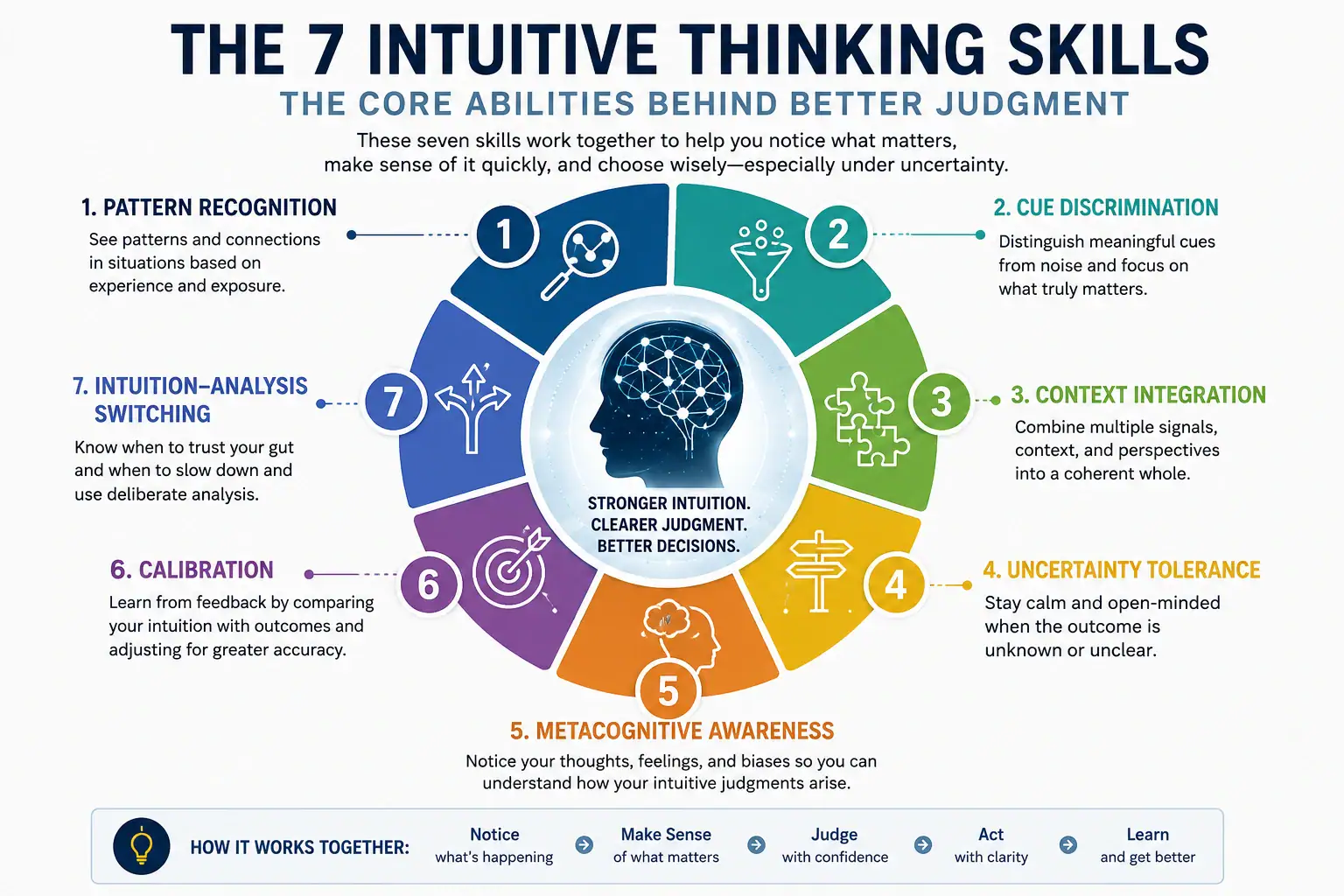
1. Pattern Recognition
Pattern recognition is the ability to detect familiar configurations across many separate details. Experienced people often do not consciously compare every available option. They notice that a situation resembles something they have encountered before and rapidly retrieve expectations, warnings, or possible actions associated with that pattern.
This idea is central to research on expert decision-making. Recognition-primed decision models describe how experienced decision-makers can use pattern matching to generate workable responses in complex, time-pressured situations. But expert intuition is domain-specific and conditional: the environment must contain sufficiently stable, learnable regularities, and the decision-maker must receive feedback capable of correcting mistakes. Repeated exposure to misleading, random, or poorly observed outcomes can create familiarity and confidence without genuine predictive skill.
That is why Intuition Management treats intuition as pattern recognition under uncertainty, not as a mysterious signal that bypasses learning.
2. Cue Discrimination
Good intuitive thinkers do not merely notice more. They become better at deciding which cues deserve attention. A loud cue is not necessarily a useful cue. Emotionally striking information can be memorable while carrying little predictive value; quiet recurring details can matter much more.
Cue discrimination means asking whether a signal is relevant, reliable, repeated, and consistent with the wider context. It also means remaining open to disconfirming information. The purpose is not to eliminate subjective signals, including bodily sensations, but to avoid treating the presence of a strong sensation as proof that its interpretation is correct.
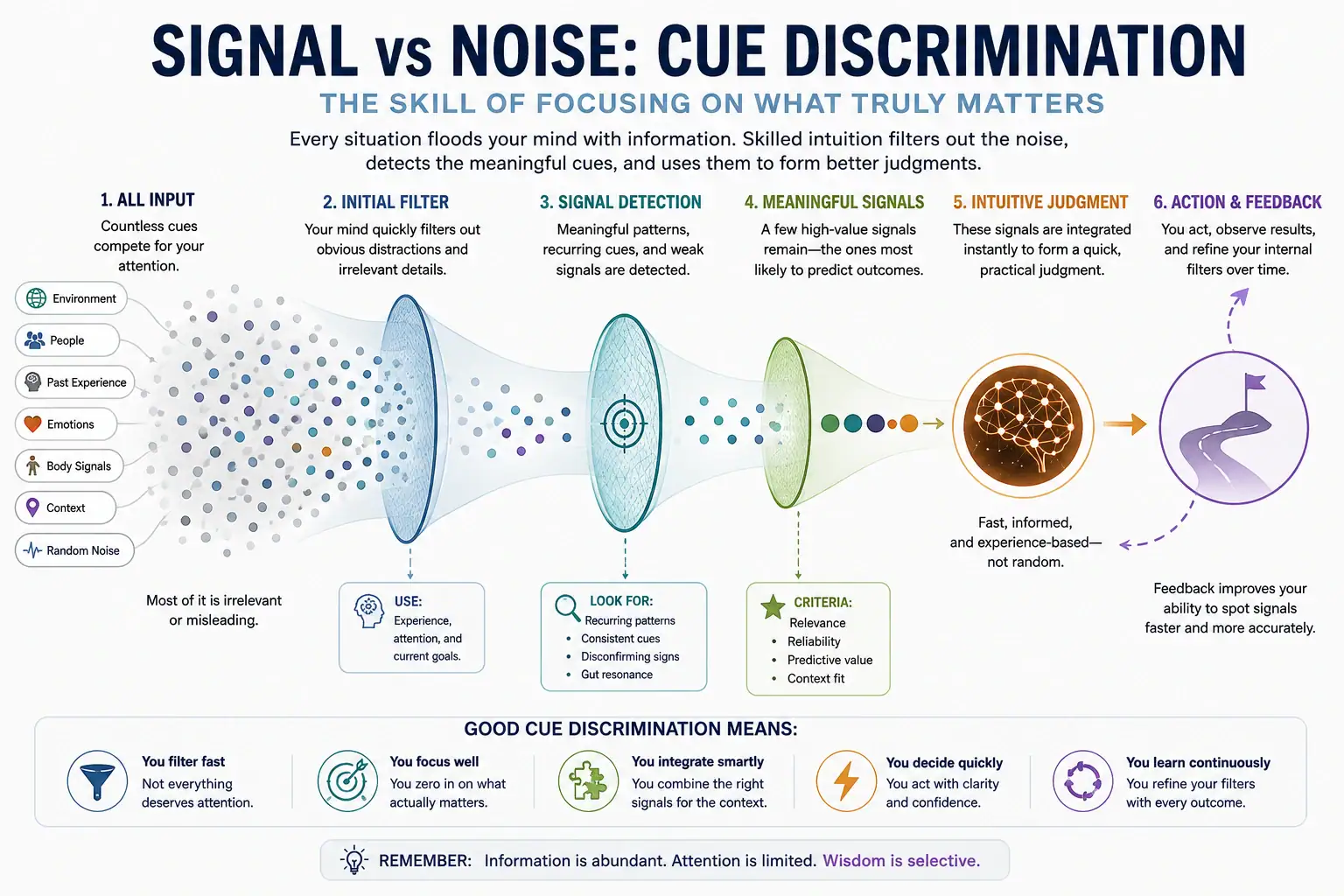
A useful companion concept is signal vs. noise: the challenge is not just gathering information, but identifying which information changes the judgment.
3. Context Integration
Sophisticated intuition rarely comes from one isolated cue. The mind combines current conditions, prior experience, behavior, goals, constraints, timing, and environmental information into an internal representation of what is happening. A judgment can then arise from whether that representation matches—or fails to match—known patterns.
This is why the same cue can mean different things in different situations. Silence in a meeting may indicate disagreement, concentration, uncertainty, fatigue, or nothing important at all. Context determines which interpretation deserves weight.
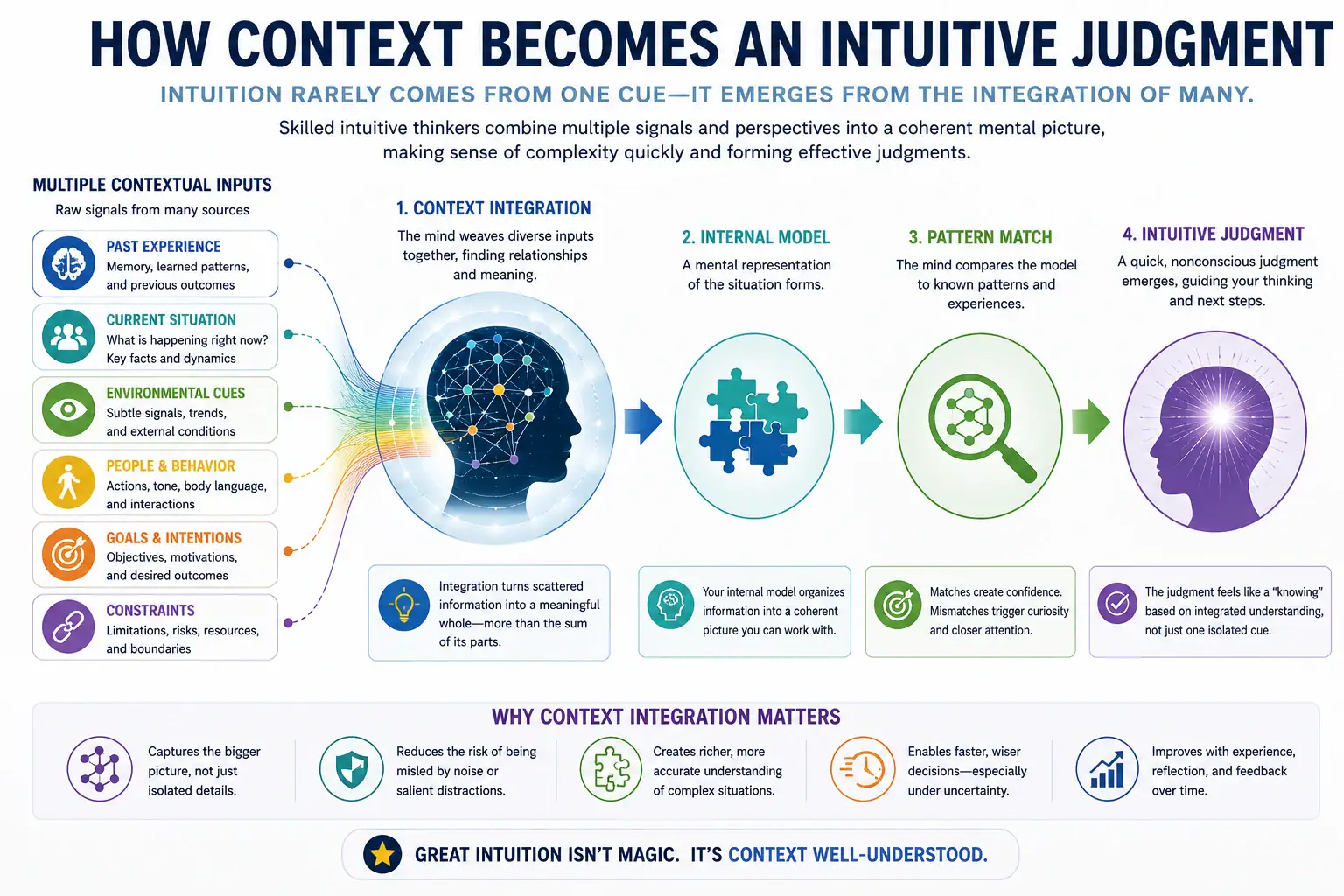
The result is an internal model of reality: a working representation rather than a perfect copy of the world. Better intuitive judgment depends partly on keeping that model responsive to evidence instead of forcing new situations into old assumptions.
4. Uncertainty Tolerance
Intuitive judgment often matters precisely when complete certainty is unavailable. Uncertainty tolerance is the ability to hold a provisional conclusion without converting it into false certainty. You can think, “This pattern concerns me,” while still recognizing, “I may be wrong, and I need more evidence before making an irreversible choice.”
This skill reduces two opposite errors: freezing until certainty becomes impossible, and rushing into certainty because ambiguity feels uncomfortable. When everything feels uncertain, the goal is not to eliminate uncertainty but to decide what level of uncertainty the decision can tolerate.
5. Metacognitive Awareness
Metacognition is thinking about your own thinking. In intuitive judgment, it means noticing the difference between a raw signal, what you attended to, the interpretation you created, how confident you feel, and what you ultimately decide.
That separation is crucial because confidence and accuracy can diverge. Contemporary research on metacognition treats confidence as an inference about one’s own performance, and those self-evaluations can be more or less accurate. In practical terms, “I feel certain” and “I have strong evidence” are different statements.
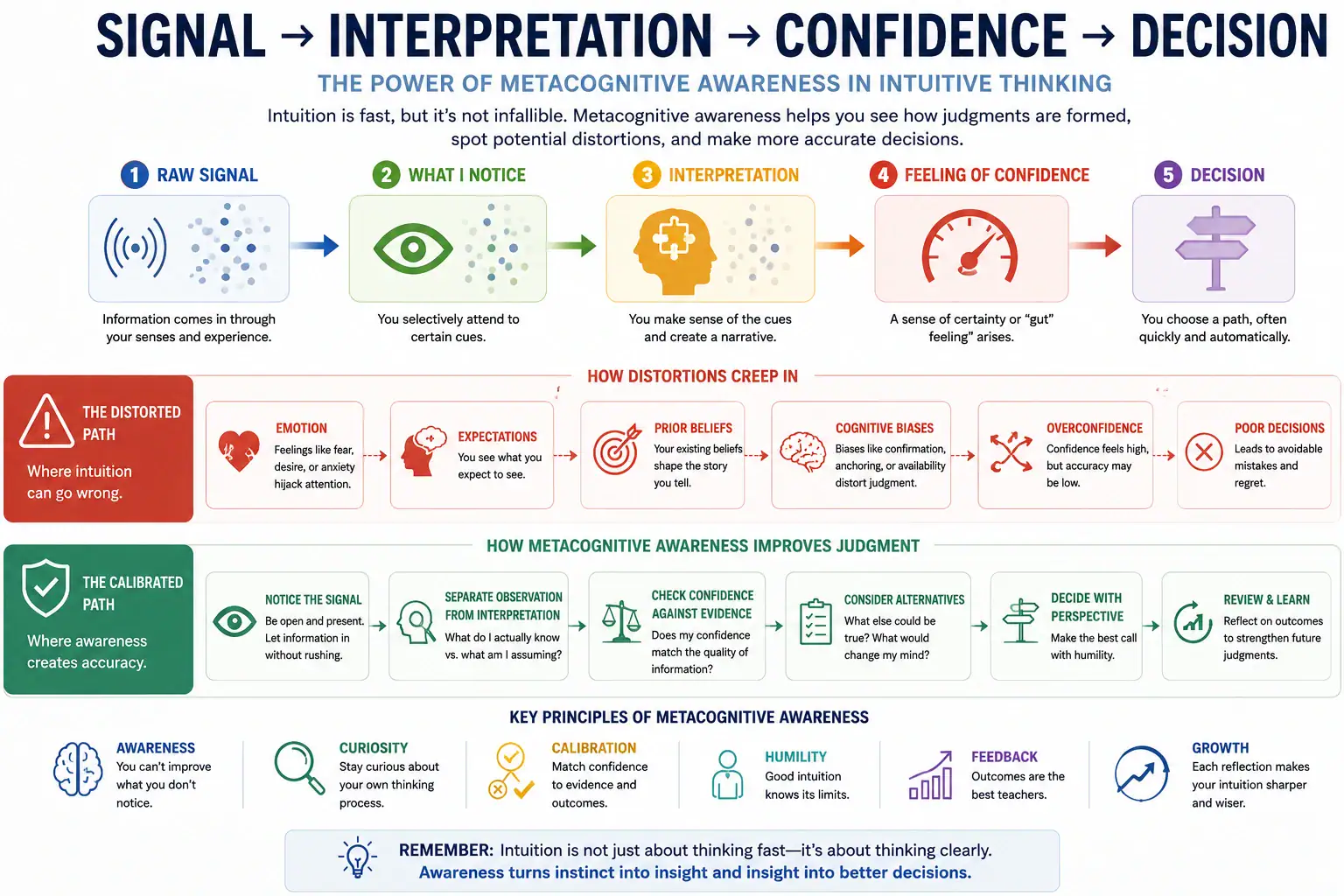
Metacognitive awareness helps you ask: What did I actually notice? What did I add? What assumption is carrying the most weight? What evidence would change my mind? These questions do not destroy intuition. They make it easier to distinguish an informative first impression from a story built around it.
6. Calibration
Calibration is the discipline of comparing what you expected with what actually happened. If you routinely feel 90% confident in judgments that are correct only half the time, confidence is poorly calibrated. If your confidence rises and falls in a way that tracks actual performance, it is better calibrated.
Daniel Kahneman and Gary Klein argued that reliable intuitive expertise depends heavily on two conditions: the environment must contain enough regularity to be learnable, and the person must have adequate opportunities to learn those regularities. Subjective certainty alone is not a dependable test of intuitive accuracy.
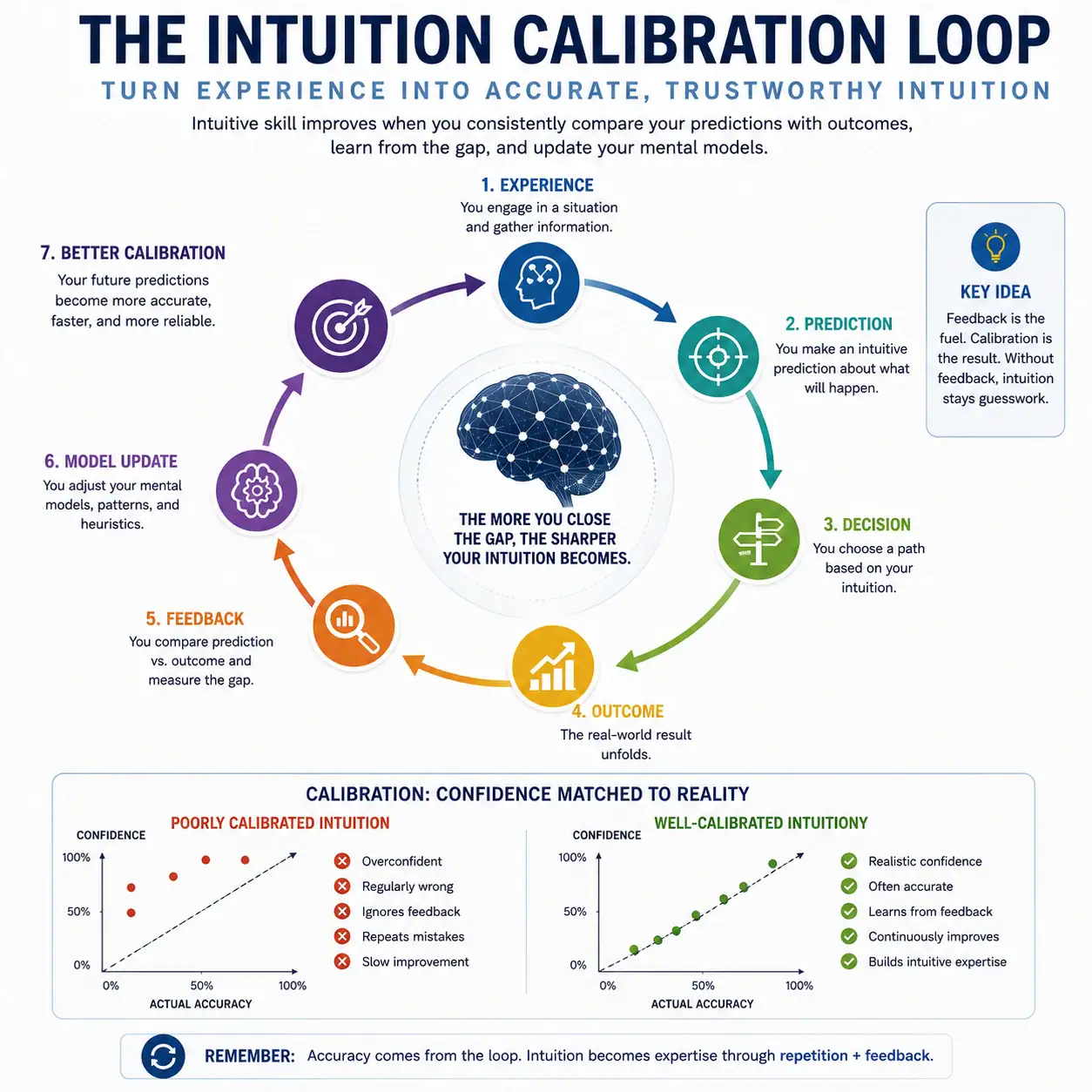
The practical loop is simple: make a prediction, act or observe, record the outcome, compare expectation with reality, and update the model. For a more structured version, see the intuition calibration program.
7. Intuition–Analysis Switching
The final skill is knowing when fast judgment is enough and when it needs deliberate verification. The strongest decision-maker is not permanently “intuitive” or permanently “analytical.” The person can switch modes as the situation changes.
A practical rule is to consider two questions: How familiar is this situation? and what is the cost of being wrong? Familiar, low-cost decisions often permit faster intuitive action. Unfamiliar, high-cost decisions deserve more structured analysis. Familiar but high-stakes choices can benefit from intuition generating the initial hypothesis and analysis testing it.
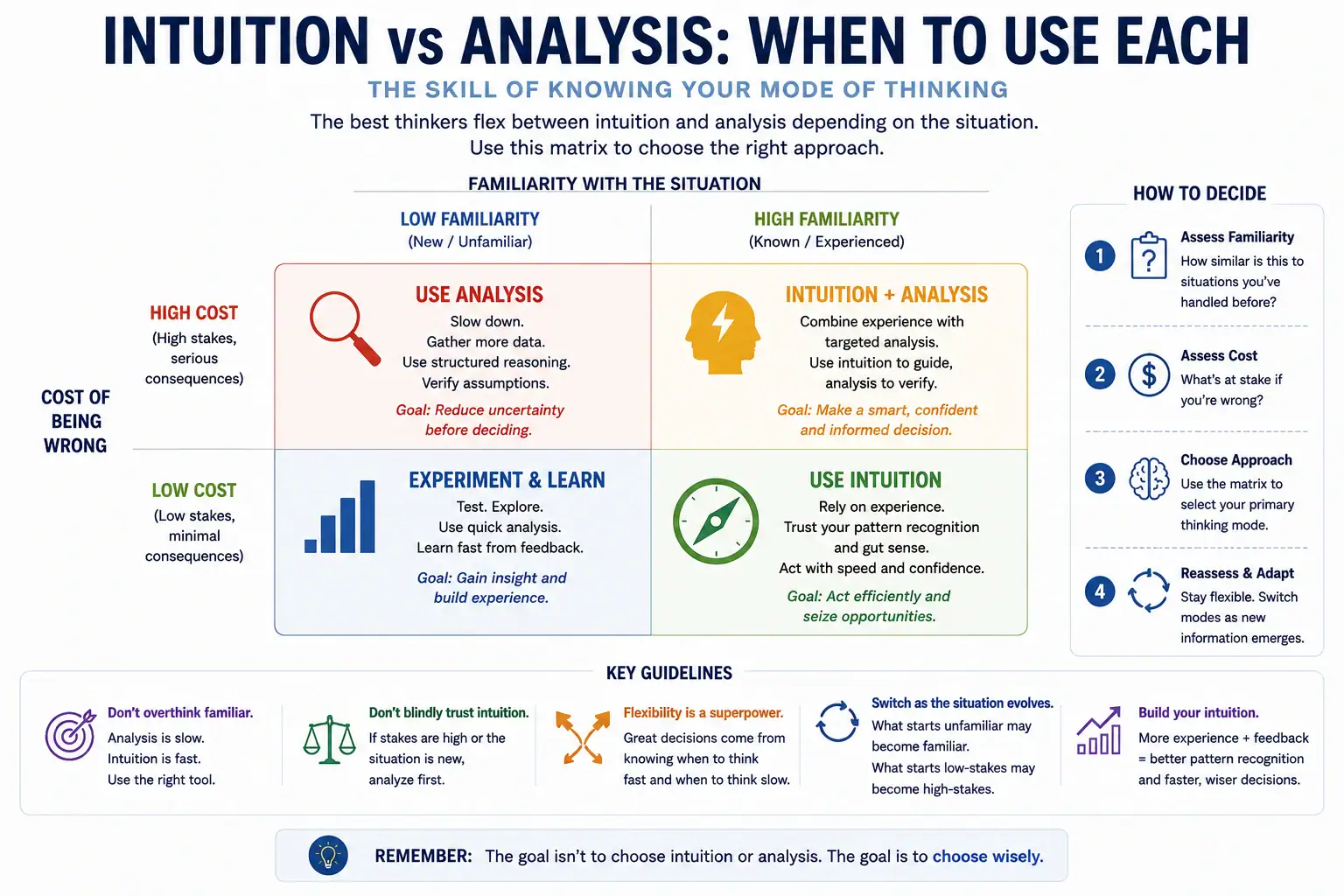
The objective is not to win an argument between intuition and reason. It is to select the right cognitive tool. That is also why intuition and heuristics should not be treated as interchangeable, and why intuition in decision-making works best when its role is matched to the decision environment.
Intuitive Thinking Skills vs. Intuitive Thinking Style
An intuitive thinking style is a tendency or preference: you may naturally favor rapid, holistic judgments. Intuitive thinking skill is a capability: how effectively you detect useful patterns, evaluate cues, integrate context, and learn from outcomes.
| Intuitive thinking style | Intuitive thinking skill |
|---|---|
| A preference for how to think | A capability that affects judgment quality |
| May feel natural or personality-like | Can improve through experience and feedback |
| Can exist without expertise | Becomes stronger within learnable domains |
| Does not guarantee accuracy | Can be tested and calibrated against outcomes |
| Describes tendency | Describes performance-relevant processes |
This distinction protects against a common mistake: assuming that being “an intuitive person” automatically means one’s intuitions are reliable.
Intuitive Thinking Skills vs. Cognitive Biases
Fast judgments can be useful, but speed itself is not evidence of expertise. A cognitive bias is a systematic tendency that can distort judgment. Skilled intuition is learned sensitivity to meaningful structure in an environment. Subjectively, both can arrive as an immediate impression.
For example, a manager may immediately believe a project will fail because several current signals match patterns seen in previous failed projects. That could be informed pattern recognition. But if the manager ignores contradictory evidence because the first impression is emotionally compelling, confirmation bias can begin reinforcing the judgment.
The practical defense is not to distrust every fast thought. It is to ask whether the judgment comes from a domain with learnable regularities, whether you have relevant experience, whether the important cues are identifiable, and whether past judgments have received meaningful feedback. See also mental models vs. cognitive biases.
How Intuitive Expertise Develops
Experience helps build the pattern library behind intuition, but experience alone is not enough. Repeating the same behavior can increase familiarity and confidence even when the underlying judgment remains wrong.
A more useful development cycle is:
- Exposure: encounter recurring situations in a meaningful domain.
- Prediction: commit to what you expect before the outcome is known.
- Outcome: observe what actually happens.
- Comparison: identify where prediction and reality diverged.
- Correction: revise the cues, assumptions, or mental model.
- Calibration: adjust confidence to match demonstrated accuracy.
- Compression: repeated learning makes useful patterns easier to recognize rapidly.
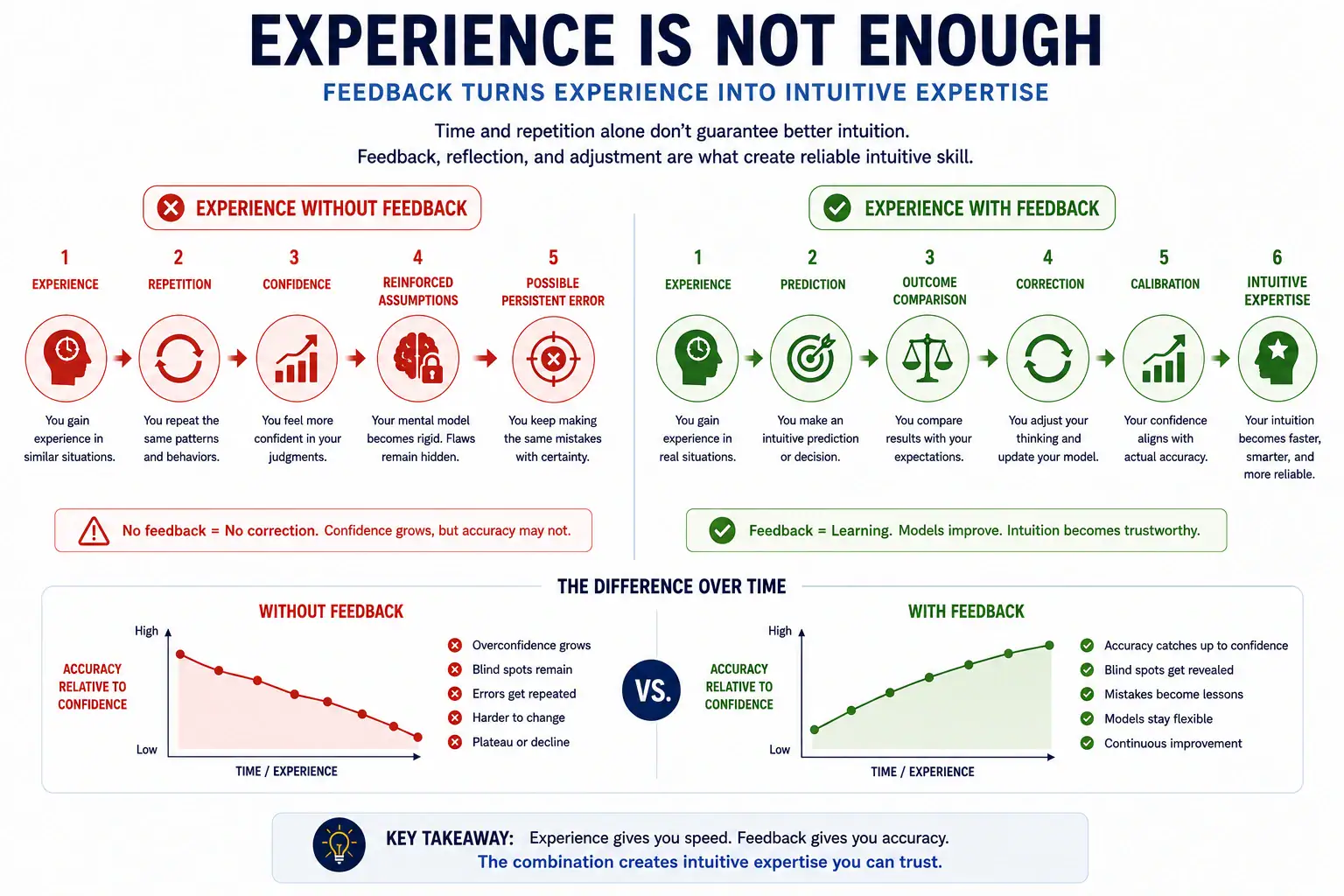
Feedback also has to be informative. In a highly random environment, outcomes may not reveal stable patterns. In a delayed-feedback environment, it may be difficult to connect a decision with its consequences. And in an organization where bad news is filtered out, decision-makers may accumulate years of seniority without receiving the corrective signals needed to improve.
Novice Intuition vs. Expert Intuition
| Novice intuition | Expert intuition |
|---|---|
| Often reacts to obvious or salient cues | More likely to detect domain-relevant cues |
| Has a smaller pattern library | Draws on many differentiated patterns |
| May confuse familiarity with accuracy | Can develop better confidence calibration |
| May simplify context too quickly | Can integrate multiple contextual constraints |
| Has limited outcome history | Can compare judgments with repeated feedback |
| Needs more deliberate exploration in unfamiliar cases | Can recognize recurring situations rapidly |
Expert intuition is also domain-specific. Expertise in one environment does not automatically transfer to another. A skilled clinician, engineer, negotiator, or project leader may possess excellent intuition inside familiar patterns and still need careful analysis in a genuinely novel domain.
Can Intuitive Thinking Skills Be Learned?
Yes—when the environment provides something learnable and the practice includes feedback. Training intuition is less about listening harder to every feeling and more about improving the relationship between cues, predictions, outcomes, and correction.
Useful practice includes repeated exposure to relevant situations, making predictions before outcomes are known, reviewing errors, distinguishing signal from noise, comparing confidence with accuracy, and gradually increasing decision difficulty. The deeper training process is covered in how to train your intuition.
A 5-Minute Exercise to Strengthen Intuitive Thinking
Use an Intuitive Prediction Log for decisions where an observable outcome will eventually exist. Before you know the result, record six things:
- Situation: What is happening?
- First judgment: What do you expect will happen?
- Cues: Which specific details produced that judgment?
- Confidence: How confident are you, from 0% to 100%?
- Outcome: What actually happened?
- Adjustment: Which cues mattered, which were noise, and what will you change next time?
The most important rule is to record the prediction before the result. Otherwise hindsight can make an outcome feel more predictable than it was. Over time, the log reveals not merely whether you are “intuitive,” but where your intuition is actually calibrated.
When You Should Not Trust Intuitive Thinking Alone
Intuition deserves more verification when the decision environment does not support reliable learning or when the cost of error is high. Be especially cautious when:
- you have little relevant experience in the domain;
- the situation is genuinely novel;
- outcomes are highly random or feedback is weak;
- fear, desire, status, or incentives strongly favor one conclusion;
- you cannot identify what cues are driving the judgment;
- base rates or quantitative evidence contradict the impression;
- the decision is difficult or expensive to reverse;
- your confidence is much stronger than the available evidence.
A mature intuitive system includes the ability to distrust itself under the wrong conditions. For a deeper treatment, see when intuition is wrong.
The Intuitive Skill Calibration Check
Use the following seven questions as a reflective check. Score each item 0 = rarely, 1 = sometimes, 2 = consistently.
- Can I recognize recurring patterns in this specific domain?
- Can I identify the cues that triggered my first judgment?
- Do I integrate the wider context instead of reacting to one striking cue?
- Can I remain uncertain without forcing myself into premature certainty?
- Can I distinguish what I observed from what I interpreted?
- Do I receive useful feedback about whether my judgments were correct?
- Do I know when to switch from intuition to deliberate analysis?
0–4: mostly uncalibrated conditions.
5–9: developing intuitive skill.
10–12: increasingly calibrated conditions.
13–14: strong conditions for skilled intuition.
This is an educational reflection framework created for Intuition Management. It is not a validated psychological test, clinical assessment, or diagnostic instrument.
Frequently Asked Questions About Intuitive Thinking Skills
What are intuitive thinking skills?
Intuitive thinking skills are the abilities that support useful fast judgment, including pattern recognition, cue discrimination, context integration, uncertainty tolerance, metacognitive awareness, calibration, and switching appropriately between intuition and analysis.
What are the 7 intuitive thinking skills?
The seven intuitive thinking skills are pattern recognition, cue discrimination, context integration, uncertainty tolerance, metacognitive awareness, calibration, and intuition–analysis switching. Together, they help a person notice useful patterns, filter noise, judge under uncertainty, learn from outcomes, and choose when analysis is necessary.
What is an example of an intuitive thinking skill?
Pattern recognition is a clear example. An experienced person may rapidly notice that several small cues resemble an earlier situation and form a provisional judgment before consciously listing every similarity.
Is intuition a skill or a personality trait?
A preference for intuitive thinking can resemble a thinking style, while reliable intuitive judgment involves skills that depend on learning, context, experience, and feedback. Feeling naturally intuitive does not by itself establish accuracy.
Can intuitive thinking be developed?
Yes, especially in domains with recurring patterns and useful feedback. Development is stronger when you make explicit predictions, observe outcomes, review errors, and update the cues and mental models behind your judgments.
What makes someone an intuitive thinker?
An intuitive thinker tends to form rapid, holistic judgments without consciously verbalizing every reasoning step. Skilled intuitive thinkers additionally discriminate useful cues, integrate context, monitor uncertainty, and learn from feedback.
Is intuitive thinking the same as instinct?
No. Instinct generally refers to more biologically rooted tendencies, while intuition can incorporate learned patterns, experience, memory, context, and implicit knowledge. See the full comparison of intuition vs. instinct.
Is intuitive thinking always accurate?
No. Intuition can reflect expertise, but it can also reflect bias, emotion, false pattern recognition, or experience gained in an environment that does not provide reliable feedback. Confidence is therefore not enough to establish accuracy.
What is intuitive expertise?
Intuitive expertise is domain-specific rapid judgment that has been shaped by meaningful experience with recurring patterns and opportunities for corrective feedback. It should not be assumed simply from seniority or confidence.
Should you trust intuition or logic?
Neither should be trusted universally. Intuition can be efficient in familiar, learnable environments; deliberate analysis becomes more important when a situation is novel, evidence conflicts, consequences are difficult to reverse, or quantitative reasoning is central.
Research Behind the Framework
The seven-skill framework in this article is an Intuition Management synthesis rather than a standardized psychological taxonomy. Its design is informed by research streams on expert intuition, naturalistic decision-making, pattern recognition, metacognition, confidence, and error monitoring.
- Kahneman, D., & Klein, G. (2009). Conditions for intuitive expertise: A failure to disagree. American Psychologist, 64(6), 515–526. DOI: 10.1037/a0016755.
- Fleming, S. M. (2024). Metacognition and Confidence: A Review and Synthesis. Annual Review of Psychology, 75.
- Yeung, N., & Summerfield, C. (2012). Metacognition in human decision-making: confidence and error monitoring. Philosophical Transactions of the Royal Society B, 367(1594), 1310–1321.
- Sadler-Smith, E. (2023). Why Intuition Often Gets It Right: Recognition-Primed Decision-Making. In Intuition in Business, Oxford University Press.
Better Intuition Means Better Calibration, Not Stronger Certainty
The most useful intuitive thinker is not the person who feels certain fastest. It is the person who can recognize patterns without becoming trapped by them, distinguish signal from noise, integrate context, tolerate uncertainty, inspect the path from sensation to interpretation, learn from outcomes, and switch to deliberate analysis when the situation demands it.
That turns intuition from an identity—“I am intuitive”—into a practice: notice, interpret, test, learn, and recalibrate.
Next, deepen the process with Intuitive Thinking, then move into deliberate practice with How to Train Your Intuition.